


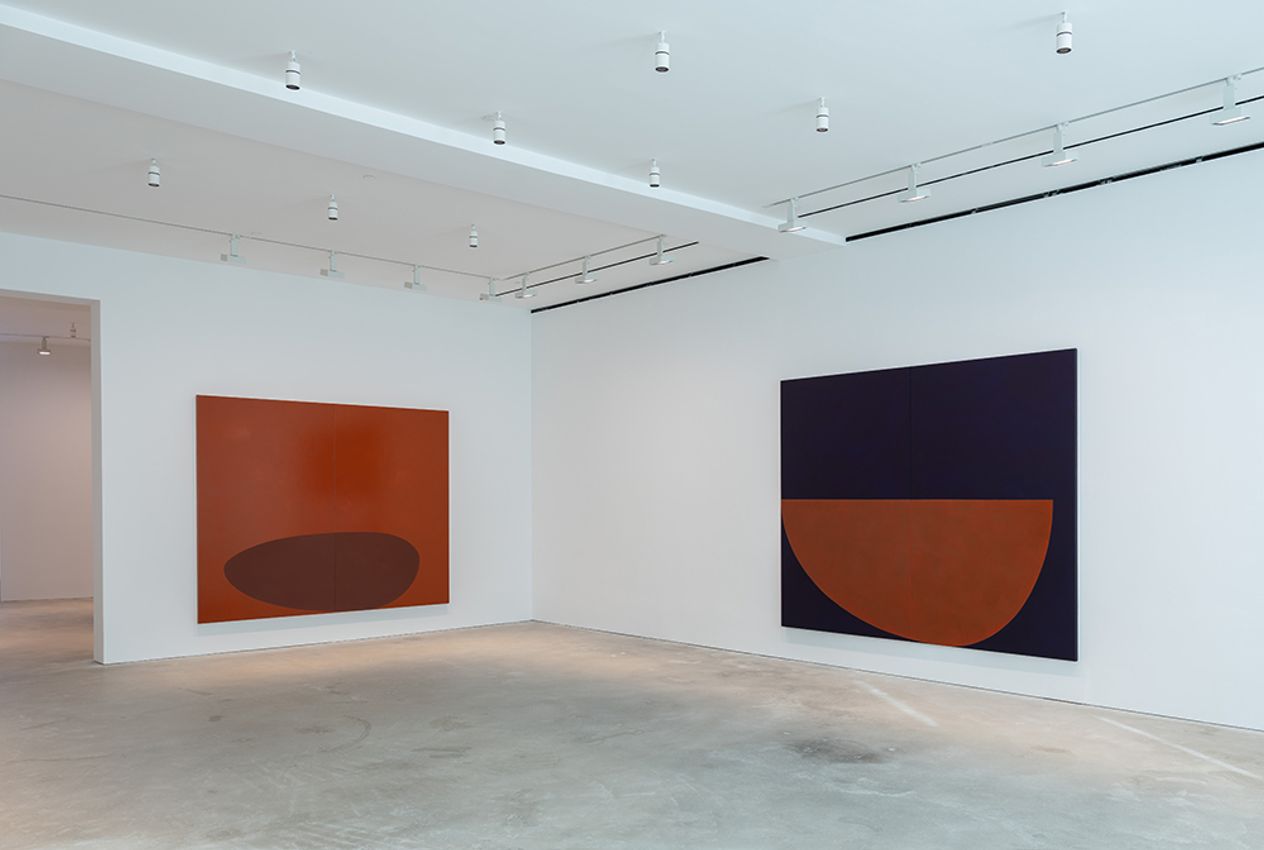
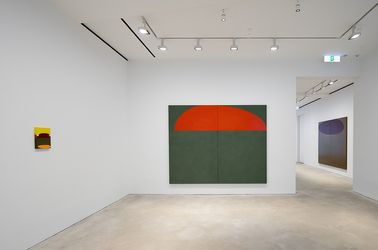
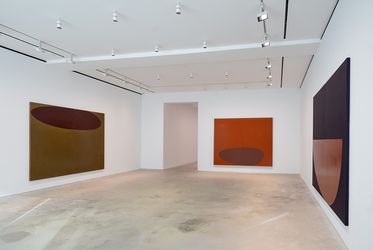
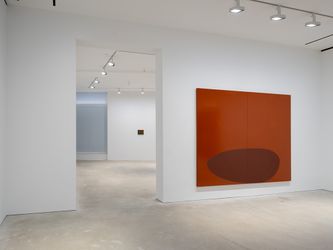

For almost five decades, Frecon has created abstract oil paintings and works on paper that are at once reductive and expressive. Made over long stretches of time, her canvases embody the durational activity of painting itself and invite the viewer’s sustained attention: these, as the artist herself has noted, are ‘paintings that you experience’.1
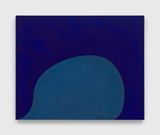
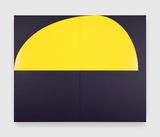
The artist’s compositions are characterised by arcing and asymmetrically balanced forms and are defined by precise spatial and proportional relationships. Each surface is developed carefully and gradually, evolving from one canvas to the next in a process that combines preparation and intuition, order and chance. In Frecon’s paintings, composition serves as a foundational structure, holding colour, material, and light.
Mixing pigments and oils to differing effects, the artist’s almost tactile use of colour and contrasting matte and sheen surfaces heightens the visual experience of her work. Depending on the light source and viewing angle, different perceptions emerge. Colours and surfaces vary in terms of density and reflectivity, and areas of the compositions frequently shift between positive and negative space, or between figure and ground.
As Richard Shiff has noted, ‘Within a fantasia of colour, Frecon suspends the force of her structure. Offsetting the unseen mathematical foundation, her visible surface is organic and irregular, as if she were working against herself...Her paint, especially along ellipsoidal contours, develops an uneven appearance due to the distribution of the pigment and its oil binder as she works the material against the resist of the linen. Add to this the transient effects of ambient light from which Frecon’s surfaces are designed to benefit, and what began as a logical geometrical structure has become suspended in a web of living sensation. Her composition...may well be experienced as anti-composition. It is and is not.’2
Typically made on found vintage paper, Frecon’s watercolours, in turn, take as their point of departure the unique characteristics of each leaf of paper she uses. Varying from sheet to sheet, the irregular scale, texture, and surfaces impose their own dynamic constraints upon her compositions. These works demonstrate in a different medium the artist’s continued engagement with the chromatic and sensory possibilities of painting, and of pure abstraction.
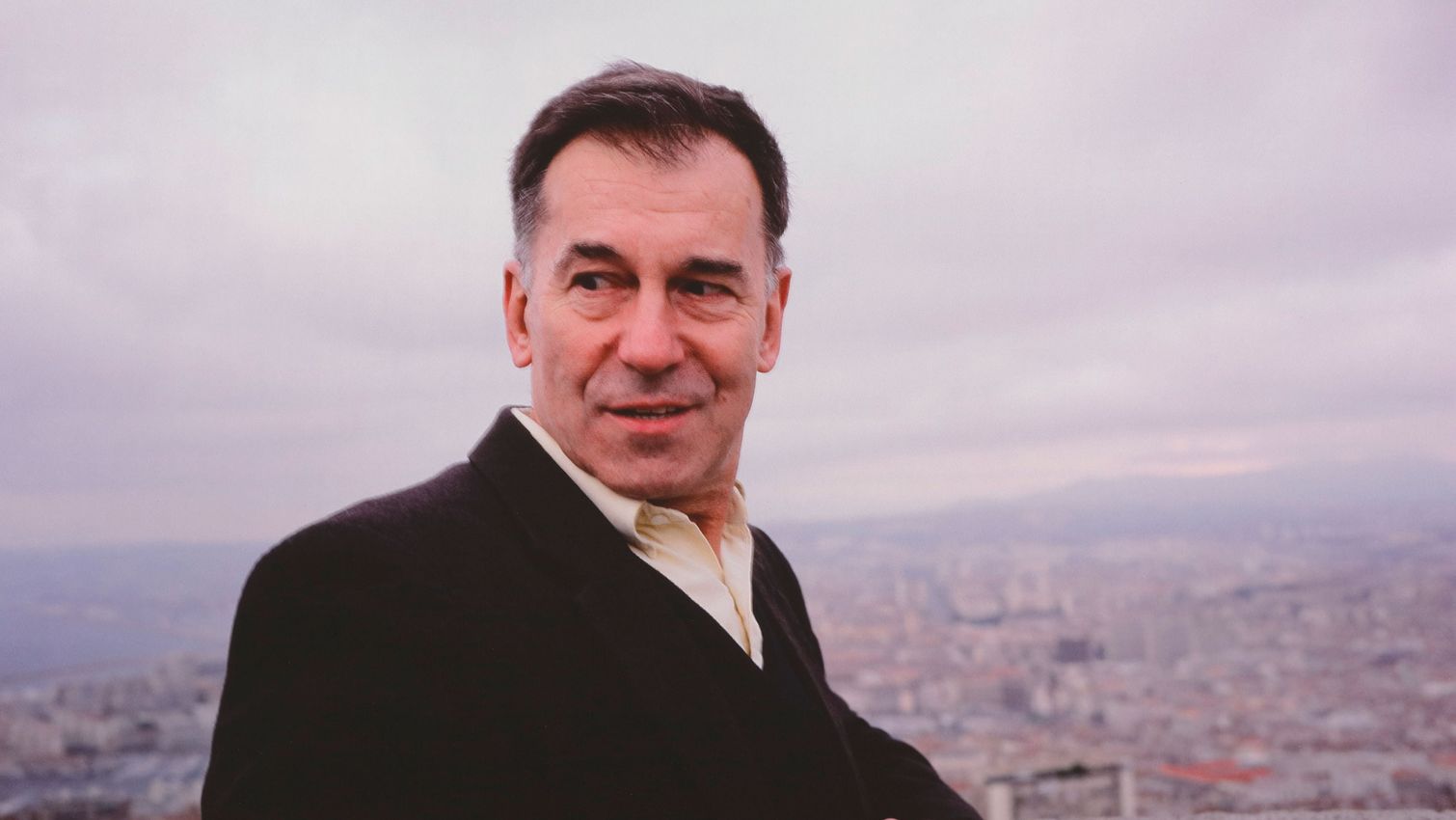
Suzan Frecon was born in 1941 in Mexico, Pennsylvania. Following a degree in fine arts from Pennsylvania State University in 1963, she spent three years at the École nationale supérieure des Beaux-Arts in Paris and studied paintings in museums throughout Europe.
The artist has been represented by David Zwirner since 2008. Previous solo shows with the gallery include recent painting, New York (2010); paper, New York (2013); oil paintings and sun, New York (2015); recent oil paintings, New York (2017); and watercolours and small oil paintings, London (2017).
1 Suzan Frecon, ‘text and related work’ in Suzan Frecon: oil paintings and sun. Exh. cat. (New York: David Zwirner, 2015), p. 63. Frecon notes: ‘These are not pictures that you look at. They are paintings that you experience. There is no ‘story.’
2 Richard Shiff, Suzan Frecon. Exh. cat. (New York: David Zwirner Books, 2017), p. 67.


Suzan Frecon is known for her abstract oil paintings and watercolors, which she has been making since the 1970s. Composed with meticulous attention to the physical qualities of her chosen medium, Frecon’s subtle, interacting arrangements of color and form are at once reductive and expressive. In the artist’s hands, color assumes a tactile quality, appearing almost material: Frecon develops her own color palette derived from pigments ground in oil, altering the quantities in order to obtain varying degrees of matte and sheen, surface and depth. She explains, “Color is the generator of the painting....I gravitate toward more natural colors rather than synthetic or artificial ones because they are what I feel what I want to convey....I think of the word ‘innate’ which perhaps means ‘within nature.’ I like the word ‘innate’ regarding color because I do try to have dimension within the color so that it is more than one color.”1

A respected voice in contemporary art discourse.
Focusing on ambitious storytelling and insightful art-world commentary. Ocula Magazine publishes in-depth interviews, critical essays and timely analysis on the artists, exhibitions and ideas driving the global art world.
Learn more about Ocula Magazine
Showcasing the best of the art world.
Ocula partners with galleries from around the world to highlight their artists, artworks and exhibitions. Gallery membership is by application and invitation, with each member vetted by an independent panel.
Learn more about Ocula Membership

Specialises in the sale of major artworks.
Led by a team with deep ties to the world’s leading auction houses, galleries and collectors. Ocula’s advisory team offers bespoke services to high-net-worth clients from around the world who are looking to acquire the best of contemporary and modern art.
Learn more about our team and services