




PAUL KLEE
1879-1940, SwitzerlandPaul Klee was born in Münchenbuchsee, near Bern, Switzerland, in 1879. The son of a music teacher and a singer, Klee was a gifted violinist before choosing to pursue visual art. He studied at the Academy of Fine Arts in Munich from 1898 to 1901, where he was taught by Heinrich Knirr and Franz von Stuck.
Klee later taught at two of the most important art schools of the early 20th century—the Bauhaus (1921–1931) and Düsseldorf Academy (1931–1933)—before being dismissed by the Nazi regime. He spent his final years in Switzerland, working intensively until his death in 1940.
Paul Klee Artworks
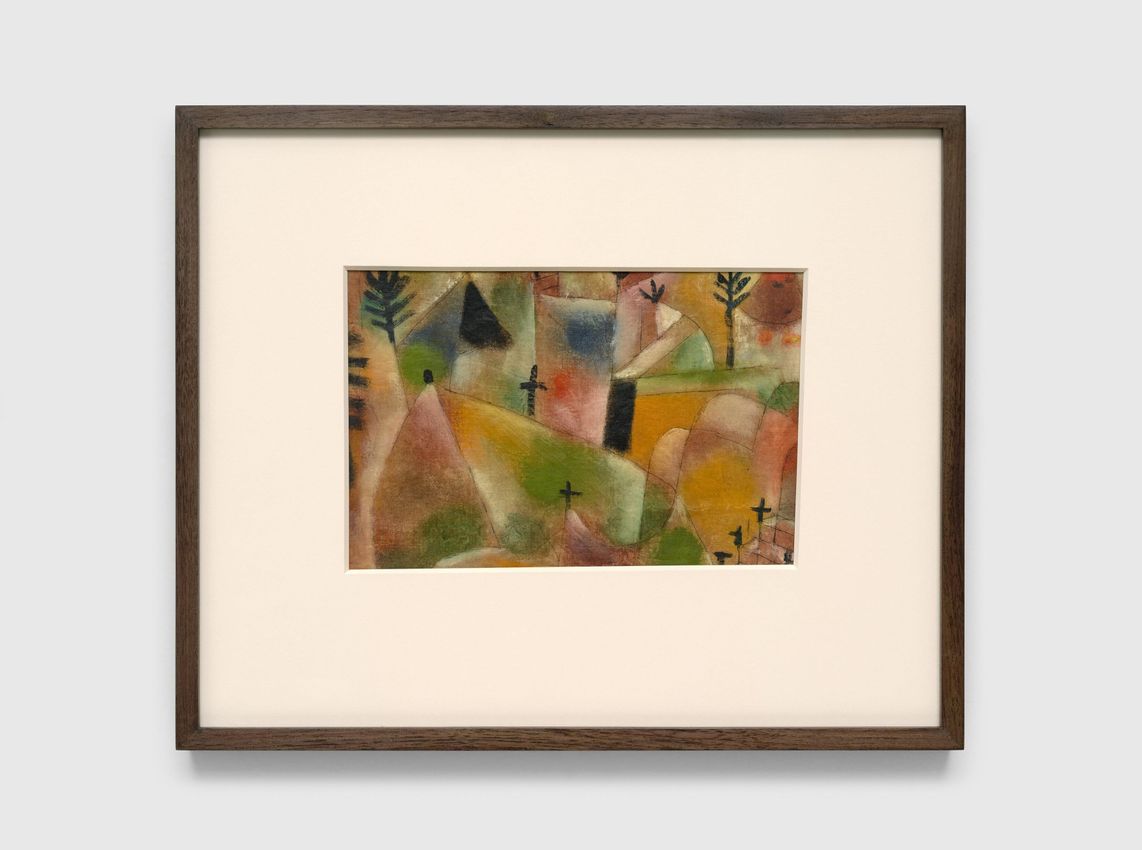
Paul Klee’s artworks are known for their dreamlike, poetic qualities, combining childlike imagery with complex ideas drawn from music, science, and philosophy.
Early Works: Line, Structure, and the Turn to Colour
In his early works, Klee explored structure and the expressive potential of line. Influenced by Cubism and Expressionism, he used drawing as a primary mode of inquiry, describing drawing as ‘taking a line for a walk’—a philosophy evident in works like Virgin in a Tree (1903) or the delicate ink illustrations from his sketchbooks.
A pivotal moment came in 1914, when Klee travelled to Tunisia. Encountering the region’s intense light and vibrant hues, he experienced a personal and artistic awakening, famously writing, ‘Colour has taken possession of me’. Works like In the Style of Kairouan (1914) demonstrate his new direction, abstracting architectural motifs into luminous patterns of coloured rectangles. This period also saw the beginning of Klee’s development of a personal visual language, incorporating hieroglyphs, arrows, and signs into his compositions.
Later Works: Myth, Music, and Inner Worlds
In the final decade of his life, Klee’s art became increasingly introspective. Dismissed from his post at the Düsseldorf Academy in 1933 by the Nazi regime—who labelled his work ‘degenerate’—he returned to Switzerland and entered a period of extraordinary productivity despite declining health.
Klee’s later works are characterised by their rawness, clarity, and psychological depth. Pieces such as Death and Fire (1940), composed just weeks before his death, feature simplified symbols and bold use of line, showing a return to essential forms.
How did music influence Paul Klee’s art?
A classically trained violinist, Klee frequently likened painting to musical composition. He translated principles like rhythm, harmony, and counterpoint into visual form. Works such as Fugue in Red (1921) and Polyphony (1932) draw directly from musical concepts, translating melody into visual form through repetition and variation.
What was Paul Klee’s role at the Bauhaus?
From 1921 to 1931, Klee taught at the Bauhaus, where he developed influential theories on colour and form. His Pedagogical Sketchbook (1925) became a foundational text in modern art education, detailing his analytical approach to pictorial construction and the expressive potential of the line.
Public Commissions
Monument to the Angel of Death, Kunstmuseum Bern, Switzerland (posthumously assembled from drawings and models).
Exhibitions
Paul Klee has been the subject of both solo and group exhibitions at major international institutions.
Solo Exhibitions
- Paul Klee: Life and Work, Zentrum Paul Klee, Bern (2025)
- Paul Klee: Philosopher of the Line, Centre Pompidou, Paris, 2016–2017
- Paul Klee: The Abstract Dimension, Guggenheim Bilbao, 2015
- Paul Klee: Making Visible, Tate Modern, London, 2013–2014
- Paul Klee: 1879–1940, Solomon R. Guggenheim Museum, New York, 1967
- Paul Klee, Museum of Modern Art, New York, 1930
Group Exhibitions
- The Avant-Garde Networks of Amauta: Argentina, Mexico, and Peru in the 1920s, Reina Sofía, Madrid, 2019
- Inventing Modern Art: 1870–1970, Musée d’Orsay, Paris, 2017
- The EY Exhibition: Paul Klee and the Surrealists, Tate Modern, London, 2016
- Expressionism in Germany and France: From Van Gogh to Kandinsky, Los Angeles County Museum of Art (LACMA), 2014
- Inventing Abstraction, 1910–1925, Museum of Modern Art, New York, 2012
- The Bauhaus: 1919–1933 – Workshops for Modernity, Museum of Modern Art, New York, 2009–2010
Critical Reception
Klee’s practice has been extensively covered in major publications, including Apollo, Artforum, and The Guardian.
Ocula | 2025


Explore Paul Klee's Exhibitions










Explore and Follow Artists Shaping Contemporary Art
A respected voice in contemporary art discourse.
Focusing on ambitious storytelling and insightful art-world commentary. Ocula Magazine publishes in-depth interviews, critical essays and timely analysis on the artists, exhibitions and ideas driving the global art world.
Learn more about Ocula Magazine
Showcasing the best of the art world.
Ocula partners with galleries from around the world to highlight their artists, artworks and exhibitions. Gallery membership is by application and invitation, with each member vetted by an independent panel.
Learn more about Ocula Membership
Specialises in the sale of major artworks.
Led by a team with deep ties to the world’s leading auction houses, galleries and collectors. Ocula’s advisory team offers bespoke services to high-net-worth clients from around the world who are looking to acquire the best of contemporary and modern art.
Learn more about our team and services