DUMONTEIL Paris is pleased to present The Last Java, Liane CHU’s first solo exhibition in France and her second with the gallery. Taking its title from a Parisian dance and the programming language that later shared its name, the exhibition explores how the artist translates bodily experience into a visual language. Her ever-shifting landscapes bring together memories and the rhythms of life through the interplay between nature and technology, control and spontaneity.
Before Java became a programming language, Java was already a dance.
In the early twentieth century, la java was popular in Parisian dance halls and cafés. Unlike the grandeur of the ballroom, its formal steps and carefully controlled bodies, the java was fast, close and physical. Partners danced within a small space, continually adjusting their distance, rhythm and balance as they moved.
Decades later, Java became the language of another era: programs, systems, code, and the structures that shape the digital environments we live in today. The Last Java begins with these two seemingly distant meanings of Java. In Liane Chu’s work, however, they do not carry equal weight.
The body comes before the machine. Movement comes before code. The tremor comes before the glitch.
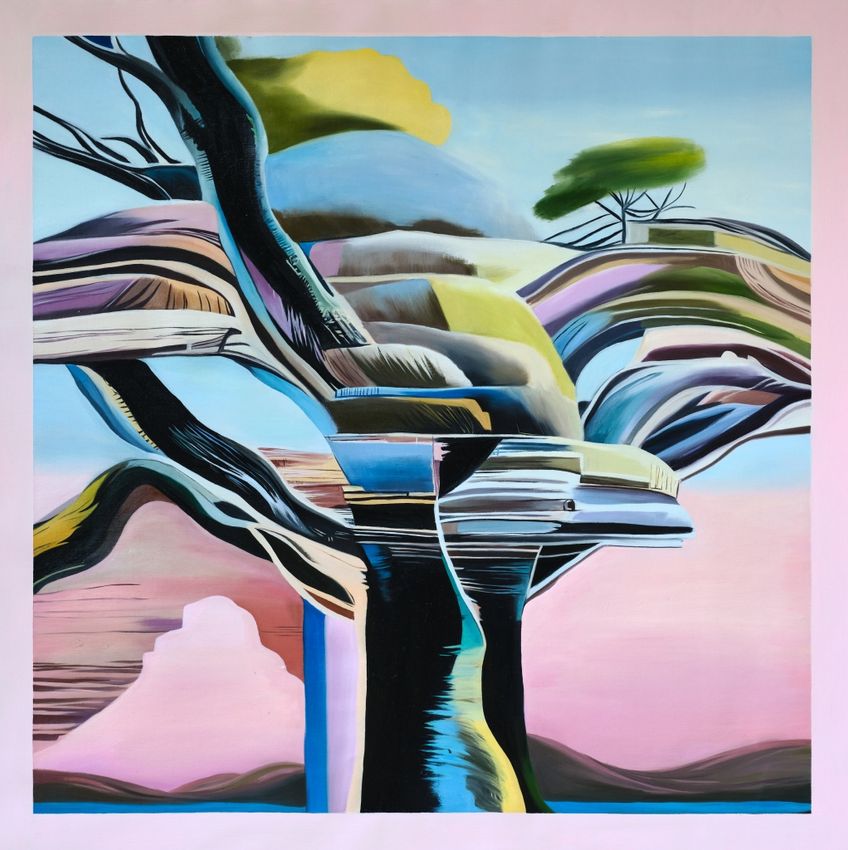
Before there was code, the body was already moving. Trees have long been a central image in the artist’s work. Across paintings, installations and digital interfaces, they have grown, shifted and been reassembled alongside different stages of her life. They absorb the neon light of Hong Kong, the density of its streets, the pressure of a city moving at speed, as well as the unstable rhythm of the artist’s hands.
These trees have therefore never been simply representations of nature. Real trees, remembered trees, images seen on screens, and traces left behind through digital processing overlap within the work. The boundary between nature and technology becomes increasingly difficult to locate. Through repeated translation, fragmentation and reconstruction, the two become part of the same visual experience.
But digital language is not where these works begin.The body is.
The artist’s involuntary tics enter the movement of her hands and, from there, the image itself. Lines shift, break and repeat. At times, they move away from their intended direction altogether. Marks that might otherwise be treated as mistakes are not fully corrected or erased. Over time, they have been allowed to remain and have become part of the way the work is made. This gives the glitch in her work a different meaning. It is not simply borrowed from the visual language of digital error, nor is it an imitation of technological imagery. Instead, the digital glitch becomes an extension of something that has already taken place in the body.
Code comes after the tremor. The glitch comes after the twitch.
The tremor begins in the body. It becomes a line. The line enters the image, where it is transformed again into pixels, breaks and glitches.
For this reason, The Last Java is ultimately not about technology. It is about the body. At one end is the closeness of bodies dancing in the Parisian halls of the early twentieth century; at the other is the programming language of the contemporary digital world. Liane Chu’s work moves between the two—between control and its loss, nature and the artificial, body and image, movement and code.
Java, then, is more than a title. It is both a dance and a programming language. It points at once to the direct movement of the body and to the systems that organise the digital world. Yet throughout this relationship, the body always comes first.
The Last Java is also a reflection on, and a farewell to, this period of the artist’s practice. Over the years, trees, pixels, glitches, broken lines and the unstable rhythms of the body have formed a visual language recognisably her own. These elements have grown with the work, carrying traces of different media, experiences of the city and changing states of the body.That language has now reached a turning point.This is not the end of the artist’s practice, nor is it a rejection of what came before. The Last Java is closer to the final movement of a dance: a return, before leaving, to familiar images, rhythms and bodily experiences one last time.What comes next remains unknown.The trees in the exhibition are still standing. They are neither complete nor stable. Breaks, shifts, repetitions and traces of past movements remain within them, like memories held by the body itself.Only this time, they are no longer asked to keep growing.Before Java was code, it was a dance.And this is the last Java.
Liane Chu (b.1997, Hong Kong) graduated from the Communication and New Media program at City University of Hong Kong. She is currently pursuing a Master’s degree in Experimental Art and Technology at the Central Academy of Fine Arts. Chu’s works have been exhibited at institutions such as Aurora Museum, Shanghai; Shining Art Gallery, Guangzhou; K11 Art and Culture Center, Hong Kong; and Madein Art Center, Shanghai, etc. Her works have been included in the collections of Aurora Museum, Liangyang Group, Cathay Pacific, among other institutions.


A respected voice in contemporary art discourse.
Focusing on ambitious storytelling and insightful art-world commentary. Ocula Magazine publishes in-depth interviews, critical essays and timely analysis on the artists, exhibitions and ideas driving the global art world.
Learn more about Ocula Magazine
Showcasing the best of the art world.
Ocula partners with galleries from around the world to highlight their artists, artworks and exhibitions. Gallery membership is by application and invitation, with each member vetted by an independent panel.
Learn more about Ocula Membership

Specialises in the sale of major artworks.
Led by a team with deep ties to the world’s leading auction houses, galleries and collectors. Ocula’s advisory team offers bespoke services to high-net-worth clients from around the world who are looking to acquire the best of contemporary and modern art.
Learn more about our team and services
