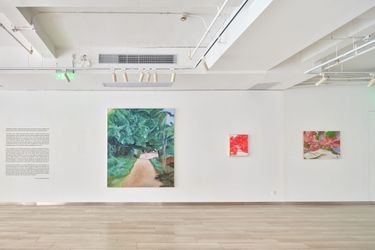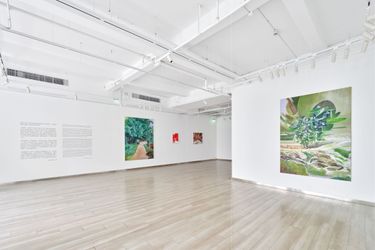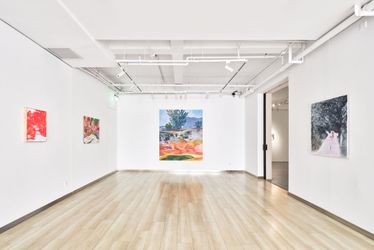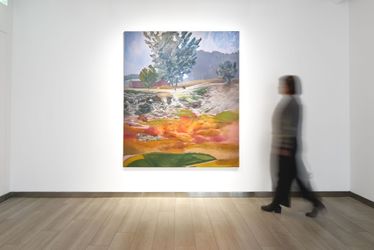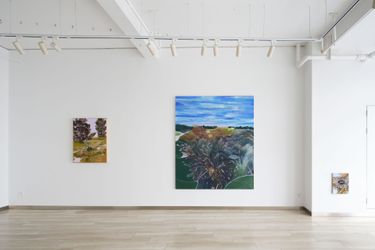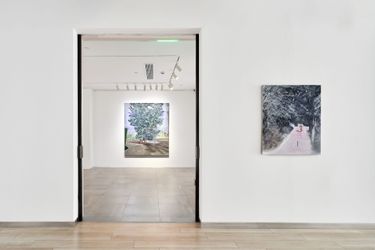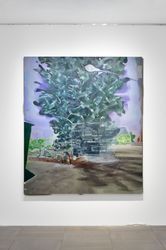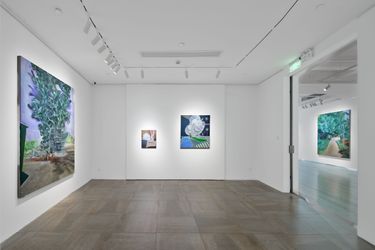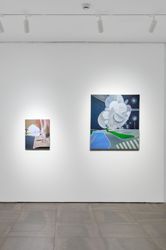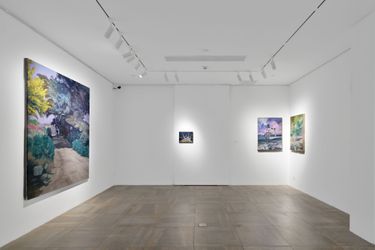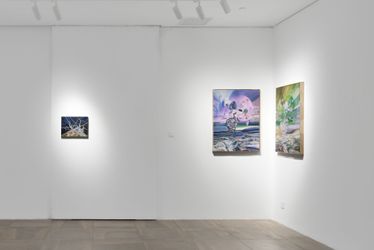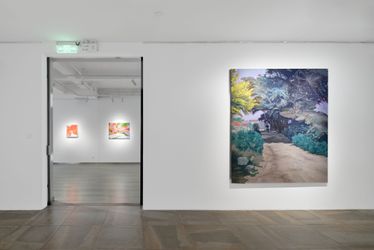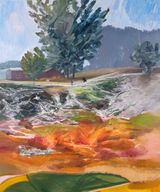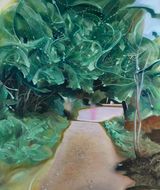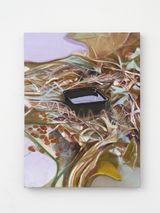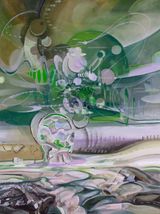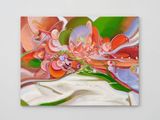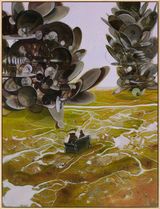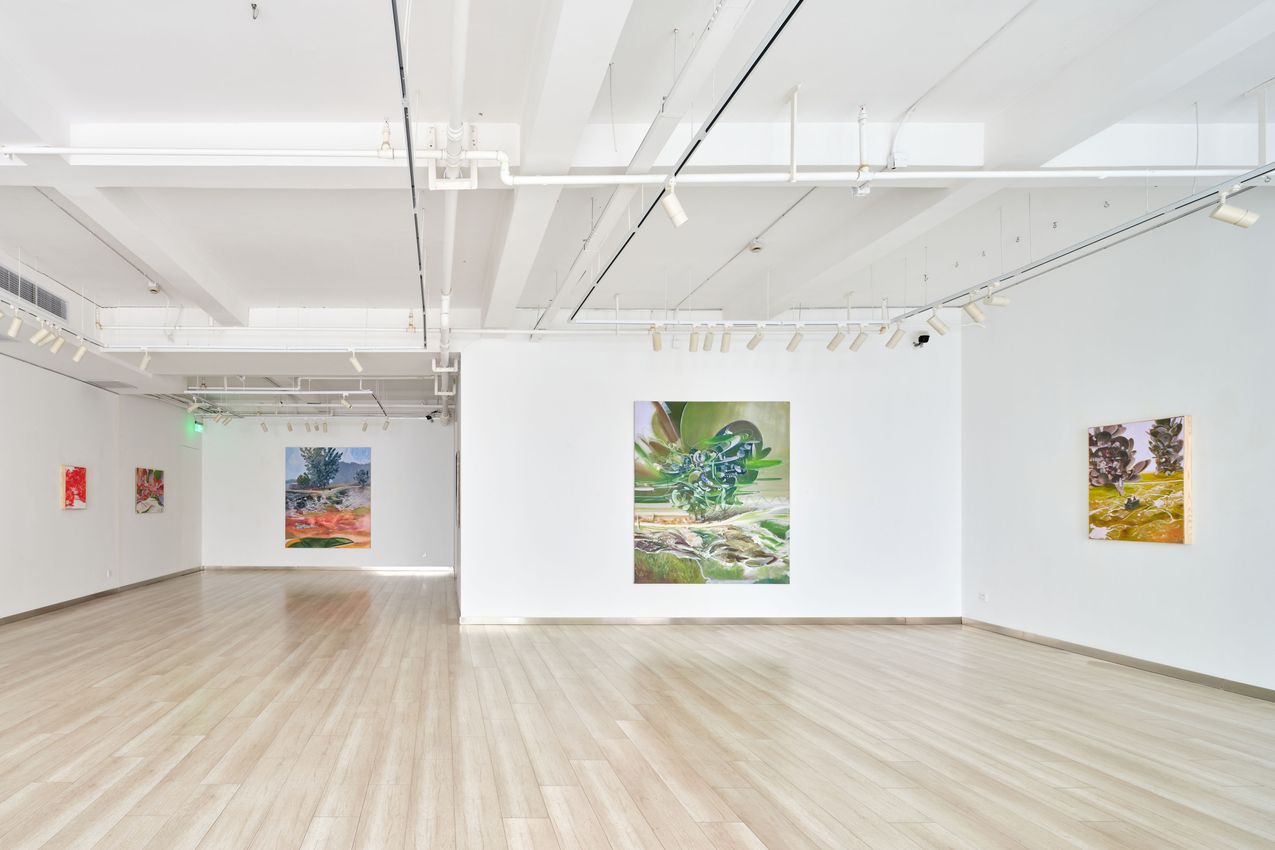
DUMONTEIL Shanghai is pleased to present Nows, Zhu Xinyu’s first solo exhibition at the gallery, which unveils the artist’s visual spectacles rooted in his daily life and spiritual quest through his recent painting practice, on view fromFebruary 15 to April 12.
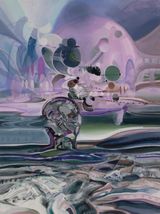
The phrase “Nows” comes from Dante’s Divine Comedy - Paradise, Canto XVII. In this literary masterpiece, Dante’s dialogue with his ancestor Cacciaguida reveals a profound philosophical idea: that all time is an eternal ‘now’ in the sight of God. This concept transcends the boundaries of time, integrating the past, present and future into a unified view of time that surpasses human experience. In his new series of paintings, Zhu deconstructs and reorganises the multiple dimensions of time and space with his insightful visual language, revealing a ‘now’ filled with endless possibilities for the viewer through his paintings.
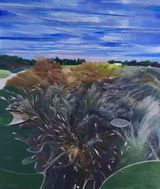
Zhu Xinyu depicts sound in his paintings as ‘the faint rumble of thunder on a cloudy spring day’. These moments arise unconsciously as he tries to figure out how to paint—whether they come from a glance at his favorite art history, the weather evoking memories of his teenage years, the convergence of inspirations, or the act of painting them. They appear all in the same image. Time and space, like roads containing various moments, merge into a single instant, holding the secrets of the world without revealing them. In his images, time is not a simple linear progression but a complex layering. The growth of a tree contrasts sharply with the withering of a blade of grass, intertwining and echoing each other—like two poles at different stages of life. Though they follow independent rhythms, they converge at a shared point in time. Zhu invites the viewer into a multi-dimensional experience of time, where countless ‘nows’ coexist and overlap, as Emily Dickinson beautifully writes: ‘Forever is composed of Nows.’
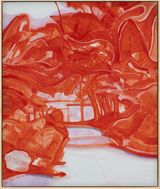
In Zhu’s paintings, time is quantified through scale, and space is measured by distance. Using symbols and images, he constructs a unique spatial world that observes time from a distance: symmetrical mirrors, replicated arrays, entangled trajectories, and the play of light and shadow stretching from near to far. These forms resemble intricate mathematical models, illustrating a process of self-centred, continuous fission that forms a larger system—as if measuring the dimensions of the world through our individual emotions. The world we perceive through our senses gradually reveals the traces of rationality as we engage in infinite exploration, constantly moving closer to truth and wisdom.
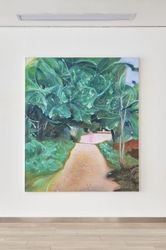
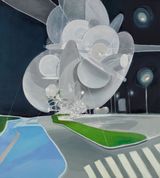
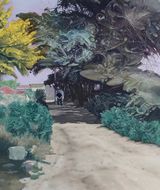
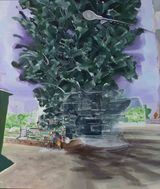
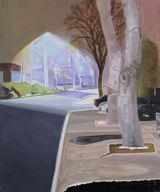
In Story Vendor, a warm light illuminates the arrivals, marking an intersection of time: it points to a past stored in the memory of the self, while also foretelling the infinite possibilities of the future. In It Grows as You Walk from Here to There, the figure walking through the woods, marked with a scale, leaves only a pink smudge of a trail—an endlessly extending form that suggests outward vitality and symbolises inner balance. The path and the light represent both the distance between spaces and that between events. In Grids and Woods, various species—a human, a bear, trees, and blades of grass—coexist harmoniously, intertwining the multiple dimensions of time and space: here and then, there and now, all possibilities unfolding simultaneously.
If the world can be measured, then Zhu’s paintings transcend mere emotional connections to the outside world, becoming a rational interpretation of the sensory experience. As he puts it, he aims to paint “a kind of distance that can be seen.”
Interestingly, the orderliness in Zhu’s works reflects two distinct views of time in physics. The delayed bearings, infinite lines, and interwoven slices represent the Newtonian concept of absolute time—an existence separate from the material universe. Yet, in some paintings, the artist includes a symbol ‘x’ in the upper right corner of the figure, resembling the ‘close’ function of an Internet page. This detail introduces new possibilities for time and space: time can be toggled on and off, and paths can vanish or be recreated. This deconstruction and reorganization of time evokes the general relativistic view of time, in which time is not fixed, but relative and dynamic.
In Zhu’s works, humanity, still amidst chaos, intertwines with the starry rivers of the universe, and the dimensions of space are repeatedly compressed and stretched in all directions, forming a poetic expression. In the geometric trajectories of the rising sun and setting moon, we seem to find ourselves in the vortex of time—simultaneously connected to the distant past while watching the future unfold. In this vision, humans appear both small and grand: in comparison to the ancient universe, our existence is fleeting, but on smaller scales, such as when observing an ant colony, we seem enormous. This tension makes his paintings an ever-expanding container of time, one in which the viewer becomes an integral part. His works bear the weight of time while also exuding boundless imagination of space.
Through Zhu Xinyu’s paintings, we travel across the dimensions of time and space, witnessing both the flow and stillness of time. The artist says, “Guided by that hidden thunder, I grope for my ignorance and paint what the world tells me, what I am manipulated by.” His works remind us that time is not a static, linear passage but a dynamic whole made up of countless ‘nows’. Each tree, each blade of grass, each ray of light symbolizes a distinct dimension of time, and their collective existence makes the idea of ‘now’ a tangible and visible reality, and each ‘now’ forms a path to eternity.
——Xia Jie, curator and scholar
ABOUT THE ARTIST
Zhu Xinyu’s paintings draw inspiration from daily life, constructing a spiritual spatial model that serves as a vessel for time, memory, and emotion. Using visually captivating elements like geometric shapes, fluctuating curves, and juxtaposed perspectives, he transforms everyday minutiae into musical and mathematical visual spectacles, enhanced by an atmospheric colour palette. Through this, he bridges the real environment with its traces of past and future perceptions. The artist likens the human condition to a state of strandedness, seeking to express moments of wonder within it by exploring eternity beyond the confines of time.
Zhu Xinyu (b.1980, Liaoning) graduated from Luxun Academy of Fine Arts in Shenyang. Now he lives and works in Beijing. Zhu’s work has been the subject of solo exhibitions in galleries and art institutions such as Authur Gallery, Beijing (2023); GOME Art Foundation, Beijing (2018); HdM Gallery, Beijing (2015); Galerie Paris-Beijing, Brussels (2014); Art Seasons, Singapore (2012), etc. His works have been included in the collections of the White Rabbit Gallery in Australia, the DSL Art Foundation in France, the Gome Art Foundation, and the Huawei Art Foundation, etc.


A respected voice in contemporary art discourse.
Focusing on ambitious storytelling and insightful art-world commentary. Ocula Magazine publishes in-depth interviews, critical essays and timely analysis on the artists, exhibitions and ideas driving the global art world.
Learn more about Ocula Magazine
Showcasing the best of the art world.
Ocula partners with galleries from around the world to highlight their artists, artworks and exhibitions. Gallery membership is by application and invitation, with each member vetted by an independent panel.
Learn more about Ocula Membership

Specialises in the sale of major artworks.
Led by a team with deep ties to the world’s leading auction houses, galleries and collectors. Ocula’s advisory team offers bespoke services to high-net-worth clients from around the world who are looking to acquire the best of contemporary and modern art.
Learn more about our team and services