Esther Schipper is pleased to present Etienne Chambaud’s solo exhibition Prism Prison, the artist’s third withthe gallery and his first in Korea. On view will be all new works, among them a neon, a series of modified foundobjects including icon paintings, and bronze sculptures.
Etienne Chambaud works across a wide spectrum of media, exploring the categories we impose on experiences,objects, and disciplines. His works, installations and exhibitions destabilize our notions of what art is and can be,how an artist conceptualizes and produces a work, and the form, function, and history of the exhibition. In 2022the artist had a major solo exhibition at LaM, in Villeneuve-d’Ascq, France. Chambaud’s work was included in theOkayama Art Summit 2019, curated by Pierre Huyghe.
Prism Prison, the title of the exhibition, links the prism to the prison, two entities of confinement andsegmentation, one for individuals and the social body, the other for the trajectory of light and its spectrum.Crossing categories as diverse as optics, geometry, the animal body and politics, the exhibition functions as areflection on constraints, producing both forms and the potential for their emancipation.
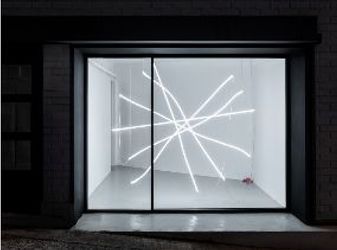
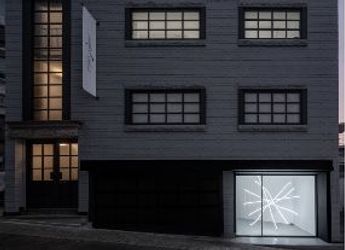
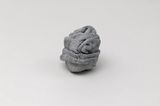
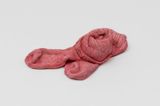
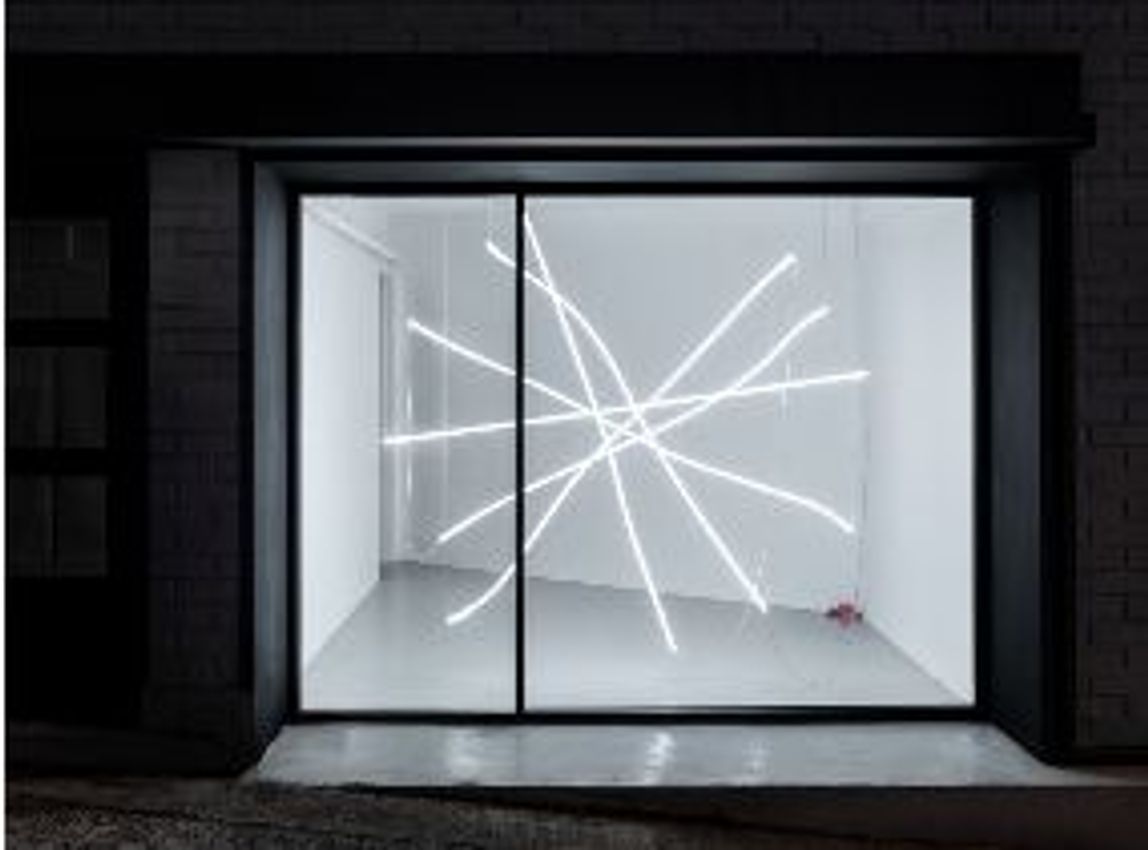
In the gallery’s ground floor space The Window, a multipart neon illuminates the almost bare interior room, as wellas the nearby street. Titled Erasure, it reproduces a handwritten cross-out gesture enlarged to the scale of theexhibition space. As both an X that marks a spot and a physical barrier at the entrance of the space, Erasureseems to delete nothing other than the space it occupies, while simultaneously providing the light to make itvisible. In the background on the floor, a pair of socks appears to have been left behind. Reappearing throughoutthe different levels of the exhibition, it is in fact a work from a new series of sculptures, each titled Topos. Cast inbronze from folded, turned inside out, or twisted pairs of socks, the works are insistent in their unobtrusiveness.Although their placement on the floor recalls the banality of an abandoned piece of clothing, their forms also havean abstract quality akin to mathematical or cosmological models.
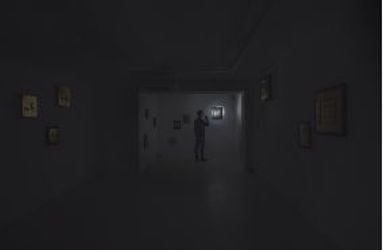
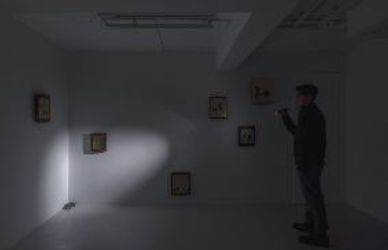
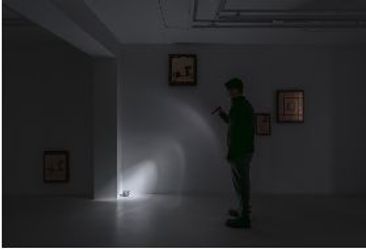
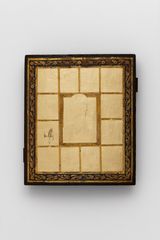
A new series of found and modified religious icons is presented on the second floor. The characteristic gilding ofthe background of the icons has been extended to cover the entire scene only sparing the bodies of the animalsin it. Freed from the narrative into which they were painted, the horses, donkeys, oxen, and sheep seem to floatoff-world, Untamed, as the title suggests. To accentuate this sense of ethereal fragmentation, the artist devisedspecial viewing conditions: visitors will be given flashlights to navigate in the otherwise dark space, like in a closedmuseum or a prehistoric cave.
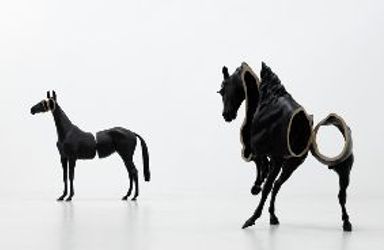
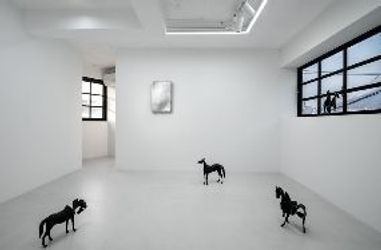
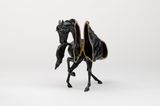
On the top floor another process of segmentation can be seen in a group of animal sculptures. Created fromfound realist depictions of horses made in the nineteenth century, the bronze works are the result of a process ofcutting, folding and reassembling. Split yet still connected, the horse’s bodies are diffracted and occupy multipleperspectives at once. Entitled Zebroids, these works evoke the figure of the zebra, wild and untamable Equidae(the animal family of horses), and its famous stripes, which here have become permanent cuts.
Mirror, finally, consists of a found butcher’s block that has been modified. Presented vertically on the wall, thesurface of the object has been covered in aluminum, gold and palladium leaf, transforming the former cuttingdevice into an optical one. Not only preserving but accentuating the visibility of the marks left in the wood byknives and bones, the surface now reflects and modulates its surrounding lights. Mirror acts as a plane ofsymmetry that is not only spatial, but also temporal: it reveals its past use in the manner of a negative portrait offragmented gestures and bodies; and lets in the lights of the exhibition space, as well as the ghostly reflections ofits visitors.
Etienne Chambaud was born 1980 in Mulhouse, France. He studied at Ecole Cantonale d’Art de Lausanne(ECAL), Villa Arson, Nice, and Ecole Nationale des Beaux-Arts (ENBA), Lyon. In 2022, he received a Ph.D. fromthe SACRe program of PSL University, Ecole Normale Supérieure and Ecole Nationale Supérieure des Beaux-Arts, Paris. The artist lives and works in Paris.
The artist participated in several residency programs: EMPAC, Troy, NY (2017), Fieldwork: Marfa, Marfa, TX(2014), International Studio & Curatorial Program, ISCP, Brooklyn, NY (2011) and Cité Internationale des Arts,Paris (2003-2005).
Chambaud’s solo exhibitions include: Lâme, LaM – Lille Métropole Musée d’art moderne, d’art contemporain etd’art brut, Villeneuve-d’Ascq (2022); Negative Knots, La Kunsthalle Mulhouse, Mulhouse (2018); Undercuts,Forde, Geneva (2012); Contre-Histoire de la Séparation, CIAP, Vassivière (2010); The Sirens’ Stage, DavidRoberts Art Foundation, London (2010); Le Stade des Sirènes, Kadist Art Foundation, Paris (2010); Lo statodelle sirene, Nomas Foundation, Rome (2010), and Color Suite, Palais de Tokyo, Paris (2009). Selected groupexhibitions include: Stories of Stone, Villa Medici, Rome (2023); Icônes, Punta della Dogana, Venice (2023); IFTHE SNAKE, Okayama Art Summit 2019, Okayama (2019).
Chambaud’s work is held in the following collections: Musée National d’Art Moderne – Centre Pompidou, Paris;Musée d’Art Moderne de la Ville de Paris; Fond National d’Art Contemporain (FNAC), Paris; Fond Municipal d’ArtContemporain (FMAC), Paris; FRAC Île-de-France, Paris, Languedoc Roussillon, Toulouse, Auvergne, and others;Pinault Collection, Paris; MACBA, Barcelona; Ishikawa Foundation, Okayama; Fondation Lafayette, Paris; KadistArt Foundation, Paris / San Francisco; Nomas Foundation, Rome; David Robert Art Foundation (DRAF), London.
Press release courtesy Esther Schipper


From altered atlases to room-scale fever simulations, French contemporary artist Etienne Chambaud has a conceptual and materially diverse practice that includes art objects, situational and multimedia installations, and text and film.


A respected voice in contemporary art discourse.
Focusing on ambitious storytelling and insightful art-world commentary. Ocula Magazine publishes in-depth interviews, critical essays and timely analysis on the artists, exhibitions and ideas driving the global art world.
Learn more about Ocula Magazine
Showcasing the best of the art world.
Ocula partners with galleries from around the world to highlight their artists, artworks and exhibitions. Gallery membership is by application and invitation, with each member vetted by an independent panel.
Learn more about Ocula Membership

Specialises in the sale of major artworks.
Led by a team with deep ties to the world’s leading auction houses, galleries and collectors. Ocula’s advisory team offers bespoke services to high-net-worth clients from around the world who are looking to acquire the best of contemporary and modern art.
Learn more about our team and services