Esther Schipper is pleased to announce Karin Sander’s third solo exhibition with the gallery.
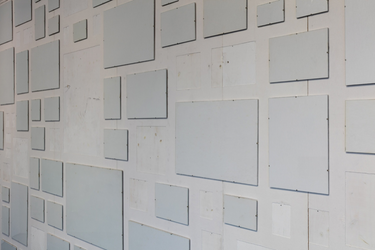
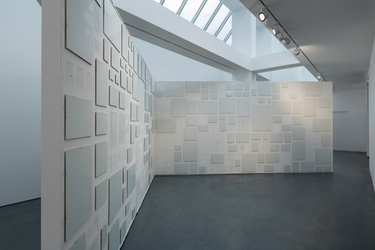
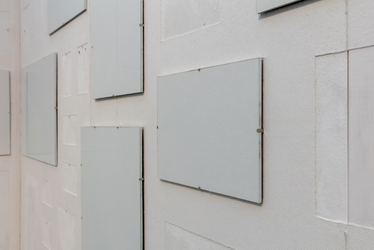
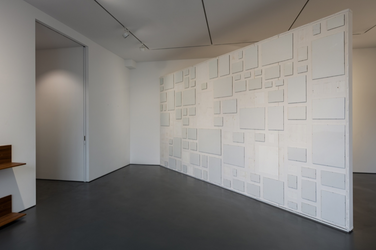
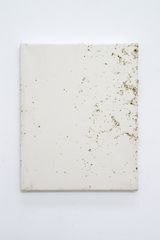
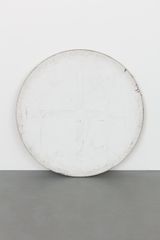
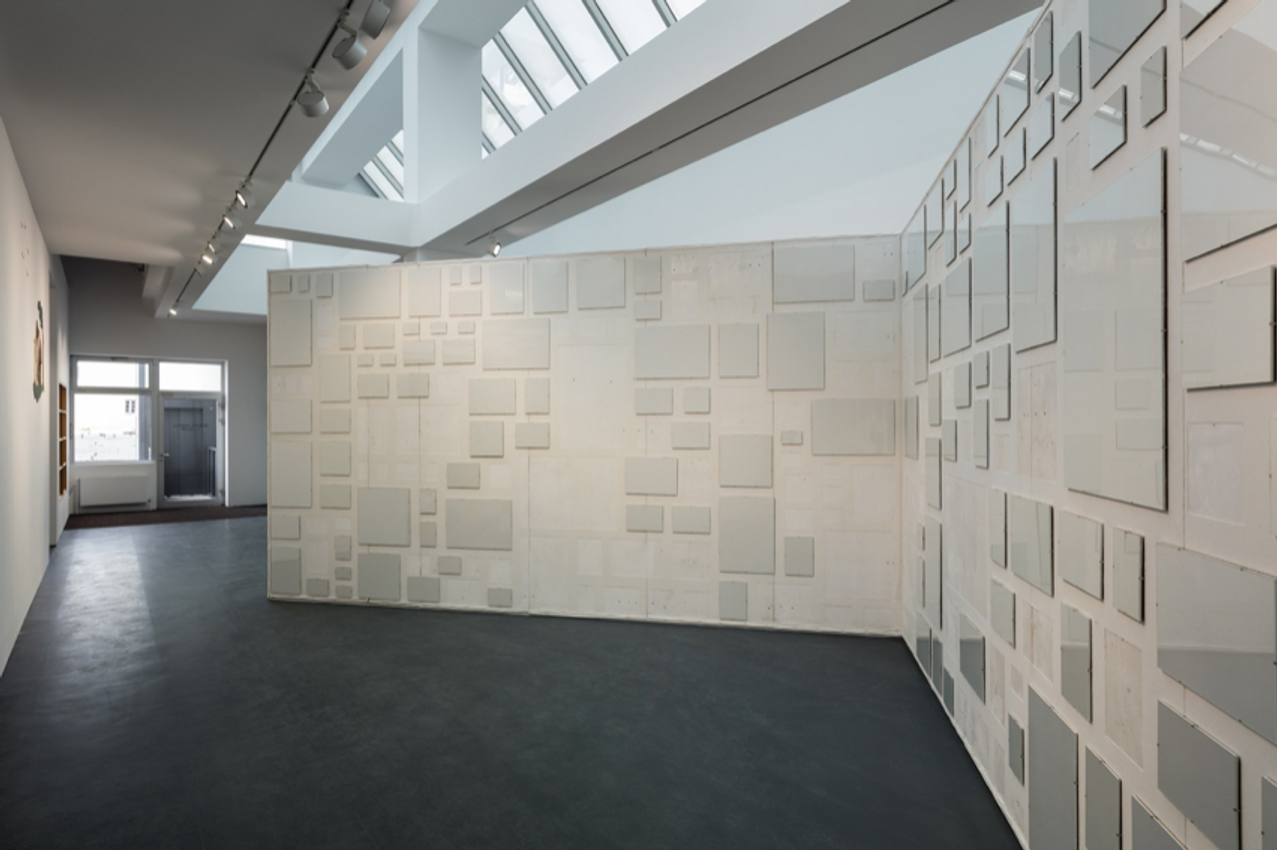
In 1996, Karin Sander realised the work Stoffraum Art Basel (Canvas Room Art Basel) for the newly introduced ‘Statements’ section at the 27th Art Basel. In the approximately 6 x 6 metre booth, sections in various DIN and square formats were cut from the canvas wall coverings then commonly used at the Basel art fair and placed in clip frames which were hung on top of the now blank sections of wall. 434 clip frames were placed on the wall’s surface, according to computer calculations, with approx. 5 cm distance between them. In this presentation, the canvas became both picture and consumer product. Signed and numbered on the back, these white tableaus were for sale and could be taken away immediately. Each sold work left an exposed section on the booth’s wall, revealing the wall’s raw wooden backing. While this process made visible the continual emptying of the booth as the art fair continued and works were sold, the end of the 1996 Art Basel marked the final condition of the work–the remaining framed works as well as the empty sections were fixed.
At the end of the fair, the booth walls were preserved in that state, documented and stored as a whole. Twenty-one years later, the ‘Statements’ booth will now be exhibited in its original 1996 condition as a free-standing, walk-in sculpture. From the artist’s concept to its realisation, the art fair presentation, the ‘composition resulting from the sales’ of frames and left blank spots at the end of the fair, the path of the individual framed works into private collections and into a museum exhibition (Museum Weserburg, Bremen, 2005), the work now finds another form of appearance in the exhibition space at Esther Schipper.
In order to reframe this work in a contemporary context, Harald Welzer has noted:
‘If a work which consisted of pieces of fabric cut from the canvas wall coverings of a booth, put into clip frames and sold inexpensively was a radical position then, it is even more so in its repetition (...). Today the situation has changed only insofar as Sander presents the booth as a free-standing sculpture, accessible from all sides, as the sculpture of an art fair booth, which thereby has returned to itself. Yet it is not an art fair booth, but in a strange way a quotation placed in a different yet nearly identical context. Different because so much time has passed and the context of art production and the art market has changed; and identical, because it is still booth and still commentary and nonetheless still art.’
Generally using each artistic and/or ‘non-artistic’ medium available to her in order to unfold its specific potential, its social and historical context, Karin Sander here works with space and its content, with the specific spatial, social and historic contexts within the frame of the given structural and institutional conditions in which her work is exhibited. Stoffraum Art Basel highlights the art fair booth as an ephemeral, pragmatic form of display. The canvas wall covering turns into the material of a picture–a picture reminiscent of the kind of canvas that is widely used as the backdrop for artworks–the material elements of both the art fair’s and the gallery’s manifestation–is transformed here into an artwork of its own, and once more ends up re-presented at the gallery.
Karin Sander was born in 1957 in Bensberg, Germany. She studied at the Staatliche Akademie der Bildenden Künste in Stuttgart and at the Independent Study Program of the Whitney Museum in New York. From 1999 to 2007, Sander was professor at the Kunsthochschule Berlin-Weißensee. Since 2007, she holds a professorship of Art and Architecture at ETH Zurich Swiss Federal Institute of Technology.
Sander’s work has been exhibited extensively. Notable solo exhibitions include: Zeigen. An Audio Tour through the collection of the GfZK, Galerie für Zeitgenössische Kunst, Leipzig (2017-2018); Karin Sander - Identities on Display, Kunstmuseum Villa Zanders, Bergisch Gladbach (2017); Karin Sander, Kunsthalle Marcel Duchamp, Cully (2016); Karin Sander - Visitors on Display, Lehmbruckmuseum, Duisburg (2013); Karin Sander, n.b.k. Neuer Berliner Kunstverein, Berlin (2011); Gebrauchsbilder und Andere, Kunstmuseum St. Gallen (2010); Labor, K20 Kunstsammlung Nordrhein-Westfalen, Düsseldorf (2010); Zeigen. An Audio Tour through Berlin, Temporäre Kunsthalle, Berlin (2009); Karin Sander, Staatsgalerie Stuttgart (2002); Karin Sander, Kunstmuseum St. Gallen (1996); Projects 46: Karin Sander, The Museum of Modern Art, New York (1994).
The artist’s work is included in many public collections, including: The Museum of Modern Art, New York; The Metropolitan Museum, New York; San Francisco Museum of Modern Art; Kunstmuseum Bonn; Staatsgalerie Stuttgart; Kunstmuseum Stuttgart; National Museum, Osaka; Sprengel Museum, Hannover; Muzeum Artystów, Łódź; Kunstmuseum St. Gallen; Hirshhorn Museum, Washington, D.C.; Daimler Stuttgart; Deutsche Bank Frankfurt am Main; UBS Art Collection Munich/Zurich.


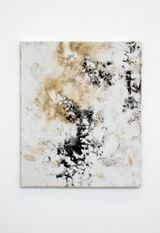
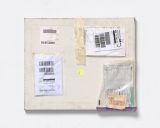
Karin Sander works with situations, their social and historical contexts, involving interventions in existing structures and institutions. The medium the work is realised in is painting, sculpture, electronic media, science, architecture; in brief: each medium is available for working out its specific potential. The intersection of work, recipient and institution, of what is found and what is added, of presence and absence, is emphasised and exhibited. Her Mailed Paintings (begun in 2004), for example, standard-sized and primed canvases of various shapes, are sent to exhibitions without any kind of protection; while being on display constantly, they collect and display traces and marks of their journey. At n.b.k. – Neuer Berliner Kunstverein (2011), one work consisted of piles of crumpled-up waste paper, post-it notes, tossed-out magazines etc. accumulating on the floor, the material originating from the offices of the institution, located directly above the exhibition space. Karin Sander had 30-centimeter wide holes drilled through the ceiling of the exhibition space, the floor of the n.b.k. offices above, in places where originally waste paper baskets were located and instructed the staff of n.b.k to use these holes in the floor just as they would normally use the bins.


Esther Schipper founded the gallery in 1989 in Cologne. In 1997 the gallery relocated to Berlin. Through more than three decades of continuous exhibition practice, the gallery has established itself as a major force not only in Germany but in an international context, with offices in Paris and Seoul and representatives in France, Spain, the United States, Latin America, South Korea, Taiwan and China. The gallery holds up to ten gallery exhibitions as well as multiple off-site projects each year and participates in leading art fairs across the globe.

A respected voice in contemporary art discourse.
Focusing on ambitious storytelling and insightful art-world commentary. Ocula Magazine publishes in-depth interviews, critical essays and timely analysis on the artists, exhibitions and ideas driving the global art world.
Learn more about Ocula Magazine
Showcasing the best of the art world.
Ocula partners with galleries from around the world to highlight their artists, artworks and exhibitions. Gallery membership is by application and invitation, with each member vetted by an independent panel.
Learn more about Ocula Membership

Specialises in the sale of major artworks.
Led by a team with deep ties to the world’s leading auction houses, galleries and collectors. Ocula’s advisory team offers bespoke services to high-net-worth clients from around the world who are looking to acquire the best of contemporary and modern art.
Learn more about our team and services