



Press Release

Esther Schipper is pleased to announce an exhibition of works by Karolina Jabłońska, Tomasz Kręcicki andCyryl Polaczek. On view will be new paintings by the three artists in an especially conceived scenery.

The three young Polish artists—all in their early 30s—began to work collaboratively under the name Potencjain 2012, while working towards their diplomas at the Fine Arts Academy in Kraków. Potencja has exhibitedtogether—and apart—and operated an independent art space by that name. Characterised by a sense of theabsurd, playing with extreme scale and distinct colour palettes, their paintings take everyday life experiences assubjects, with frequent nods to art historical references, and riff off each other in a close artistic dialogue. At thesame time, each artist has developed their own formal vocabulary.

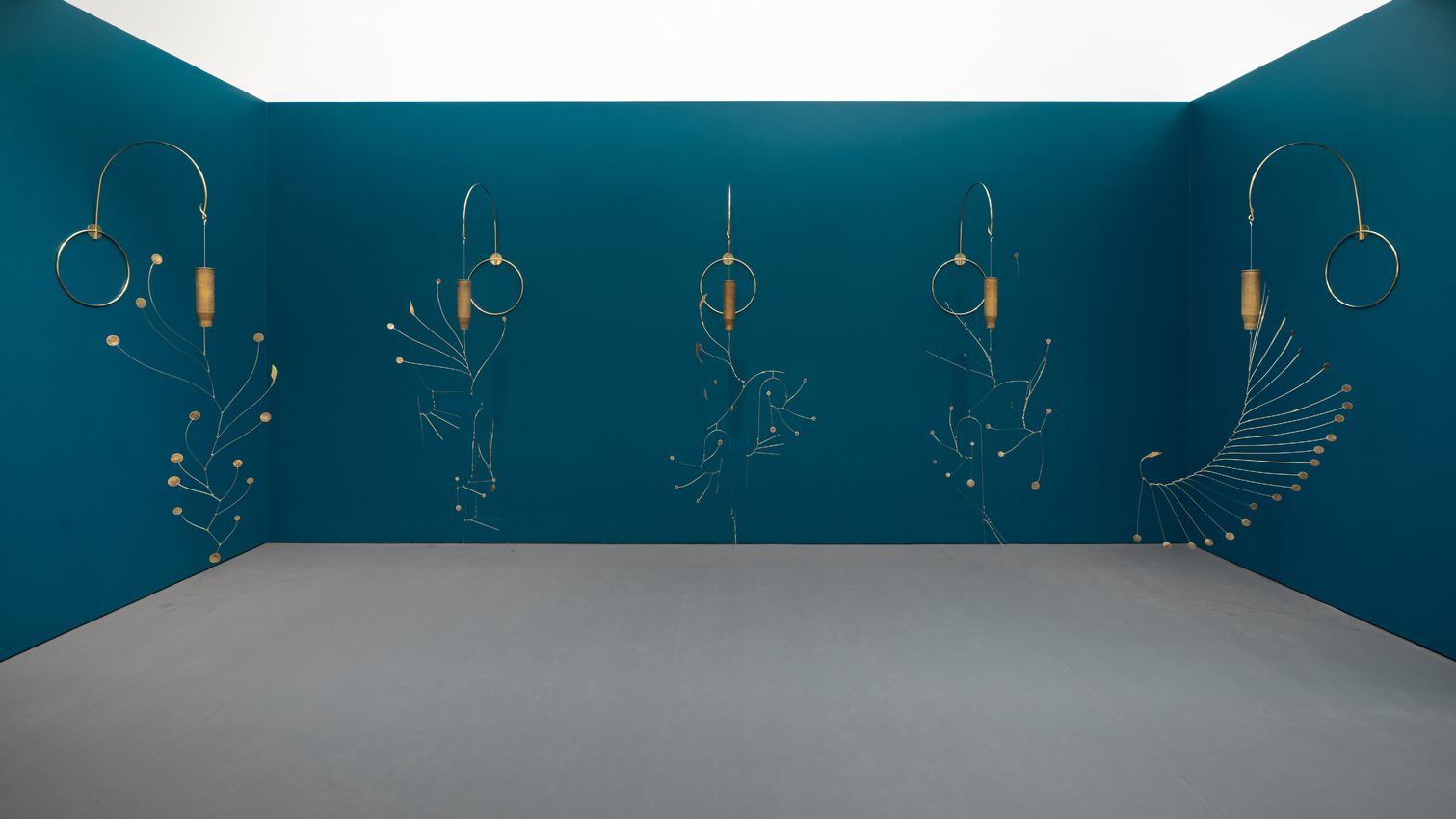
Installed on a painted background made to resemble pages of an open book, Reconciling ApparentContradictions plays with the idea of what an exhibition of paintings may look like. The works by the threeartists are mixed and placed as if illustrations on a page. At the same time, the setting—and the monumentally-scaled book in the centre of the room—are references to their recent publication Potency. A Glossary ofSymbols. Published to accompany their exhibition at BWA Zielona Góra in 2021, the book tells a tall tale ofthe founding of their group, taking a mock mythologizing tone to playfully introduce their respective paintingpractices and symbolism of (shared) motifs. This mixture of self-seriousness and mockery is characteristic oftheir practices and equally evident in the paintings on view.

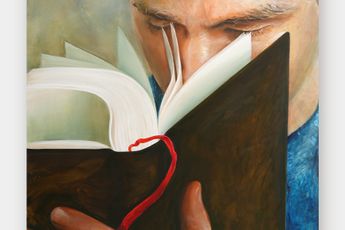
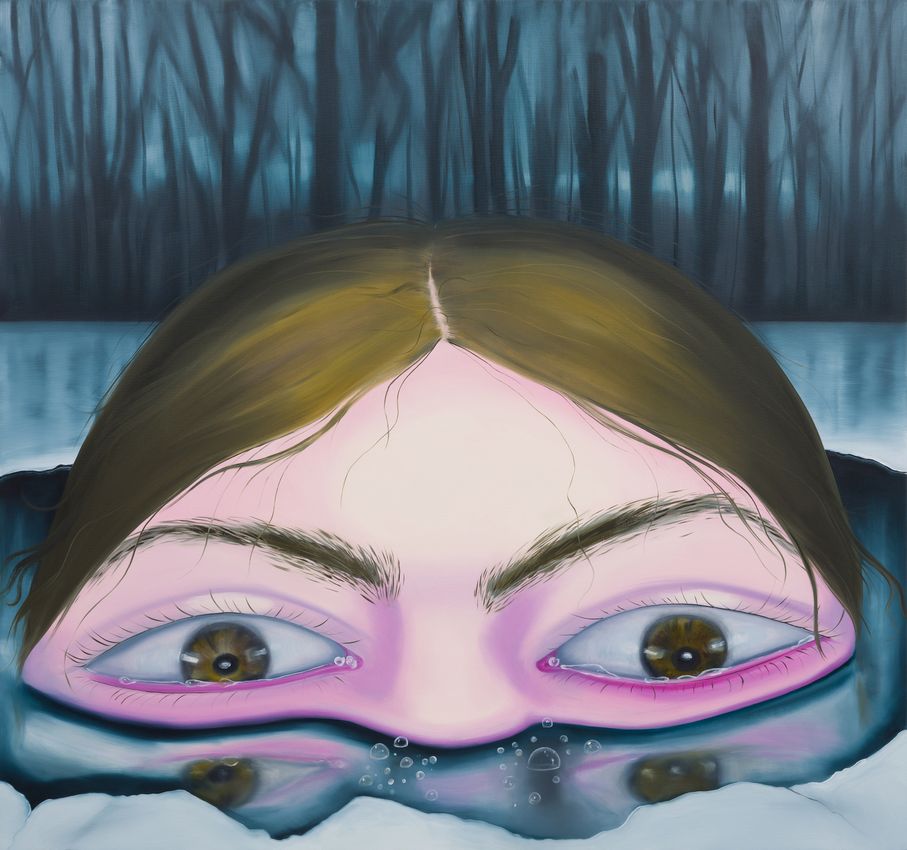
Karolina Jabłońska’s paintings in this exhibition have a distinct palette. Her purplish depictions of faces—generally self-portraits–suggest strong emotions but also evoke a visceral response in the viewer. We feel thefreezing cold, even if her pictorial alter ego, standing in a frozen lake or with her head encased in a giant icecube, appears not to mind. Turtleneck, 2022, depicts a large sweater, slightly snowed in, apparently with aperson inside. Feet are seen below and a flimsy ponytail protrudes from the collar. A recurring motif, the workis a perfect example of Jabłońska’s mixture of low-key drama and hilarity. Deeply felt and keenly observed,the work captures the awkwardness but also the brief moment of panic that can take hold when taking off asweater. As the artist has put it, ‘the paintings come from small sensory and emotional impressions.’ Yet, thepersonal is also political: metaphors for emotional states, inherent in these paintings are references to the roleof women, the existential threat to their bodies and restrictions imposed by political realities.

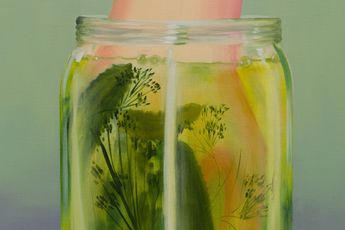
Scale and the body are also major motifs in the paintings of Tomasz Kręcicki. Grotesquely enlarged fingersapplying gelatinous substances from an unmarked tube have an absurdist element but also evoke the artist’scontinued exploration of the abstract in figuration. A surrealist unreality imbues the artist’s depictions ofcommon activities and everyday objects, recalling a Lynchian atmosphere but often cut with a dash of thecampy spookiness of B-movie horror. Yet, the recurrence of fingers, hands and eyes, also refers to a painter’stools. A major theme has been a kind of bathos: the mockery of earnestness, undercutting aspirations throughabsurdity, jokes, and wit. At the same time, works such as Pin 2023, or Needles, 2022, evoke a sense ofanxiety and foreboding created by the implied physical threat of a pushpin poised to break the skin or patternof long black wires used to deter birds. Kręcicki’s subject matter then is inherently existential and addressesboth contemporary politics and its repercussions on the individual.

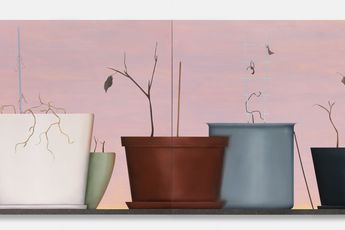
Oscillating between the natural and the everyday—sometimes in the same work—Cyryl Polaczek imagery canhave a rebus-like and/or narrative quality that conjures up a story or, in its incongruity, provokes puzzlement:what are we to make of the comb hovering over a brooding seascape, cloverleaves in a wallet or a handholding an oyster with its pearl? Often the spectator is part of the scene, as in Rain, 2023, walking in a rainylandscape and apparently looking through a transparent umbrella at either a path or a river as water dripsdown all around us. Polaczek, as do Karolina Jabłońska and Tomasz Kręcicki, uses scale in a deliberate, oftenfunny, manner as in his depictions of the monumental dandelions “battling” a bright red poppy. Technicallysophisticated, the artist’s paintings vary in technique. Works such as Pearl and Wallet, both 2023, use thicklayers of paint almost in a sculptural way to create surfaces outlining depicted objects. Another series of recentworks, the seascape and rainy scene mentioned above and a dramatic painting of storm clouds, are painted inthin washes with loose brushstrokes, on the brink of dissolving the contours of its motifs.

BiographiesKarolina Jabłońska, born 1991 in Niedomice. Lives and works in Kraków.The artist studied at the Academy of Fine Arts in Kraków (2010-2015). Residencies and fellowships includeScholarship in Vysoká škola uměleckoprůmyslováv Praze UMPRUM (2014-2015), LIA Programme Residency,Spinnerei Leipzig (2018), Fern Residency, Brussels (2021), Fores Project Residency, London (2022).Institutional group exhibitions include Mainly for Women, SCAD Museum of Art, Savannah (2021); Sensation:Closer to the people, Kunstverein Schattendorf (2019); Paint also known as Blood, Museum of Modern Art,Warsaw (2019).

Tomasz Kręcicki, born 1990 in Żary. Lives and works in Kraków.The artist studied at the Academy of Fine Arts in Kraków (2010–2015) and the Academy of Fine Arts,Nuremberg (2014–2015). Residencies and fellowships include LIA Programme Residency, Spinnerei Leipzig(2018), MeetFactory Residency, Prague, (2018), Fores Project Residency, London (2022). Institutional soloexhibitions include XXL, Muzeum Regionalne, Stalowa Wola (2020); Spirit level, Grey House Foundation,Kraków (2019); XXL, BWA Tarnów (2019).

Cyryl Polaczek, born 1989 in Zielona Góra. Lives and works in Kraków.The artist studied painting at the Academies of Fine Arts in Gdańsk (2008–2010), Berlin (2013) and Kraków(2010–2014). Winner of the main prize of the 11th edition of the Hestia Artistic Journey competition (2012).Institutional group exhibitions include Czas i piana, Academy of Fine Arts Gallery, Kraków (2020); All of Poland.The Journey to the Source of Art (Non-institutional Art Spaces in Poland), BWA Wrocław (2019).

Institutional exhibitions of Potencja include Potencja – Humoral Theory: Quattro Stagioni, Galeria BielskaBWA, Bielsko-Biała (2022); Potencja – Humoral Theory, BWA Zielona Góra (2021).

Read More

Artists Exhibiting

Also Exhibiting at Esther Schipper

About the Gallery

Esther Schipper founded the gallery in 1989 in Cologne. In 1997 the gallery relocated to Berlin. Through more than three decades of continuous exhibition practice, the gallery has established itself as a major force not only in Germany but in an international context, with offices in Paris and Seoul and representatives in France, Spain, the United States, Latin America, South Korea, Taiwan and China. The gallery holds up to ten gallery exhibitions as well as multiple off-site projects each year and participates in leading art fairs across the globe.

View Gallery Profile
Address
Potsdamer Strasse 81E
Berlin
Germany
Opening Hours
Tues - Sat, 11am - 6pm
And by appointment
(1)
Berlin Potsdamer Strasse 81E
Esther Schipper
Potsdamer Strasse 81E, Berlin, Germany
+49 303 744 331 33
http://www.estherschipper.com

Opening hours
Tues - Sat, 11am - 6pm
And by appointment
The art world in focus