Press Release

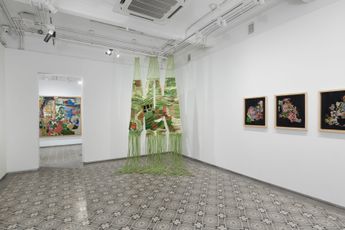
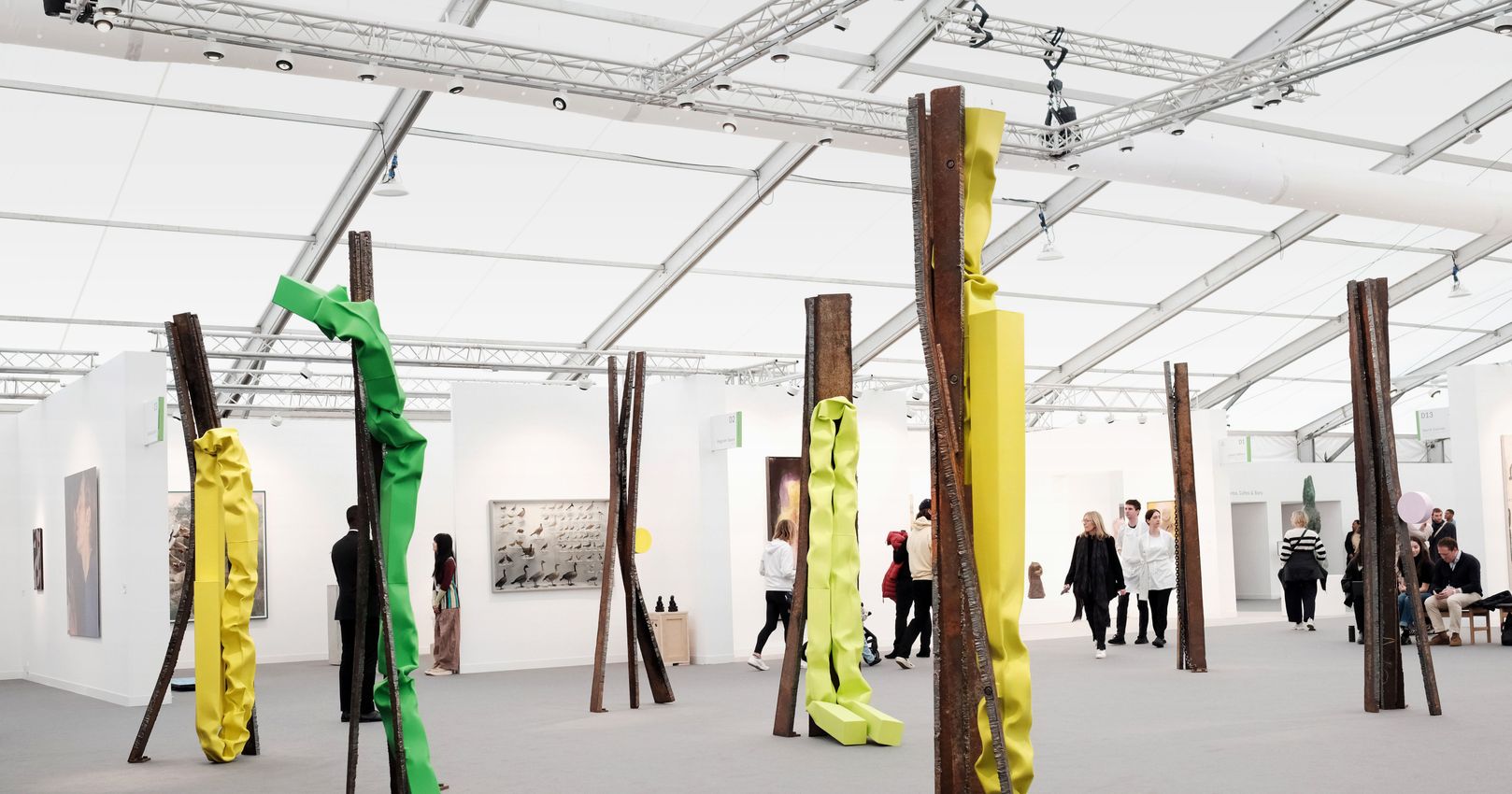
Experimenter presents a group exhibition at Frieze London with works by Ayesha Sultana, Chanakya School, Kallol Datta, Kaveri Raina, Radhika Khimji, Sahil Naik, Sohrab Hura, and Vikrant Bhise.

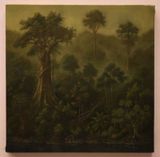
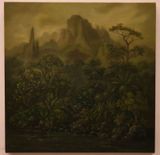
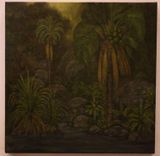
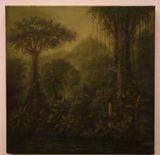
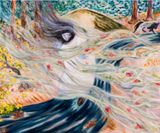
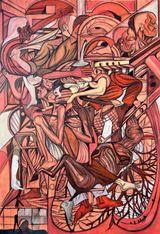
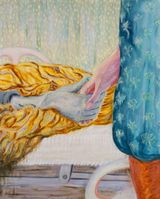
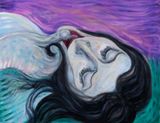
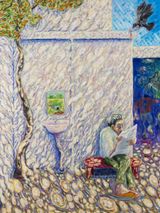
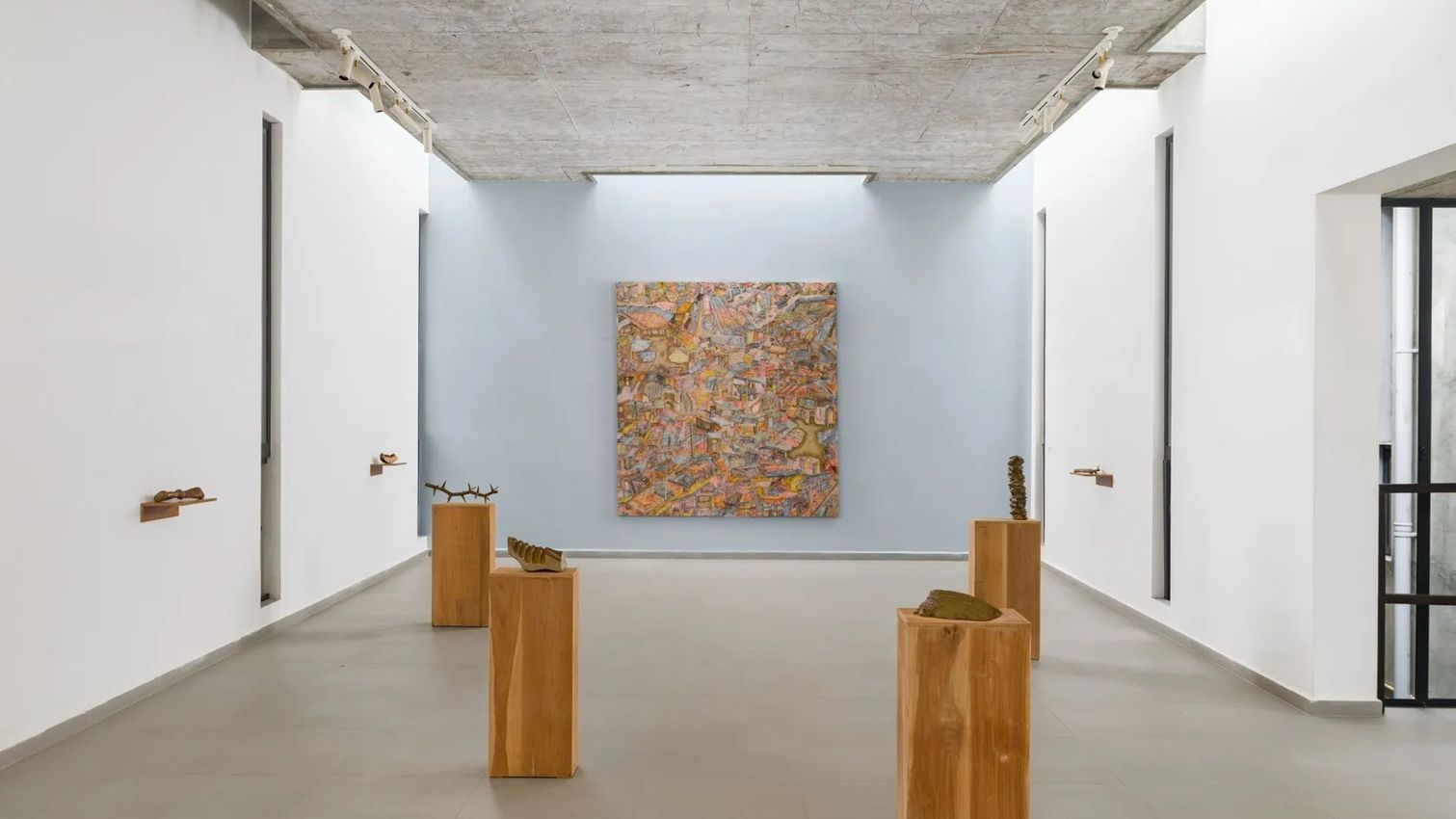
Sohrab Hura will present a selection of oil paintings from his body of work The Forest. The title encompasses the act of waiting within itself, evoking the forest as a space of myriad possibilities—it can harbour secrets, offer refuge, or provide a sense of solace and comfort. For Hura, the forest becomes both a physical and psychological manifestation. These works emerge from a place of remembrance, anticipation, and imagination. In the recent months, Hura has been accompanying his father to medical appointments that made him acutely aware of how time can feel interminable in the hospital waiting rooms. When he began working with oil paint, he felt a similar sense of waiting—the slow process of allowing one layer to dry before applying the next.

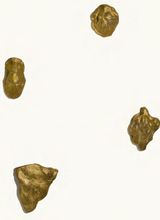
Ayesha Sultana’s (b. 1984; lives and works between Jashore, Bangladesh and Atlanta, USA) bronze sculptures Interval draw from organic shapes found in nature, with an interest in weight, balance and gravity. Water, as an amorphous and shape-shifting presence, offers one point of departure. Their irregular contours and depressions suggest bodily and geological references without settling into any one reference. Despite the density and permanence of the material, the sculptures retain a sense of softness and movement. Their surfaces appear to fold, compress and shift, creating a tension between the weight of bronze and its apparent fluidity.

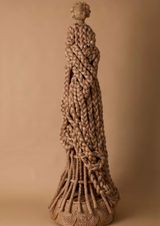
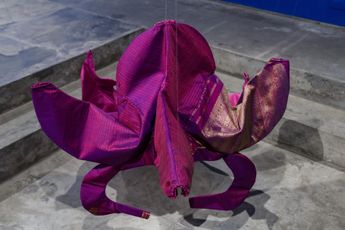
In Chanakya School’s body of work Saptamatrika, the movement from textile process to sculptural form, constructed from coconut, banana, and jute fibres. The female figures that inhabit these works draw upon the philosophical and iconographic histories of the Saptamatrikas, the Seven Mothers whose manifestations belong to the larger field of Shakti, the divine feminine force. Yet these figures are not simply returned to as historical symbols. They are reactivated through the conditions of making. Curiosity, insight, nourishment, protection, transformation, resilience, and collective strength become less attributes of represented deities than principles embedded within the labour of the work itself. Saptamatrika__ X __(Narasimhi) __depicts one of the divine mothers who rise together to protect cosmic order. Narasimhi is the sudden, intense protective power that breaks through moments of great danger, instantly destroying fear and shielding the innocent. Braiding, coiling, binding, wrapping, and weaving—gestures conventionally associated with textile—are released from the plane and allowed to occupy volume. The resulting forms inhabit an unstable territory between body, architecture, and organic matter. They suggest that sculpture need not begin with the solid or the monumental; it may emerge instead from acts of joining, gathering, enfolding, and holding. In this transition from surface to volume, Chanakya School’s long engagement with textile becomes an inquiry into what textile might become when it exceeds the limits of cloth.

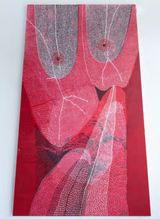
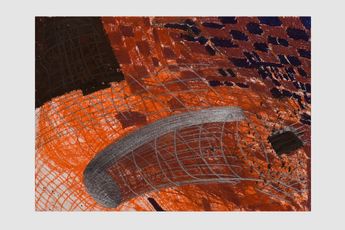
Employing a range of processes that are central to her works, including photographic transfers from personal archives, collage, painting, stitching and drawing, Radhika Khimji (b. 1979; lives and works between Muscat, Oman and London, United Kingdom) pushes the edges of her practice. Khimji’s ongoing interests in expanding the possibilities of thinking through shapes, geometry, and the body in relation to landscapes are often the point of departure in the works. Abstracted landscape forms and images from construction sites seem ensconced within innumerable repeated dots and oblong shapes, an act that makes the surface of her works tactile and acutely textured.

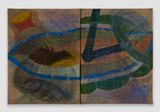
Bust of tongue and cheek bridges the space between interior and exterior, a body dissolved. It began with a photograph of scaffolding: not a support system for a building, but an interior skeleton. Over it, forms build up like slabs of tissue, an inner dialogue melting over bone. Detached, magnified, closer to cells seen under a lens than to anatomy as we usually picture it, the body never quite resolves. Khimji works by layering photographic images of structure with fields of painted dots, building surfaces that shift like seismic activity, ground that never quite settles. The dot work breaks the body down: it takes what could read as a fixed anatomical form and disperses it into something closer to sensation than structure, folding the body into a fluid, gestural palette rather than letting it hold still as a single, legible shape. A sexual charge runs through the work. The nipple forms are direct and unambiguous, and the surrounding tissue, the ridge of teeth-like marks, sits close to the body’s more private, sensate zones. That tension between exposure and dissolution feels central to the work: a body caught between physical presence and self-erasure, wanted and withheld at once.

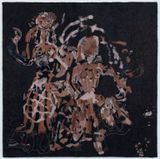
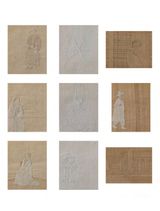
Kaveri Raina’s (b.1990; New Delhi, India, lives and works in New York, USA) acrylic, graphite, and oil pastel paintings on burlap evoke the corporeality of past tales—both witnessed and imagined. Raina transforms the agrarian material into a diaphanous screen, layering acrylic with loose graphite, oil paint, and pastel. Abstracted forms drawn from personal experience and inherited histories reveal generations of dislocation, as her somatic memories intertwine with legends of creation and destruction. In the new paintings, Raina reflects her own journey of displacement—born in Delhi into a Kashmiri family and moving to the United States at the age of ten. The body of work draws inspiration from the mystic Kashmiri poet Lalleshwari (1320–1392), known as Lal Ded, who created the poetic style vatsun or Vakhs, meaning “speech.” Through Lal Ded’s Vakhs, Raina unearths a missing thread in a fragmented lineage, reconnecting with an obscured past. Feeling a deep affinity with Lal Ded, Raina pays homage to the Sufi poet whose message transcended cultural and religious boundaries while invoking her own complex ancestry. Her layered compositions become shifting landscapes where fragmented histories resurface, framing memory in motion.

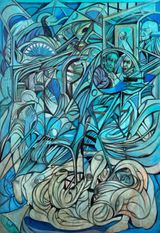
Vikrant Bhise’s (b.1984; lives and works in Mumbai, India) painting Kranti Bhoomi__ –__ Mahad__ emerge from the history of the anti-caste movement and its struggles for freedom, dignity, and equality. Together, the works draw upon the revolutionary legacies of Jotiba Phule, Savitribai Phule, and B.R. Ambedkar, tracing how their contributions and acts of resistance transformed the possibility of social change into a movement for justice. Kranti__ Bhoomi__ –__ Mahad__ traces the Phules’ struggle to make education accessible to those who were denied it, while also reflecting on Ambedkar’s historic Mahad Satyagraha of 1927. About 3,000 Dalits, led by Ambedkar, drank water from the Chavdar Tank, asserting their fundamental rights and their right to access public resources—to learn, to live, to drink water, to enter public spaces, and to exist as equal human beings. The year 2027 will mark the centenary of this landmark moment in the history of the subcontinent, when water became a symbol of freedom. The act of drinking from the Chavdar Tank was an assertion that water, like dignity and liberty, cannot belong to one caste alone. It transformed an everyday act into a revolutionary gesture against the social order of untouchability, where the thirst for freedom became a movement. In Kranti __Bhoomi __– __Mahad, land, water, and the human body become carriers of memory. The painting looks at these histories not as moments from the past, but as living struggles that continue to shape the pursuit of liberty, equality, and fraternity to this day.

Read More

Selected Works

Loading...

Artists Exhibiting

Also Exhibiting at Experimenter

The art world in focus