

Press Release

Experimenter presents خواب / খোয়াব / ख़्वाब / Khwab, Bhasha Chakrabarti’s second solo in the city, where she will be showing a stellar new body of work.

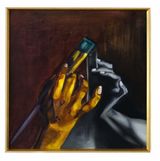
Dreams are fleeting and elusive, often disappearing as soon as one wakes from slumber. But what if there were a way to capture the materiality of dreams? This is the question that pulses through Bhasha Chakrabarti’s خواب / খোয়াব / ख़्वाब / Khwab. By combining quilting and embroidery with painting and drawing, Chakrabarti invites us to touch the landscapes of sleep and dreams, referencing the double meaning of ‘khwab’ in Urdu and Farsi. As we move through the works, we discover that this means occupying a space constellated by beds, dreamers, and dreaming.

Chakrabarti is an artist who works with textiles as a way to show how layers of history—global, local, and personal are felt in and on the body. In خواب / খোয়াব / ख़्वाब / Khwab, she works with, through, and on various fabrics to illuminate the haptic infrastructures that undergird dreaming. Chakrabarti pushes us to think about all that supports dreaming—pillows, quilts, and sleeping chambers—so that we might consider the roles that they play in enabling the mind to roam. Moreover, focusing on the material not only reveals connections between dreaming and constraint, especially under conditions of repression or duress, but also gives us insight into both the durability and ephemerality of thought. Among the questions that the exhibition offers are what constitutes these architectures: is it fabric, ideology, history?

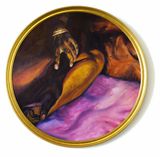
The works in the first room of the exhibition, خواب و خیال / ख़्वाब-ओ-ख़याल / Khwab-o-Khayal I & II, oil paintings on sheer organza with kimkhwab brocade panels, foreground the relationship between the artist and the dreamer. These paintings show the artist herself, asleep but active; her eyes are closed and her limbs are tangled in sheets, matching the dynamism of the translucent panels designed to flutter, float, and envelop. In these different types of movement, we find an echo of Chakrabarti’s interest in the story of Usha’s Dream from the Bhagavata Purana, where a painter, Chitralekha, unites two lovers by bridging the dream world and the real world. Thinking about the artist as dreamer allows us to see how the composition of this exhibition and art, more generally, is its own dream, where one can break from the constraints of medium, which Chakrabarti does here through her use of organza as painting support and brocade as strainer bar. The resulting play with light is not only unconventional, but also asks us to contemplate the shadowy side of dreaming: what lies on the surface, what is opaque, and what must be felt to be understood. Through this choice of hazy textile, we have been freed from thinking about the shape that things should take and introduced to the unexpected journeys that can happen when one takes a leap of faith into the dream world.

خواب / খোয়াব / ख़्वाब / Khwab assembles a vibrant archive of dreamers. In their own way, each of these dreamers has forged plans for bringing together a collective and for fighting against the violence of colonialism and orthodoxy, making the connection between the act of strategising and the act of dreaming especially potent. Here, Toni Morrison’s description of dreaming as thinking is especially apt when she writes: “Thought” was the verb my parents and grandparents used when describing what they had dreamed the night before. Not “I dreamt” or “It seemed” or even “I saw or did” this or that—but” I thought.1 In alerting us to the potential for dreams to be both deeply considered and materialisable, Chakrabarti also asks us to sit with the tension between the personhood of the dreamer and the still-possible futures that they have conjured.

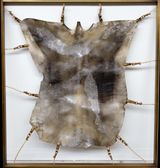
There is still a way to feel, for example, Akbar’s desire for a unified, multi-religious India in خوابگاه / ख़्वाब-गाह / Khwabgah, a suite of seven drawings of the Mughal emperor’s bedroom. While each image presents a different perspective of the room referred to as the khwabgah in Fatehpur Sikri, Chakrabarti’s use of silver and gold-point on used bedclothes remade into paper, alerts us to the absent interior fabrics that once decorated and demarcated the rooms in the sandstone palace. Although these tapestries are lost to the ravages of time just as the silver in the drawings will tarnish before degenerating, we can imagine the ways that their textures coloured Akbar’s thoughts and eased his body into slumber. Following the traces of fabric, Chakrabarti insists, gives insight into the interior contours of dreams.

The ferociousness of Tipu Sultan’s anger at the British is one of the binding agents of his dream diary, which contains pages that describe lush fruits, unexpected encounters, and freedom from the “foreign yoke”.2 In خواب نامہ / ख़्वाब-नामा / Khwabnama, Chakrabarti has carefully hand-embroidered the Sultan’s handwritten Farsi pages, as well as their English translations on silk and cotton and assembled them into a large suspended quilt. Here, Chakrabarti’s play with fiber—notice the shine on his nastaliq—asks us to ponder the ways that fabric may camouflage but not dull these dreams. This diary, after all, was stolen and hidden away in the British Library in a location inaccessible to most, but what we see is that its contents can never truly be domesticated or censored.

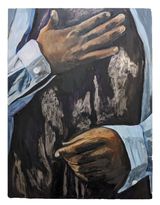
خوابیده / ख़्वाबीदा / Khwabida (Spivak as an Allegory for Postcolonial Dreaming) I & II depict postcolonial theorist Gayatri Chakravorty Spivak in elegant repose in her library. She is sleeping, propped up by a cushion with a book. Known for her feminist scholarship on the gendering of subalternity as well as her arguments for a global class-based uprising, Spivak here, has been painted on old kantha quilts from Birbhum, where she has founded a network of schools for marginalised children. Allowing the texture from the kanthas to show through the gold leaf and oil painting calls attention to the ways that her dreams have been actualised. In these paintings, however, Spivak serves as an allegory for the scholar as dreamer where we can see, through the painting’s attention to Spivak’s aging body, that the body of the dreamer is vulnerable to time, even if those dreams persist.

Finally, we come to خواب بسیرا / ख़्वाब बसेरा / Khwab Basera (after Constable) I-V, a series of white embroidered pillowcases painted with clouds laid horizontally on glass and scattered throughout the exhibition. These are yet another nod toward the material conditions that make dreaming possible. In this case, the clouds that Chakrabarti sees when she wakes up. In addition to giving new meaning to the description of a dreamer as having one’s “head in the clouds,” these works invite us not only to consider the perspective of the dreamer but also to ask ourselves what conditions might make dreaming possible for us. Here, we have a soft pillow for our heads and much food for our imaginations.

When we pay attention to form, خواب / খোয়াব / ख़्वाब / Khwab offers yet another way to think about the act of dreaming. Chakrabarti has made deliberate choices in the exhibition to produce a conversation between her art works and the canon of art history. The seven silverpoints of Akbar’s bedroom are made to the same scale as Vincent Van Gogh’s painting of his bedroom in Arles. In their composition, the portraits of Spivak reference the first painting of a reclining nude in Western art, Sleeping Venus by Giorgione and Titian. Meanwhile, they are styled in the manner of icon paintings, which adhere to specific techniques designed to produce idealised representations rather than realism. Thinking about the exhibition from this perspective especially reveals the importance of Chakrabarti’s work with textile. Using pillows, bedsheets, and blankets as grounds for these drawings and paintings allows us to see that dreaming is both corporeal and intimate. Dreaming is born from material conditions which imprint upon the body, even as the dreams, themselves, might live on separately in their own way.

1 Toni Morrison, in “Unspeakable Things Unspoken: The Afro-American Presence in American Literature”
2 from “The Dreams of Tipu Sultan”, translations and notes by Dr. Mahmud Husain

Amber Jamilla Musser teaches at the CUNY Graduate Center and writes about race, sexuality, and aesthetics. She is the author of Sensational Flesh: Race, Power, and Masochism, Sensual Excess: Queer Femininity and Brown Jouissance, and Between Shadows and Noise: Sensation, Situatedness, and the Undisciplined.

Text by Amber Jamilla Musser. Courtesy Experimenter

Read More
About the Artist

Bhasha Chakrabarti is interested in exploring how artwork, even when grounded in local materials and symbols, can speak to issues beyond the local by situating her practice within global conversations around race, gender, and power.

View Artist Profile

Also Exhibiting at Experimenter

Address
17, Judges Court Rd, Alipore
Kolkata
India
Opening Hours
Tuesday – Sunday
11.30am – 5.30pm
(1)
Kolkata 17, Judges Court Rd, Alipore
Experimenter
17, Judges Court Rd, Alipore, Kolkata, India

Opening hours
Tuesday – Sunday
11.30am – 5.30pm
The art world in focus