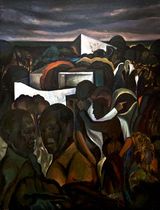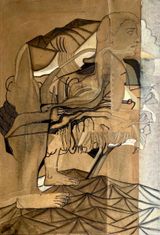


Experimenter presents Neel Ambar, Vikrant Bhise’s first solo in Kolkata and with the gallery, bringing together an ambitious and expansive body of work that serves as an archive of the Ambedkarite movement, using the colour blue to articulate a collective consciousness.
In this exhibition, blue embodies B. R. Ambedkar’s boundless vision across scholarship, resistance and assertion against caste oppression. It figures as a chromatic visual language of collective identity, aspiration, and cultural belonging. Samata, or equality, a core principle for the anti-caste movement, finds a symbolic expression in this blue. As an Ambedkarite artist, Bhise thinks through forms of equality, placing himself within the historic moment when the Republic of India was established and the Indian Constitution came into effect. Drawing from the traditions of the Phule-Ambedkarite movement, his works foreground the citizens of India, particularly the oppressed and labouring communities.
Against the current socio-political realities, Bhise’s practice underscores labour, protest, and equality as visual and conceptual frameworks for understanding the anti-caste struggle. Drawing on cultural observations and literary traditions rooted in Ambedkarite scholarship, he develops a kinetic visual language and creates atmospheric narratives that traverse histories and geographies. His works serve as registers of collective memory grounded in lived realities rather than transcendence. He renders figures and architectural forms on muted terrains, using bold, sweeping brushstrokes to create a distinct artistic vocabulary. His visual forms oscillate between entanglement and equanimity. These gestures activate the spatial and temporal dimensions, by turns collapsing, resurrecting, or remaining suspended in a continuous flux.
Bhise’s practice builds on Ambedkar’s emancipatory ideals. His works become more resonant when situated within the larger framework of this exhibition, in which Bhise chronicles the memory and experiences of the Dalit-Bahujan community, alongside various trajectories of the anti-caste movement, transforming them into a visual archive that subverts hegemonic narratives surrounding caste in the Indian subcontinent. In Neel Ambar, there are no myths, no barriers; rather a vast, unfolding expansion of metta (kindness), karuna (compassion), and ahimsa (non-violence)—reminiscent of the sky and its limitless horizon.
Rumi Samadhan is an independent researcher, curator, and visual artist based in Mumbai and Kolhapur. She holds a PG in Curatorial Studies from Dr. BDL Museum, Mumbai. Her research interests span Existential Politics, Museum and Regional Studies. As a CISA 2019 Fellow at Khoj, she curated The Mahad Satyagraha – ‘Erasure’ as a Form of Assertion.
Bhise’s body of work Samata – Stupas of Equality emerges in response to a comment made in 2024, retorting how the invocation of B.R. Ambedkar had become commonplace in the popular narrative. The works assume the form of stupas, Buddhist architectural structures traditionally built to house sacred relics of Buddha. Bhise’s stupas resist the tendency to reduce Ambedkar to his role as the architect of the Indian Constitution, foregrounding instead his enduring significance within Dalit-Bahujan communities as a revered figure of emancipation and dignity, a pivotal symbol of the anti-caste struggle and collective resistance, and a key figure in women’s liberation and the labour rights movement.
Across this suite of works, he depicts and commemorates the lived realities, the past and present of the Dalit community: the normative dehumanisation of the marginalised, the intergenerational denial of basic resources, the instances of episodic caste-based violence—incidents of caste-based lynchings and police brutality—that are routine occurrences around the country. Bhise underscores how caste hierarchies are entrenched within the everyday, where even ordinary markers of celebration and self-expression—riding a horse during wedding processions and wearing a moustache—become sites of control and repression. The recurrent motifs of blue flags and the dhamma chakra allude to the broader Ambedkarite struggle for self-assertion.
Samata – Stupas of Equality also draws parallels between the Dalit movements and the contemporary protests that have unfolded across the nation in the past few years, spanning the Farmers’ Protest (2020-21) against the three stringent farm acts that were passed in the Parliament in September 2020 to the recent Students’ Protests (2026) which took place in the aftermath of NEET paper leak, where students took to the streets to demand accountability for an increasingly collapsing education system.
Placed against a blue backdrop, Samata – Stupas of Equality reasserts the significance of the colour blue within Ambedkarite pedagogy. Chosen by Ambedkar as the colour of the Scheduled Castes Federation of India’s party flag in 1942, within these works, blue acts as visual signifier of Dalit selfhood and consciousness, an emblem for collective memory, and a chromatic language for social transformation.
On 11 July 1997, residents of Ramabai Ambedkar Nagar, a predominantly Dalit-populated urban colony in Mumbai, woke up to find their statue of Ambedkar desecrated by a garland of sandals around his neck. After lodging an official complaint, the residents began gathering in protest, blocking the highway near the colony, moments after which the Special Reserve Police Force (SRPF) arrived in front of the colony, several hundred metres away from the statue and the site of protest. They opened fire on the service road immediately outside the colony and in the alleys between the houses, killing ten Dalits within minutes. The incident was one of the most tragic outcomes of the series of organized attacks by the dominant castes in retaliation to Dalit assertion for self-respect and liberation.
Reminiscent of the Dhammachakra gateways and stupa-shaped entrances associated with Buddhism, Wheel of Dhamma depicts the gates outside the Ramabai Nagar colony, which Bhise—who witnessed the massacre in person—continues revisiting almost three decades later. The Dhammachakra itself alludes to Buddha’s first sermon at Sarnath, considered to have set in motion the Wheel of Dhamma (Dhammachakkappavattana or धम्मचक्कप्पवत्तन in Pali). In the work, bustling within these gates are glimpses of the tightly-knit working class Dalit life, whether of demolition or celebration. Poet and singer Bhimshahir Vilas Ghogre, who died by suicide in protest of the brutal firing, is also depicted. With every successive visit to the colony, Bhise learns of new histories, which are inextricably intertwined with the fabric of these gates.
On 14 October 1956, Dr. B.R. Ambedkar embraced Buddhism in a historic gathering at Deekshabhoomi in Nagpur. Consequently, the values upheld by Buddhism became a safe space for asserting Dalit identity and selfhood while breaking free from the graded inequality and caste hierarchies entrenched within Hinduism and its varna system.
In Vihara of Blue Consciousness, Vikrant Bhise reimagines a Buddhist vihara as a living, breathing resonance of collective and egalitarian existence, depicting a confluence of overlapping figures from Dalit-Bahujan community. By conflating past and present, he integrates an archive of references from Marathi literary texts, protest songs or Bhimgeet (music and poetry honouring Ambedkar and other Bahujan icons, their ideologies, and Buddhist philosophies), political theories, historical inscriptions, and key moments in Dalit socio-political history. Oral traditions, theatre practices, and powadas (traditional Marathi ballad-singing and poetic form rooted in a medieval genre of martial glory) are reclaimed as cultural weapons for social justice and anti-caste resistance.
Bhise also builds on the visual language of Blue and its connotations in Dalit consciousness by immersing his figures in different shades of the colour. In the darker hues of the triptych, Bhimshahir Vaman Dada Kardak, who composed more than ten thousand Bhimsongs, can be seen playing the harmonium. The protesting figures around him depict scenes of caste oppression and subjugation. A beam of light cuts through this darkness, becoming a metaphor for resilience, knowledge, and equality as the core facets of the Dalit liberation movement.
Vikrant Bhise represents the historical trajectory of the Dalit Panthers, a revolutionary group of poets, artists and writers within the Ambedkarite political movement founded in the early 1970s by Namdeo Dhasal, Raja Dhale, Arjun Dangle, and J. V. Pawar, who drew upon the ideological legacy of the Black Panther party of the 1960s in the United States. Bhise has a deeper lens into the trajectory of the organisation towards the emancipation of the Dalit and the historically oppressed communities and their protests against the caste atrocities in Maharashtra through his father Vishvas Bhau Bhise who was directly involved with the group.
Bhise reproduces the letterheads, iconographic elements, and portraits of leaders used by the Dalit Panthers in their published pamphlets, manifesto, and magazines through watercolour, gouache, and ink in the series Archival Historicity/Dalit Panthers. This body of work commemorates the movement’s enduring influence in carrying out constitutional democratic practices and the fight for social justice within the rubric of our nation’s history.
Vikrant Bhise’s Krantijyoti (क्रांतिज्योती) – Light of Revolution depicts vignettes from the daily realities of Dalit communities, where public sites of collective gathering become spaces through which lives at the urban margins are made visible and their histories are reconstituted. Moving through the bylanes of Chembur’s Siddharth Colony, Ghatkopar’s Ramabai Ambedkar Nagar, Matunga Labour Camp, Worli’s BDD chawls, Bhise portrays human settlement within the contested geographies of the city of Mumbai. These fragile worlds, continually threatened by redevelopment, hold the traces of histories that have been eroded, while also underscoring how the city has been shaped by industrial labour and economic expansion. The sirens of the mills and the labour that sustained Mumbai’s economic life exist alongside forms of cultural production that have generated distinct and resilient alternative cultural traditions. Within these spaces, music, literature, theatre, and political expression, alongside the invocation of Jai Bhim, become forms of collective dissent, converging within Bhise’s visual landscape as a tactile and ever-evolving archive.
The night emerges as a charged temporal and spatial register, evoking the Ambedkarite Blue, in which the shekoti, or community fire, becomes a site of gathering, transmission, and exchange. Bhimgeet, powada, abhanga, and other forms of protest poetry are performed, meals are shared, and marriage rituals are carried out within these collective spaces. Ambedkar’s legacy finds expression through Dhamma talks and social festivities, extending Ambedkarite thought beyond the monument and into lived forms of community. Public squares become viharas—not simply as physical sites, but as provisional structures of collective learning, knowledge-making, and living. In Bhise’s work, these spaces become sites where memory is continually activated through gathering, cultural production, and collective life.
The title of the work refers to the book Baluta, written by Daya Pawar, one of the first Dalit autobiographies in India. The book moves between rural Maharwada and the urban squalor of Kawakhana in Mumbai. Under the traditional socio-economic system in rural Maharashtra, individuals from non-farming castes, or Balutedars, were hired to provide manual labour on the field or in domestic spheres in exchange for a meagre share of annual agricultural produce, called baluta. Pawar uses this system as a powerful metaphor to speak about the oppression, economic deprivation, and social exclusion faced by the Dalit community at large.
Employing Pawar’s book as an entry point, Bhise reflects on the escalating atrocities against the Dalit-Bahujan community over the past few decades, while affirming the enduring hope found in their resistance and resilience in the face of injustice and tyranny. While the book makes space for a vocabulary through which the marginalised can speak about their experiences in their own language, Bhise’s Baluta (बलुतं) creates a visual landscape of episodes from their lived realities, collapsing several spatio-temporal frames. Depicted are figures who move from village to village with no permanent home, constructing temporary tents from whatever material they have accumulated. The tent thus becomes both an abode and something they can call their ‘own’. Interspersed with the figures are objects that one would find in any Dalit household—a framed portrait of Ambedkar, a copy of the Constitution of India, a lone door bearing the slogan “Jai Bhim”, a collection of books significant to anti-caste scholarship and Ambedkarite consciousness. The work becomes more resonant when situated within the larger framework of the exhibition, where Bhise chronicles the memory and experiences of the Dalit community, alongside various trajectories of the anti-caste movement, transforming them into a visual archive that subverts hegemonic narratives surrounding caste in the Indian subcontinent.
Text by Rumi Samadhan. Courtesy Experimenter


A respected voice in contemporary art discourse.
Focusing on ambitious storytelling and insightful art-world commentary. Ocula Magazine publishes in-depth interviews, critical essays and timely analysis on the artists, exhibitions and ideas driving the global art world.
Learn more about Ocula Magazine
Showcasing the best of the art world.
Ocula partners with galleries from around the world to highlight their artists, artworks and exhibitions. Gallery membership is by application and invitation, with each member vetted by an independent panel.
Learn more about Ocula Membership
Specialises in the sale of major artworks.
Led by a team with deep ties to the world’s leading auction houses, galleries and collectors. Ocula’s advisory team offers bespoke services to high-net-worth clients from around the world who are looking to acquire the best of contemporary and modern art.
Learn more about our team and services