





URS FISCHER
b. 1973, Switzerland‘People seem to fear art. Art has always been a word for this thing that can’t be rationalised; when you see or hear something that you struggle to explain. But that’s its strength, of course, that’s what the word ‘art’ is for.’—Urs Fischer
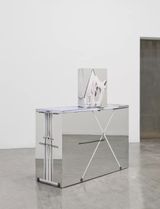
Urs Fischer mines the potential of materials—from clay, steel, and paint to bread, dirt, and produce—to create works that disorient and bewilder. Through scale distortions, illusion, and the juxtaposition of common objects, his sculptures, paintings, photographs, and large-scale installations explore themes of perception and representation while maintaining a witty irreverence and mordant humour.
Fischer began his artistic career studying photography at the Schule für Gestaltung in Zurich. He later lived in London and Los Angeles, and shared a studio with Rudolf Stingel in both Berlin and New York. Themes of absence and presence, as well as the processes of art production, pervade his work, in which Fischer makes use of tables, chairs, shadows, and light to explore distortion and anthropomorphism. In Stuhl mit (1995–2001), bulbous, fabric-covered legs merge with a wooden chair, and in Studies for chairs for individual seating positions (1993), the absence of a human body is suggested by a sawdust and rubber mould draped over the furniture. Food is also a major element in Fischer’s work. Rotting, melting, and crumbling, and placed in juxtaposition with permanent materials like metal, bricks, and mortar, it serves as a memento mori; Rotten Foundation (1998) comprises a brick structure built on a foundation of rotting produce; Untitled (Bread House) (2004–2005), a Swiss chalet constructed entirely of loaves of bread, was left to be eaten by parakeets; and in the Problem Paintings (2011), portraits mounted on aluminum panels are obscured by images of eggs, peppers, and kiwis, as well as twisted bolts and half-smoked cigarettes.
In 2009 Fischer had his first large-scale solo presentation in an American museum, at New York’s New Museum; the exhibition featured a series of immersive installations and hallucinatory environments including cityscapes and mirrored labyrinths. At the Venice Biennale in 2011, his wax copy of Giambologna’s late-sixteenth-century sculpture Rape of the Sabine Women slowly melted, looming over another candle depicting an ordinary man wearing glasses and a sport coat. The candle works, which Fischer has produced since 2001, attest to his mastery of entropy, as well as his simultaneous incorporation and rejection of tradition.
Fischer had his first solo show with Gagosian in 2012. The following year for his exhibition Yes at the Geffen Contemporary at MOCA Los Angeles, 1,400 volunteers produced unfired clay sculptures in the weeks leading up to the exhibition. As soon as Fischer has accomplished one material feat, he embarks on another, in ways that are complicated and playful, messy and perfected.
Courtesy Gagosian

Recently Exhibited




Works Elsewhere
















Explore and Follow Artists Shaping Contemporary Art
A respected voice in contemporary art discourse.
Focusing on ambitious storytelling and insightful art-world commentary. Ocula Magazine publishes in-depth interviews, critical essays and timely analysis on the artists, exhibitions and ideas driving the global art world.
Learn more about Ocula Magazine
Showcasing the best of the art world.
Ocula partners with galleries from around the world to highlight their artists, artworks and exhibitions. Gallery membership is by application and invitation, with each member vetted by an independent panel.
Learn more about Ocula Membership
Specialises in the sale of major artworks.
Led by a team with deep ties to the world’s leading auction houses, galleries and collectors. Ocula’s advisory team offers bespoke services to high-net-worth clients from around the world who are looking to acquire the best of contemporary and modern art.
Learn more about our team and services