Press Release

Gagosian is pleased to announce European Couples, an exhibition uniting all nine fluorescent corner light works from Dan Flavin’s European Couples series (1966–71), opening at the Le Bourget gallery on October 18. Presented in their entirety for only the third time ever—and for the first time in France—these “situations,” as Flavin called them, offer a rare opportunity to experience the series as a unified installation and to consider the relationships between color, seriality, architecture, and the titles’ dedications that underpin it. Five works on loan from the Estate of Dan Flavin join four from the collection of Heiner Friedrich, following the complete series’ long-term presentation at DASMAXIMUM KunstGegenwart, the private museum Friedrich founded in Traunreut, Germany, in 2011, which closed in 2024.

The European Couples series is rooted in Flavin’s relationships and his long-standing practice of dedicating works to people he knew or worked with, including artists, electricians, and gallery workers, as well as friends and family members. Among these figures, Heiner Friedrich is particularly significant; as an influential German art dealer in the 1960s and ’70s, he became a lifelong supporter of several artists. Since the late 1960s, he worked closely with Flavin, exhibiting the artist’s work at his galleries in Munich, Cologne, and New York. In 1974, Friedrich cofounded the Dia Art Foundation, which established the Dan Flavin Art Institute in Bridgehampton, New York, in 1983 (now Dia Bridgehampton). Decades later, he launched DASMAXIMUM, conceived as a place where significant groups of works by selected artists could remain on view for extended periods, a nonconventional museum sited in a former industrial complex.

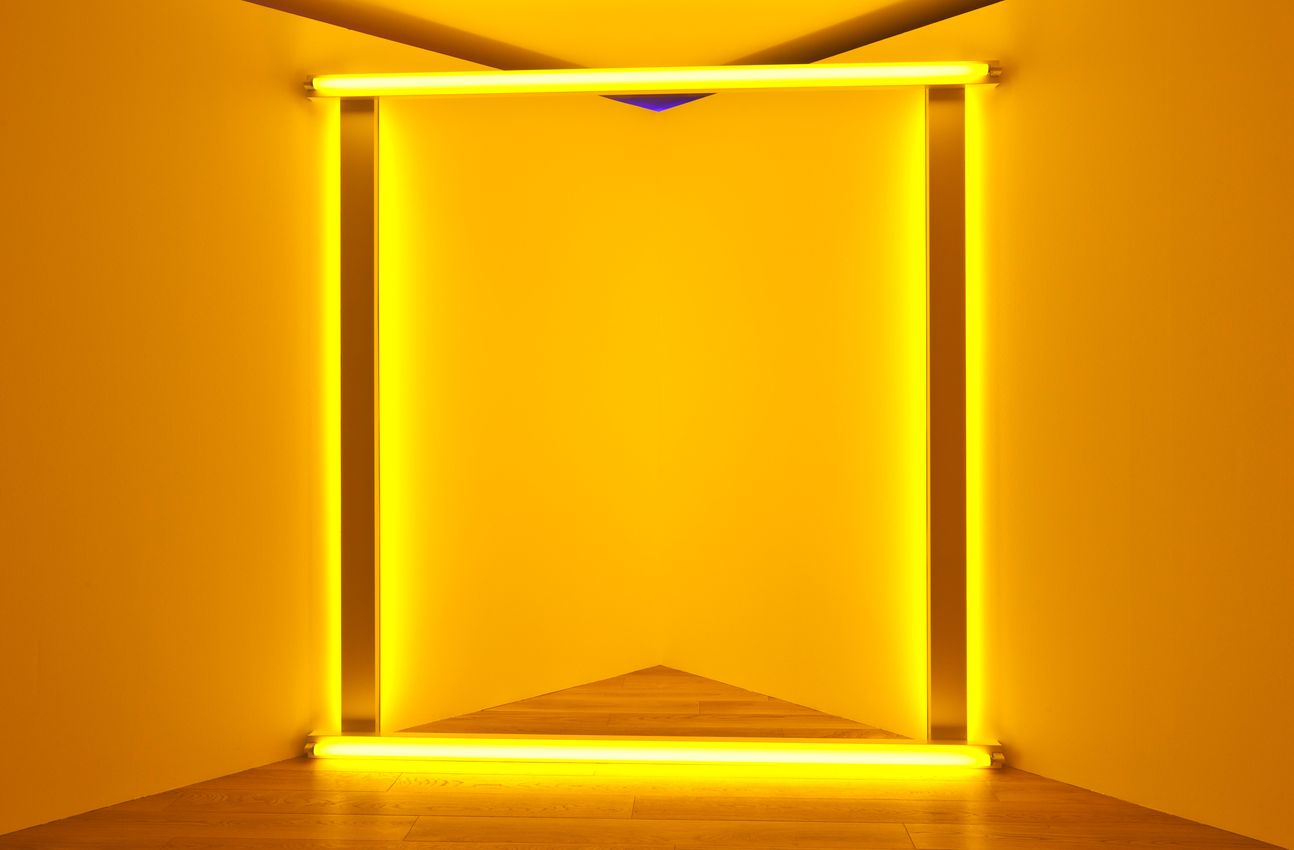
European Couples was initiated in 1966, only three years after Flavin abandoned painting and collage for light assemblies made from industrially produced fluorescent lamps and fixtures. The works in the series are all eight-foot (244 cm) open squares in a single color of fluorescent light—yellow, pink, red, blue, green, warm white, cool white, daylight, and soft white—installed across a corner. The works’ repetition of geometric forms underscores Flavin’s interest in serial configurations, while their placement alters and activates the architecture itself, with light spilling across adjoining surfaces.

As Flavin states in “‘. . . in daylight or cool white.’ An autobiographical sketch,” __in the December 1965 issue of Artforum:

_I came to these conclusions about what I had found in fluorescent lights and about what might be done with it plastically: . . . I knew that the actual space of a room could be broken down and played with by planting illusions of real light (electric light) at crucial junctures in the room’s composition. _

At the Le Bourget gallery, this dialogue is amplified by Jean Nouvel’s transformation of the former industrial building, which provides an architectural framework for Flavin’s exploration of fluorescent light’s effects.

Beginning in the early 1960s, Flavin frequently titled works in honor of friends, family, artists, writers, and other people important to him. European Couples is particularly intimate: each work in the series is dedicated to a different pair of individuals who were close to the artist. These include Friedrich and his then-partner Thordis Moeller, commemorated in soft white fluorescent light, and Swiss art dealer Bruno Bischofberger and his wife, Christina, commemorated with yellow.

Alongside European Couples, a set of six further works from 1963 and 1964—untitled (for Charlotte and Jim Brooks) 1 to 6—is on view. Each juxtaposes an eight-foot (244 cm) blue fluorescent lamp with a two-foot (61 cm) fluorescent lamp in pink, red, yellow, blue, or ultraviolet. Installed in an adjacent space, they form a single line almost 50 feet (more than 15 meters) long. Here, too, Flavin has titled the works after friends—in this case, American Abstract Expressionist painters.

Providing an additional, focused, historical accent to the presentation are two paintings by German Expressionist painter Ernst Ludwig Kirchner (1880–1938): a landscape, Hohe Kiefern vor Hügellandschaft (Tall Pines in Front of Hills, 1921–23), and Nachtfrau (Frau geht über nächtliche Straße) (Night-Woman [Woman Walking on a Night Street], 1928), a nocturnal city scene inspired by the electrification of Berlin in the early twentieth century. Their inclusion stems from a conversation, fondly remembered by Friedrich, in which Flavin cited his deep admiration for Kirchner. Together, Flavin and Kirchner revealed the very essence of light and color, showing how they can transcend medium, reconfigure space, and alter perception.

Dan Flavin: European Couples precedes the opening of Dan Flavin: Some Light at the Guggenheim Bilbao, Spain, this December.

Read More

Installation Views

Dan Flavin, untitled (to Christina and Bruno), 1966–71, yellow fluorescent light, 96 1/8 x 96 1/8 inches (244 x 244 cm), Edition 2/5 © 2026 Stephen Flavin/Artist Rights Society (ARS), New York. Photo: Franz Kimmel. Courtesy Collection Heiner Friedrich and Gagosian
About the Artist

Daniel Nicholas Flavin Jnr was a pioneer light artist and installation-maker associated with the Minimalist movement.

View Artist Profile

Also Exhibiting at Gagosian

About the Gallery
Gagosian is a global network of art galleries specialising in modern and contemporary art with eighteen exhibition spaces worldwide.
View Gallery Profile
Address
26 avenue de l’Europe
Le Bourget
France
(1)
Le Bourget 26 avenue de l’Europe
Gagosian
26 avenue de l’Europe, Le Bourget, France
+33 148 161 647
http://gagosian.com
The art world in focus