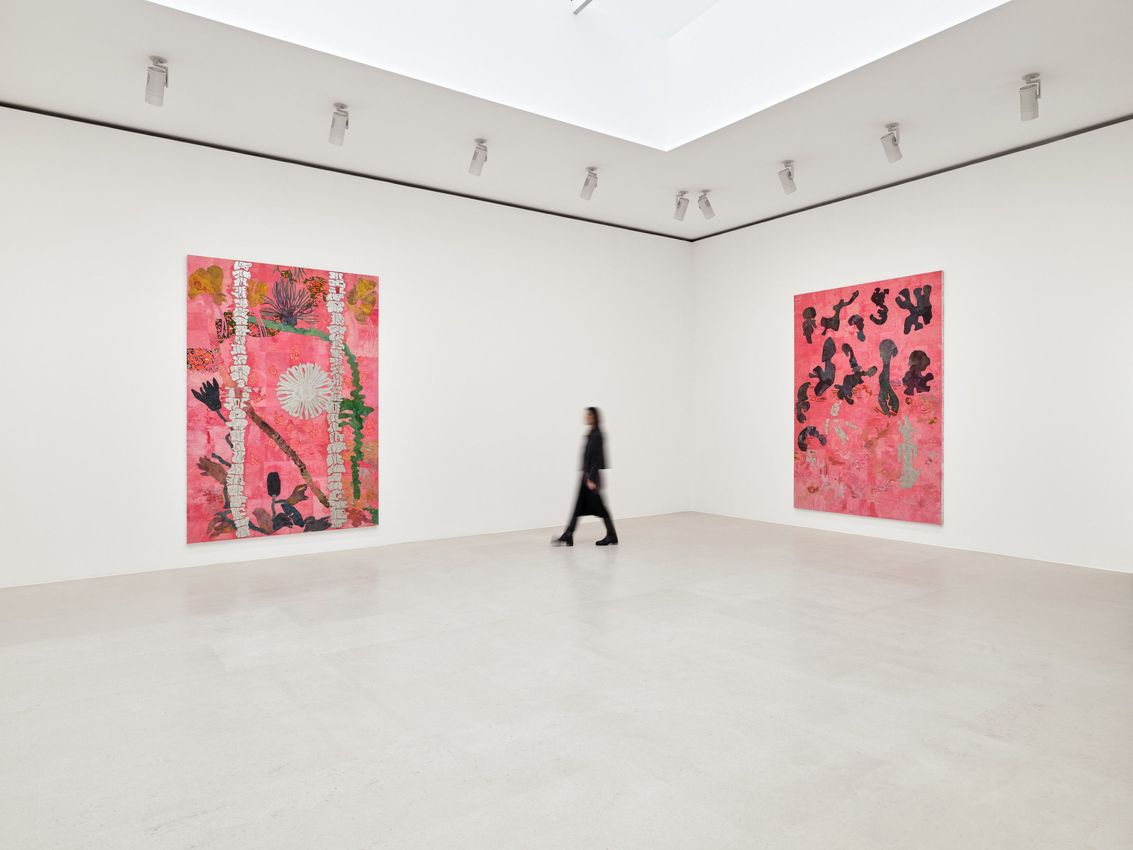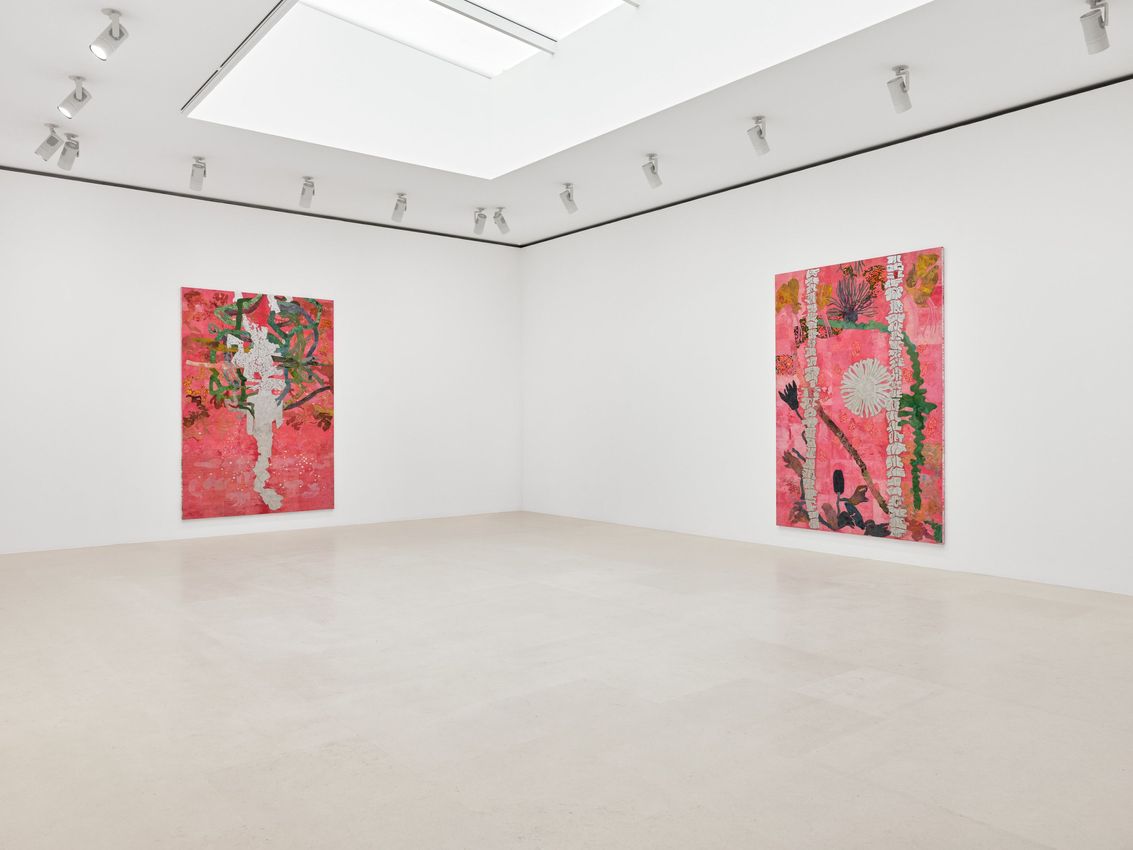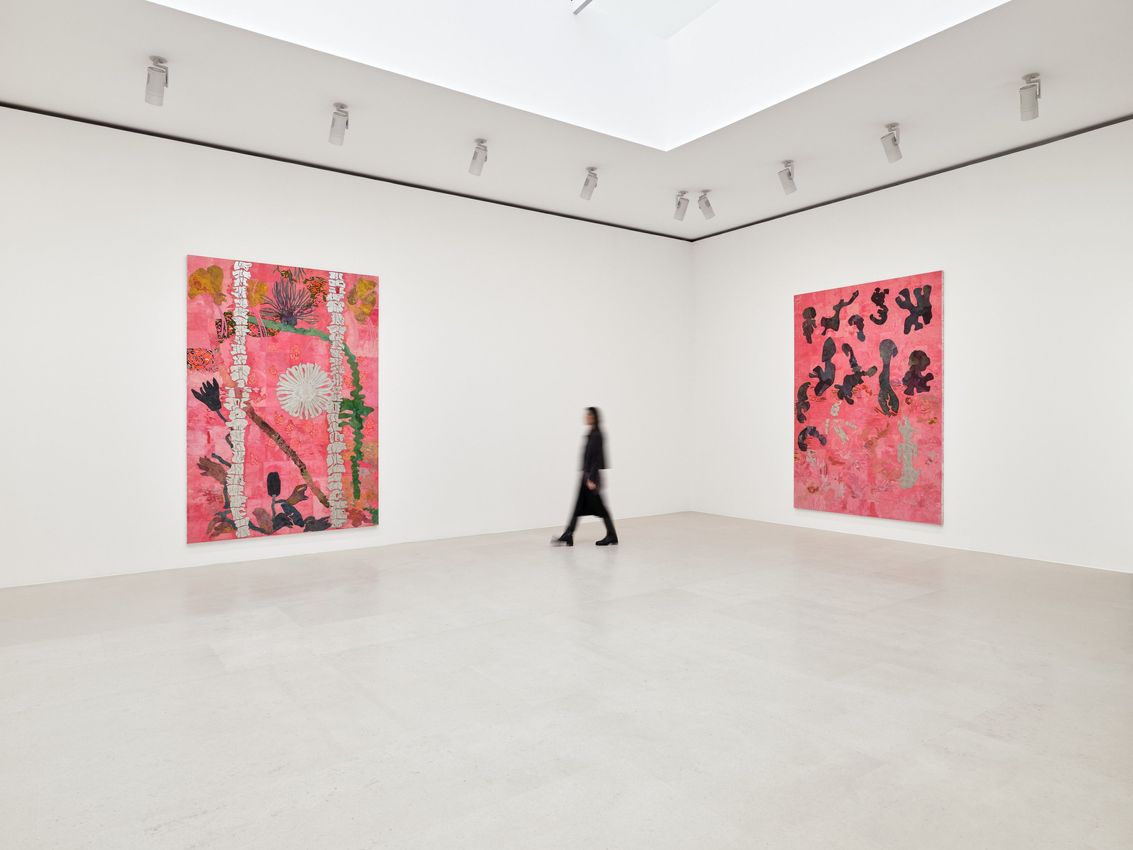
Gagosian is pleased to announce Ellen Gallagher: Fast-Fish and Loose- Fish, on view through May 23 at the rue de Ponthieu gallery. The exhibition features a cycle of three large-scale paintings titled Fast-Fish and Loose-Fish that Gallagher produced between 2023 and 2026. Among these is a work featured in Gallagher’s exhibition All of No Man’s Land Is Ours at the Stedelijk Museum, Amsterdam (2023–24).
Built upon canvas-mounted sheets of ruled, gridded paper that are stained in a vibrant pink hue, then layered with brilliantly colored, thickly impastoed pigment and incised palladium leaf, each of the Fast-Fish and Loose-Fish paintings employs a material abundance from which Gallagher’s playful meditations emerge. She takes a sculptural approach to her process, often working paintings from multiple positions. Exploding their compositional grids into groupings of vibrant lines and biomorphic shapes, she melds Post-Minimalist abstraction with imagined ocean-floor topographies and phantasmal worlds.
Gallagher has long been fascinated by the ocean. Her 2010 film installation Osedax, a collaboration with Edgar Cleijne, opens with a shipwreck off the coast of Rhode Island, interspersing animated imagery of a whale fall—the descent of a whale carcass to the abyssal depths of the ocean floor—within a radiant network of sea flora and fauna.
The Fast-Fish and Loose-Fish series similarly considers this phenomenon of slow decomposition becoming an intertwined regenerative ecosystem. The whales’ bodies support a profusion of life, from crustaceans and mollusks to bone-eating Osedax worms and specialized bacteria. Cross sections of the same bones suggest a shifting orientation within each picture plane, exploring the permeability between bodies and the environments they inhabit. For Gallagher, the seabed is inseparable from the historical marks of colonization and enslavement. In these works, tumbling caryatid forms inspired by African Fang sculptures join the whale bones amid strands of kelp and crinoid fossils.
Herman Melville’s Moby-Dick (1851) is an important source of inspiration for Gallagher. The series title, Fast-Fish and Loose-Fish, alludes to chapter 89 of the famously discursive novel, in which the author departs from the book’s primary narrative to define “fast-fish,” which have been claimed by a whaler, versus “loose-fish,” which remain free of such claims.
This discussion develops into a wide-ranging reflection on the nature of possession and freedom.
Melville further uses the microcosm of human conflicts and frailties on the ship to suggest broader struggles in American society. The book’s publication coincided with the enactment of the Fugitive Slave Act (1850), which legally obliged free states to return escaped fugitives to their enslavers in the South. Whaling ships were a place where Black men might find refuge. For the artist, we are the progeny of the novel’s Pip, one of the earliest significant Black characters in American literature, whose grammars we inherit whether we like it or not. Pip’s descent to the seabed is obliquely referenced in each of the Fast-Fish and Loose-Fish paintings. With their underlying grids of penmanship paper, above which hover imaginative and interspecific realms, Gallagher’s works suggest a wealth of resources that can constitute possibilities on the other side of the Middle Passage.


From the outset of her career, Ellen Gallagher has brought together non-representational formal concerns and charged figuration in paintings, drawings, collages, and films that reveal themselves slowly, first as intricate abstractions, then later as unnerving stories. The tension sustained between minimalist abstraction and image-based narratives deriving from her use of found materials gives rise to a dynamic that posits the historical constructions of the ‘New Negro’—a central development of the Harlem Renaissance—with concurrent developments in modernist abstraction. In doing so, she points to the artificiality of the perceived schism between figuration and abstraction in art. Selecting from a wealth of popular ephemera—lined penmanship paper, magazine pages, journals, and advertising—as support for her paintings and drawings, Gallagher subjects the original elements and motifs to intense and laborious processes of transformation: accumulation, erasure, interruption, and interference. Like forensic evidence, only traces of their original state remain, veiled by inky saturation, smudges, staining, perforations, punctures, spills, abrasions, printed lettering and marking—all potent evocations and emanations of time and its materiality. This attained state of ‘un–knowing’ fascinates Gallagher and is one of the primary themes in her work.


A respected voice in contemporary art discourse.
Focusing on ambitious storytelling and insightful art-world commentary. Ocula Magazine publishes in-depth interviews, critical essays and timely analysis on the artists, exhibitions and ideas driving the global art world.
Learn more about Ocula Magazine
Showcasing the best of the art world.
Ocula partners with galleries from around the world to highlight their artists, artworks and exhibitions. Gallery membership is by application and invitation, with each member vetted by an independent panel.
Learn more about Ocula Membership

Specialises in the sale of major artworks.
Led by a team with deep ties to the world’s leading auction houses, galleries and collectors. Ocula’s advisory team offers bespoke services to high-net-worth clients from around the world who are looking to acquire the best of contemporary and modern art.
Learn more about our team and services