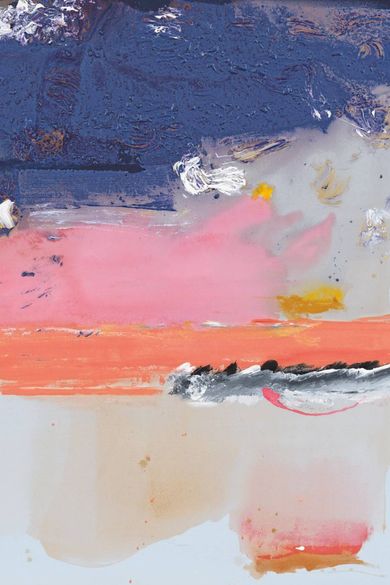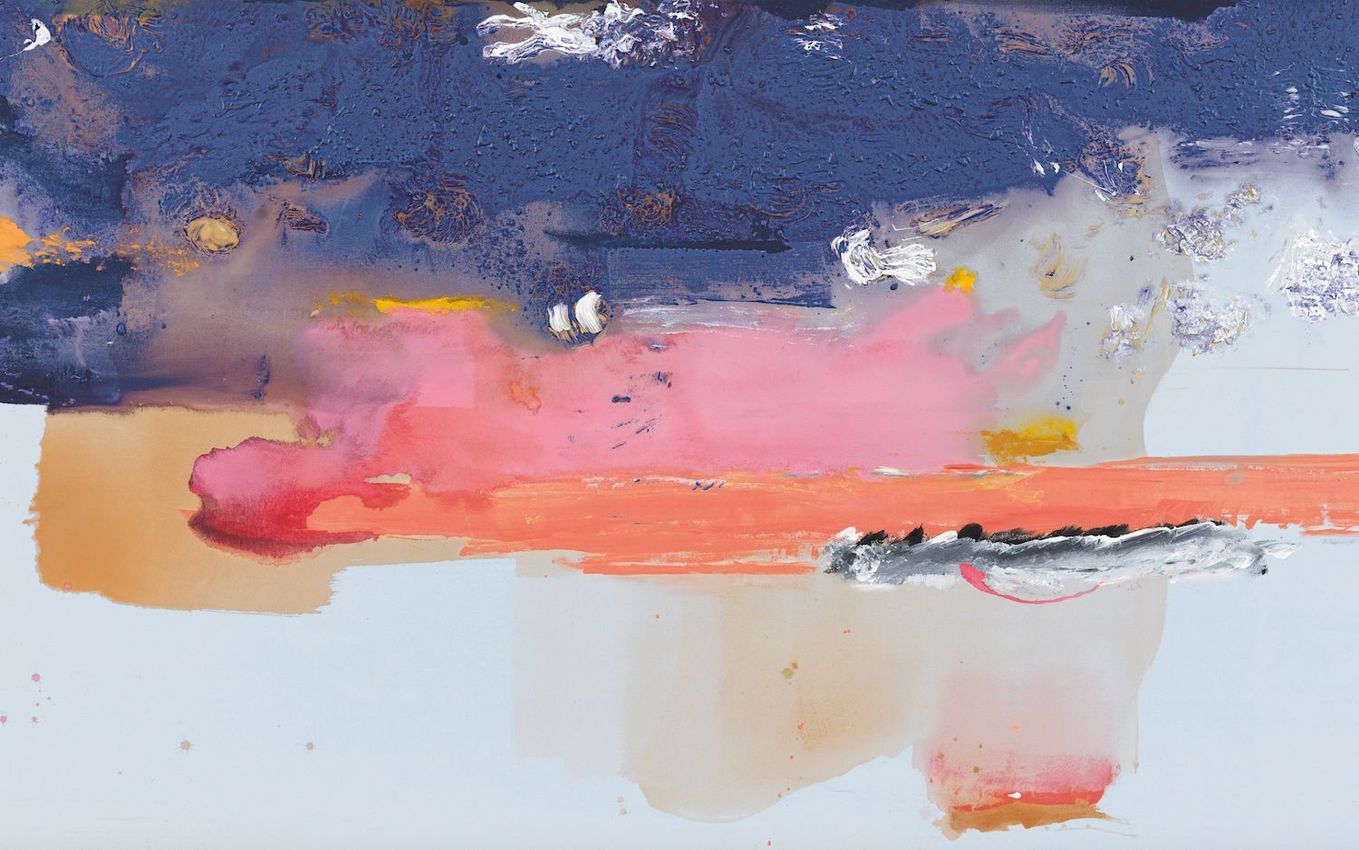
My pictures are full of climates, abstract climates, and not nature per se. But a feeling. And the feeling of an order that is associated more with nature. Nature in seasons, maybe; but nature in, well, an order. And I think art itself is order out of chaos.—Helen Frankenthaler
Gagosian is pleased to announce Drawing within Nature: Paintings from the 1990s, an exhibition of twelve paintings and three large-scale works on paper by Helen Frankenthaler. This will be the first time in almost two decades that a group of the artist’s paintings from this era have been presented in New York, with some that have never previously been exhibited.
Frankenthaler’s celebrated 1952 composition, Mountains and Sea, was the first of her soak-stained canvases and was highly influential in the development of 1960s Colour Field painting. By the 1970s, though, she had amplified her methods to include the expressive possibilities of surface inflection and density. Over the course of the 1980s, highly painterly canvases became her principal pictorial means, soon resulting in, during what would be her final decade, canvases of the greatest dramatic impact of her entire career, some of an unexpectedly large size.
Drawing within Nature features works dating from 1990 through 1995, made following Frankenthaler’s paintings retrospective which opened in 1989 at the Museum of Modern Art, New York. Composed in her studios in New York; Stamford, Connecticut; and Santa Fe, New Mexico—where she held a summer teaching residency at the Santa Fe Institute of Art in 1990 and 1991—these abstractions are inspired by the artist’s experience of landscapes.
Works in the exhibition include Poseidon (1990), more than eight feet wide, which calls on qualities of Frankenthaler’s earlier soak-stained canvases to evoke ocean currents, with its wet-on-wet passages of aqua, white, and green. The even larger Stella Polaris (1990) sets streams and patches of dense cloudlike white paint beneath the starlight of its title. Western Roadmap (1991) transforms the desert rock and glowing sunsets of the American Southwest into a stratified abstraction that hangs within an almost nine-foot-wide panorama. Reef and Spellbound (both 1991) lay out washes of rich, glowing colour of varying density across dark grounds. The verdant hues of The Rake’s Progress (1991) suggest a garden in bloom, and show how Frankenthaler began to use gel to thicken her paint as well as combing and raking tools to create tracks bearing the imprint of the energy passing over the surface.
Painted a few years later, in acrylic on large sheets of paper, Acrobat, Flirt, and Aerie (all 1995) are less grounded in memories of landscape vistas. Rather, their open, cursive forms invoke vividly coloured and magnified details of drawing within nature.
The exhibited works were selected by John Elderfield and Jason Ysenburg in collaboration with the Helen Frankenthaler Foundation. An accompanying catalogue, illustrated with colour plates and photographs of the artist in her studio, includes a new essay by art historian Thomas Crow.

Helen Frankenthaler (1928–2011), whose career spanned six decades, has long been recognised as one of the great American artists of the twentieth century. Heir of first-generation Abstract Expressionism, she brought together in her work—with prodigious inventiveness and singular beauty—a conception of the canvas as both a formalised field and an arena for gestural drawing. She was eminent among the second generation of postwar American abstract painters and is widely credited for playing a pivotal role in the transition from Abstract Expressionism to Colour Field painting. One of the foremost colourists of our time, she produced a body of work whose impact on contemporary art has been profound.


A respected voice in contemporary art discourse.
Focusing on ambitious storytelling and insightful art-world commentary. Ocula Magazine publishes in-depth interviews, critical essays and timely analysis on the artists, exhibitions and ideas driving the global art world.
Learn more about Ocula Magazine
Showcasing the best of the art world.
Ocula partners with galleries from around the world to highlight their artists, artworks and exhibitions. Gallery membership is by application and invitation, with each member vetted by an independent panel.
Learn more about Ocula Membership

Specialises in the sale of major artworks.
Led by a team with deep ties to the world’s leading auction houses, galleries and collectors. Ocula’s advisory team offers bespoke services to high-net-worth clients from around the world who are looking to acquire the best of contemporary and modern art.
Learn more about our team and services