I had the landscape in my arms when I painted it. I had the landscapes in my mind and shoulder and wrist.
—Helen Frankenthaler
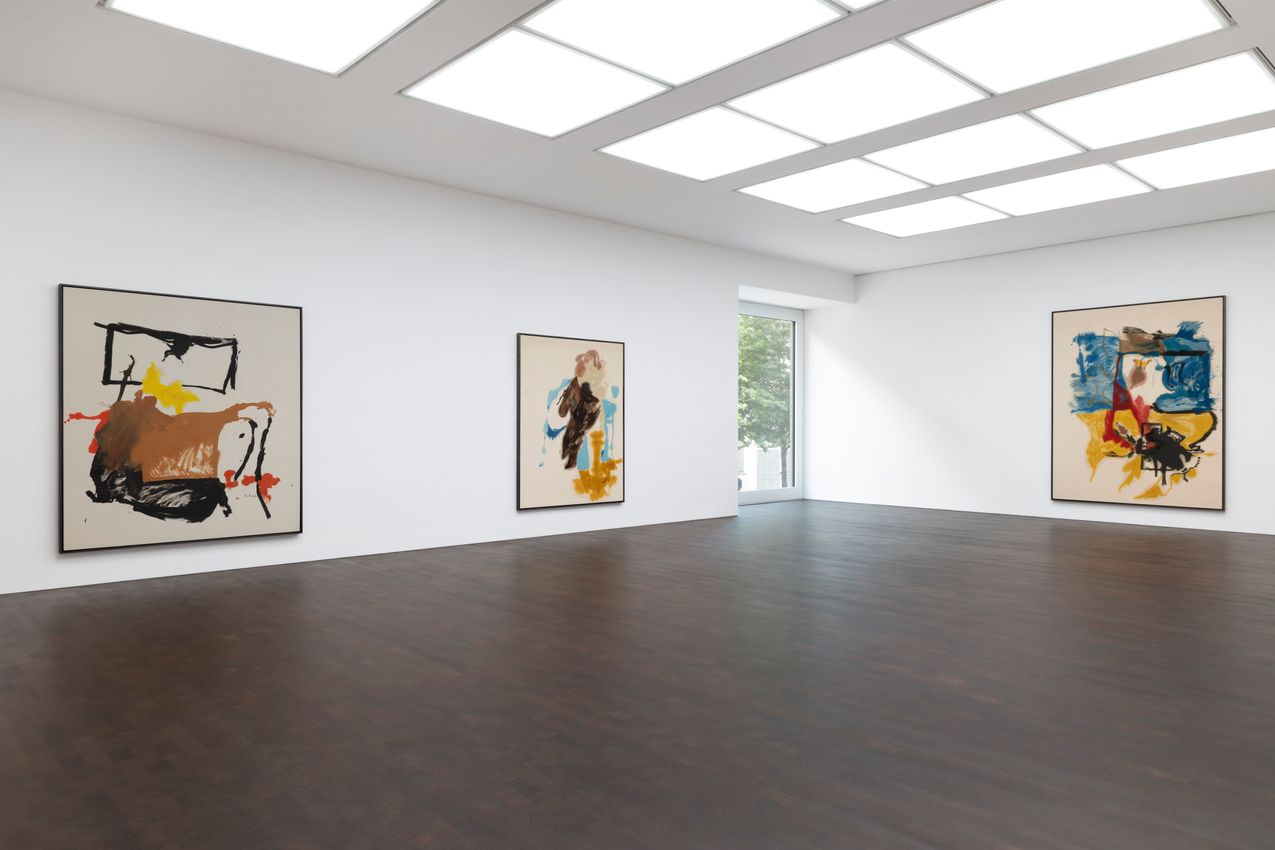
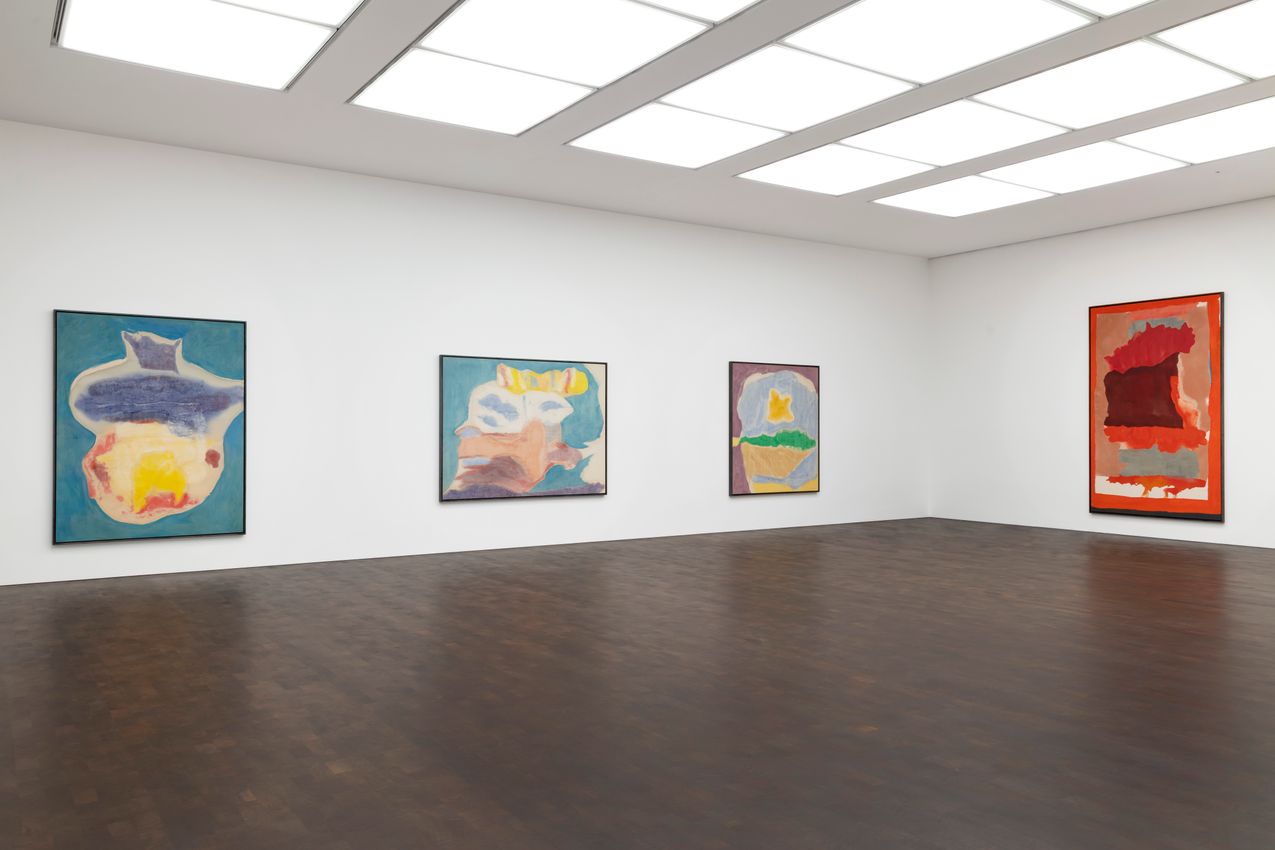
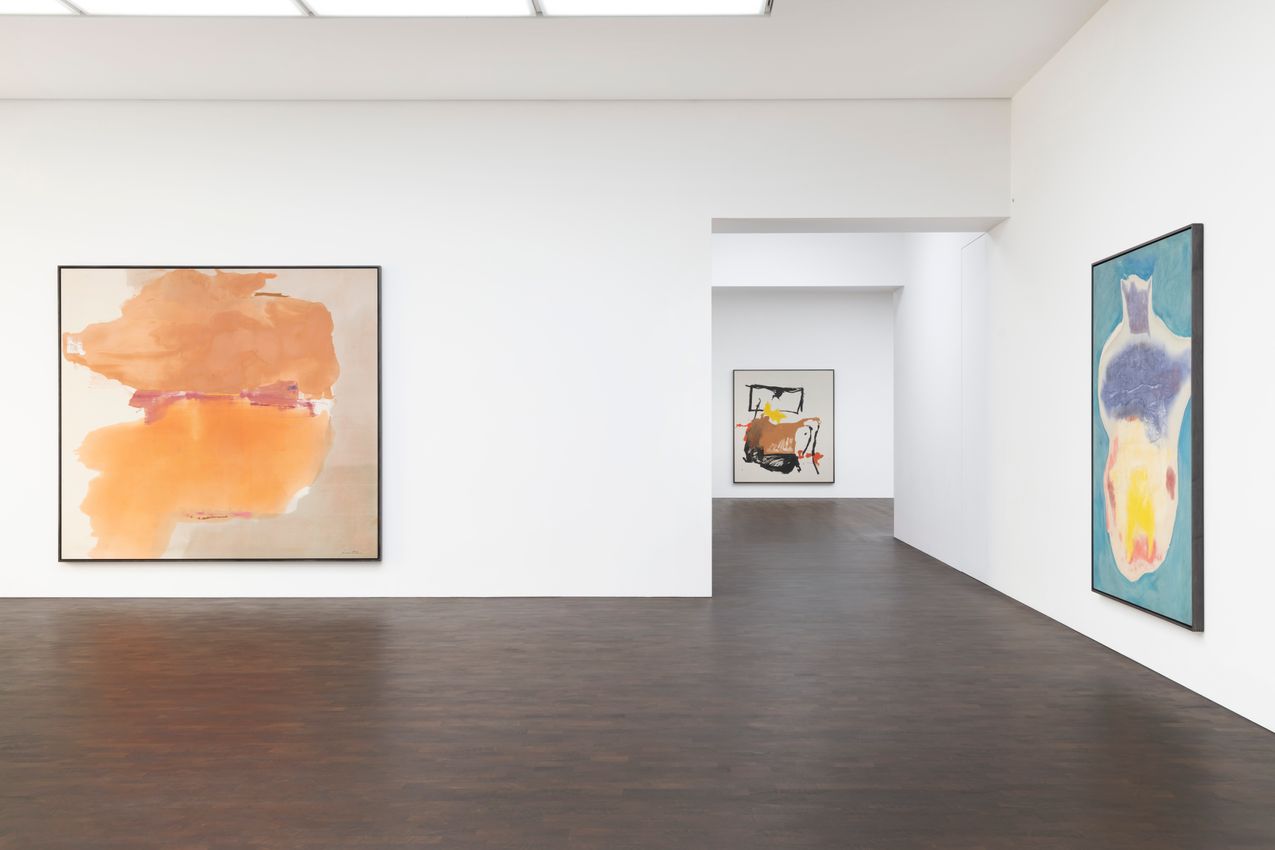
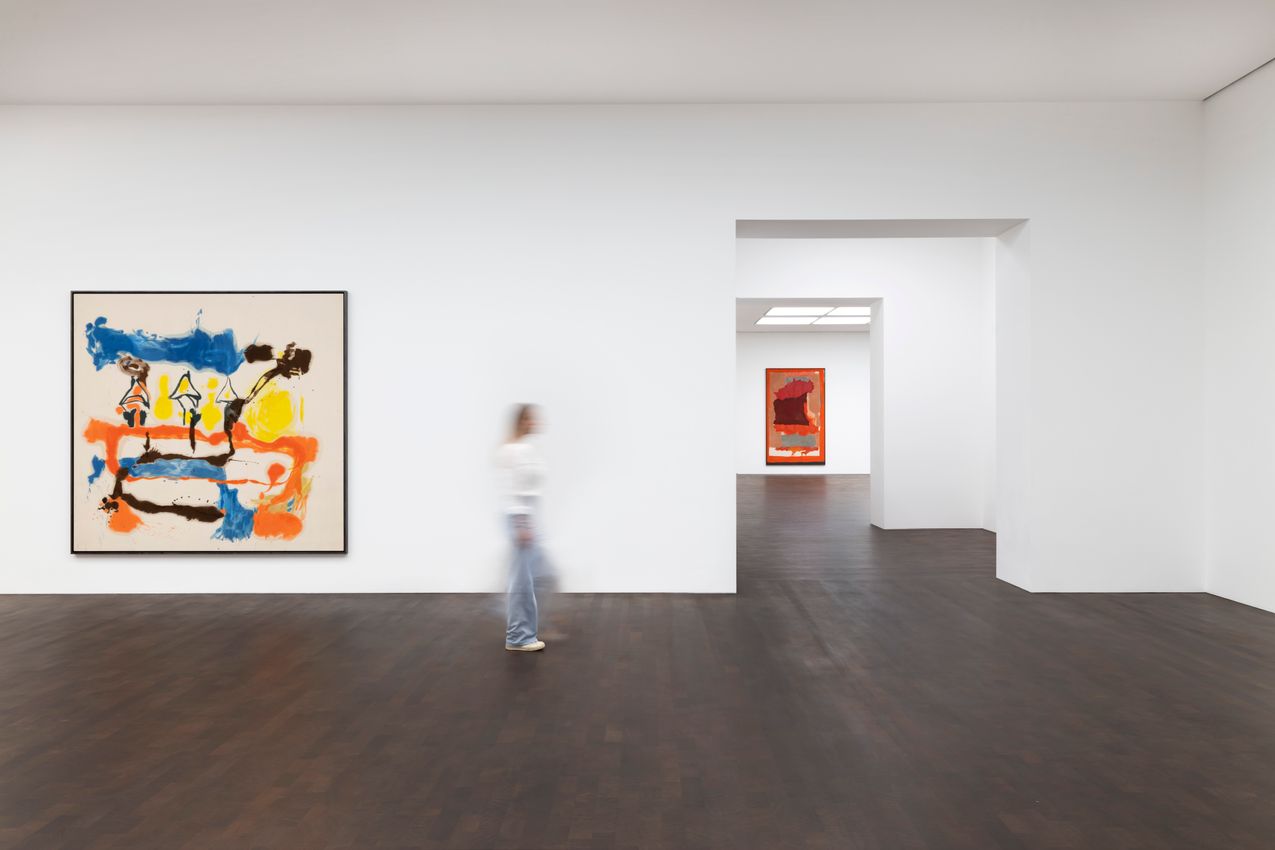
Gagosian is pleased to present Imagining Landscapes: Paintings by Helen Frankenthaler, 1952–1976, an exhibition of fourteen paintings from the collection of the Helen Frankenthaler Foundation, several of which have never been exhibited before.
The references to landscape that are inherent in these paintings shift between subtle and explicit, as critic E. C. Goossen observed in 1958. All are characterised by an extraordinary variety of line and colour. The earliest of them—painted in 1952, before Frankenthaler’s breakthrough development of soak-stain painting later that year with Mountains and Sea—is the work of an already mature artist: an invented panorama with suggestions of palm fronds and mountain peaks. The next belongs to a small group of canvases with drawn forms that Frankenthaler painted on her honeymoon with Robert Motherwell in the southwest of France. And four canvases from 1961—Fable, Beach Scene, Square Figure, and After Rubens—show her simplifying her drawing and making it more calligraphic, even as she continued to create figural as well as landscape references.
In three canvases from 1963, a major change is evident in Frankenthaler’s approach. Juxtaposed areas of lush stained colour replace the lines of the earlier paintings, their irregular borders evoking the boundaries of natural forms. The titles of these works—Narcissus, Yolk, Sea Goddess—invite interpretation of their sometimes aqueous, sometimes cloudy forms in the manner that Leonardo da Vinci advised painters to look at stained walls and see in them images of the natural world. Even as Pop art was recuperating explicit depiction, and Color Field painting purist abstraction, Frankenthaler maintained in her own way an art of allusion—the richness of ambiguous reference—and cultivated a complexity akin to the volatility of the physical universe.
In the imposingly large Cape Orange of 1964, Frankenthaler advances this approach with flatter, more opaque colour to a bolder effect, suggesting a topographical map. And the pair of canvases from 1971, Orange Hem and Red Travels, simplify the effect further, evoking details of landscape seen from above—perhaps, the movement of water around an obstruction and a view into a cleft or onto a stretch of coastline, respectively. In both cases, the rectangle of the canvas substitutes for a framed view. The final two works in the exhibition, Chill Factor (1973) and Sphinx (1976), reintroduce earlier features to the format: the former with its meandering filaments of drawing and atmospheric colour; the latter, a reprise of the bipartite structure of Narcissus (1963), with memories of the fluid, centralised composition of Mountains and Sea.
A catalogue featuring a new essay by art historian Robert Slifkin along with three historical texts will be published to accompany the exhibition. In addition, a room of paintings by Frankenthaler is installed at Tate Modern, London, until November 2021. Helen Frankenthaler: Radical Beauty, the first major UK exhibition of Frankenthaler’s woodcut prints, will open at Dulwich Picture Gallery, London, on September 15, 2021.
Helen Frankenthaler (1928–2011), whose career spanned six decades, has long been recognised as one of the great American artists of the twentieth century. Heir of first-generation Abstract Expressionism, she brought together in her work—with prodigious inventiveness and singular beauty—a conception of the canvas as both a formalised field and an arena for gestural drawing. She was eminent among the second generation of postwar American abstract painters and is widely credited for playing a pivotal role in the transition from Abstract Expressionism to Colour Field painting. One of the foremost colourists of our time, she produced a body of work whose impact on contemporary art has been profound.


A respected voice in contemporary art discourse.
Focusing on ambitious storytelling and insightful art-world commentary. Ocula Magazine publishes in-depth interviews, critical essays and timely analysis on the artists, exhibitions and ideas driving the global art world.
Learn more about Ocula Magazine
Showcasing the best of the art world.
Ocula partners with galleries from around the world to highlight their artists, artworks and exhibitions. Gallery membership is by application and invitation, with each member vetted by an independent panel.
Learn more about Ocula Membership

Specialises in the sale of major artworks.
Led by a team with deep ties to the world’s leading auction houses, galleries and collectors. Ocula’s advisory team offers bespoke services to high-net-worth clients from around the world who are looking to acquire the best of contemporary and modern art.
Learn more about our team and services