



A moral and legal grey area is opened up when the prefix ‘Inspired by ...’ is used in matters creative. If the subject of inspiration is obscure, the motives to exploit it are justified as educational, revealing to a wider public something of merit. If the material is somehow questionable, the relationship can be safely classified as critical rather than complicit, especially when it is presented in the context of a museum or gallery. Acquisition and colonisation, and their parallels in the natural world, are the theme of ‘Inspired by an Atlas of Leprosy’.
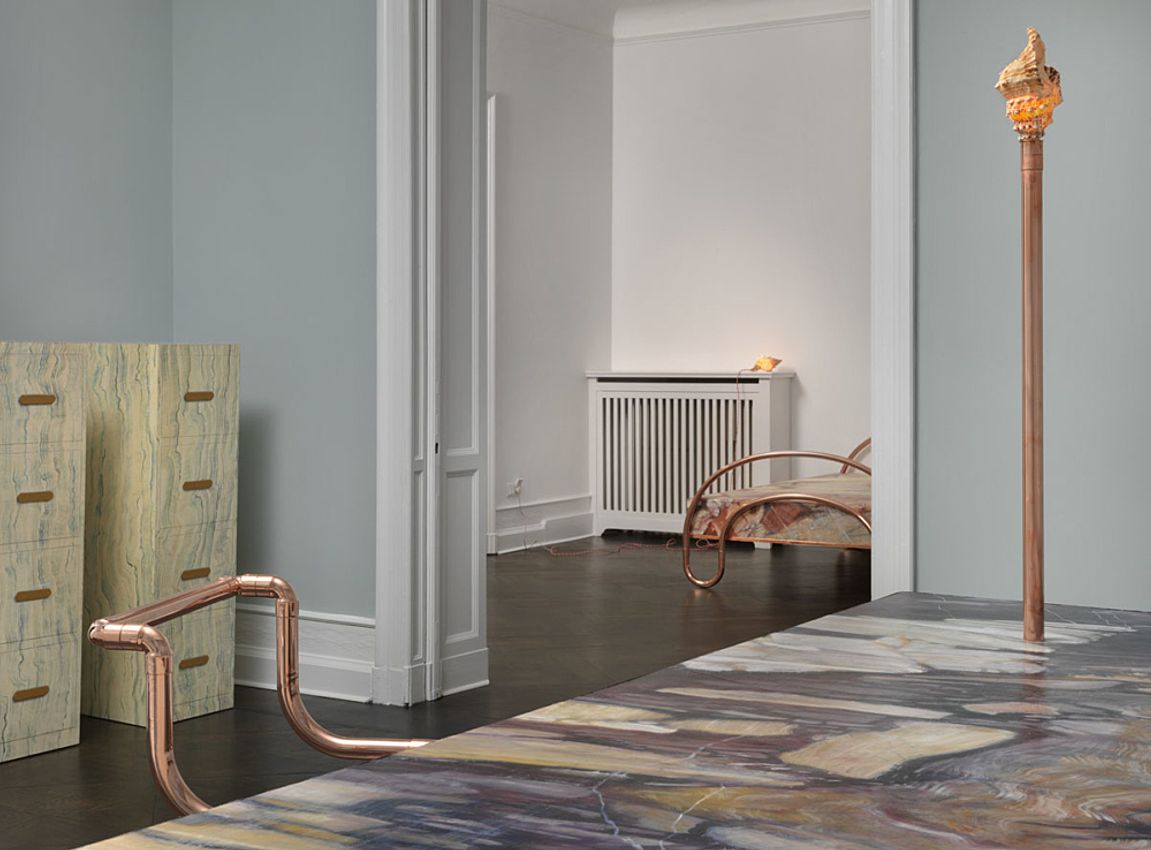
In this, her fourth solo exhibition with Galerie Buchholz, Lucy McKenzie has taken over the upstairs gallery to install a simulation of a private dwelling–the quintessential ‘live-work’ interior associated with young cultural entrepreneurs. The members of this social group are characterised as having lifestyles in which the traditional boundaries between industry, leisure and intimacy have apparently dissolved, and in which their values are reflected in the spaces they inhabit. The simplified décor of the apartment here ignores this stylistic doctrine, eschewing bare bricks and beanbags for patrician marble and the trappings of bureaucracy. The thresholds between genderised spaces (the boudoir or ‘below stairs’ for instance) are misaligned; their erotic charge redirected.
How the imagined owner of this studio apartment makes a living is unclear, yet it is not hidden behind a screen of phoney transparency. The narrative of the décor suggests perhaps banking, manufacturing, education or religion. No matter which, exploitation is in the mix. Marble can symbolise authority, evoking interiors constructed in an age when those in power had limitless means at their disposal. It also represents the prized status of natural resources. This, for McKenzie, has parallels with culture’s appetite for the genuine–political and ecological alternatives, subculture and the historic avant garde, are often mere content to be mined and polished, instrumentalised through appropriation into works of contemporary art.
McKenzie studied at a private school for decorative painting in Brussels in 20072008, and the commercial techniques she learned there have been central to her work ever since. She employs trompe l’oeil for the marble and wooden structures, and in the quodlibet pin-boards and table compositions. These include ‘found’ compositions, derived from sources as random as offices, churches, a waiting room and student accommodation. Its labour-intensive mode of production, especially its alignment of value with craftsmanship, makes the quodlibet an innately conservative idiom. Yet it is this conservativism that facilitates the tense relationship between form and content, and which gives it its subversive force.


Galerie Buchholz is an art gallery specializing in international contemporary art, with exhibition spaces in Cologne, Berlin and New York City. The gallery was founded in Cologne in 1986 by Daniel Buchholz, and today is run jointly with Christopher Müller.

A respected voice in contemporary art discourse.
Focusing on ambitious storytelling and insightful art-world commentary. Ocula Magazine publishes in-depth interviews, critical essays and timely analysis on the artists, exhibitions and ideas driving the global art world.
Learn more about Ocula Magazine
Showcasing the best of the art world.
Ocula partners with galleries from around the world to highlight their artists, artworks and exhibitions. Gallery membership is by application and invitation, with each member vetted by an independent panel.
Learn more about Ocula Membership

Specialises in the sale of major artworks.
Led by a team with deep ties to the world’s leading auction houses, galleries and collectors. Ocula’s advisory team offers bespoke services to high-net-worth clients from around the world who are looking to acquire the best of contemporary and modern art.
Learn more about our team and services