Press Release

Without People

‘Money is a kind of poetry.’–Wallace Stevens, Adagia

‘I feel completely empty now that I’ve told you this story. It’s my secret. Do you understand?’
‘And now?’
‘I don’t want to have to ask you not to repeat it.’
‘Yes, but now your secret has also become my secret. It’s part of me, and I’ll treat it as my secret–I’ll get rid of it when the time comes. Then it will become someone else’s secret.’
‘You’re right. Secrets have to circulate...’–Hervé Guibert, Ghost Image

‘To do without people is for photography the most impossible of renunciations’, Moyra Davey quotes Walter Benjamin in her film, Les Goddesses. Pacing about inside her New York apartment, she tells us how this abandonment of the human was precisely what would begin to take place in her photography from the mid-Eighties onwards, ‘until my subjects constituted little more than the dust on my bookshelves or the view under the bed’. This was both a ‘etreat’ on her part and ‘a gradual seeping in of a kind of biographical reticence’. As she tells us about her anxiety regarding ‘the burden of image theft’ from the human subjects of her ‘pathography’ in those years of withdrawal into silence, the light coming in through the windows or from a lamp begins to familiarise our eyes to the interiors of her apartment. While we listen to her halting but insistent commentary, we look into her bookshelves and cabinets, at her bed and tables, at the photographs taped to the walls. The things inside her apartment become mute or ironic ‘objective correlatives’ of what we hear, as their ordinariness acquires a kind of Flemish or Lucien Freud-like sharpness and luminescence.

This sense of everyday objects becoming instinct with words and thoughts, or with wordless feeling–of the graphic nature of sight itself–is impossible not to bring to bear upon the work of Davey’s ‘silent’ decades. We have learned from her films that what she shows and what she tells can be parallel or contiguous stories, without each dispelling the reticence of the other: the traffic between words and things can illuminate without becoming illustrative or explanatory. Is that why she has become less anxious, once again, about letting the stories find their way back to these images, infusing them with a new sharpness and life?

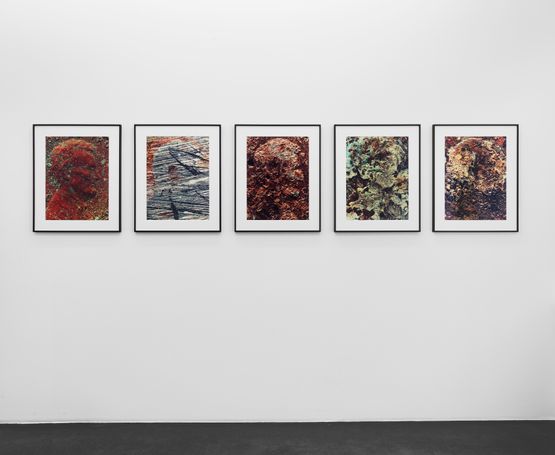
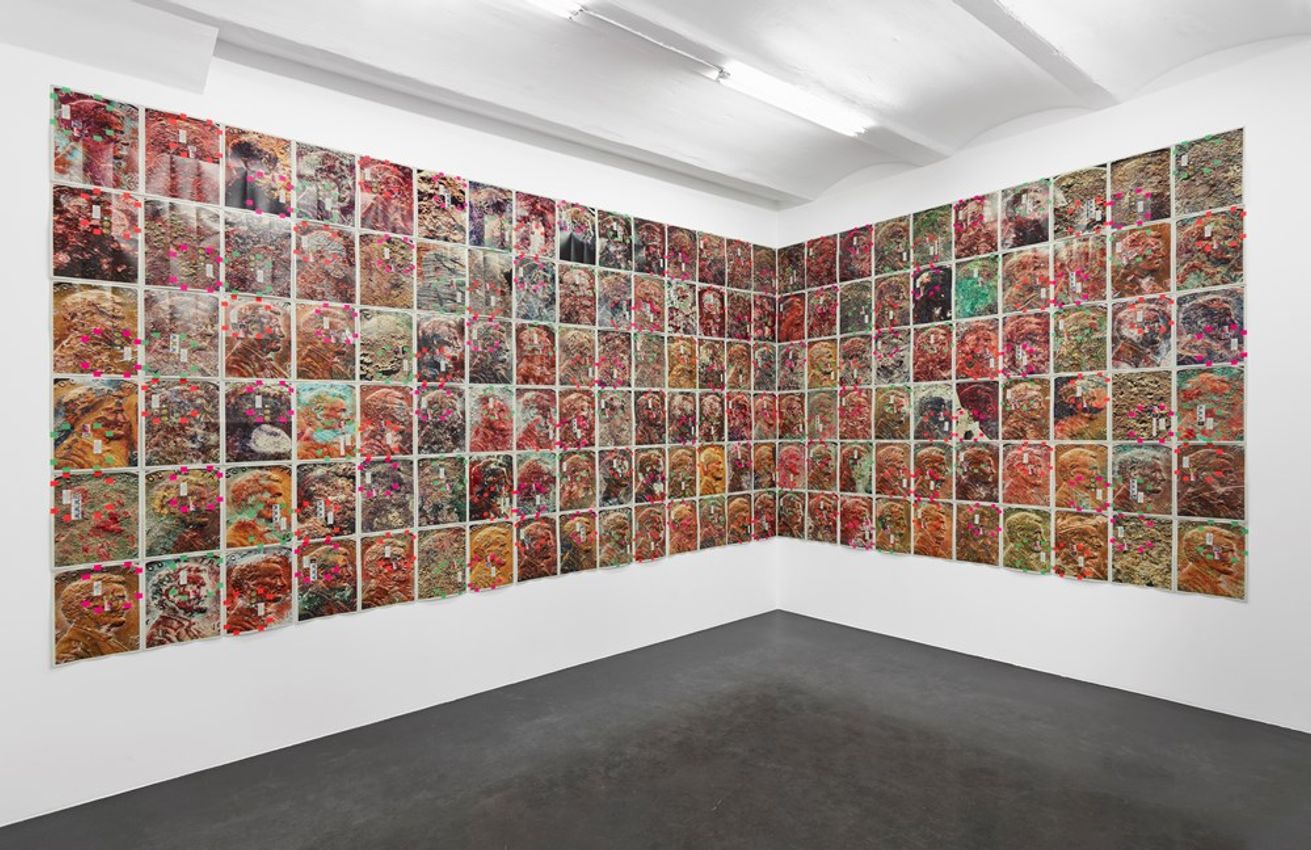
Given to her by her neighbour, Edward Mapplethorpe, brother of Robert (and a photographer in his own right), and shot by Davey with a macro lens, the EM Copperheads have not only moved, as coins do, from hand to hand, but also through many layers of time, acquiring physical traces of these journeys as well as different kinds of meaning and value–from currency to gift to work of art. All four of the Copperheads series, of which EM is the most recent, go back to a time in Davey’s life, from the late Eighties to the early Nineties, when not having much money bred a fascination with miserliness and the psychology of money. She began photographing the pennies around the time following the crash of the stock market and the fall of the Berlin Wall, coming back to the images today, when the familiar stamp of Lincoln’s head begins to look ironic once again in the ‘raking light’ as her country of residence finds itself afresh in a new crisis of democracy.

Money, like art, is at once the most material and the most symbolic of artifacts. In the reverse alchemy of history, it has changed from gold through copper to paper before disappearing into the virtual, much as photography moves between absence and presence, shadow and substance, pixels and paper. In Davey’s private mythology, informed by her reading of Marcel Mauss and Sigmund Freud, the lived experience of money moves from the ethical and psychological to the visceral. The binaries of excess and parsimony become analogous to the opposites of gorging and starving, retention and incontinence, through the Freudian link between excrement and gold. As the copperheads grow to her eye, they seem to ripen and rot into unpredictable varieties of form that are rich and strange, beautiful and grotesque, seductive and revolting, fleshly and magical at the same time.

In Benjamin’s Short History of Photography–an essay Davey has read ‘over and over, sometimes getting it, sometimes not’–photographic enlargement is linked to the discovery of ‘another nature’ that ‘speaks to the camera rather than to the eye’. ‘It is through photography’, Benjamin writes, ‘that we first discover the existence of this optical unconscious, just as we discover the instinctual unconscious through psychoanalysis. Details of structure, cellular tissue, with which technology and medicine are normally concerned–all this is, in its origins, more native to the camera than the atmospheric landscape or the soulful portrait. Yet at the same time, photography reveals in this material physiognomic aspects, image worlds, which dwell in the smallest things–meaningful yet covert enough to find a hiding place in waking dreams, but which, enlarged and capable of formulation, make the difference between technology and magic visible as a thoroughly historical variable.’ Arousing in the viewer an entire gamut of sensations from revulsion to fascination, Davey’s enlarged copperheads transform the soulless uniformity of numismatic portraiture into a multiplicity of atmospheric landscapes, while the singularity of each is brought into a complex relationship with repetition and identity through their arrangement into a grid.

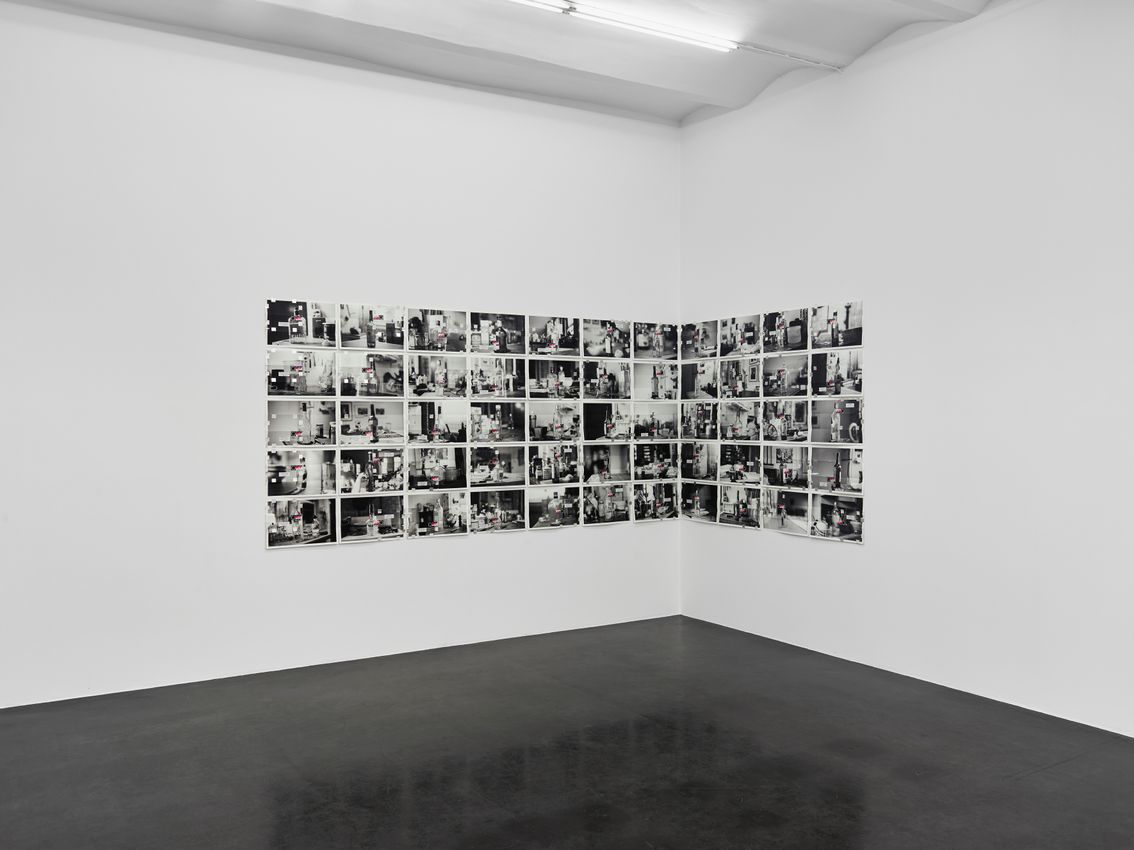
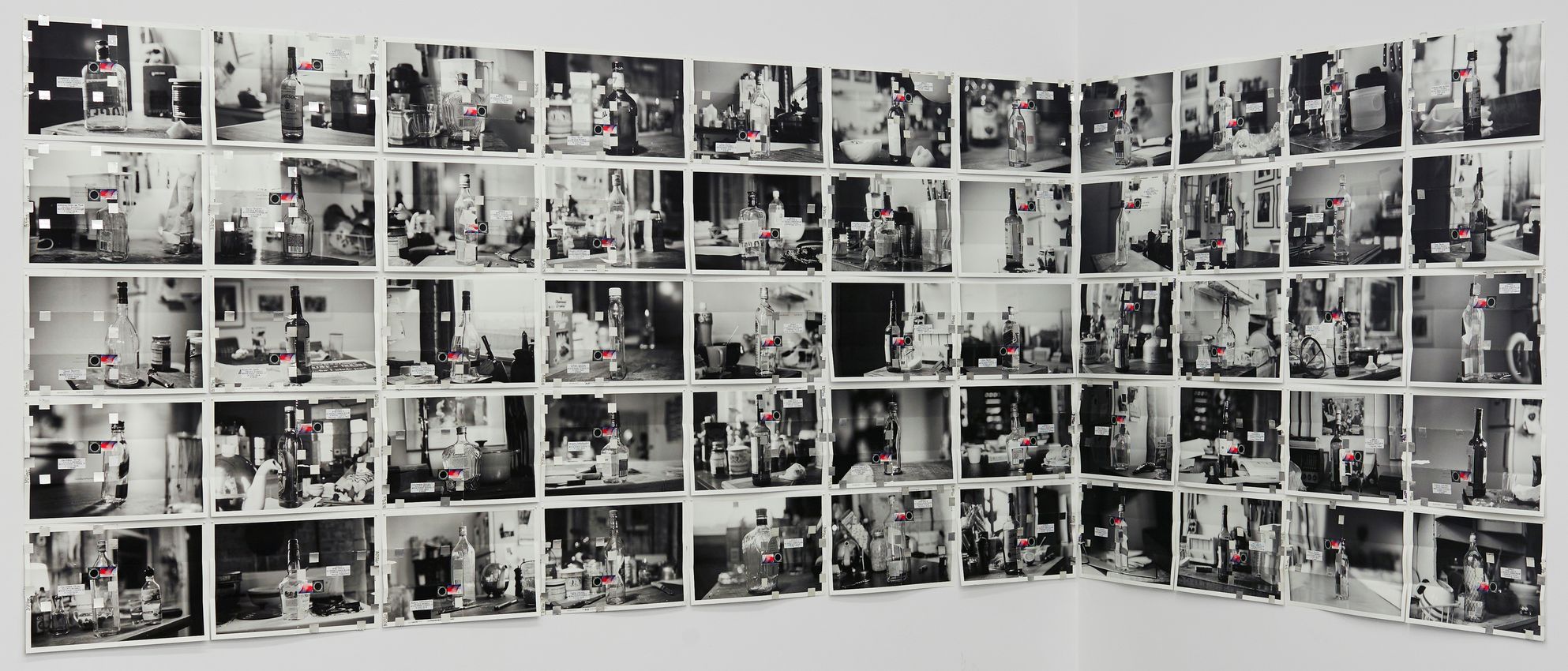
Formally and conceptually, something very similar begins to happen when we contemplate her grid of ‘empties’, though in quite another visual and emotional key. Davey has written about this ‘totality of images’ as a calendar of inebriation: ‘a marker of time denoted by a particular type of consumption’. She also mentions that this work goes back to the first five years of her son’s life, or the first five years of being a mother, when she had begun to put her ‘drinking days’ behind her.

Looking long at a set of slender upright forms inevitably begins to suggest the verticality of the human figure, so that these liquor bottles start to take on a quality of presence close to the feel of being with the Personages of Louise Bourgeois. Sculpted between 1945 and 1955, Bourgeois had ‘conceived’ her sculptures as ‘figures, each given a personality by its shape and articulation, and responding to one another’. These words are from an exhibition catalogue that Davey refers to in her recent lecture on the artist. The catalogue also describes how the making of these pieces happened during ‘an intense period’ in Bourgeois’ life with a young family of three children. Bourgeois speaks of them as ‘monoliths’ that are absolutely stiff–‘the stiffness of someone who’s afraid...Stuck...And then suddenly there’s a kind of softening that came from the softness of my children and of my husband...I got the nerve to look around me, to let go.’

The extent to which the difficulty of renouncing the human is at the heart of Davey’s preoccupation with letting go, depletion and damage is brought home to us when we consider the deadpan drollery of her Empties invitation poster. It is a grid of imaginary postage stamps commemorating_–through portraiture–_a pantheon of famous alcoholics in literature and art: women and men in whom Davey’s fear of ‘the welling up of the wet’ comes literally true.

Press release courtesy Galerie Buchholz. Text: Aveek Sen

Read More

Installation Views

About the Artist

Moyra Davey’s work initially featured documentary photographs of her family and friends, and later came to focus on the quiet, overlooked details of daily life: coins, kitchen shelves, and clumps of dust gathered along the floor. Depicting outsize close-ups of the fronts of worn pennies, Davey’s Copperhead series (1990), emphasises the circulation of banal, everyday objects individuated by the accumulation of human touch. In the mid-2000s, the moving image took on a renewed prominence in Davey’s work.

View Artist Profile

Also Exhibiting at Galerie Buchholz

About the Gallery

Galerie Buchholz is an art gallery specializing in international contemporary art, with exhibition spaces in Cologne, Berlin and New York City. The gallery was founded in Cologne in 1986 by Daniel Buchholz, and today is run jointly with Christopher Müller.

View Gallery Profile
Address
Neven-DuMont-Str. 17
Cologne
Germany
Opening Hours
Tues - Fri, 11am - 6pm
Sat, 11am - 4pm
(1)
Cologne Neven-DuMont-Str. 17
Galerie Buchholz
Neven-DuMont-Str. 17, Cologne, Germany

Opening hours
Tues - Fri, 11am - 6pm
Sat, 11am - 4pm
The art world in focus