Bringing together STATION-represented artist Esther Stewart, alongside local and international practitioners Howard Arkley, Kien Situ and Alice Gong Xiaowen, To Be Present, Is to Be in Passage presents works that share an understanding of architectural thinking and the memory embedded in material.
Architecture holds two kinds of memory: the memory built into a structure by design, and the memory a structure absorbs simply by standing, by being used. The first is intention. The second is time. Place is not something encountered only within experience, it is integral to the structure of experience itself, which is why the four artists in this exhibition hold so closely to material as a physical reminder of memory. Absence is treated here from a physical point of view: what is chosen to be left open, and the space a structure leaves behind.
Howard Arkley is remembered as the foremost painter of Australian suburbia, his signature houses and interiors produced always in dialogue with abstraction, patterning and the slide between two and three dimensions. This exhibition presents early career synthetic polymer paint and ink on paper works made between 1974 and 1978, in which that same tension between the representational and the abstracted is already present. Their motif of ruled verticals and sprayed line-work reference Arkley’s continual tension between the realistic and the abstracted image of the home and suburbia that fuelled his practice.
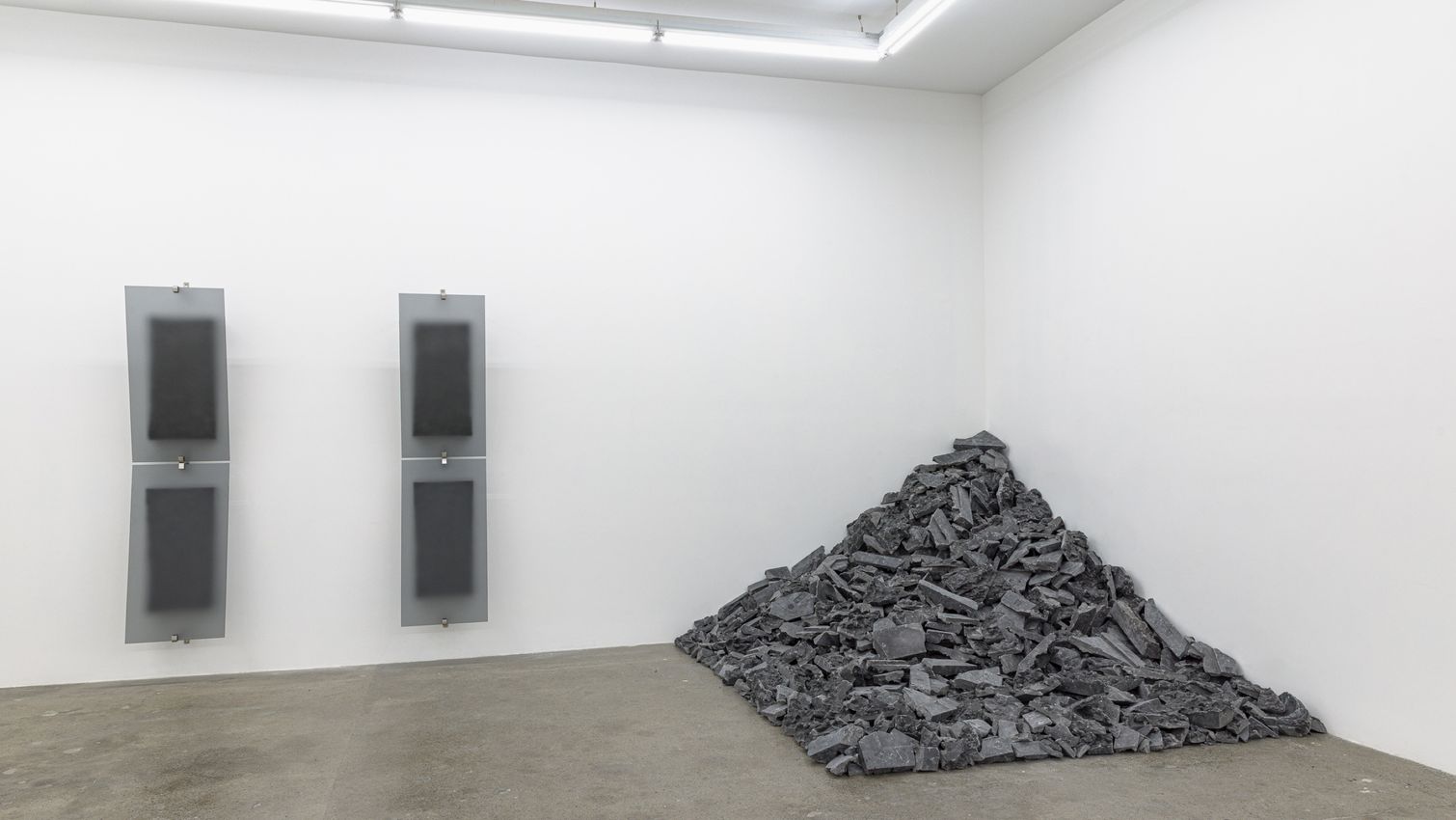
Kien Situ draws on the Sinospheric systems of thought and his training in architecture to explore contact and distance through thresholds of transparency and opacity that reveal how access and exclusion shift over time. This inquiry takes the form of works held together by Chinese ink as a constant material, alongside gypsum cement, titanium, incense ash and the shattered debris of earlier artworks. His subject here is absence: the space a structure leaves behind, and the point at which matter gives way to ruin. Formation and collapse are held in the work as evidence, weight and sedimentation standing in for what has passed through and worn away.
Esther Stewart presents two welded vinyl awnings, translating the awning, an ornamental element of domestic architecture, into hybrid sculpture-paintings of bold geometric form. Seen from an angle, the awnings shift from images of domestic place to objects with presence of their own. Scaled to life size, each work asks what happens when a house’s decorative language is unmoored from its function and left to operate as pure form.
Alice Gong Xiaowen’s wooden foundry patterns are hand-drafted voids recovered from industrial foundries, shaped by nineteenth and twentieth century manufacturing and since made redundantby shifts in political economy. Pressed repeatedly into sand to cast metal parts, they are heavy and worn, carrying hand-drawn notations and colour-coded volumes in red, black and orange, information that remains legible while no longer able to be placed. Scattered like the appendages of a dismantled assembly, they sit in ambiguity.
Alice Gong Xiaowen and Kien Situ draw material from an existing system and reorient it into another: objects whose precision was once their purpose, now released from demand and function. Esther Stewart and Howard Arkley extend the same logic to the house itself, lifting its ornament into pure form. Across all four, memory is not represented so much as held: in a pattern, a mark, an object returned to the gallery stripped of its original use.
Each artist reconjures memory to create relics from what is slipping away, pushing what is embedded in place and material through an unexpected renewal: a layer set over the present, an overlay in the space already occupied. This is a collective looking at space, at how one fills it, whether by giving new meaning to objecthood, to absence, or to the space a structure leaves behind.
Courtesy of the Estate of Howard Arkley and KALLI ROLFE CONTEMPORARY ART


A respected voice in contemporary art discourse.
Focusing on ambitious storytelling and insightful art-world commentary. Ocula Magazine publishes in-depth interviews, critical essays and timely analysis on the artists, exhibitions and ideas driving the global art world.
Learn more about Ocula Magazine
Showcasing the best of the art world.
Ocula partners with galleries from around the world to highlight their artists, artworks and exhibitions. Gallery membership is by application and invitation, with each member vetted by an independent panel.
Learn more about Ocula Membership

Specialises in the sale of major artworks.
Led by a team with deep ties to the world’s leading auction houses, galleries and collectors. Ocula’s advisory team offers bespoke services to high-net-worth clients from around the world who are looking to acquire the best of contemporary and modern art.
Learn more about our team and services