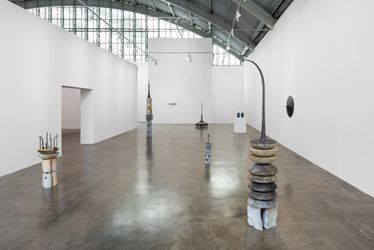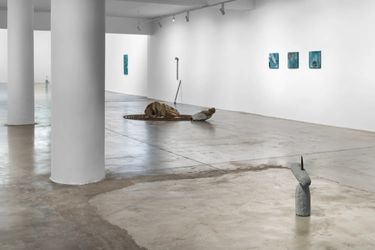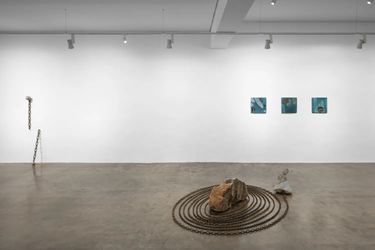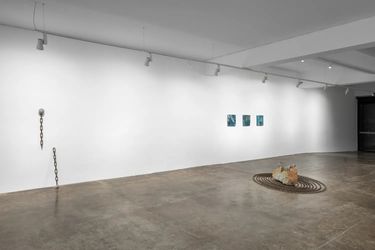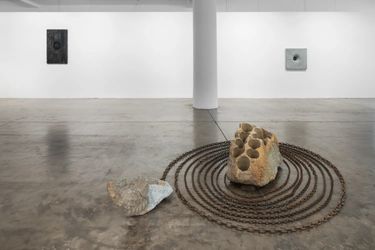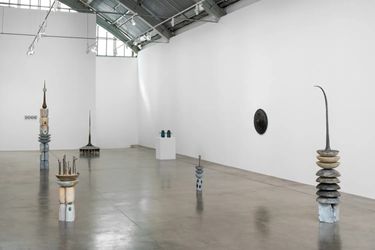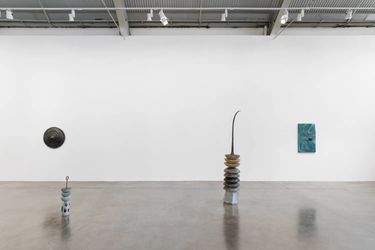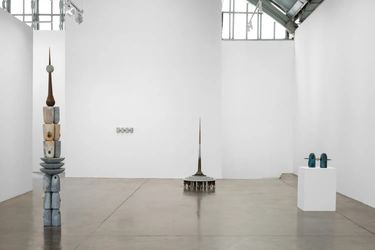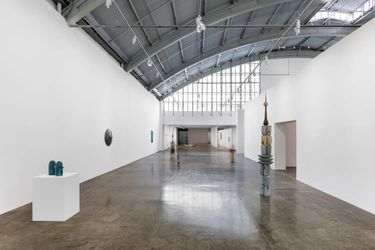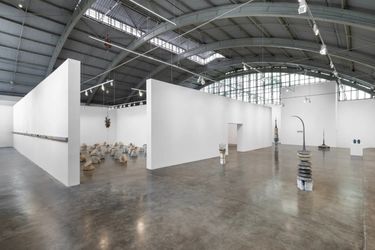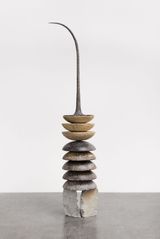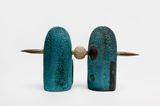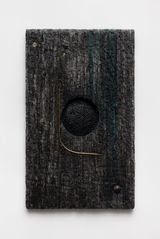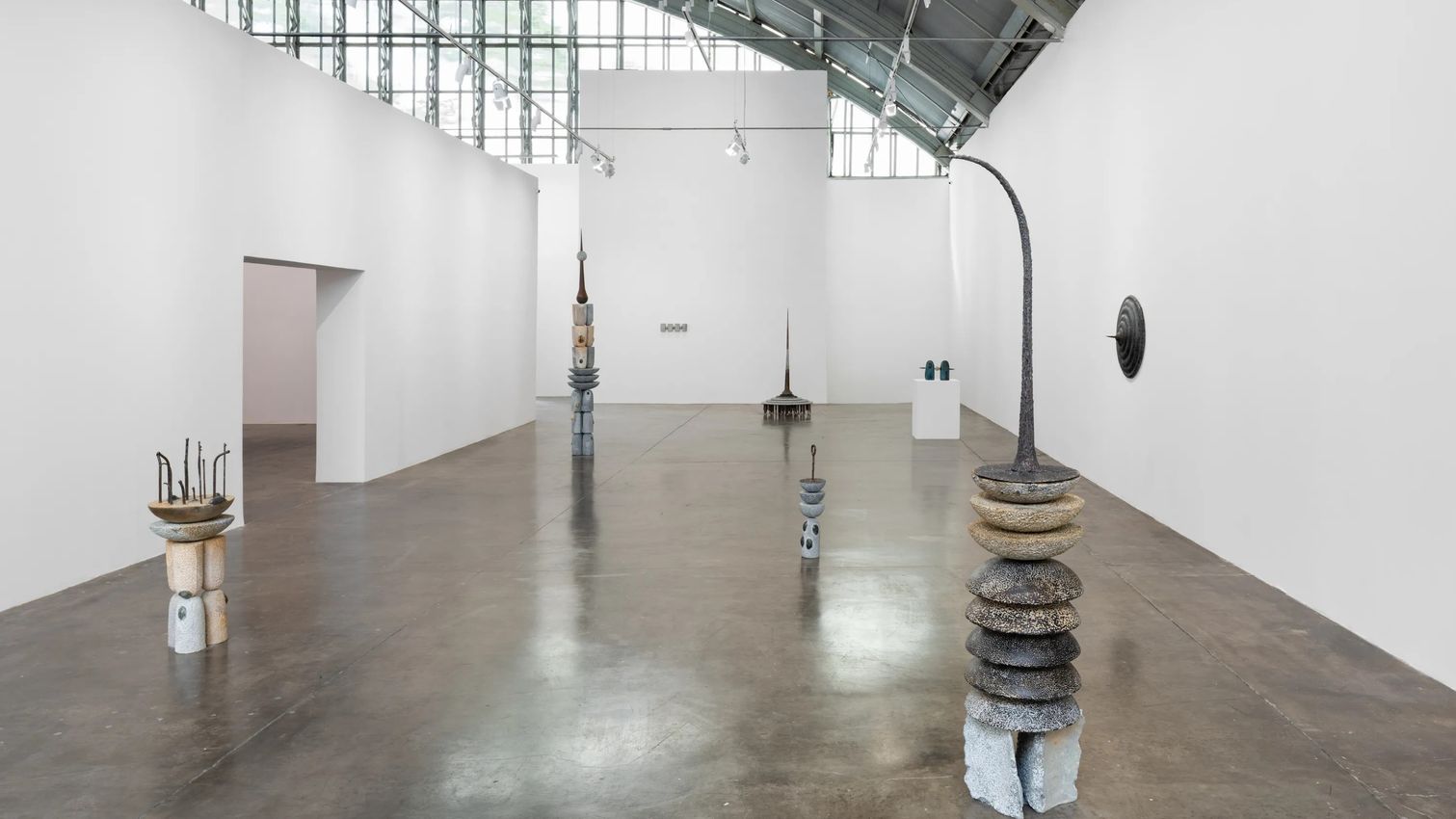
Mendes Wood DM is pleased to present Cantaria, Daniel Jorge’s first solo exhibition in São Paulo. Held in the Barra Funda warehouse, the exhibition brings together previously unseen works, including sculptures, wall reliefs, installations, and performance, and is accompanied by an original essay by curator and researcher Carlos Quijon Jr.
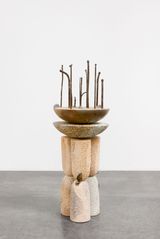
The exhibition’s title refers to the craft of the stonemason – the technical expertise of stone carving – which the artist has mastered. The word also evokes a song, as in the ritualistic and labor-related sounds that accompany the carver. It is from this intersection of hand and voice, precision and improvisation, that Jorge’s practice takes shape. In his works, the material does not arrive on its own, but is accompanied by the labor, the exchanges, and the stories that brought it there.
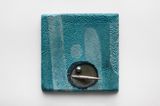
Born in Recreio, in the countryside of Minas Gerais, raised in Curumau, in Rio de Janeiro’s west zone, and now based in Salvador, Jorge works with what these three places have given him. Soapstone, a dense, soft rock used in the Baroque architecture of Minas Gerais, arrives at the studio through barter relationships with workers and small communities in Minas Gerais. “Each stone carries a chain of bodies within the work,” says the artist.For Jorge, the creative process involves “testing how far the material can go, and letting it respond.” The response lies, for example, in the pigmentation process the artist has developed. Charcoal, produced in the studio from wood collected in the city and burned there, serves as both a medium and a reagent; the blue pigment is made from printing waste acquired through exchanges with the city’s printing shops. When mixed with the charcoal and applied to soapstone, the blue reveals the quartzite veins running through it, and the surface gains sparkling spots that no deliberate gesture could have planned. Pitch – an asphalt emulsion used to pave roads and waterproof the concrete slabs of houses in the outskirts – is applied as a layer of deep black that pigments the stone and adds a thin, skin-like layer to its surface.
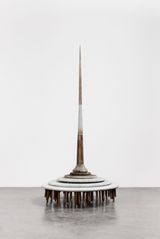
The iron collected by the artist is sometimes naturally oxidised, and at other times oxidised with salt, water, and vinegar – a technique that enslaved people on the run used to darken their tools and camouflage them in the woods during their journeys to the quilombos. Embedded in the carved stone, the iron tips rise like towers, spears, and nails. They are not mere ornamentation: they preserve the memory of escape and organise the work, in what the artist calls “symbolic revenge,” exercised through the gesture.
On the stone, Jorge performs the gesture of scarification: carvings, incisions, scratches. His research brings together the many meanings of this gesture – from the bodily mark that, among communities such as the Mursi, Yoruba, and Nuba, inscribes belonging on the skin, to the breaking of a seed’s shell so it may germinate, to the medical incision that vaccinates and heals. On the sculptural surfaces, the motif reappears in fields of perforations, orderly grooves, and protuberances. This is what leads the artist to the keloid: the skin that insists on returning to its original plane. The material that had previously been subtracted is now agglutinated, creating small anthropomorphic reliefs in some of the pieces.
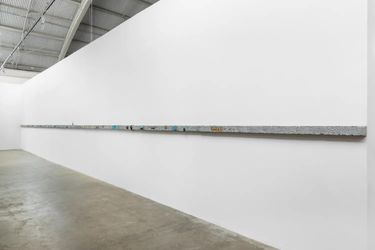
In the exhibition, the works hang from the ceiling, rest against the wall, or sit directly on the floor. In Balanced Manumission (2024), stone spheres and iron chains are not attached to anything: they simply balance each other, the weight of one holding up the other. In Boiar é entregar o peso à correnteza (2026), a block of soapstone pierced by large holes rests on the floor, surrounded by a chain bearing a seahorse at its end; the title conveys the gesture: floating requires no effort, it is surrender. And in Orifício (2024), a grey, scarred stone is embedded in a U-shaped wall that frames the path through the first room: it is as if the work were a host within the space’s wall, confusing us with the equation of matter that is lost between addition and subtraction, making it part of the whole. This movement recurs in several works in the exhibition: the artist obscures the path that would allow us to determine whether the form results from a subtraction or an addition of matter.
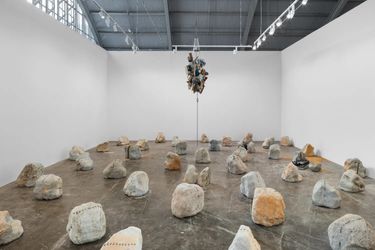
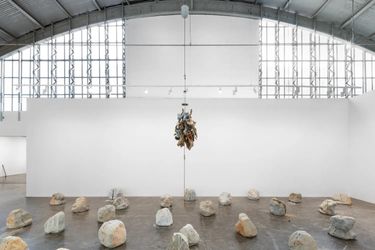
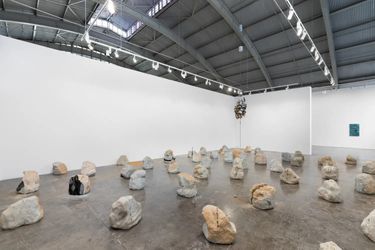
The exhibition culminates in the installation-performance Condição de Assentamento (2026), in which forty-nine soapstones are scattered across the floor, occupying an entire room of the gallery. Performed before the exhibition’s opening, the performance turns the artist’s own work into a way of occupying the space: Jorge splits the stones with wedges, pigments them with charcoal, tar, and blue graphic residue, and scars them. Once the gesture is complete, the artist withdraws, and the stones remain as a constellation throughout the exhibition period.
For the artist, “the right to subjectivity, to displacement, to abstraction, to ambiguity – rights systematically co-opted from certain bodies in Brazil – are claimed here as the material infrastructure of the work, not as its theme.” What is revealed in Cantaria is a practice sustained by elders, workers, and friendships, or, in Quijon’s words, “an ecology that thrives on uneven ground.”
Courtesy Mendes Wood DM.


Intellectually rigorous, politically active, and highly conceptual, the programme of contemporary art gallery Mendes Wood DM places an emphasis on critical conversation, working to embrace the individuality of each artist while also supporting the discovery of intersections between practices that might initially seem disparate.

A respected voice in contemporary art discourse.
Focusing on ambitious storytelling and insightful art-world commentary. Ocula Magazine publishes in-depth interviews, critical essays and timely analysis on the artists, exhibitions and ideas driving the global art world.
Learn more about Ocula Magazine
Showcasing the best of the art world.
Ocula partners with galleries from around the world to highlight their artists, artworks and exhibitions. Gallery membership is by application and invitation, with each member vetted by an independent panel.
Learn more about Ocula Membership

Specialises in the sale of major artworks.
Led by a team with deep ties to the world’s leading auction houses, galleries and collectors. Ocula’s advisory team offers bespoke services to high-net-worth clients from around the world who are looking to acquire the best of contemporary and modern art.
Learn more about our team and services