



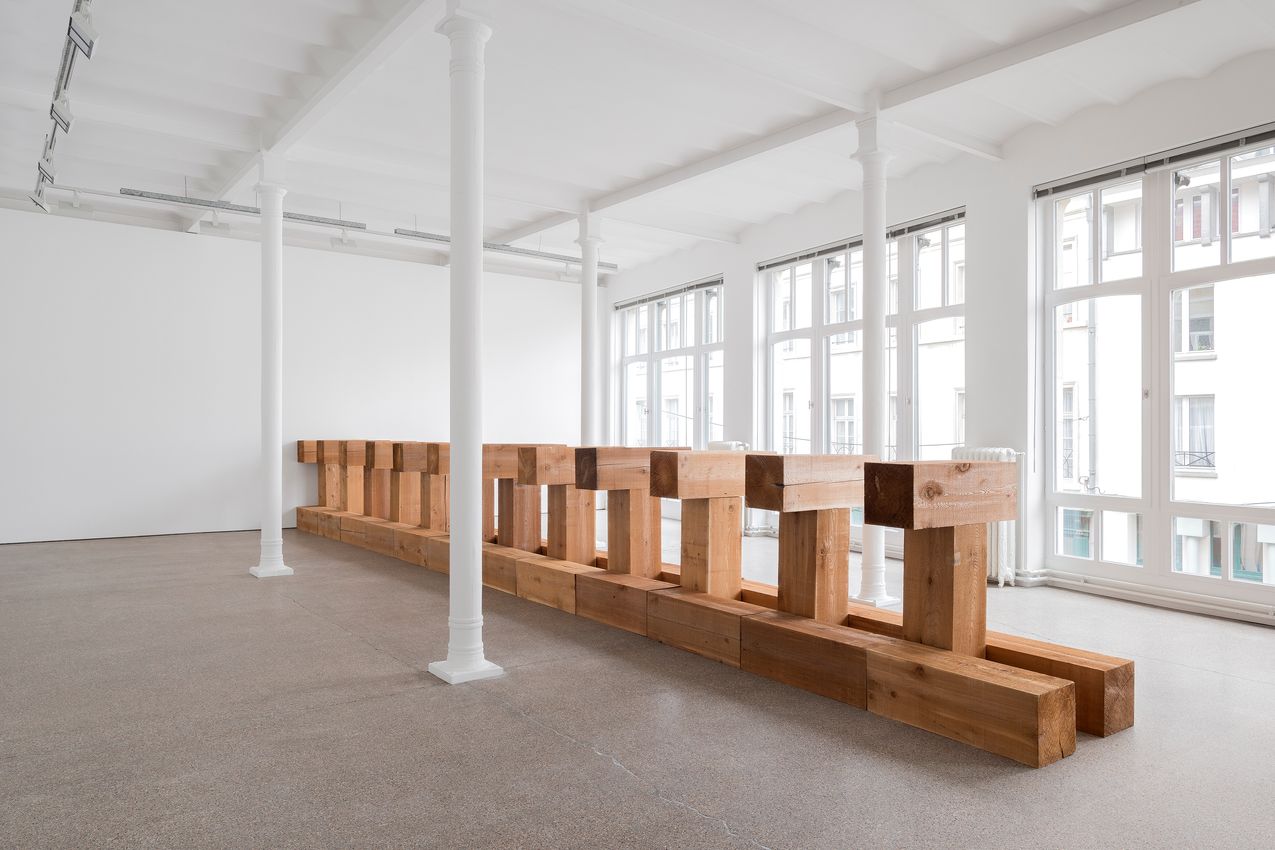
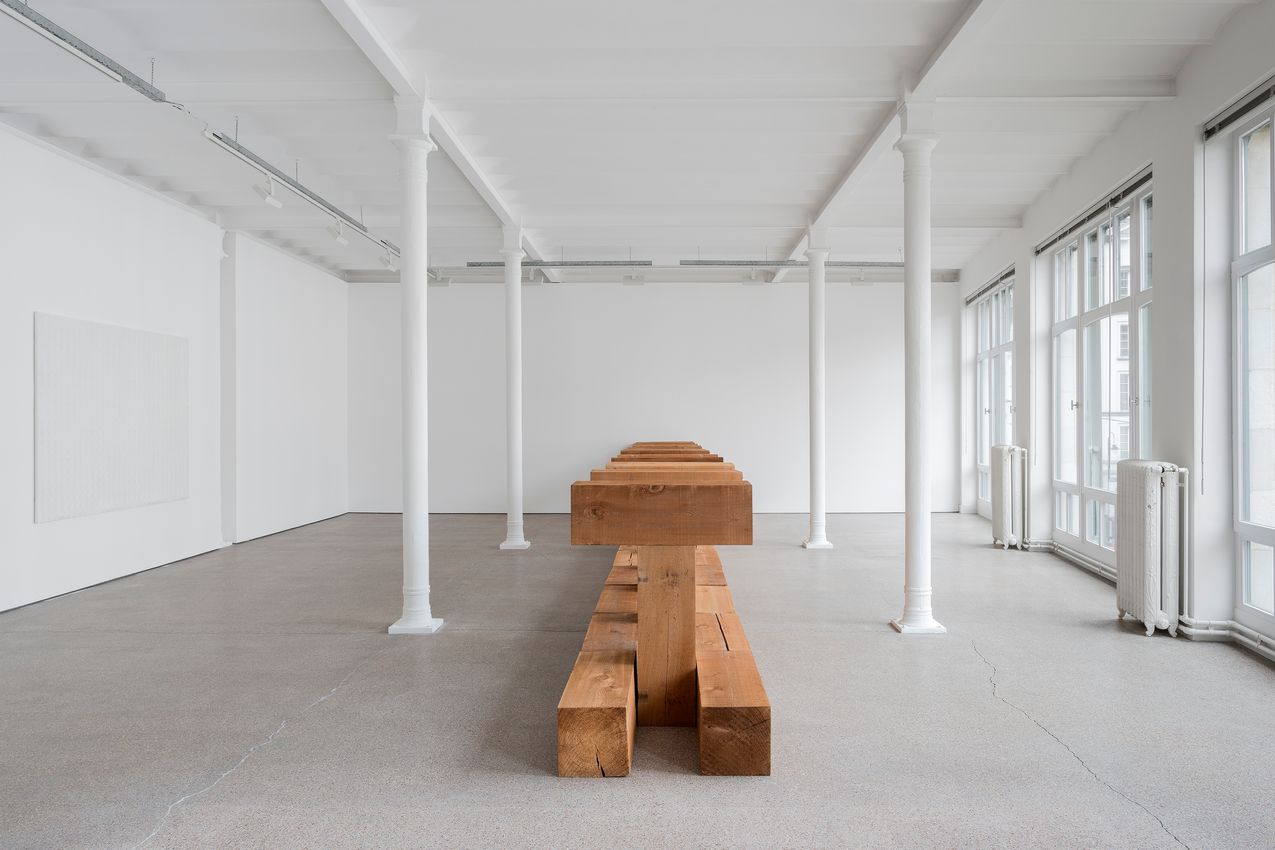
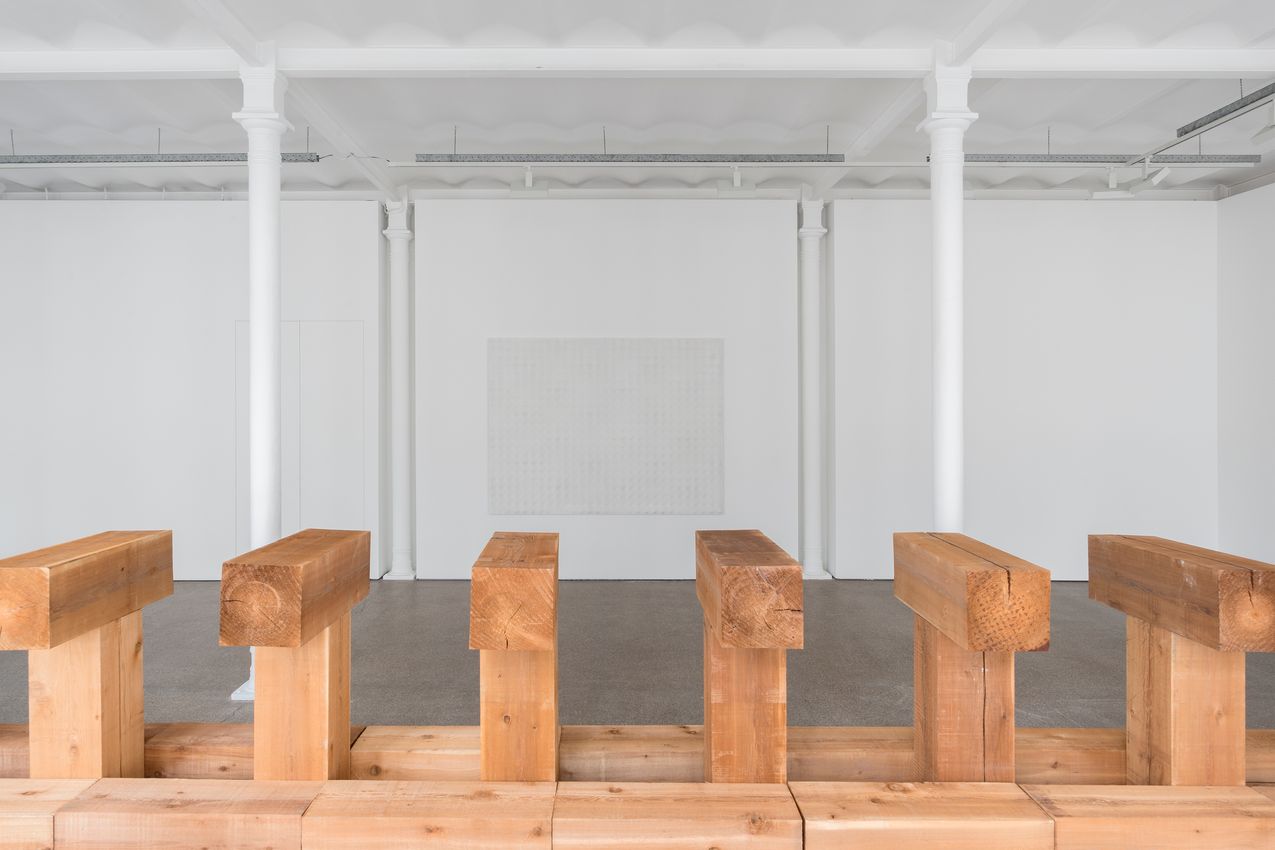
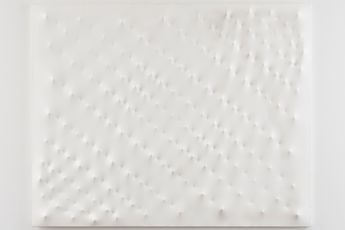
This exhibition shows one monumental work by Carl Andre: THEBES. Made out of Western red cedar wood in 2003, the work measures 120 x 90 x 1080 cm and exists out of 48 timbers, one row of 12 vertical timbers mounting one traverse horizontal tee timber each, flanked at base by two parallel rows of 12 horizontal timbers all based on the floor.
The artist uses the pieces of wood in the form of modules with standardised dimensions. As with all his sculptures the elements are connected to the ground in three ways: stacked, spread flat either on a grid or contiguously. By ways of stacking the work demands a physical involvement of the viewer, walking past the work gives you a sense of its mass, length, volume and even the smell of the cedar wood.
Carl Andre was one of the founders of the art movement known as Minimal, Systemic or ABC Art. It is an art that seeks to eliminate everything decorative, extraneous and additive, reducing all components to art’s purest elements. The movement included artists from his generation such as Donald Judd, Sol LeWitt, Dan Flavin, Eva Hesse and Robert Morris. Carl distanced sculpture from processes of carving, modelling or constructing to simply involve sorting and placing. The artist has described his works as ‘something between a piece of architectural sculpture and a carpet’.
He began making his first wooden sculptures in the late fifties, inspired by Constantin Brancusi. The work Endless Column by Brancusi made a particular impression on Carl Andre. He saw the work pushing through the boundaries of sculpture and the infinite without losing the union with earth through the vertical repetition of identical modules. These are elements we can recognise in the exhibited work THEBES, the horizontal repetition of the modules, connected closely to the scale and proportions of its immediate surrounding.
Courtesy Galerie Greta Meert
Over the past 30 years, Galerie Greta Meert established itself as one of Brussels’ leading contemporary art galleries. Founded in 1988 as Galerie Meert Rihoux, it was subsequently renamed after its founding director Greta Meert in 2006. Located in the center of Brussels, the gallery occupies a five-story Art Nouveau building designed by Louis Bral and renovated for the gallery by renowned Belgian architects Hilde Daem and Paul Robbrecht. Since 2012 three floors of the building are dedicated to exhibitions, making it possible to maintain an expanded exhibition schedule.

A respected voice in contemporary art discourse.
Focusing on ambitious storytelling and insightful art-world commentary. Ocula Magazine publishes in-depth interviews, critical essays and timely analysis on the artists, exhibitions and ideas driving the global art world.
Learn more about Ocula Magazine
Showcasing the best of the art world.
Ocula partners with galleries from around the world to highlight their artists, artworks and exhibitions. Gallery membership is by application and invitation, with each member vetted by an independent panel.
Learn more about Ocula Membership

Specialises in the sale of major artworks.
Led by a team with deep ties to the world’s leading auction houses, galleries and collectors. Ocula’s advisory team offers bespoke services to high-net-worth clients from around the world who are looking to acquire the best of contemporary and modern art.
Learn more about our team and services