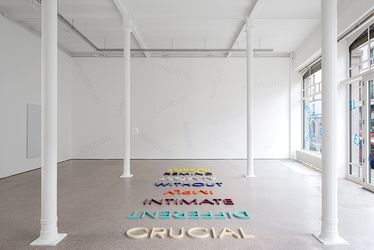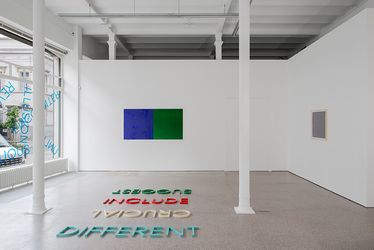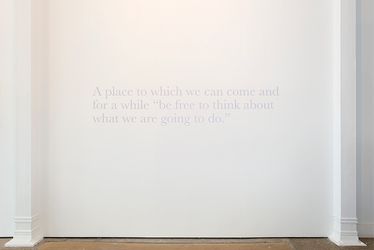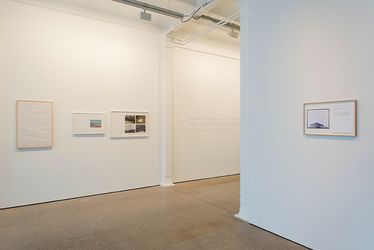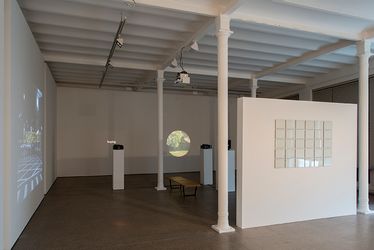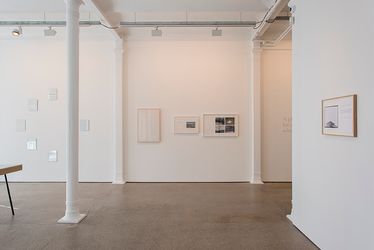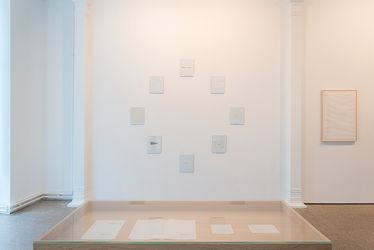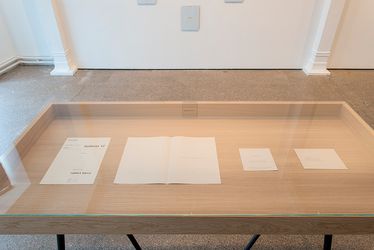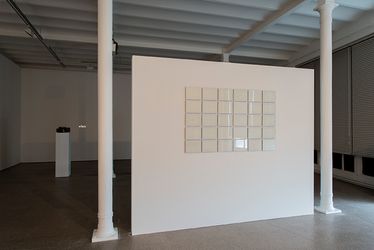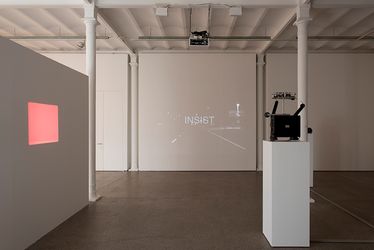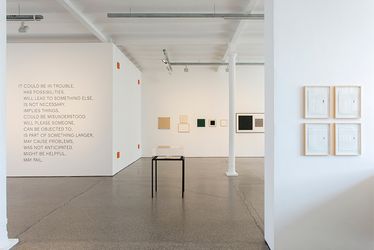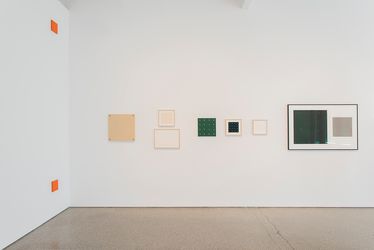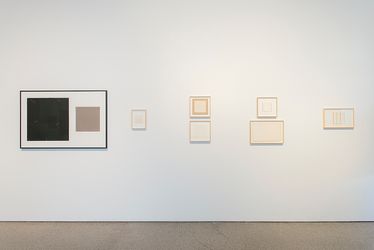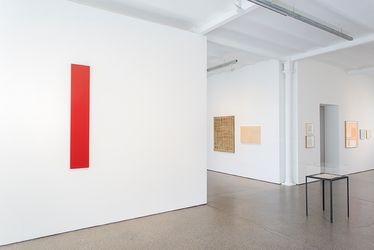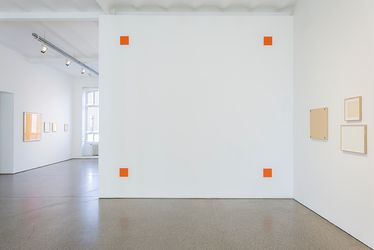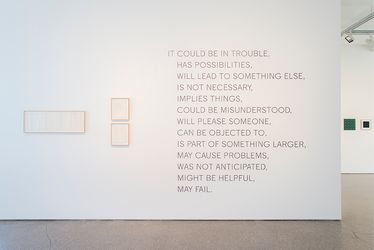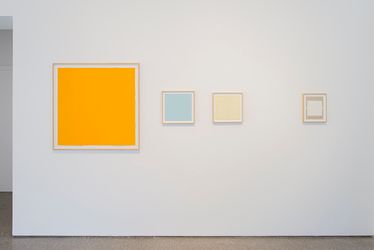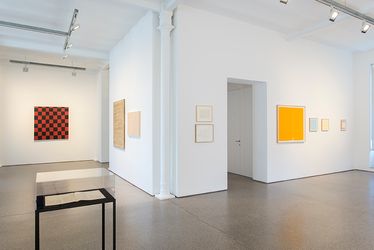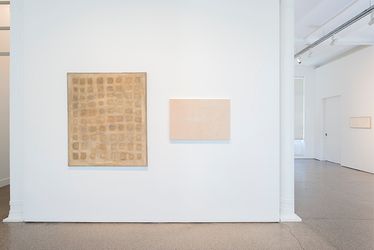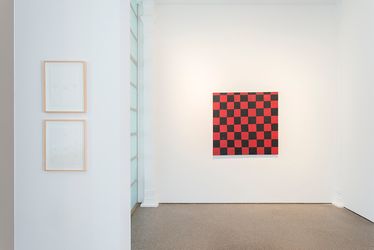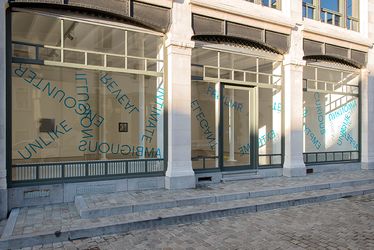
Galerie Greta Meert is pleased to present the exhibition Robert Barry works 1962 until present. This is an exceptional overview of the artist’s oeuvre which, spread over three gallery floors, takes on the proportions of a museum. Some works were never shown in Europe before, others are part of private collections or never left the artist’s studio. The exhibition has been put together by curator Franz–W. Kaiser, who works for Gemeentemuseum Den Haag.
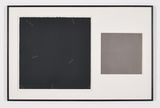
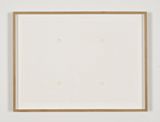
The overview starts in 1962, when the artist was studying at Hunter College, NY, taking lessons from Tony Smith and Robert Motherwell. Two early paintings from that period will be exhibited. Through the use of certain basic shapes and the art-historical structure of the ‘grid’, they are the precursors of a much more extensive three-dimensional research. This research was initially limited to the work’s support, paper or canvas, and later extended to the wall and finally the exhibition space.
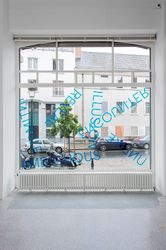
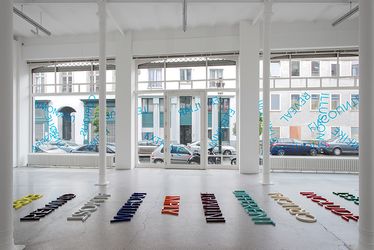
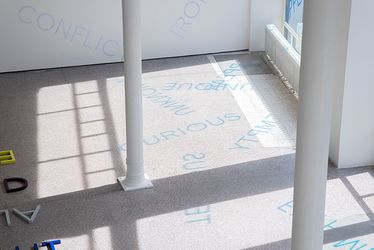
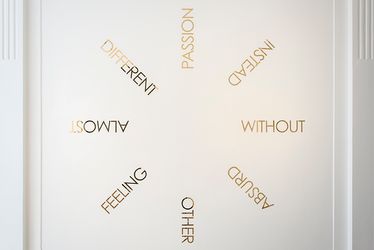
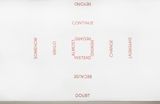
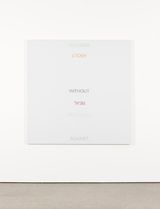
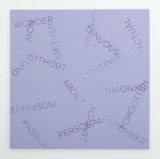
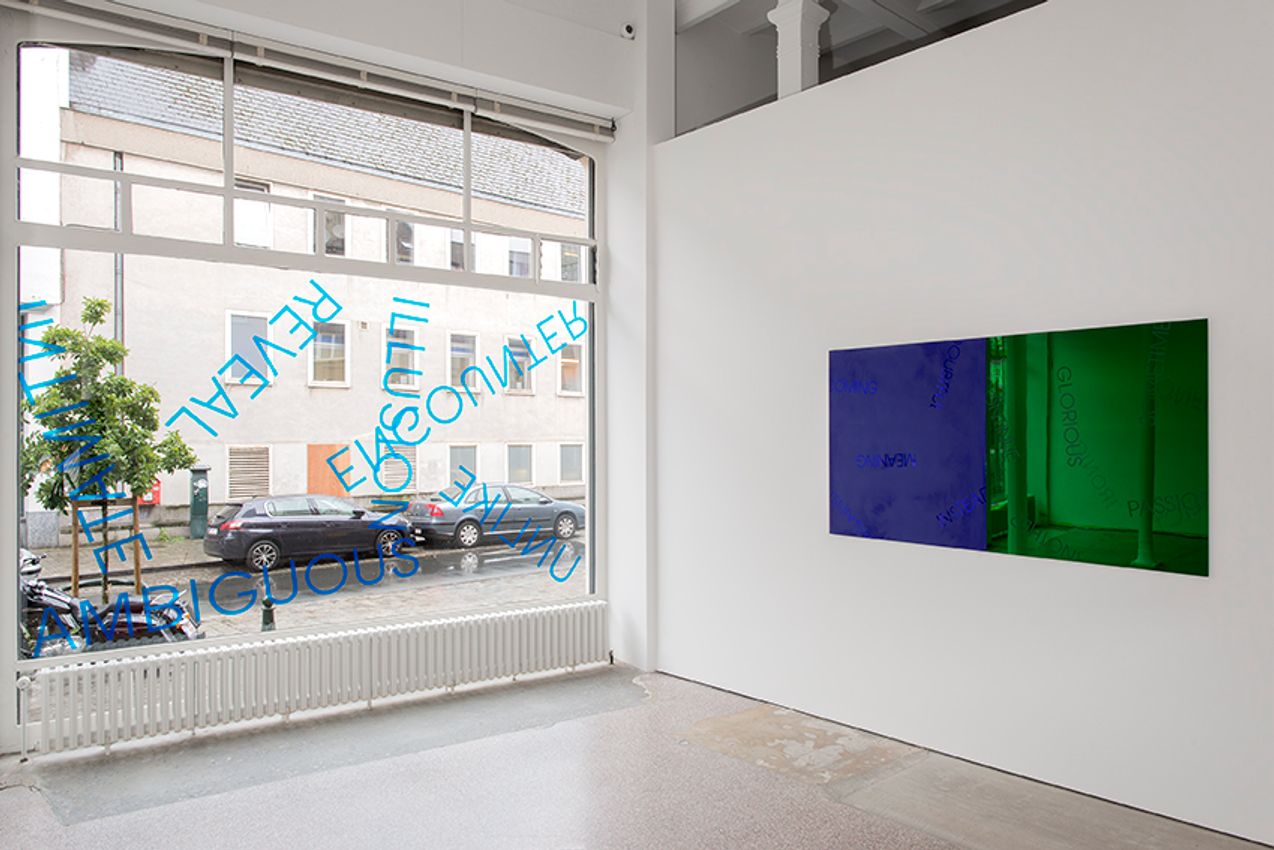
Today, language is the central aspect of his work. Words act on a non-referential and visual level. The presentation in the gallery ranges form his first textual works from 1970 to the more recent ‘in situ’ installations, with a freer and more plastic use of words.
Robert Barry’s pioneering role in conceptual ideas partly goes back to his far-reaching extension of the notion of space, which also encompasses the spectator’s mental space. His works take their final shape when they are experienced and observed by the spectator. An illustrative example is the work Interview piece (1969) in which the artist indicates that the work only exists if the reader has been invited to reflect on its contents.
On the second floor, the focus is on Barry’s experiments with immaterial substances, such as electromagnetic energy, ultrasonic radiation and inert gasses. In this context the exhibition also shows the one-time collaboration (1971) with Lucy Lippard, the art historian who in 1968 already mentioned the idea of a ‘dematerialisation’ in arts. On the same floor ‘Red Seconds’ (1967), his very first 16 mm-film, is the starting point of a brief overview of video works and slide projections.
An overview of Robert Barry’s oeuvre is inevitably interspersed with references to art historical moments and figures, because the artist was part of an international context of artists, linked to the Minimal and Conceptual movement from very early on. He participated in When Attitudes Become Form (Kunsthalle Bern, 1969), put together by curator Harald Szeeman, as well as in Prospect 69 (Städtische Kunsthalle Duseldorf, 1969) and the early collaborations with curator and art-dealer Seth Siegelaub.
This exhibition was put together by Franz-W. Kaiser, chief curator of the Gemeentemuseum Den Haag, who previously organised exhibitions of Robert Barry’s work in the Centre National d’Art Contemporain de Grenoble and the Gemeentemuseum Den Haag. In view of this project, he talked to Robert Barry about the early days of conceptual art and about his works. These conversations will also be made available.


Robert Barry is a conceptual artist whose work questions the very nature of the art object by testing the limits of materiality. His work focusses on its relationship to its surrounding and to the social sphere by using language and invisible mediums such as inert gases or radio waves. Barry strives to represent the unknown or the unperceived through installations, performances and specific works that locate the viewer in a specific time and place.

Over the past 30 years, Galerie Greta Meert established itself as one of Brussels’ leading contemporary art galleries. Founded in 1988 as Galerie Meert Rihoux, it was subsequently renamed after its founding director Greta Meert in 2006. Located in the center of Brussels, the gallery occupies a five-story Art Nouveau building designed by Louis Bral and renovated for the gallery by renowned Belgian architects Hilde Daem and Paul Robbrecht. Since 2012 three floors of the building are dedicated to exhibitions, making it possible to maintain an expanded exhibition schedule.

A respected voice in contemporary art discourse.
Focusing on ambitious storytelling and insightful art-world commentary. Ocula Magazine publishes in-depth interviews, critical essays and timely analysis on the artists, exhibitions and ideas driving the global art world.
Learn more about Ocula Magazine
Showcasing the best of the art world.
Ocula partners with galleries from around the world to highlight their artists, artworks and exhibitions. Gallery membership is by application and invitation, with each member vetted by an independent panel.
Learn more about Ocula Membership

Specialises in the sale of major artworks.
Led by a team with deep ties to the world’s leading auction houses, galleries and collectors. Ocula’s advisory team offers bespoke services to high-net-worth clients from around the world who are looking to acquire the best of contemporary and modern art.
Learn more about our team and services