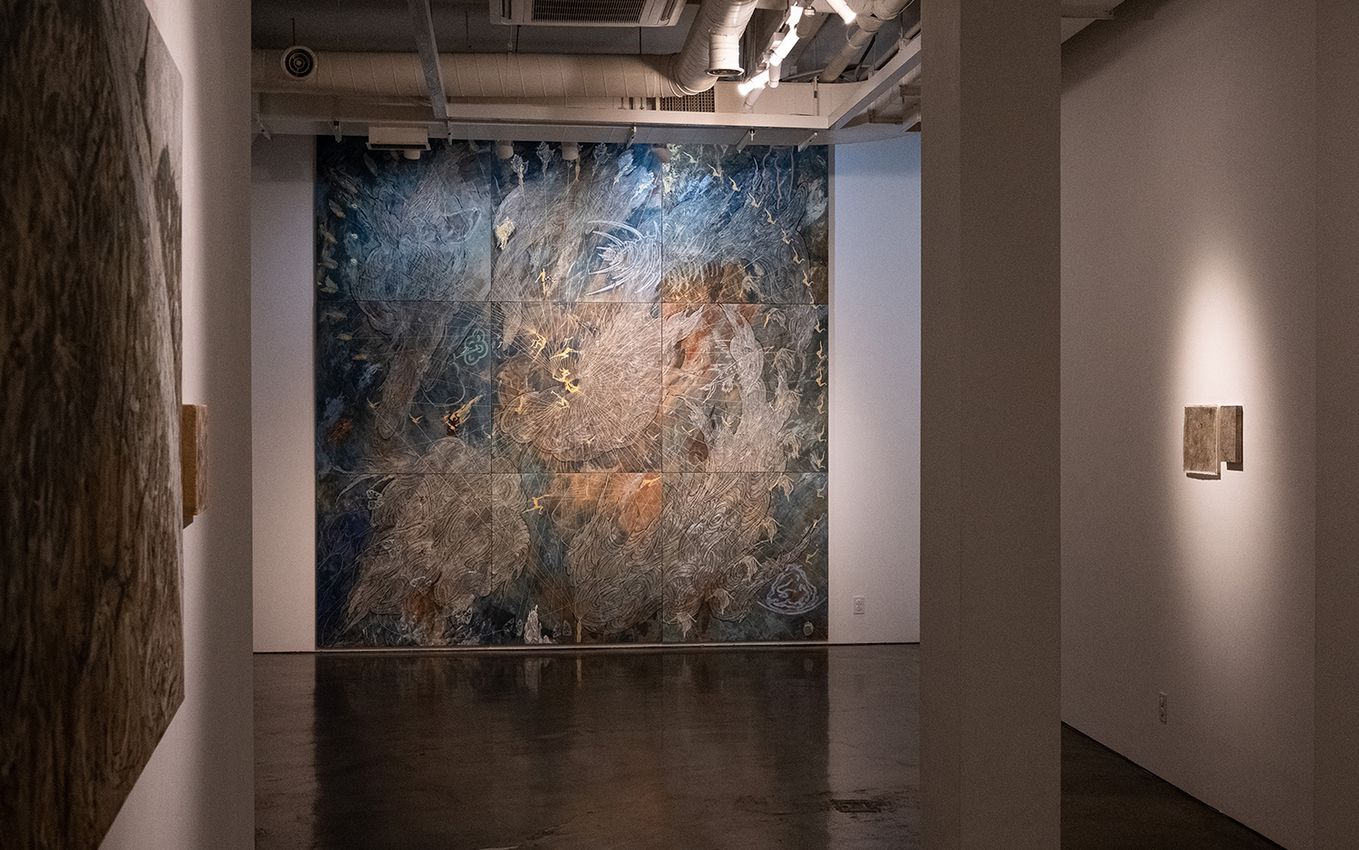
”...She rested her hands on the stump.
And she felt the worn, rough wood.
Faded by the rain and loneliness, the wood had become timeworn, antique.
(But that cut, hacked, dead wood, unfit to be firewood,
Unfit to be a plank, unfit to be a bench for lovers,
Could there be anything lonelier and sadder than wood not fit for anything?
The touch of this wood evokes in her a sense of elegance,
A sense of love, and without her knowing,
To her surprise she felt tears come forth.”
(Francoise Sagan, The Lake of Loneliness)
Starting with her first solo exhibition in 2008, Revenge is Mine, Gu Myeongseon’s solo exhibitions all bear titles defined by a sense of resolution. Then the fourth solo exhibition seems to have changed. In most cases, Gu’s women gaze straight ahead against a background that does not exist, and each is notable in their uniqueness and individuality. Their charm is amplified with spicy titles like Revenge is Mine, Got Cash?, What the Hell is This, I wanted to Get Out of the Sun, and I Walk but I’m Not Walking. These titles all come from popular phrases and lyrics that reflect the contemporary zeitgeist. Gu would write down her emotions and feelings, phrases that left an impression on her, and when a painting was finished, she would examine her notes and pick out the phrases. And so, the title of this exhibition no doubt arose from an inner inevitability from within her. Gu has adopted the visual style of the romance visual novels in her work, and she has harnessed the pointed chins and dainty figures into her own unique style of idealized femininity and unrealistic glamor. Gu’s work brings the women of these graphic novels into reality through a style of pencil drawing that was popular in art school admissions examinations in Korea and Japan, and immediately after exhibition they drew the attention of the art community in Korea. In the fall of 2008, when her first exhibition was held, she won the first Asiaf Prize as well. Afterwards she was chosen as one of the artists for the 2010 Joong-Ang National Art Competition, and she has remained a prolific artist, participating in a diverse range of exhibitions. But for this exhibition, she remained quiet as she worked, keeping her work secret. She worked in a small space with a width of less than 2m, not unlike the small prayer rooms of the monasteries[ll3] in Itaewon. There, she underwent a process of intense focus and reflection, using simple materials like her pencil and paper and eraser. That process seemed not unlike the prayers of a monastic disciple. Having spent time of her own volition in solitude, Gu says that drawing to her is like trying to see the truth. And through this shift in perspective, that the truth is reflection, she creates multiple chords, and her hands write down the story of this rhythm and truth.
Psychological Profiles
In 1906, Modigliani painted a portrait of the Eleonora Duse, a celebrated actress of the famous theatres of Europe and a regular muse of dissolute Italian artists. The mystique of Duse in the portrait is emphasized by her clear eyes that shine through the dark background and abstracted face. In Woman’s Head with Beauty Spot in 1907, Modigliani painted a woman with abnormally large eyes, and her two eyes, which shine from a face that fills the entire frame, stare at the viewer as if to challenge her, but at the same time they waver. In a similar regard, I pose the question to Gu about the use of lightning to highlight a feeling of non-realism in her work. I simply thought that she used these shards of light, which are common in romance graphic novels, as a type of cliché. In Plato’s Timaeus, it is stated the first organ of the human body that was created were the eyes. Of the many sensory organs of the human body, the eyes link the conceptions embedded in the human conscious and reality, and the eye retains the essence of phōs, or soft light, within, but upon encountering pyr, the external fire, it enables one to see. The moment the light of the eyes and the external fire encounters, a “ray of flame” is formed and the objects of the real world enter the self in the form of conceptualized images. Once more, I examine the shining lights within Gu’s drawings. The lights that shine in the landscapes are reflected in their eyes. The moment my eyes land upon these lights, my gaze is fixed, and I seek to understand the reality of the images that lay before me. It is in that moment that the feelings of the women in these drawings and the sentiments of the dark, nighttime landscape form another meaning.
A Walk in the Snow A Grand New World and The Artist Who Has Lost Her Eyes, which were drawings featured in her second solo exhibition, Of Romance, depict women who are observing something through binoculars, which enable one to transcend the biological limitations of the eyes. In A Grand New World, an innocent-looking girl holds in her hand a pair of binoculars, the lenses of which have a shine. Her pursed lips evidence her determination regarding the object that she is looking at. The girl, her desires unconcealed, is depicted in faint form, but the light that shines through the lens is clear as day. The Artist Who Has Lost Her Eyes, which is a slightly larger drawing, depicts a woman with short hair and wearing a sleeveless shirt. She holds her pair of binoculars to her eyes, and appears surprised as she watches something. Perhaps it represents the sentiments of an artist who belongs to a generation beset by an “absence of experiences,” who must compete with the fantastical visual imagery encountered in magazines, the internet, and smartphones. In her third solo exhibition, Memories Are Best Kept Buried, a single drawing is exhibited at some distance away from a series of drawings. Titled My Eyes Are Still Tender, the drawing borrows from the idiomatic expression, “tender-hearted.” The shine in the drawing, which almost appears grotesque, does not extend past the eyes, and it glows within. The faint light that surrounds her shows that her face is but a mask. Inside, she is empty. And we encounter “emptiness.” The empty eyes, where have they gone? The imagery of eyes being replaced by machinery can be seen in her first exhibition. In Never Forget, the girl’s eyes are not there. There are only two empty holes. The function of the eyes is substituted by the cameras in her hands. The image in her eyes disappears when she closes her eyes. Just as events pass with time, we each recall them in our own way, and similarly these recollections too disappear with time. But unless lost or destroyed, photographs continue to transcend time and memory. Several drawings, for which Gu intended her eyes to function as cameras, appear as if they were photographs in which the camera has failed to come in to focus. But this intentional vagueness serves as a device that reminds us of the imperfection of vision and the limitations of memory.
Of the Many Truths, of What Shall I Speak: Concerning Minutia Gu states that her drawings are quite conceptual. And, she adds, her drawings are not representations of objects on paper but rather a visualization of the conception of objects or events. In fact, she likens her drawing to the process of scraping away the paper with a pencil, as if to scar it. It is the process of revealing the conceptual imagery that already exists within, to reveal what is not seen, to visualize concepts . . .
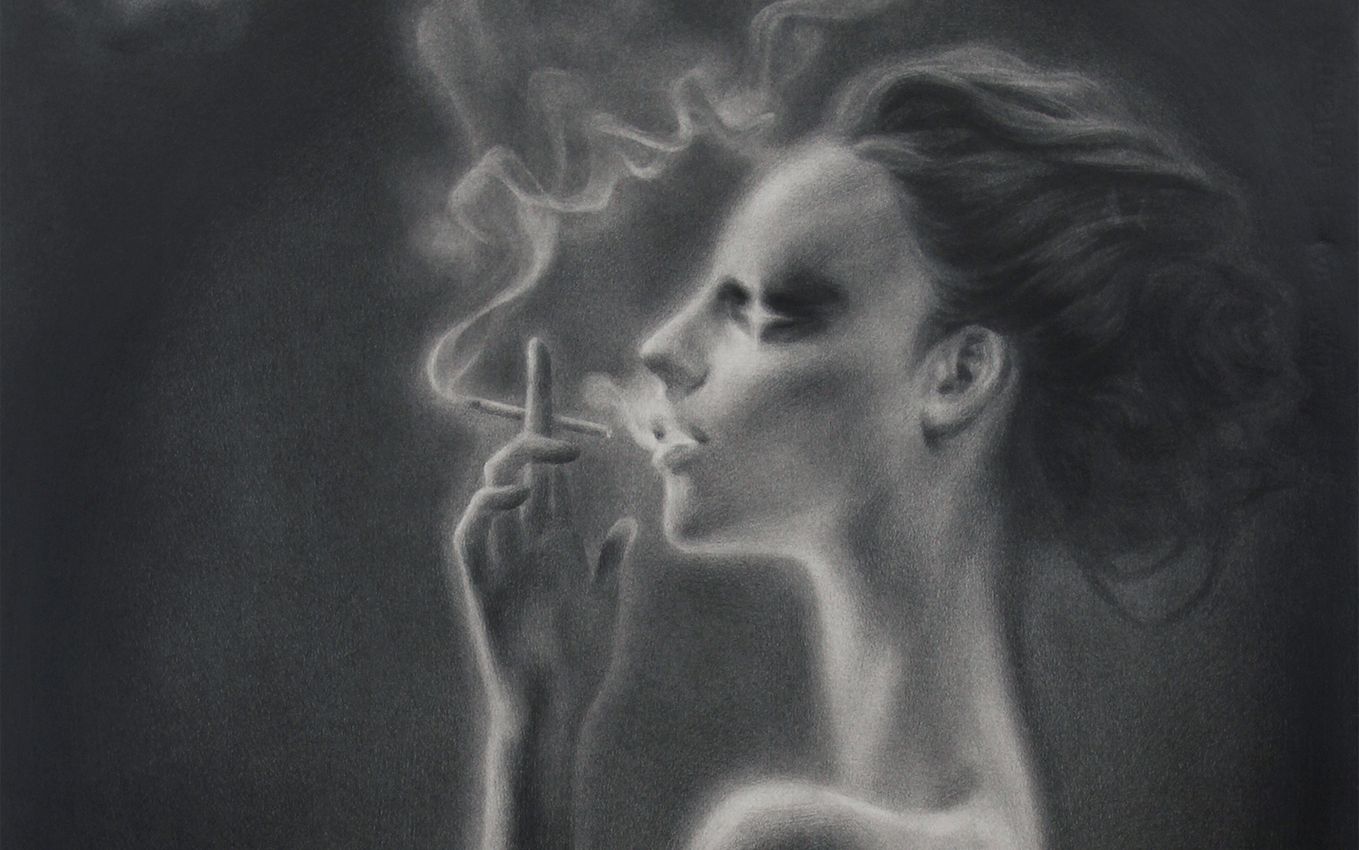
Following her debut in 2008, Gu, like other young artists of her generation, began to wonder whether she “could continue her work,” and she spent some time in self-reflection. Rather than externally searching for the theme of her work, she visualized the concepts that trickled from her memories and experiences. And she began to record the minutiae that constituted her daily life, the things that broke serenity in her life, that caused her heart to race and then plunged deep into an abyss, those sentimental things. Starting with It Was Probably One Summer Night, which recorded the moment in which unknown emotions arose in herself in the quiet morning, Gu appears not as the other but as a primary agent, and she watches the quiet of the abyss with a considerate gaze. She pauses before the landscape that has caused the emotions that have faded with time to become a pain in the present, and after remembering these emotional hardships, she smokes a cigarette and reminisces. Thus, she appears before us as a real entity, an image. The screen is gradually filled up, quickly or slowly, along with the rhythm that flows from the tranquility of the abyss. Lightness is darkness thus erased, and the person and landscape constitute an image of a series of events that happened to the artist. The process of realizing her conceptualizations has freed her. Like a piece of writing in which multiple languages and symbols are mixed together, Gu’s drawings are layered with memories and therefore offer deeply truthful stories. Reflecting on past events requires courage. In most cases, this requires a difficult process of isolating oneself within memories and rejecting the present, as it represents the non -dynamics of grief, pain, regret, and an inability to let go. As such, we may have taken an easy path to forget past events. In The Lake of Loneliness, a short story by Francoise Sagan, a master at depicting the detailed, imperfect emotions of love, a woman who has a satisfactory life finds that everything becomes unfamiliar because of a certain sensory experience. As she returns to Paris, the woman in the story vows to never speak of the existential loneliness that she felt at the unfamiliar lake. But in her heart, the landscape of this lake has become an image that she can recall at any time. The long period of loneliness left Gu with shiny fingers from the graphite of pencil. Her time spent on this endeavor was rewarded through the creation of drawings that have ability to captivate the viewers’ gaze—the gaze of we who stood at the lake of loneliness where she saw multiple truths. Can’t get the original online. Are there actually monasteries in Itaewon? This quite a specific term.


Ku Myung Seon makes her very own ‘girl concept(少女考)‘into images by picking a model appropriate to the situation from the actual reality she experienced and positioning the model inside artist’s private narrative. She cuts up images of women sampled from magazines, internet games, catalogues, and creates new characters by overcoding them with emotionally best suiting girl images from manga.

Gallery Chosun was established in 2004 in Bukchon, an area in Seoul known for its vibrant art scene comprising prominent art galleries and the National Museum of Modern and Contemporary Art. With a reputation for providing a versatile environment for its forward-thinking exhibitions, Gallery Chosun is committed to becoming an ultimate paradigm for Korean contemporary art.

A respected voice in contemporary art discourse.
Focusing on ambitious storytelling and insightful art-world commentary. Ocula Magazine publishes in-depth interviews, critical essays and timely analysis on the artists, exhibitions and ideas driving the global art world.
Learn more about Ocula Magazine
Showcasing the best of the art world.
Ocula partners with galleries from around the world to highlight their artists, artworks and exhibitions. Gallery membership is by application and invitation, with each member vetted by an independent panel.
Learn more about Ocula Membership

Specialises in the sale of major artworks.
Led by a team with deep ties to the world’s leading auction houses, galleries and collectors. Ocula’s advisory team offers bespoke services to high-net-worth clients from around the world who are looking to acquire the best of contemporary and modern art.
Learn more about our team and services