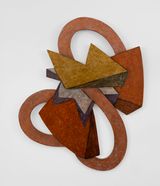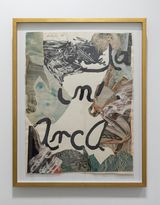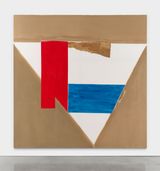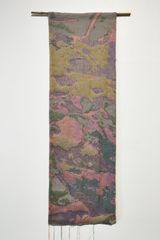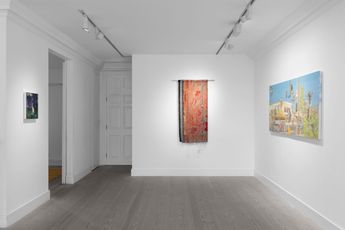
Coinciding with the launch of Gazelli Art House’s new permanent New York gallery and its inaugural exhibition, Put the Kettle On, the gallery is pleased to present Continuous Abstraction at The Armory Show 2026. Bringing together works by Gillian Ayres, Alice Baber, Sandra Blow, Lilly Fenichel, Perle Fine, Grace Hartigan, Helen Pashgian, and Joan Truckenbrod, the cross-generational presentation traces connections between post-war abstraction, Light and Space, and early computer art.
Rather than presenting abstraction as a singular movement or closed historical category, Continuous Abstraction approaches it as an evolving visual language shaped through material, gesture, perception, rhythm, and systems. Across generations and geographies, the artists in the presentation challenge established narratives surrounding abstraction while foregrounding practices that have often remained under-recognized within dominant art historical discourse.
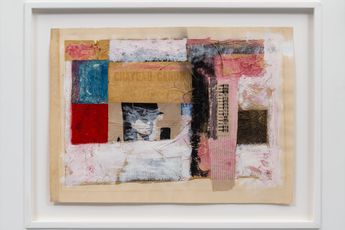
At the center of the presentation are Alice Baber, Perle Fine and Lilly Fenichel, three artists whose distinct trajectories illuminate the breadth of American post-war abstraction. Fine occupied a significant position within the New York School: a member of American Abstract Artists and one of eleven women included in the landmark 9th Street exhibition of 1951, she was also among the first women admitted as a voting member of the influential 8th Street Club. Moving between gestural, geometric and more atmospheric modes of abstraction, Fine developed an uncompromising visual language in which color and structure remained in constant tension.
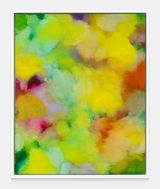
Baber pursued color through a different, deeply sensory approach. In Yellow Croquet Second Wicket (1961), painted in Paris, translucent passages of yellow, green, pink and orange dissolve into shifting biomorphic forms. An early example of her commitment to abstraction, the painting reflects an approach in which color became an active, perceptual force rather than simply a compositional device.
Fenichel offers another parallel yet distinct trajectory. Moving between California and New York before settling in New Mexico, she developed a fluid visual language that shifted between gesture and geometry, balancing restraint with improvisation while resisting stylistic categorization throughout her career. Her work is currently included in Abstract Expressionists: The Women, a major touring exhibition organized by the American Federation of Arts featuring works from the collection of Christian Levett and FAMM (Femmes Artistes du Musée de Mougins), on view at the Speed Art Museum in Louisville, Kentucky. The presentation coincides with Gazelli Art House’s announcement of its representation of the Lilly Fenichel Foundation, ahead of the centenary of the artist’s birth in 2027.
Grace Hartigan further expands the presentation’s dialogue around post-war abstraction and the New York School. Emerging in New York during the 1940s and 1950s, Hartigan became one of the leading figures of the Second Generation Abstract Expressionists, initially gaining recognition for her experiments in total abstraction before gradually incorporating recognizable imagery, figures, and references drawn from literature, history, and everyday life. While closely associated with the predominantly male circles surrounding Abstract Expressionism, Hartigan consistently resisted rigid formal boundaries, developing a highly individual visual language that moved fluidly between abstraction and representation. Across later decades, her increasingly layered and autobiographical compositions introduced elements influenced by Cubism, gesture, and narrative structure, expanding abstraction into a more emotionally and psychologically charged terrain.
British abstraction is represented through Sandra Blow and Gillian Ayres, two artists who transformed painting into a site of material and emotional intensity. Blow emerged as one of the leading figures of post- war British abstraction following her studies in Italy with Alberto Burri, incorporating rope, plaster, sawdust, and collage into tactile compositions that pushed painting beyond the plane of the canvas. Ayres approached abstraction with equal freedom and physicality. Celebrated for her exuberant use of color and improvisational energy, she rejected formal rigidity in favor of a dynamic and instinctive approach to painting. Together, Blow and Ayres foreground abstraction as something physical, expressive, and continually in flux.
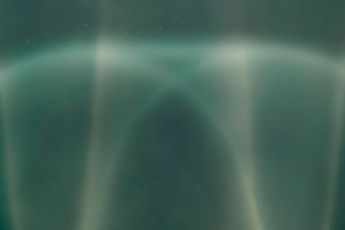
The presentation extends beyond painting through the work of Helen Pashgian, a foundational figure of the California Light and Space movement. Since the 1960s, Pashgian has used industrial materials including resin, acrylic, and coated glass to create luminous sculptural forms that shift with the movement of a viewer. Her works dissolve distinctions between object and atmosphere, transforming abstraction into a perceptual and spatial experience. Although increasingly recognized in recent years, Pashgian was one of only two women associated with the original Light and Space movement in California.
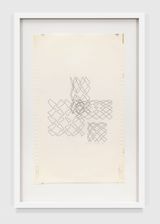
One thread within the booth explores abstraction’s relationship to systems, structure, and computational thinking. Joan Truckenbrod was among the earliest artists to employ computer programming languages such as FORTRAN within artistic practice during the late 1960s and 1970s. Translating algorithmic structures into drawings, textiles, and woven forms, she established a pioneering dialogue between computation, handcraft, and artmaking decades before digital art entered mainstream discourse. Her work forms a vital historical bridge between early computer art, geometric abstraction, and process-based artistic practices.
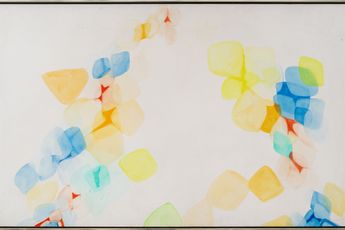
Together, the works in Continuous Abstraction position abstraction as a living and adaptive visual language continually reshaped by women artists across generations. Moving from post-war painting to later explorations of perception and form, the presentation foregrounds artists who expanded the boundaries of painting, sculpture, and perception while often remaining outside canonical narratives. Rather than presenting abstraction as a closed chapter of modernism, the booth considers it as an ongoing field of experimentation shaped by changing materials and ways of seeing.


A respected voice in contemporary art discourse.
Focusing on ambitious storytelling and insightful art-world commentary. Ocula Magazine publishes in-depth interviews, critical essays and timely analysis on the artists, exhibitions and ideas driving the global art world.
Learn more about Ocula Magazine
Showcasing the best of the art world.
Ocula partners with galleries from around the world to highlight their artists, artworks and exhibitions. Gallery membership is by application and invitation, with each member vetted by an independent panel.
Learn more about Ocula Membership

Specialises in the sale of major artworks.
Led by a team with deep ties to the world’s leading auction houses, galleries and collectors. Ocula’s advisory team offers bespoke services to high-net-worth clients from around the world who are looking to acquire the best of contemporary and modern art.
Learn more about our team and services