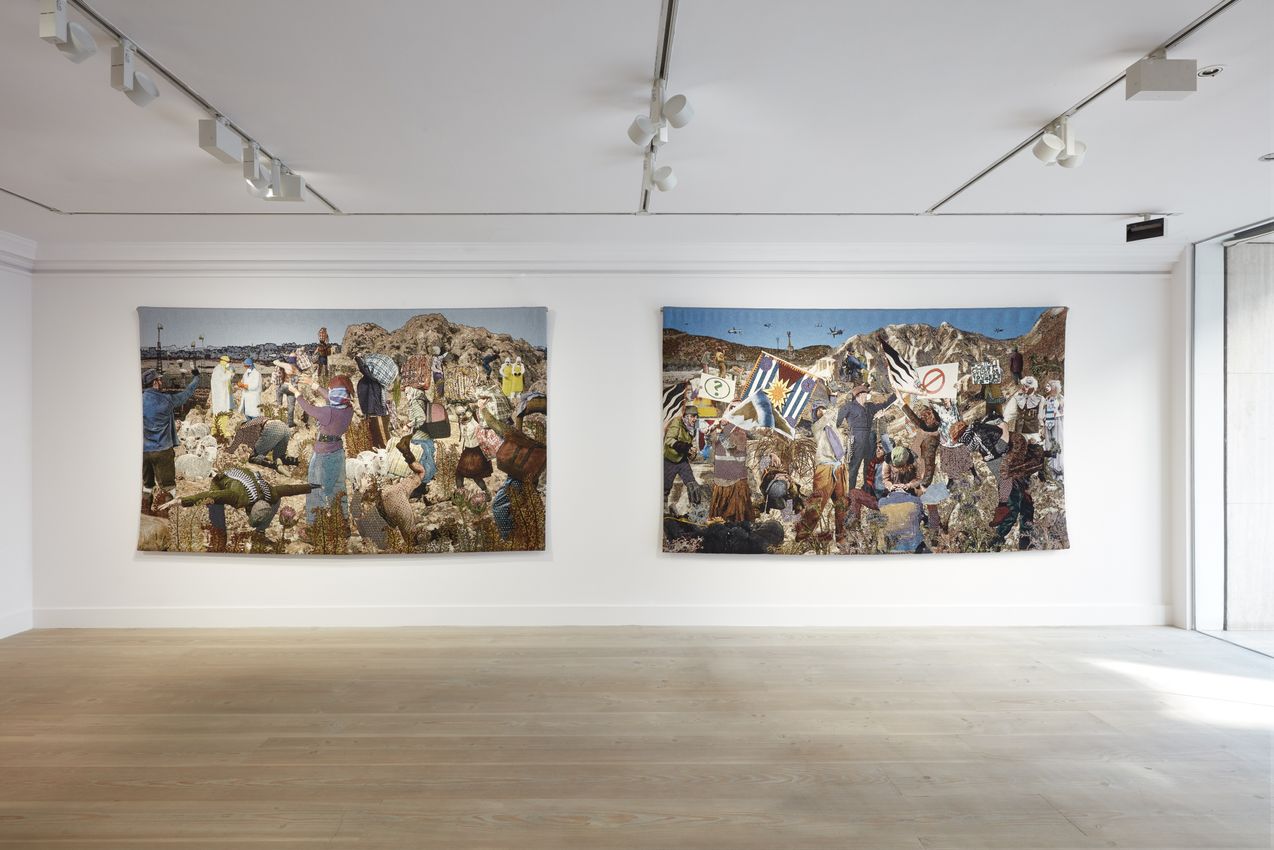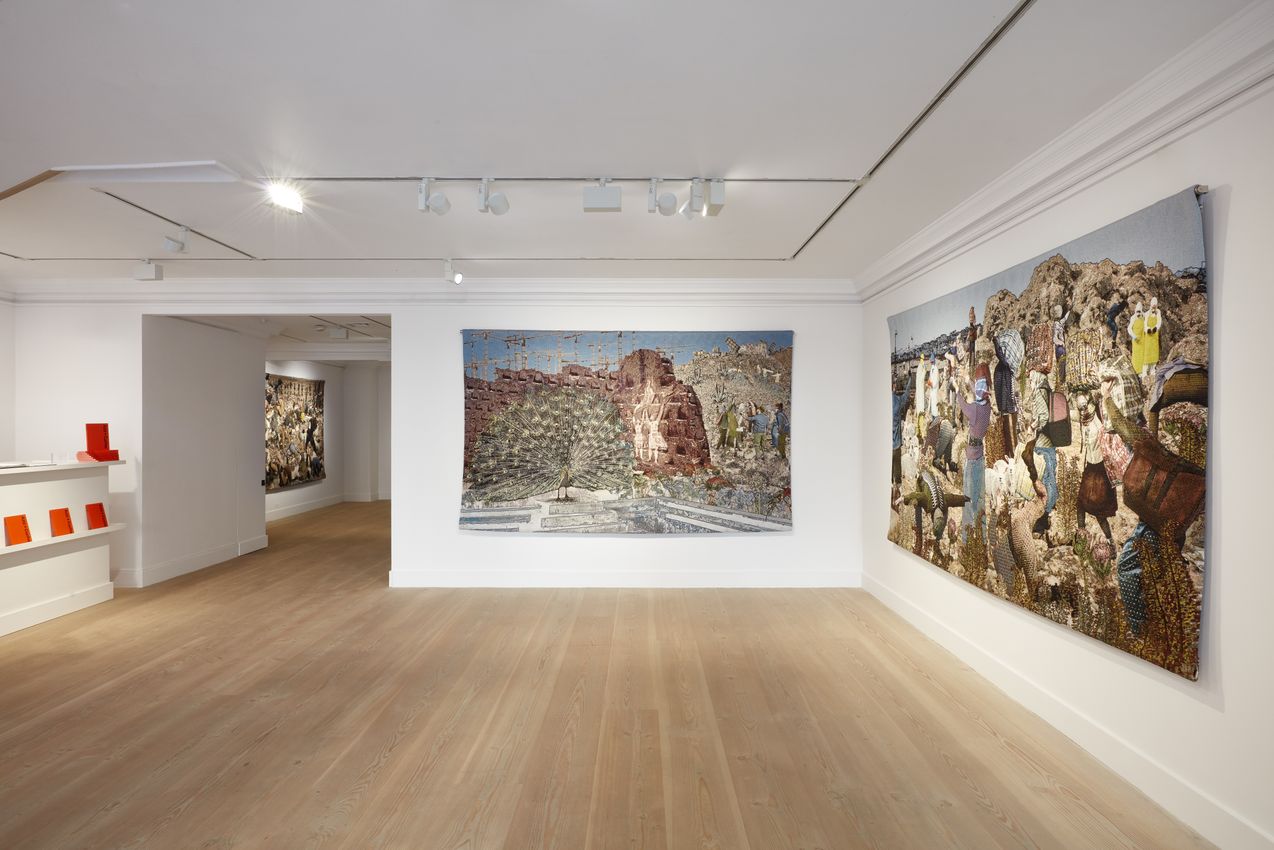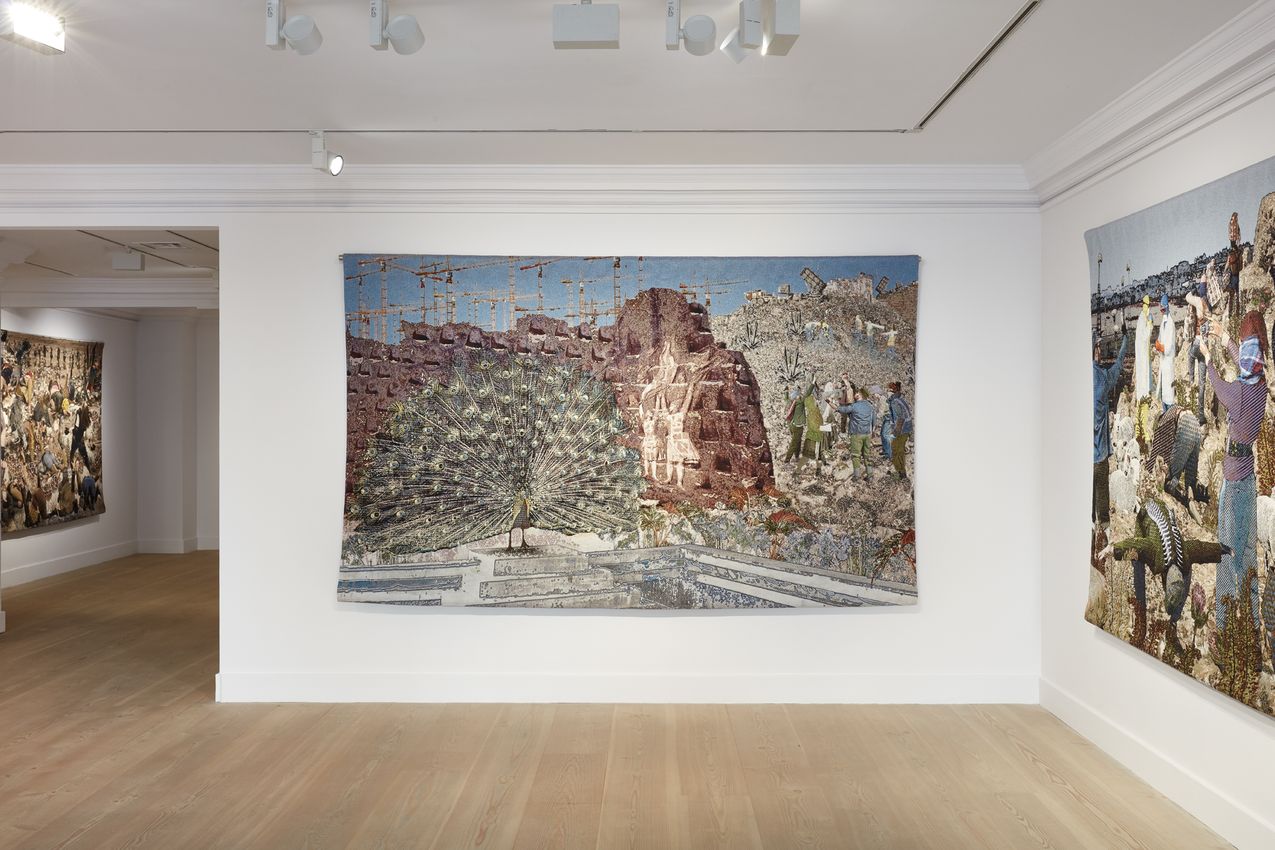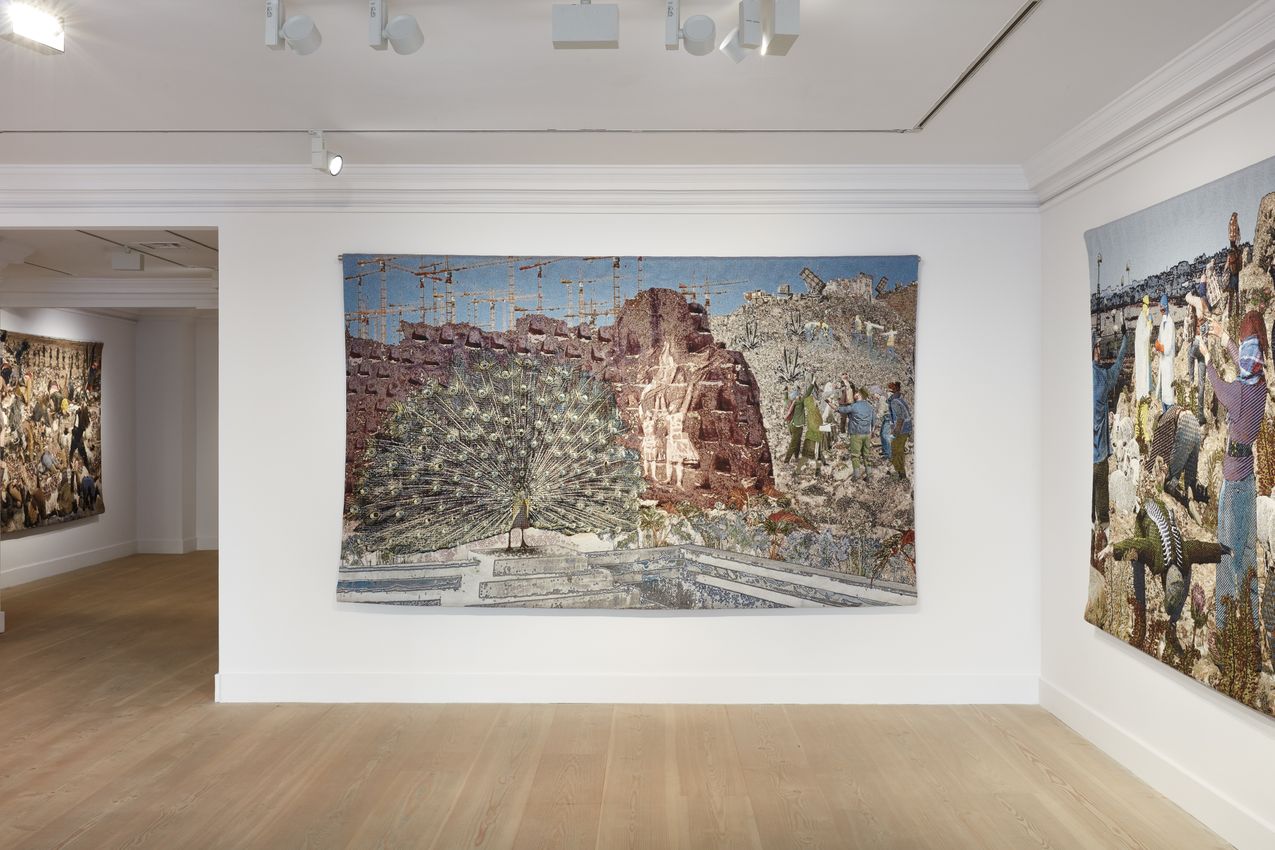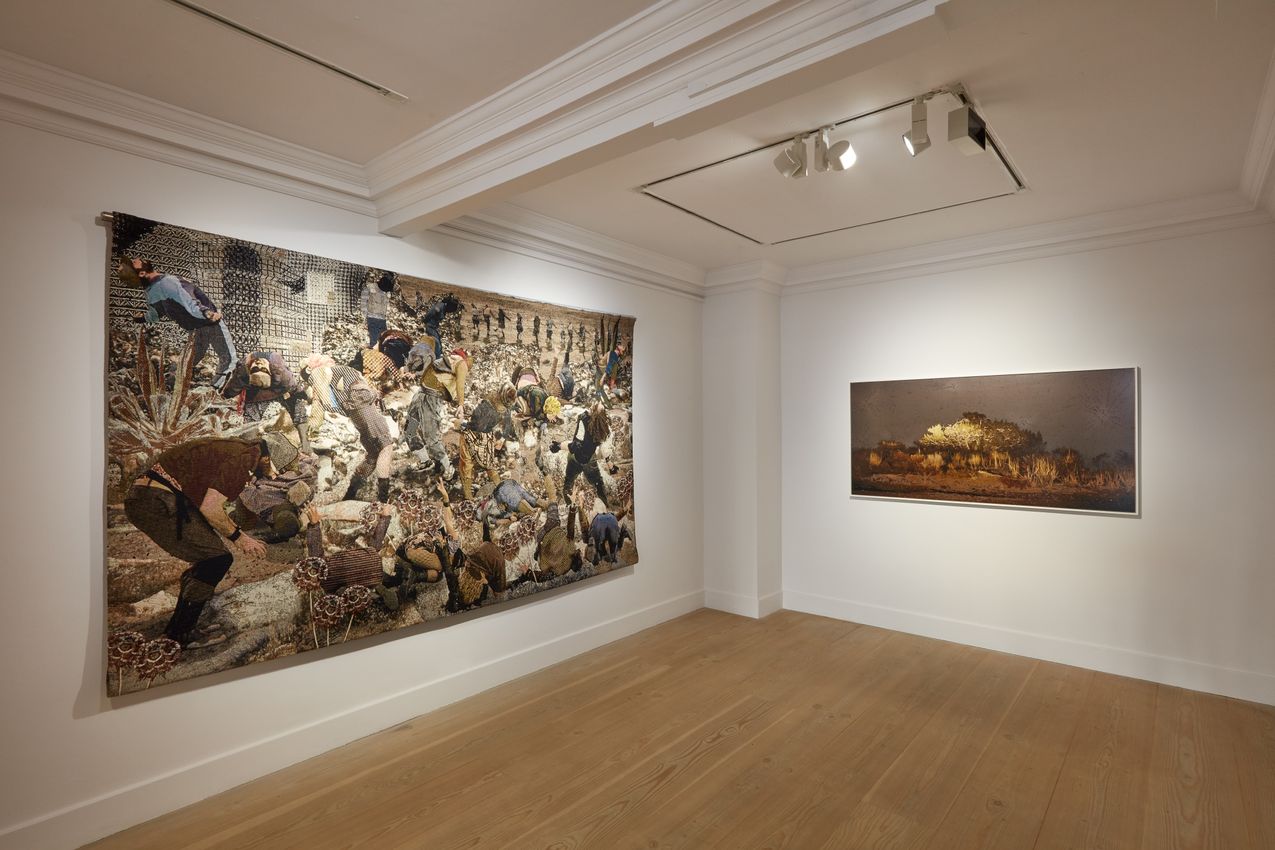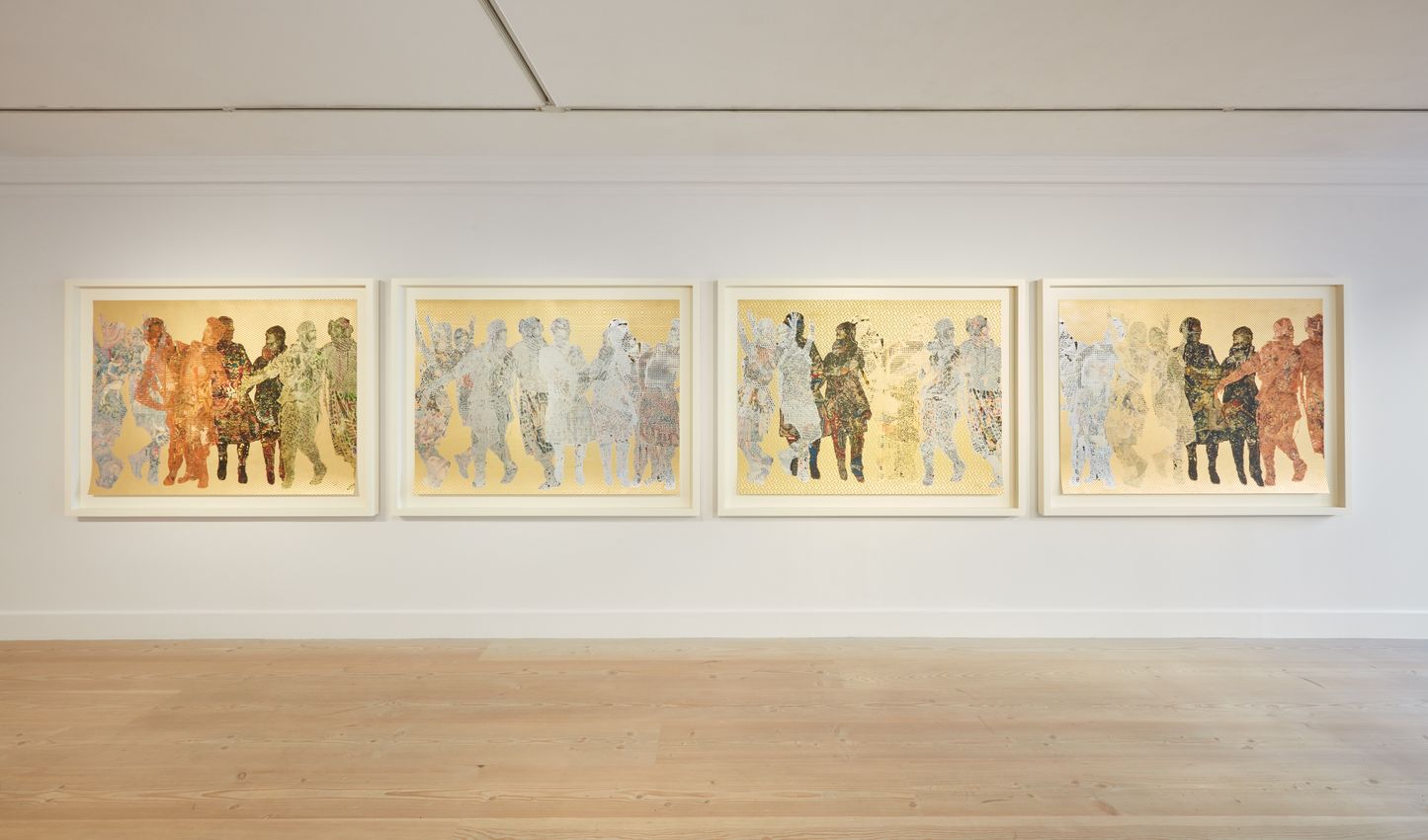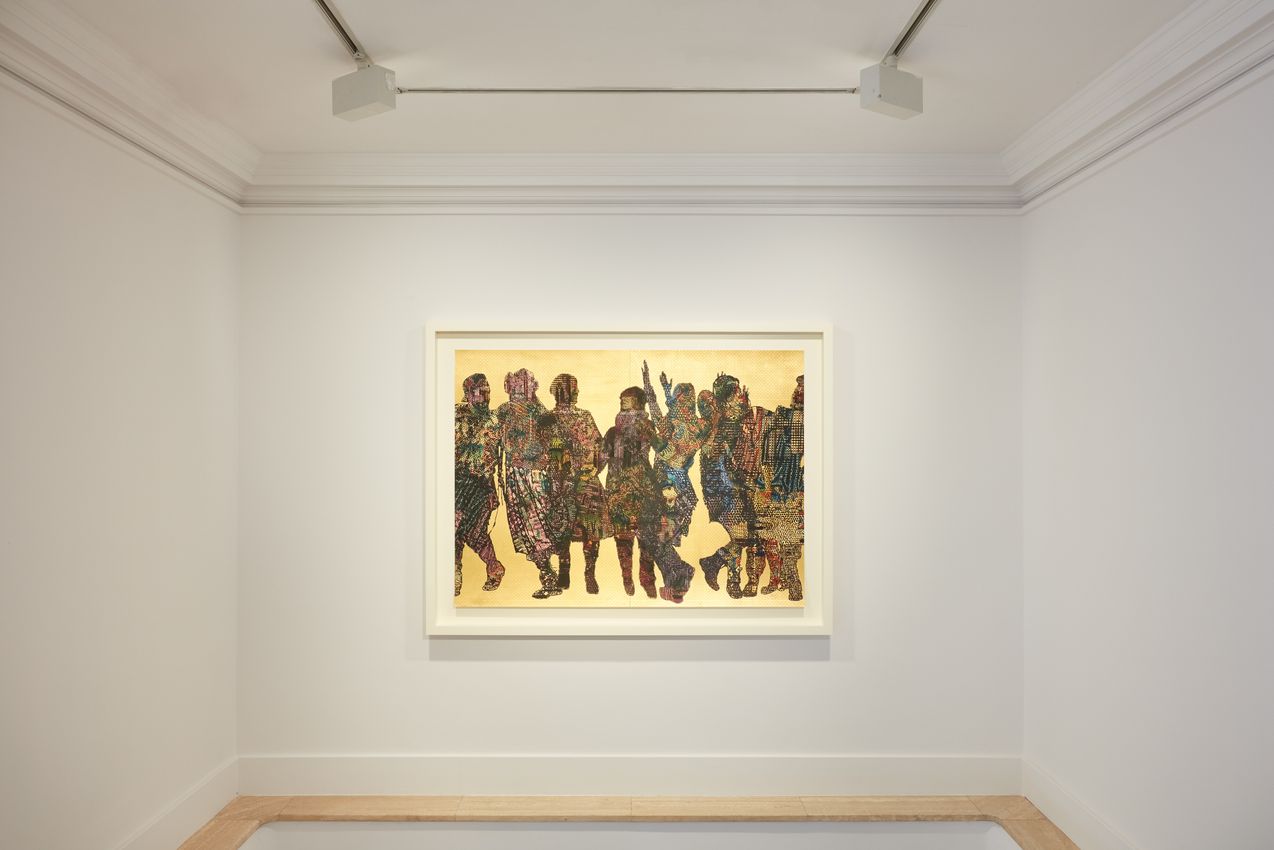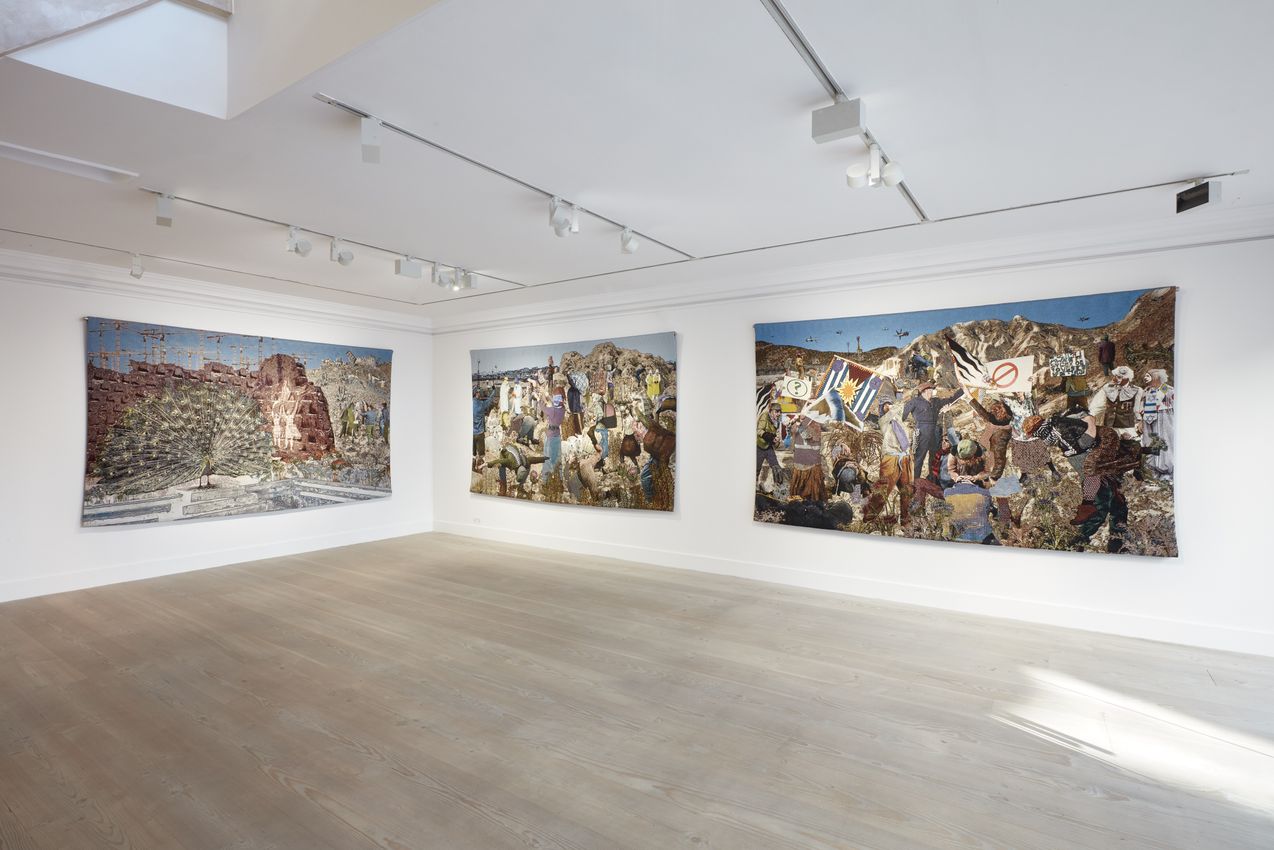
Gazelli Art House is delighted to present, Aziz + Cucher: Tapestries and New Works on Paper. The artist duo will exhibit four tapestries from the series Some People Tapestry Cycle created between 2014-2017 and five unique works on paper from the Frieze series created earlier this year.
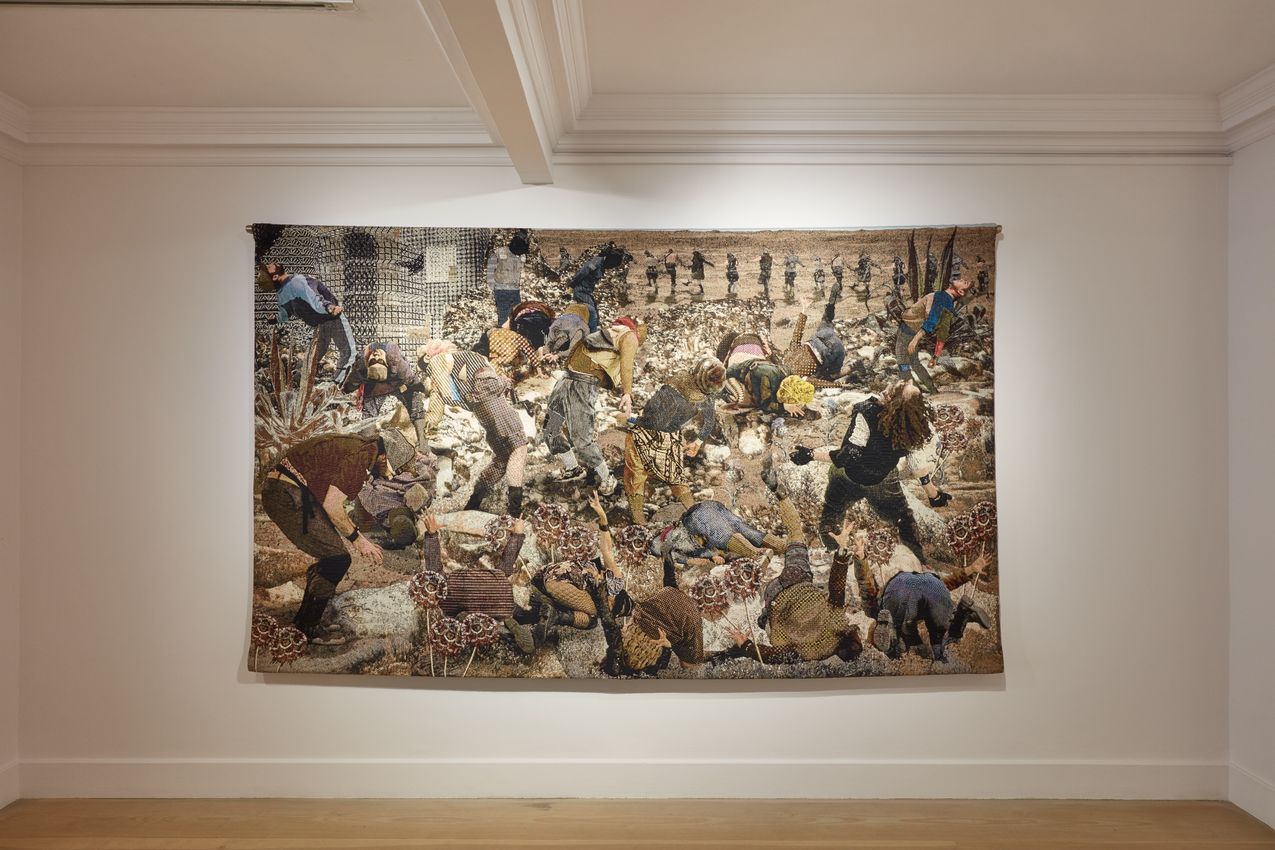
The Some People Tapestry Cycle is a series of jacquard tapestries overseen by Magnolia Editions and executed on a digital Jacquard loom in Belgium. Beginning the series in 2014, these woven works depict conflict by utilising the rich tradition of pictorial storytelling. Traditional European tapestries achieved their high point as an art form precisely at the time of the consolidation of the political and economic structures that would come to define the Modern world. Curious to see what it would mean to revisit the traditional medium through a contemporary lens, the collaborative duo wonderfully illustrates how our modern powers are being vigorously assaulted from a multitude of paradoxical extremes.
For the creation of the tapestries, they begin by outfitting dancers in customised attire and then ask them to adopt dramatic postures against a green screen. Once these poses are captured, they are sutured into a digital composition. The gures are then collaged into complex compositions set in quasi-Biblical landscapes. From there, the collages become translated into digital weaving files allowing them to utilise the abundant possibilities of the loom’s patterns and subtle gradations of colour. The jacquard loom gives the works a sensuous materiality that belies the digital nature of the process behind their making.
These monumental tapestries can be read as Historical Paintings of the Present Moment. Multiple narrative strands are merged as a result of the inherent attening that occurs through the weaving process. This also serves as a metaphor for the flattening of time and space as experienced in the image stream of the Internet and the 24-hour news cycle. The artists have described their feeling of being ‘caught in the conundrum of history’-a phrase that likewise describes the genre of history painting, and their own work’s eerie combination of stasis and turbulence.
The imagery in the tapestries contains ‘innumerable figures, intentionally non-specific. Are they refugees? freedom fighters? terrorists? tourists? And what are they up to?” They range from dramatic to the mundane, from lyrical to the absurd, in an ever-shifting point of view that does not evade from the complexities and contradictions we inhabit in the contemporary world.
Glenn Adamson writes, ‘In America and Europe, there is a sense that society is deeply fractured, at odds with itself. And-partly as a result of this dysfunction-there are actual civil wars unfolding, in Syria and elsewhere. is is the literal and gurative background for Aziz + Cucher’s powerful new tapestries, each of which shows a pageant of bodies, in freeze-frame against an unsettled landscape, pinned like butterflies within time and space itself.’
Juxtaposing the Some People tapestries, the Frieze series are unique works on paper. Borrowing similar techniques used to create the tapestries, Aziz + Cucher have translated them into a process that includes inkjet printing, silk-screen and gold leafing. Through these works the motif of dancing figures, which appears in the distance of the Some People tapestries, are brought to the fore and stand in marked contrast to the turbulent and dark world found in the tapestry works.
Anthony Aziz (b. Massachusetts) and Sammy Cucher (b. Lima, Peru) have been living and working together since 1991 when they met at the San Francisco Art Institute. They are both members of the Fine Arts faculty at Parsons School of Design/ e New School in New York and are based in Brooklyn. Aziz + Cucher have exhibited their work in museums and festivals world-wide, including the Venice Biennale, Biennale de Lyon, New Museum of Contemporary Art in New York, San Francisco Museum of Modern Art, List Visual Art Centre at MIT, National Gallery of Berlin, and the Foun- dation Cartier in Paris. They have received awards from the National Endowment for the Arts, the Pollock-Krasner Foundation, and the New York Foundation for the Arts.
Glenn Adamson, Aziz + Cucher: Tapestries and New Works on Paper, Catalogue 2018, Gazelli Art House.
Anthony Aziz + Sammy Cucher begun their career together in 1992, and have worked in a variety of media including digital imaging, sculpture, animation, and video-installation. Their new work Some People, a complex multi-channel video environment has been commissioned to premiere at the Indianapolis Museum of Art in 2012. Their work has been marked by a distinctive concern regarding technology and its impact on the human body and on consciousness. The Synaptic Bliss and Scenapse series, produced between 2003–2008 address the landscape and can be seen as an extension of their work dealing with the body in the previous decade. In these seemingly classical landscape still-images and videos, diverse forms are superimposed, become intertwined, and slowly emerge from an intensively colored flurry. Kaleidoscopic clouds evolve into trees, branches, meadows, flowers and undergrowth. Each individual shape seems in constant flux, becoming distinguished by a shift in tone, orientation, or size of its colored texture. The works in this series appear like electronic impressionism with almost hallucinatory, disorientating effects. In their work they have held a long conversation between the painterly and the photographic. Not only were their earlier works such as Dystopia, 1994–95, based on the conventions and traditions of portraiture established in the renaissance, but the actual making of those digitally altered photographs involved a kind of electronic painting where pigment and paint were replaced by pixels and data. This dynamic relationship between these two mediums tipped decisively towards the painterly in later works like the Nocturnes and the videos from Synaptic Bliss, 2003–4, where in an effort to represent a mode of perception signed by digital technology and science, they let go of photographic realism and opted for a complex and multilayered flatness that veered towards abstraction and where color and line were the main expressive elements. In the Scenapse series they have reclaimed some elements of photographic representation and its power to capture and maintain the specificity of the world. Yet this world is modulated by fragmentation, separation, and reconstitution, as markers of a consciousness that can only see the world in pieces but that can achieve a kind of ecstatic hyper-awareness of the interconnectedness of all parts.


A respected voice in contemporary art discourse.
Focusing on ambitious storytelling and insightful art-world commentary. Ocula Magazine publishes in-depth interviews, critical essays and timely analysis on the artists, exhibitions and ideas driving the global art world.
Learn more about Ocula Magazine
Showcasing the best of the art world.
Ocula partners with galleries from around the world to highlight their artists, artworks and exhibitions. Gallery membership is by application and invitation, with each member vetted by an independent panel.
Learn more about Ocula Membership

Specialises in the sale of major artworks.
Led by a team with deep ties to the world’s leading auction houses, galleries and collectors. Ocula’s advisory team offers bespoke services to high-net-worth clients from around the world who are looking to acquire the best of contemporary and modern art.
Learn more about our team and services