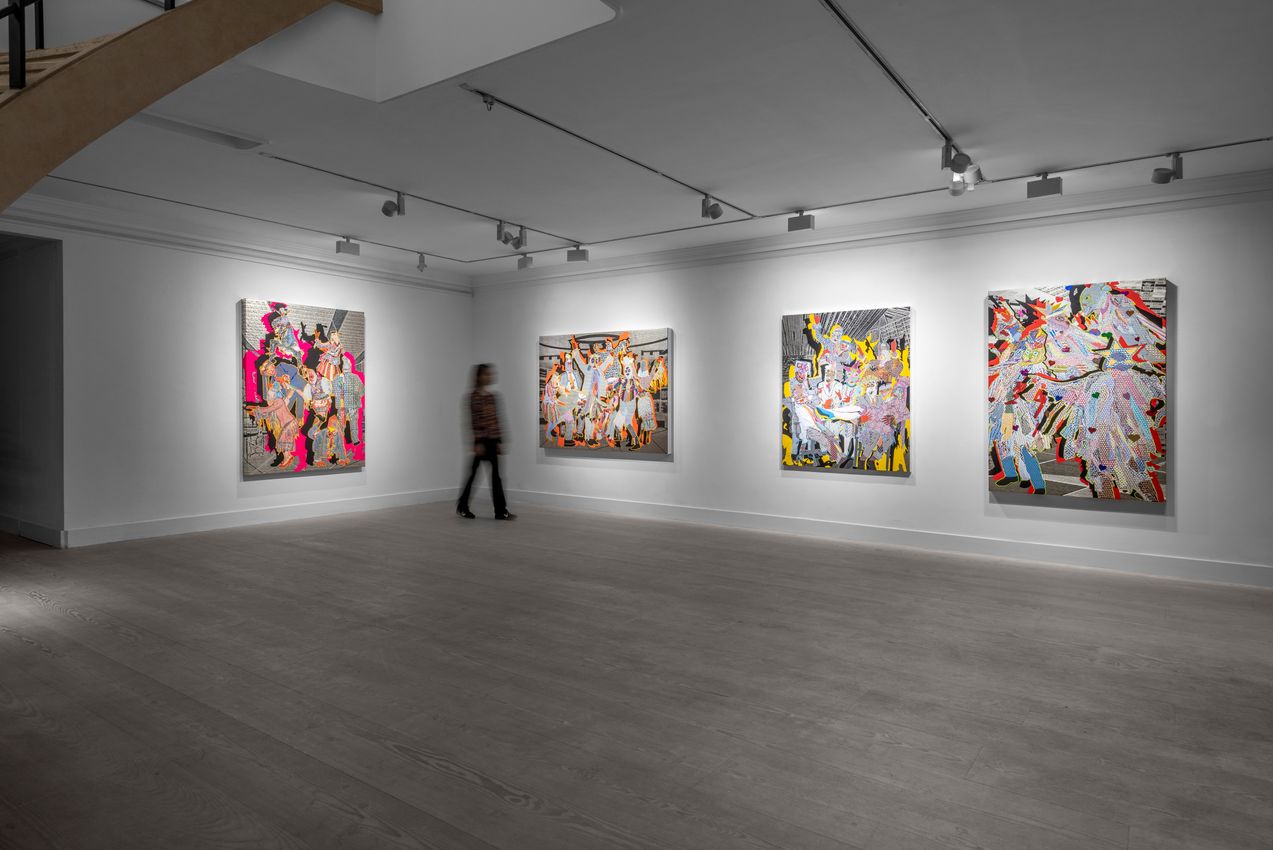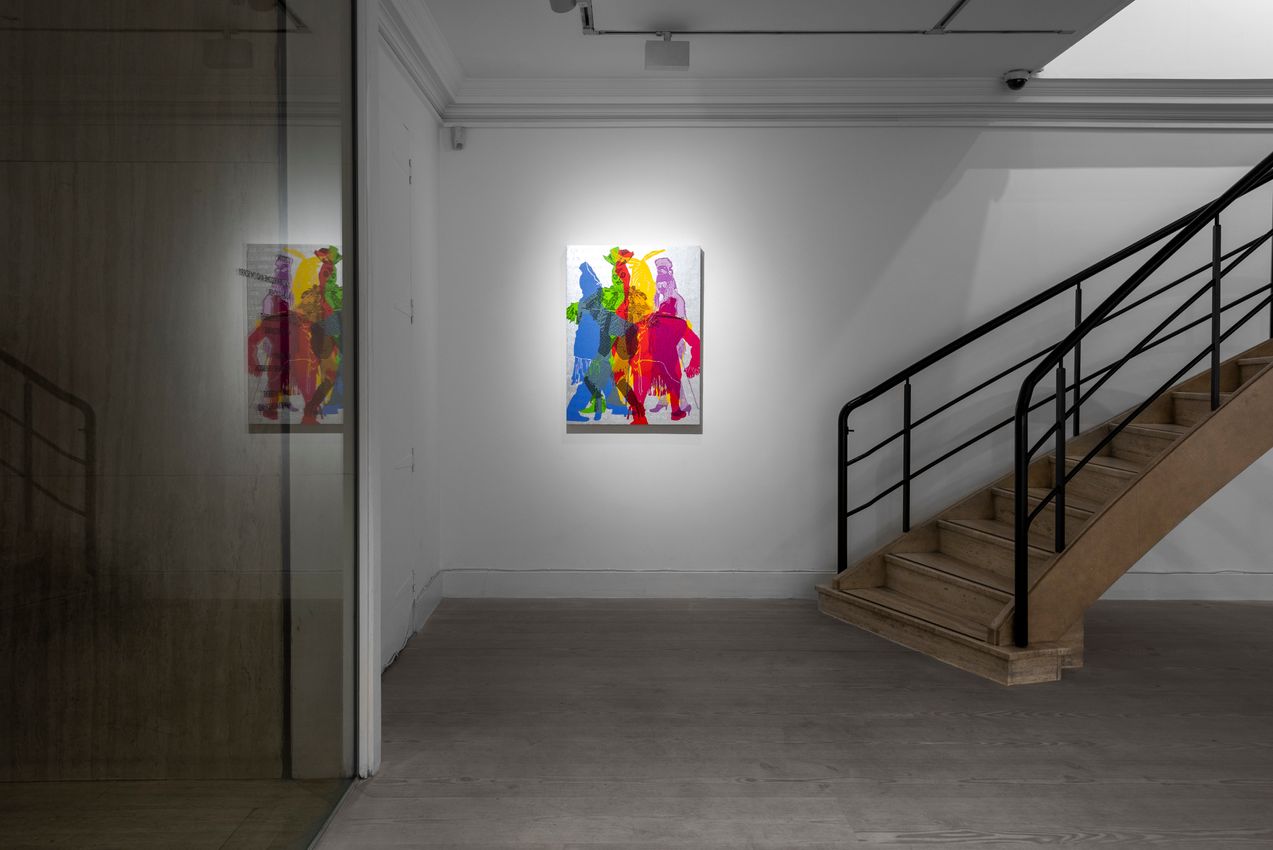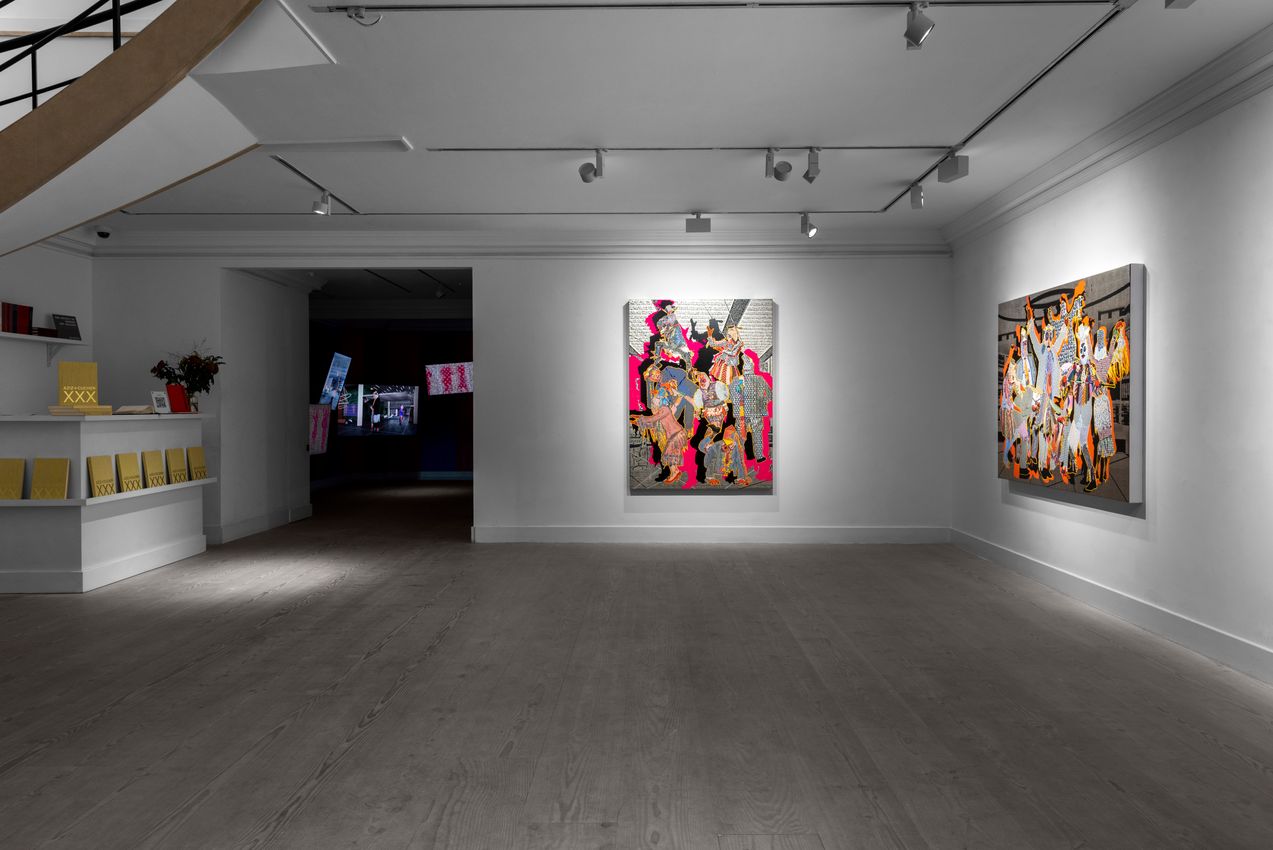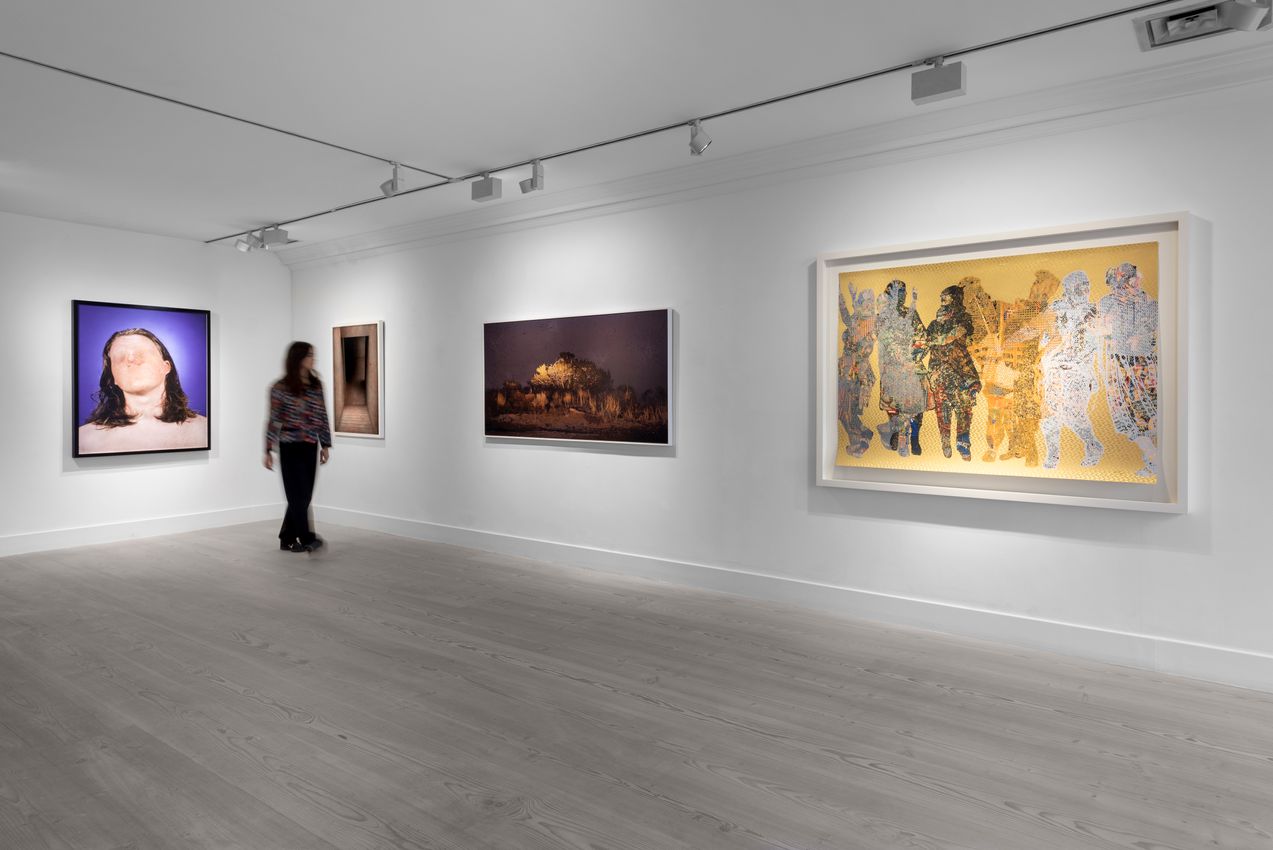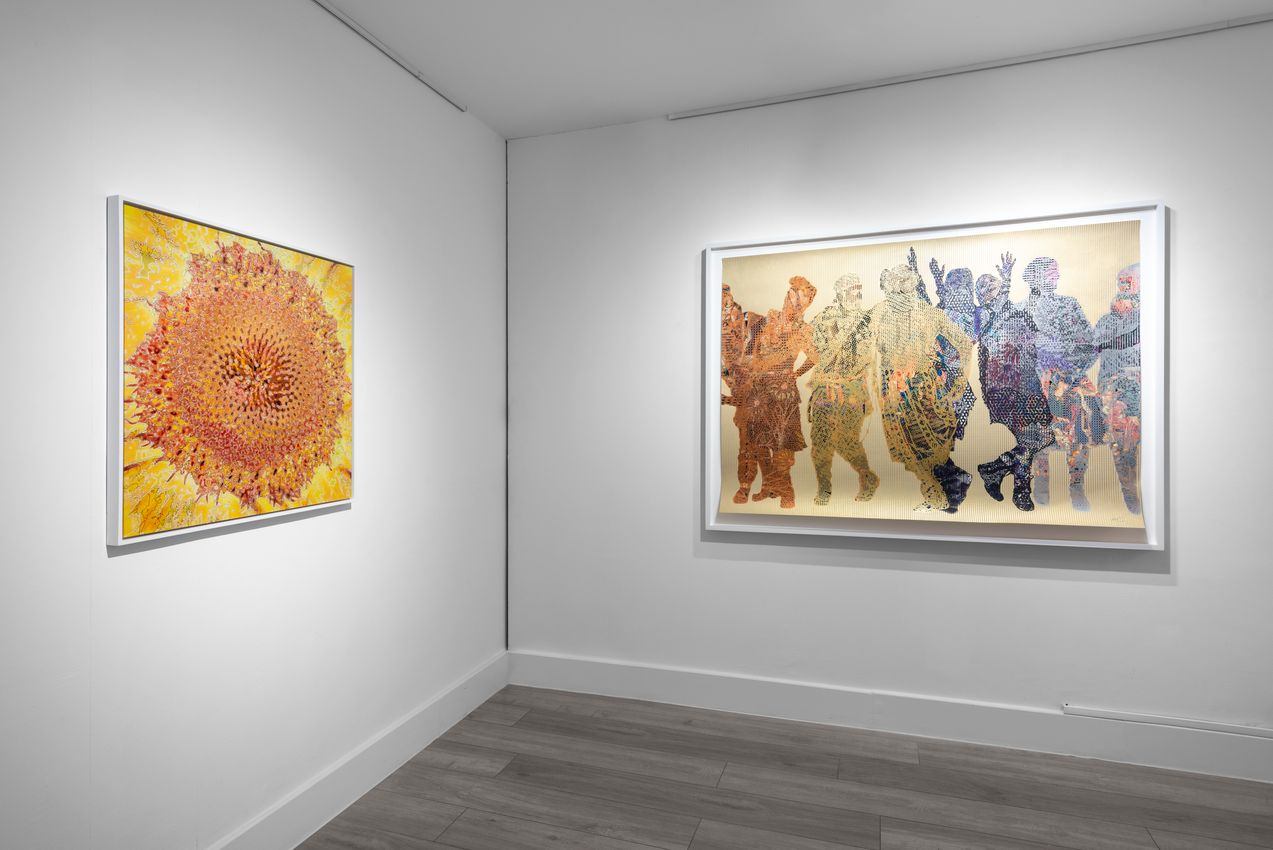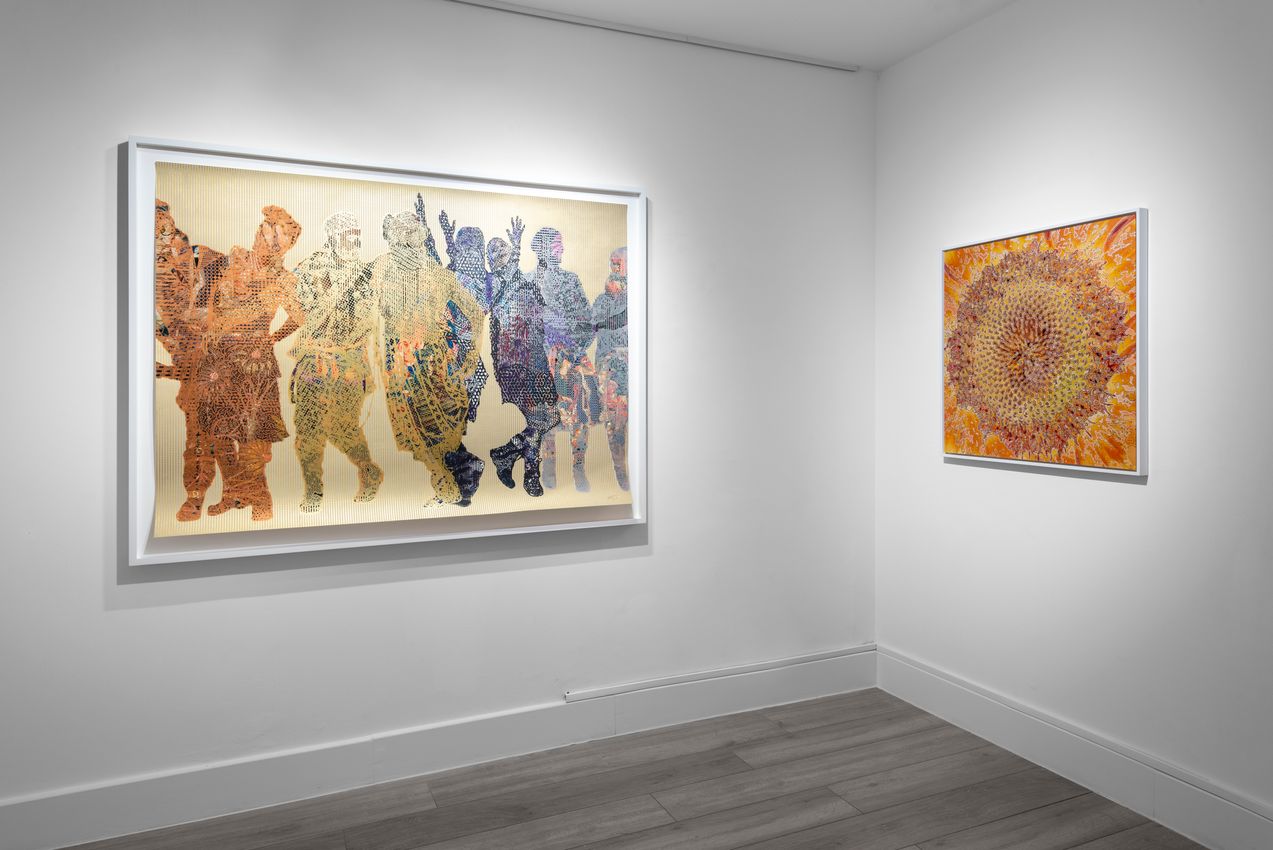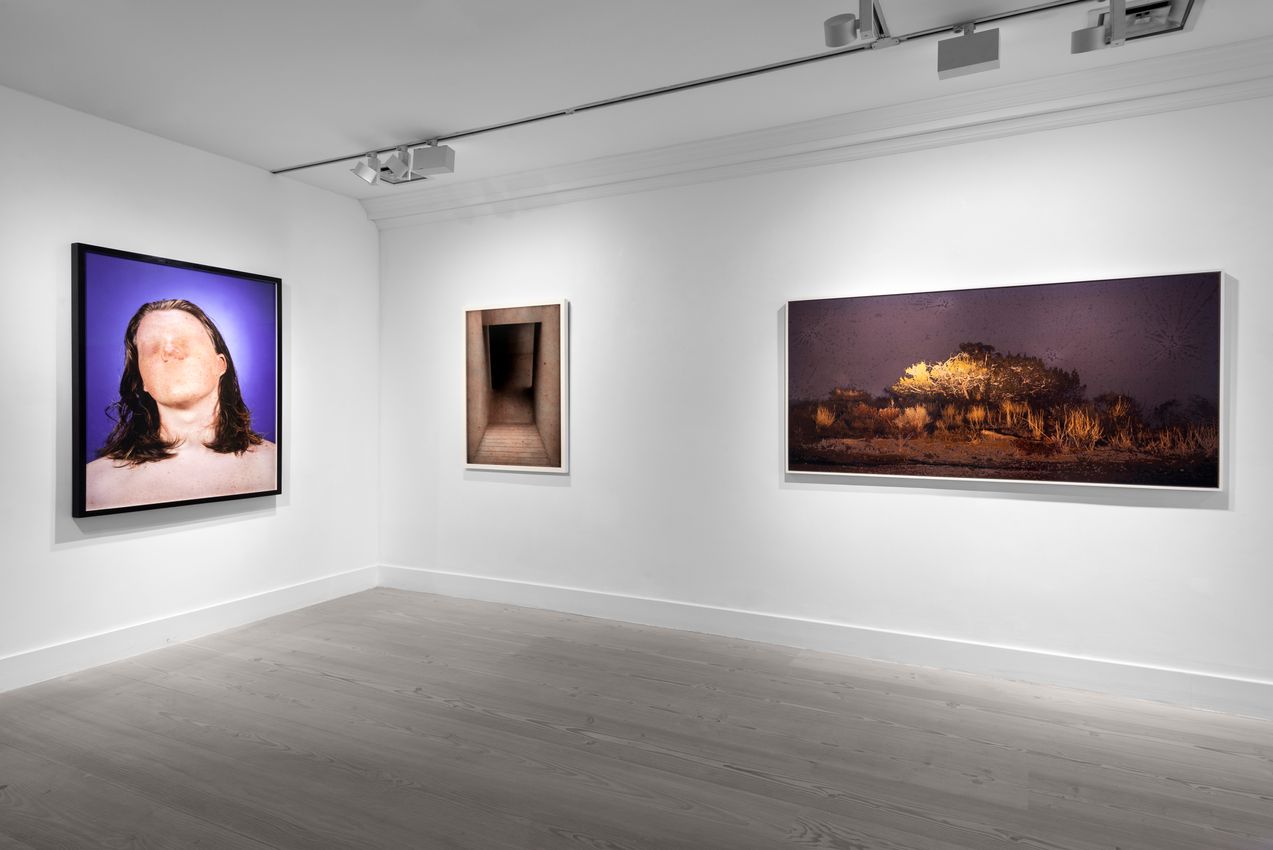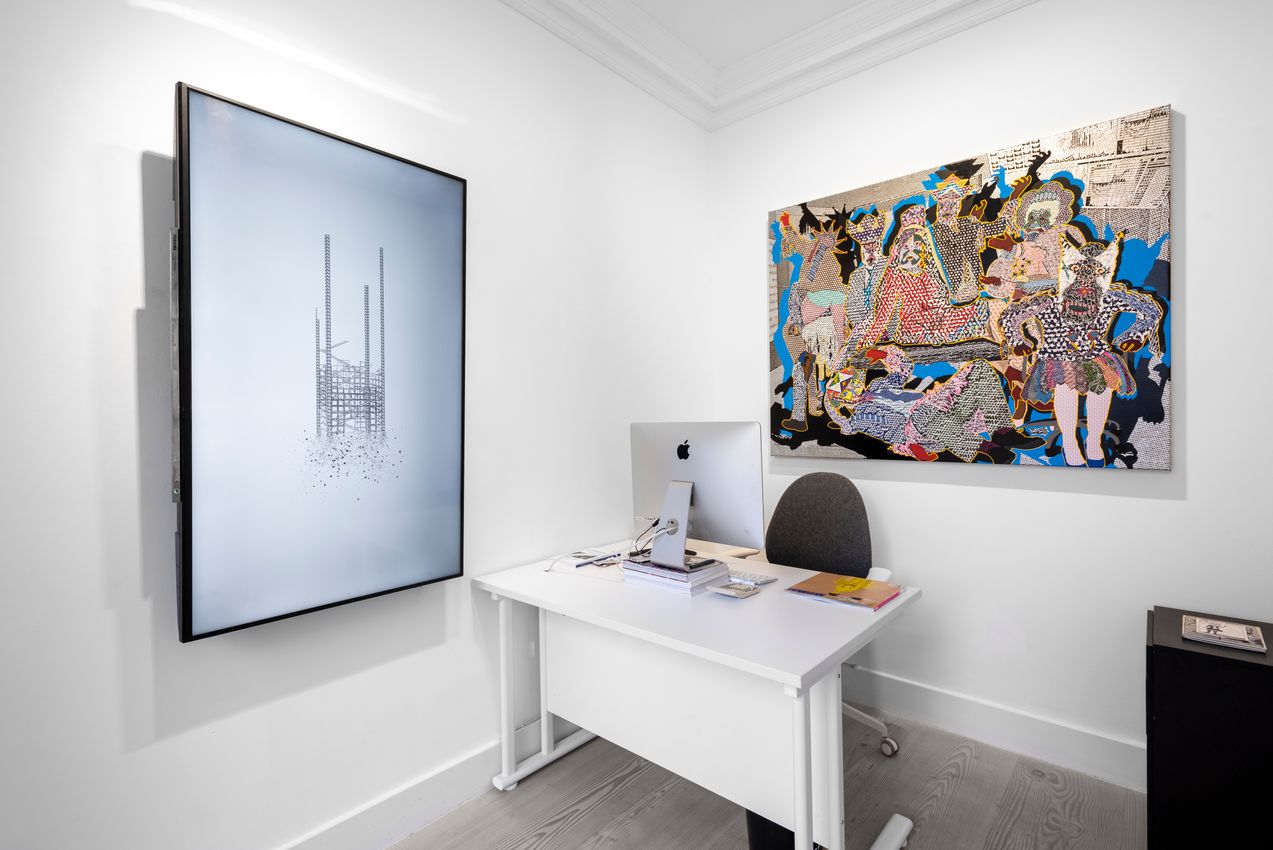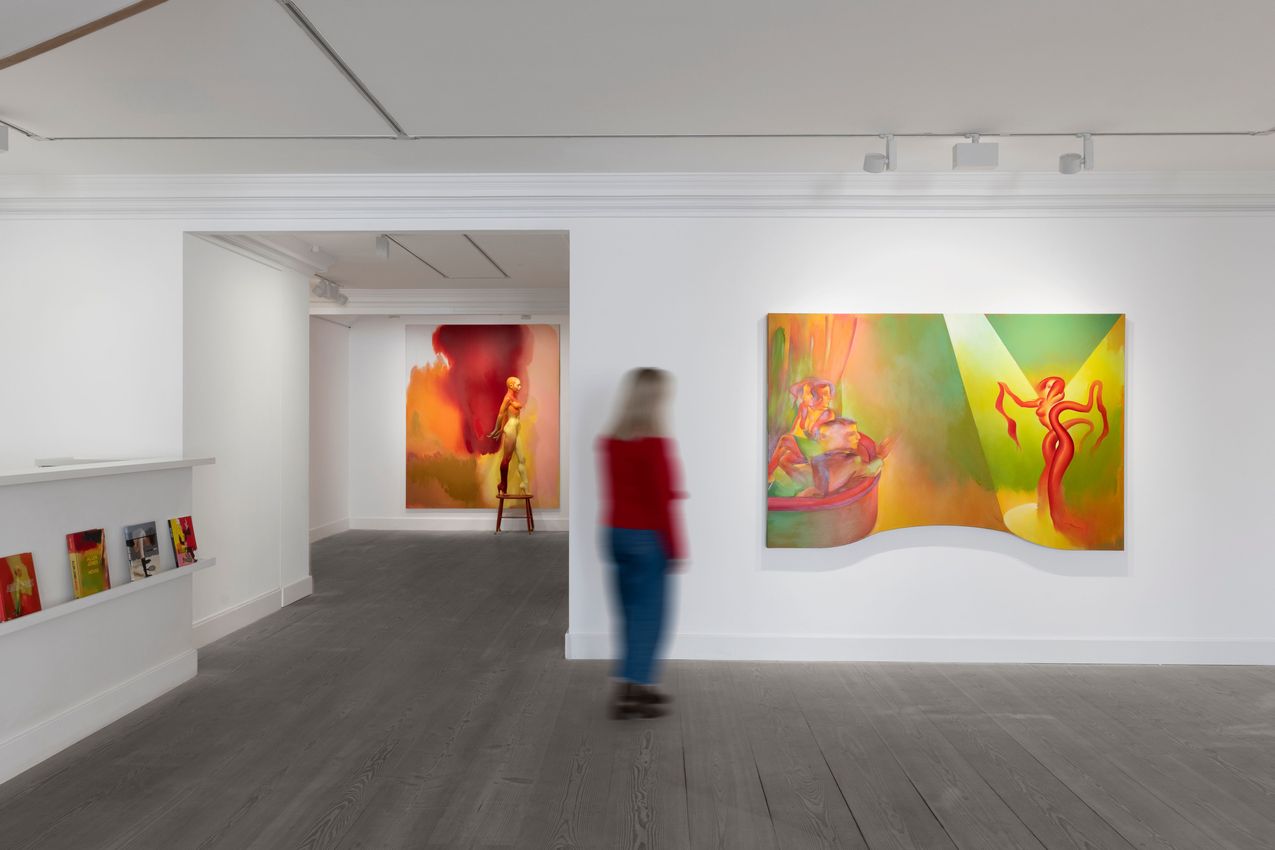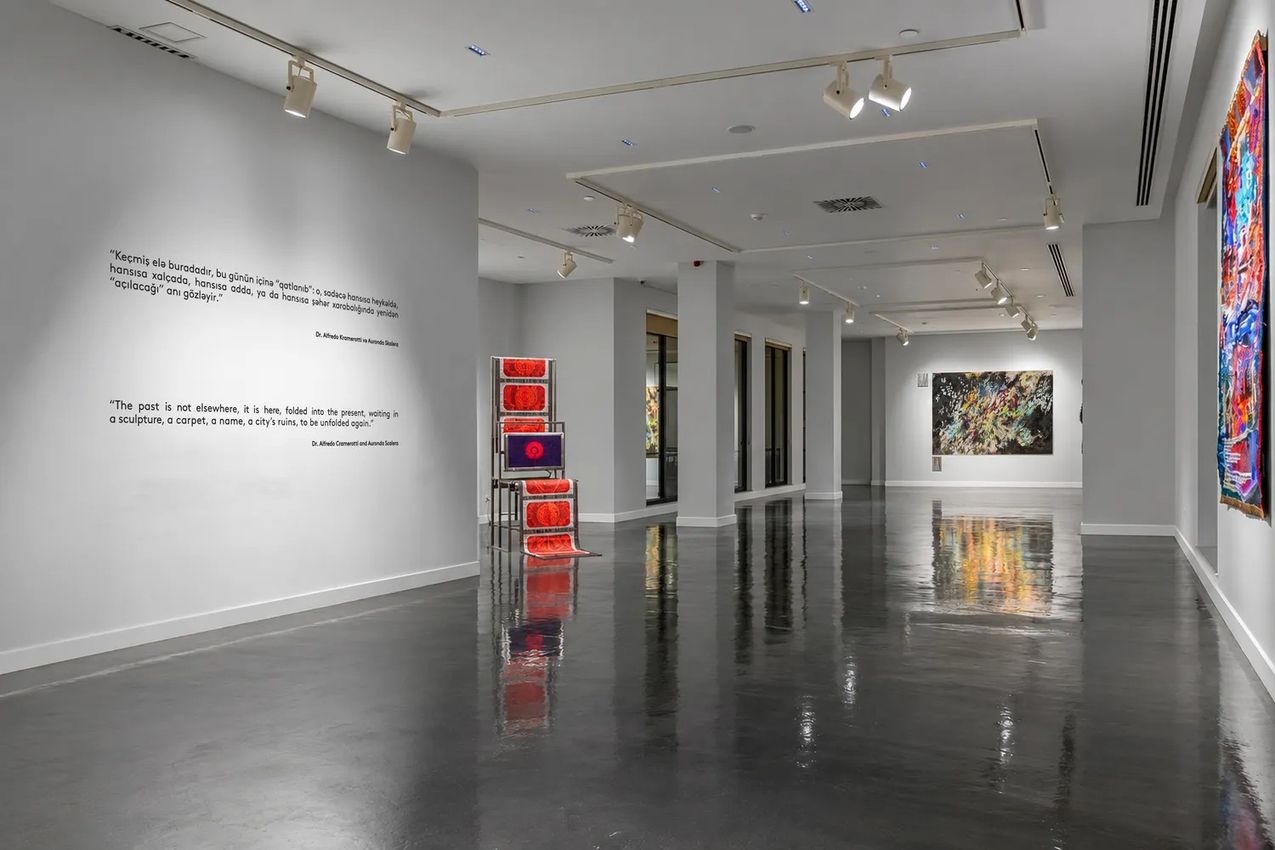




Gazelli Art House proudly presents You’re Welcome and I’m Sorry, an exhibition of recent works on canvas and video along with a selection of historically important pieces that mark the three decades of artistic collaborationbetween Anthony Aziz and Sammy Cucher (Aziz + Cucher). Encapsulating the duo’s cross-disciplinary practice,You’re Welcome and I’m Sorry offers familiar and never-before-seen artworks in a multidimensional display.
In the video installation You’re Welcome and I’m Sorry (2019, originally commissioned for MASS MoCA), elements of the carnivalesque signal the theatre of our global financial system. Within six flat-screens of various sizes,costumed characters in deconstructed power-suits dance and gesticulate across quasi-corporate locations,intertwined with images that evoke the spectre of white supremacy. The figures’ oration of financial formulasfeed into a multi-layered soundtrack, as visceral as the kaleidoscopic walls, rendered in colours of bank logos.The immersive quality of the work captures the ‘irrational forces that mould our political and economicsystems’.
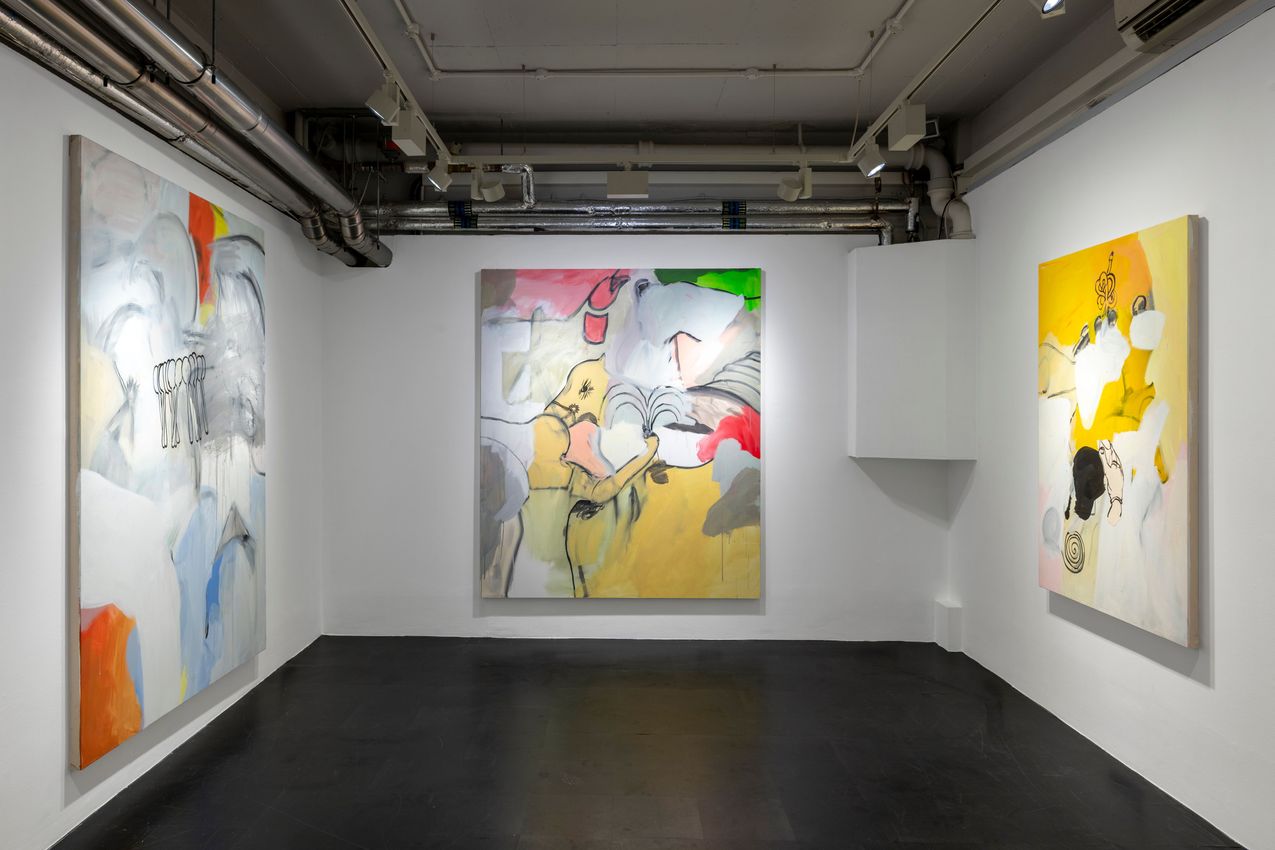
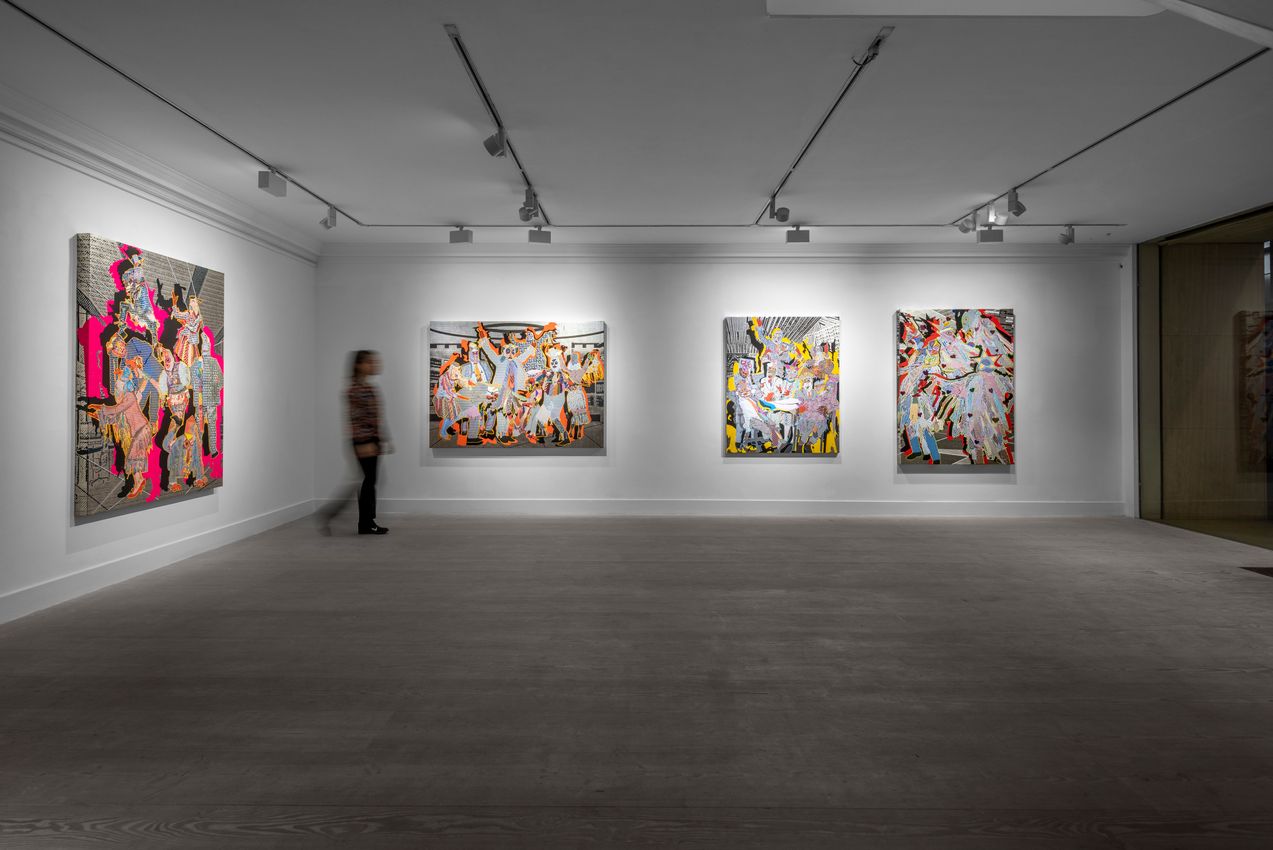
Expanding on these themes and motifs, a series of new, mixed media paintings (2021—22) translates the kinetic energy of the absurd, suited figures to two-dimensional works on canvas. Satirising the complexity andmystification of the financial system, the costumed figures are here rendered in compositions of mesmerisingtextural and visual contrasts. The artworks’ meticulous material creation continues Aziz + Cucher’s interest inusing dense, pixelated surfaces as analogies for the pervasive information that floods contemporary life.
2022 marks the 30th anniversary of the artists’ collaboration and to celebrate this milestone La Fábrica Editions (Madrid) and Gazelli Art House are pleased to present XXX: Aziz + Cucher 1992—2022. Covering theartists’ entire career, this monograph will include 130 full colour reproductions of the work that the artistshave created together since 1992. Essays by independent curator Agustin Perez Rubio and cultural critic ArunaD’Souza will be featured, along with a conversation with pioneering digital artist Lynn Hershman Leeson.
Anthony Aziz (B. 1961, USA) and Sammy Cucher (B. 1958, Peru) have worked together as artistic duo Aziz + Cucher since 1992. Experimenting across a variety of media including digital imaging, sculpture, animation,and video-installation, their work is marked by a distinctive concern for technology and its impact on thehuman body, consciousness and society.
Regarded as innovators in the field of post-photography, Aziz + Cucher have long held a cross disciplinary conversation between the painterly and photographic. Not only were earlier series, such as Dystopia (1994-95),based on the conventions of portraiture established in the Renaissance, but their production involved a kindof electronic painting where pigment and paint were replaced by pixels and data. The dynamic relationshipbetween these two mediums tipped decisively towards the painterly in later series, such as Synaptic Bliss (2003-4)and Scenapse (2007-2013) where colour and line became key expressive elements.
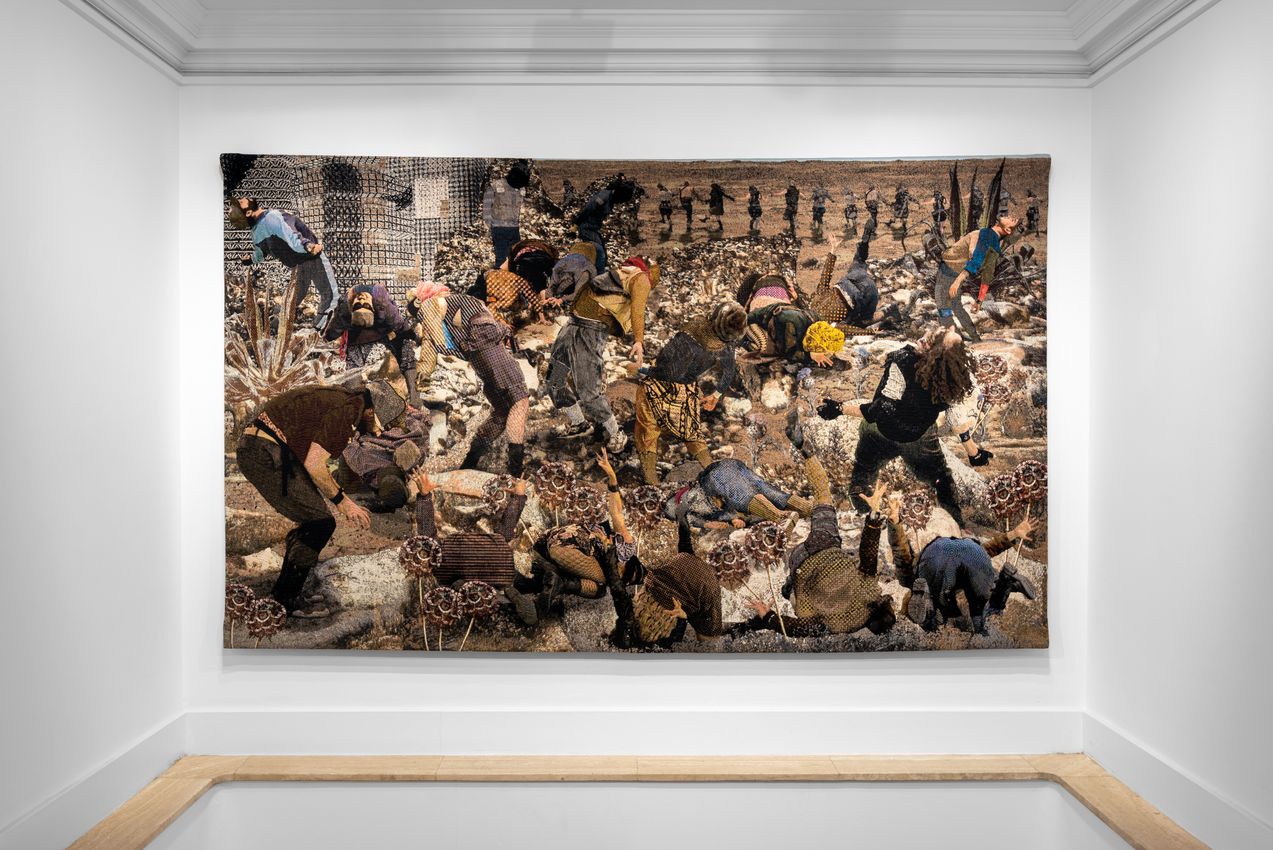
More recent series have encompassed ideas of collective consciousness, political and social unrest, and the effects of technological mediation. Fascinated by the pictorial storytelling and exacting craftsmanship ofclassical weaving, Aziz + Cucher’s tapestry series Some People (2014-16) looks to evoke the senselessness andfutility of these ongoing conflicts and the anxiety of the historical moment we all inhabit.
Aziz + Cucher have been exhibited globally, notably at the 46th Venice Biennale, with works held in museum collections including: the San Francisco Museum of Modern Art; Los Angeles County Museum of Art; TheNew School Art Collection, New York; Museo Nacional Centro de Arte Reina Sofia, Madrid; National Galleryof Australia. Based in Brooklyn, the artists are members of the Fine Arts faculty at Parsons School of Design(New York).
Anthony Aziz + Sammy Cucher begun their career together in 1992, and have worked in a variety of media including digital imaging, sculpture, animation, and video-installation. Their new work Some People, a complex multi-channel video environment has been commissioned to premiere at the Indianapolis Museum of Art in 2012. Their work has been marked by a distinctive concern regarding technology and its impact on the human body and on consciousness. The Synaptic Bliss and Scenapse series, produced between 2003–2008 address the landscape and can be seen as an extension of their work dealing with the body in the previous decade. In these seemingly classical landscape still-images and videos, diverse forms are superimposed, become intertwined, and slowly emerge from an intensively colored flurry. Kaleidoscopic clouds evolve into trees, branches, meadows, flowers and undergrowth. Each individual shape seems in constant flux, becoming distinguished by a shift in tone, orientation, or size of its colored texture. The works in this series appear like electronic impressionism with almost hallucinatory, disorientating effects. In their work they have held a long conversation between the painterly and the photographic. Not only were their earlier works such as Dystopia, 1994–95, based on the conventions and traditions of portraiture established in the renaissance, but the actual making of those digitally altered photographs involved a kind of electronic painting where pigment and paint were replaced by pixels and data. This dynamic relationship between these two mediums tipped decisively towards the painterly in later works like the Nocturnes and the videos from Synaptic Bliss, 2003–4, where in an effort to represent a mode of perception signed by digital technology and science, they let go of photographic realism and opted for a complex and multilayered flatness that veered towards abstraction and where color and line were the main expressive elements. In the Scenapse series they have reclaimed some elements of photographic representation and its power to capture and maintain the specificity of the world. Yet this world is modulated by fragmentation, separation, and reconstitution, as markers of a consciousness that can only see the world in pieces but that can achieve a kind of ecstatic hyper-awareness of the interconnectedness of all parts.


A respected voice in contemporary art discourse.
Focusing on ambitious storytelling and insightful art-world commentary. Ocula Magazine publishes in-depth interviews, critical essays and timely analysis on the artists, exhibitions and ideas driving the global art world.
Learn more about Ocula Magazine
Showcasing the best of the art world.
Ocula partners with galleries from around the world to highlight their artists, artworks and exhibitions. Gallery membership is by application and invitation, with each member vetted by an independent panel.
Learn more about Ocula Membership

Specialises in the sale of major artworks.
Led by a team with deep ties to the world’s leading auction houses, galleries and collectors. Ocula’s advisory team offers bespoke services to high-net-worth clients from around the world who are looking to acquire the best of contemporary and modern art.
Learn more about our team and services