Press Release

For the second chapter of la chambre humaine, Dominique Gonzalez-Foerster brings togethera circle of eight artists—Anísio O. Couto, Sarah-Anaïs Desbenoit, Mimosa Echard,Muyeong Kim, Matthew Lutz-Kinoy, Ji-Min Park, Rirkrit Tiravanija and Leïla Vilmouth—whose works reveal a set of shared links and echoes. The result is a subjective and affective panorama that recalls a collective or “relational” way of making exhibitions, a process DGFhas applied since L’Hiver de l’amour [The Winter of Love] at the MAMVP in 1994 and up to la Décennie [The Decade] with Stéphanie Moisdon at the Centre Pompidou-Metz in 2014.

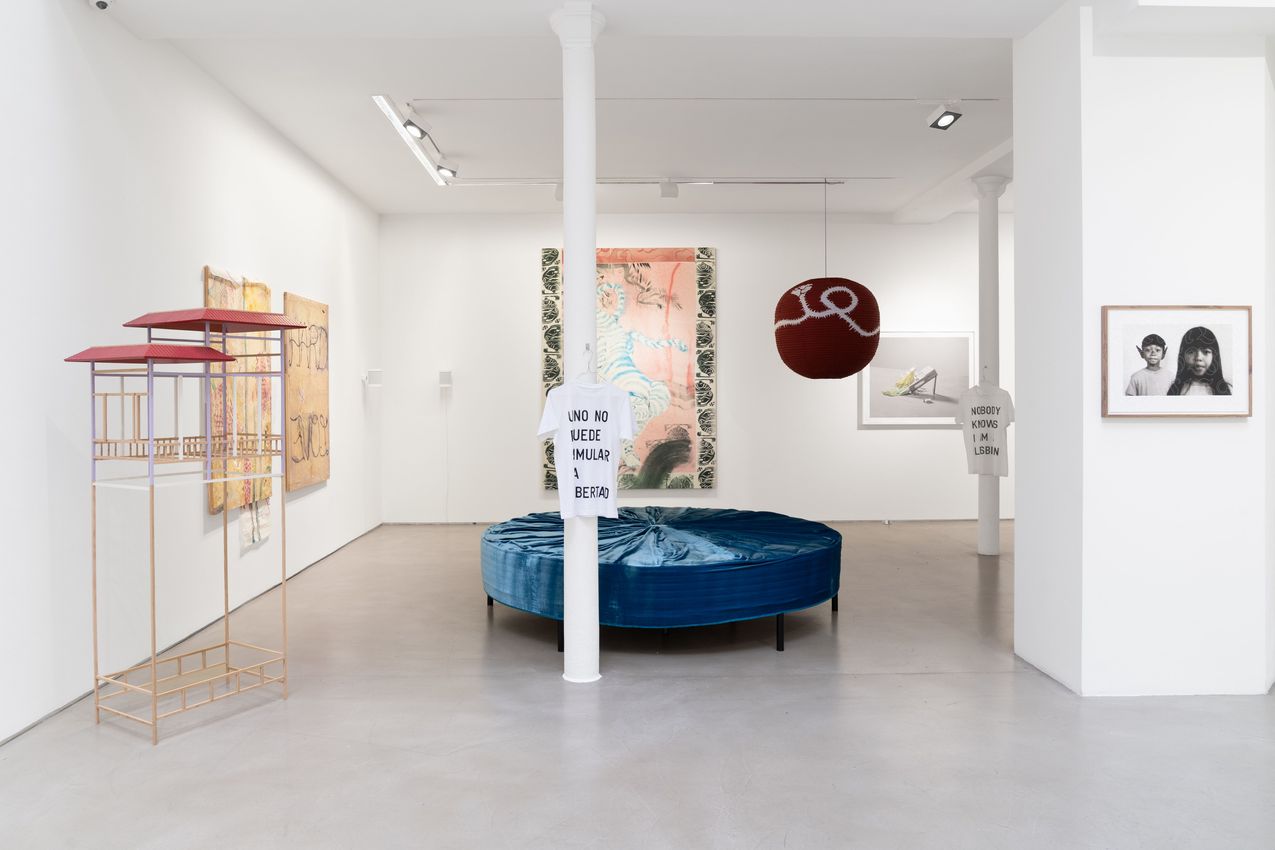
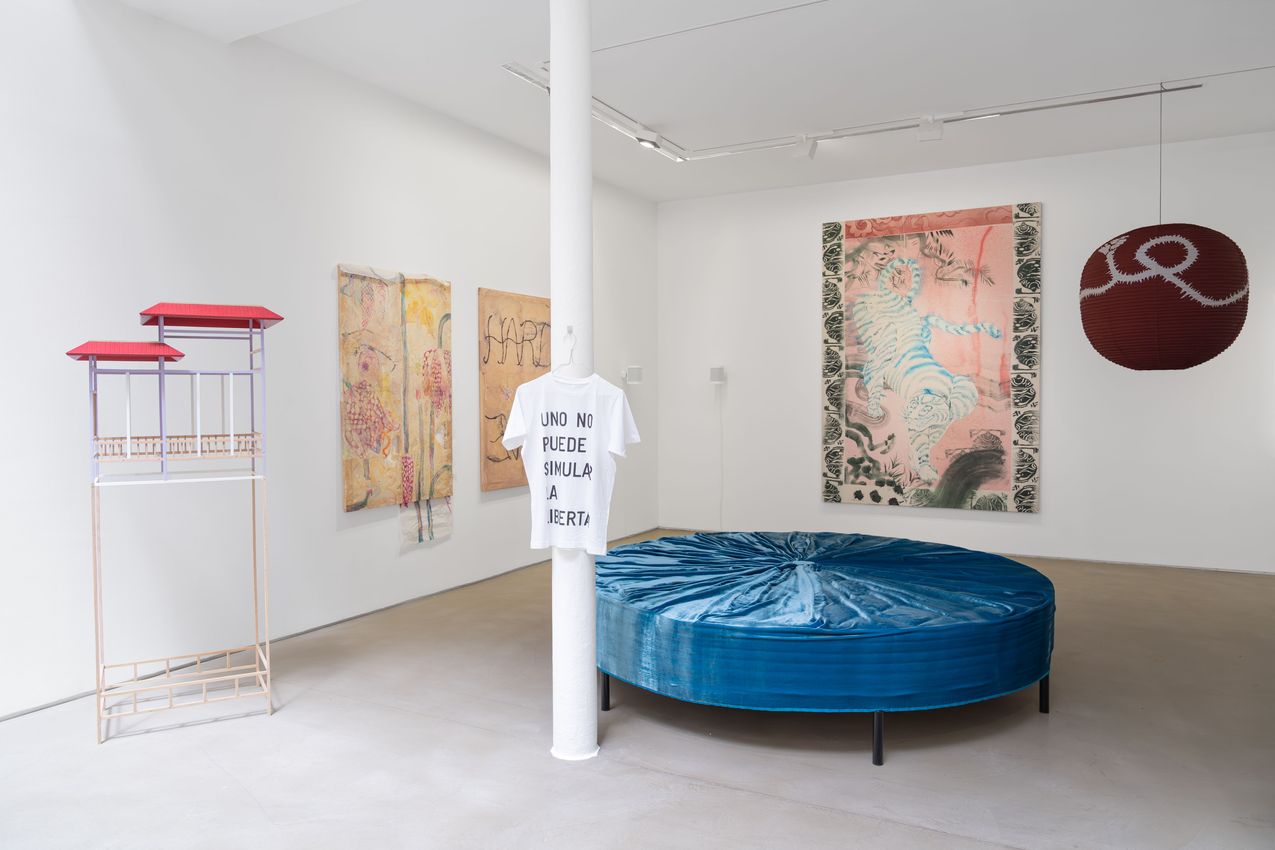
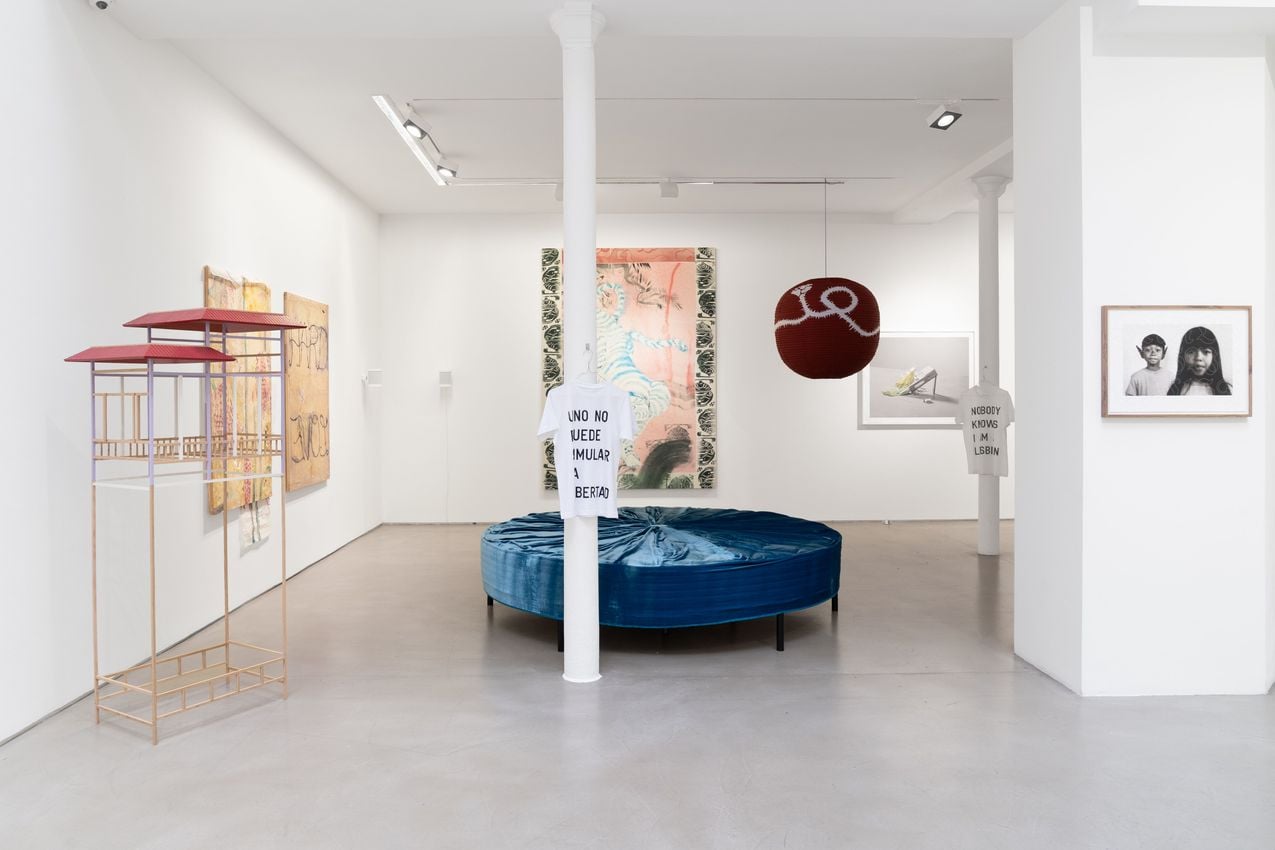
Sequels are particularly enjoyable in literature and cinema, and even more so in the field of exhibition-making, where they remain the exception. La chambre humaine & le sommeil électronique thus reclaims the space of the room—biographical as much as cinematic—as developed by Dominique Gonzalez-Foerster since Nos années 70 (1992) and RWF (Chambre) (1993), and the round bed of la chambre humaine & la planète close (2021). The bed becomes a nocturnal workshop, a seat for conversation, a sensitive observation post. It evokes both the parade bed of 19th-century courtesans, designed for receiving visitors according to the ritual established at Versailles and described by Balzac in La Comédie humaine, and contemporary ways of living: messages received and written at night, films watched in the dim light, long calls before falling asleep, computers still open upon waking, a multitude of electronic presences lingering into sleep.

As in IUM (JM) (2026), DGF’s dollhouse aquarium, mental projections and friendly presences coexist in the same space. The room becomes a site of unusual juxtapositions and acquires a cosmic dimension, in which the works form around the bed like a new kind of planetary system.

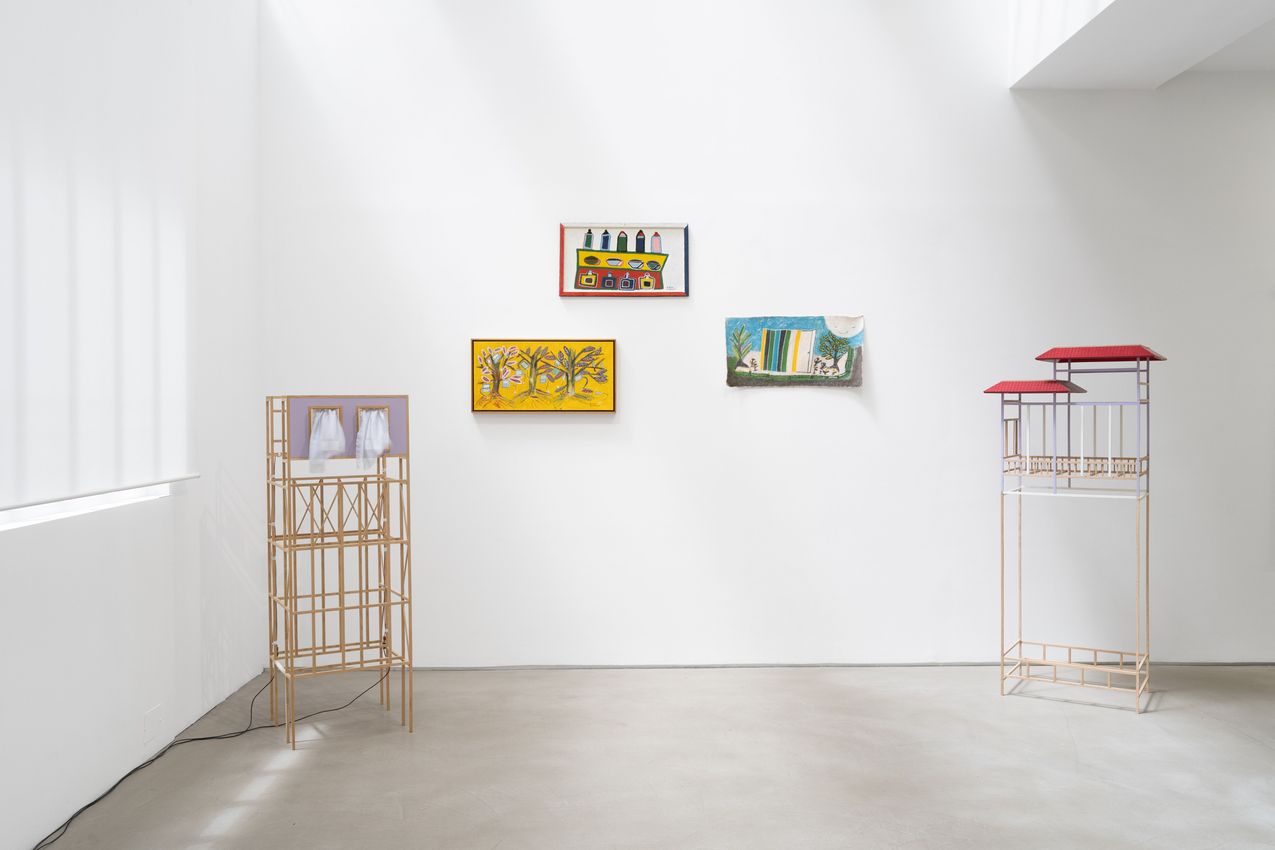
Moving between modernist heritage and vernacular repertoires, between abstraction and figuration, the paintings of Anísio O. Couto (1960) express, within compact formats, a complete formal freedom transfigured by a solar palette. “For years, I looked at his paintings in the street in Santa Teresa (RJ). I have always loved his everyday displays and his semi- abstract paintings: eggs, eyes, watermelons, mixed with butterflies, cats, toucans. In a way, he opened the doors of painting for me. A few years ago, I brought two of his works back to Paris, and I cherish their daily presence.”

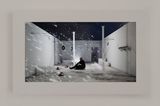
Artist and filmmaker Sarah-Anaïs Desbenoit (1992) creates multidimensional works mobilizing light, sound, projection and miniatures. DGF describes her practice as a form of “expanded cinema” in models, sounds and scenes, “an erratic eroticization of fears and reality,” and one whose changes of scale give viewers and visitors Alice in Wonderland Syndrome (AIWS). “The touching format of the miniature, of the inner landscape, is joined to gigantic emotions.”

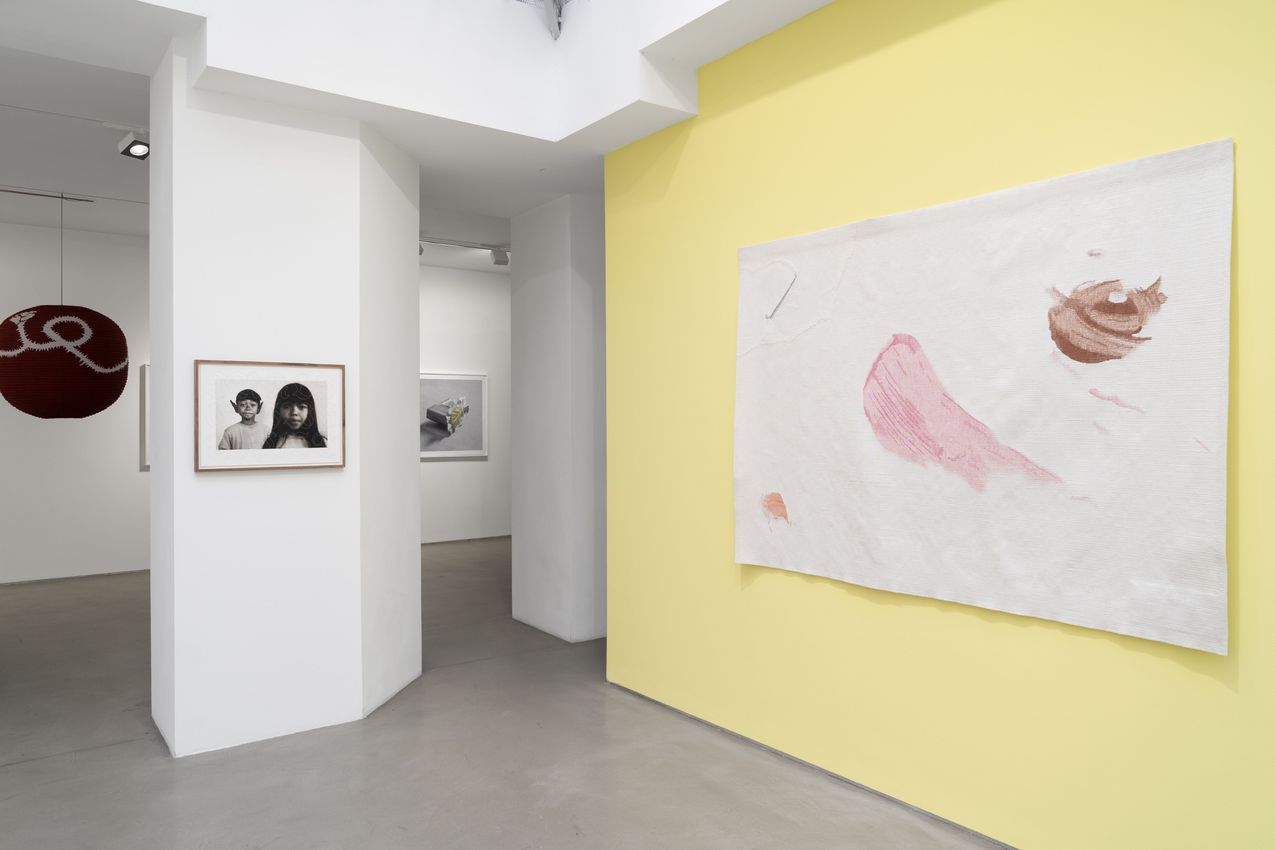
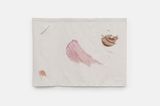
Mimosa Echard’s (1986) practice combines elements of industrial consumer culture and organic components within fluid ecosystems. The tapestry Clueless extends this attention to residual materials, the artifices of everyday life, and pop semiotics. The central pink stroke reinterprets the language of abstract expressionism into the beauty salon. As she explains to DGF, this color is defined by the word hermaphrodite. “It comes from Mike Kelley. Discussing the work of Paul Thek, he says that pink is the color of the margins, associated with hippies, little girls, queers”

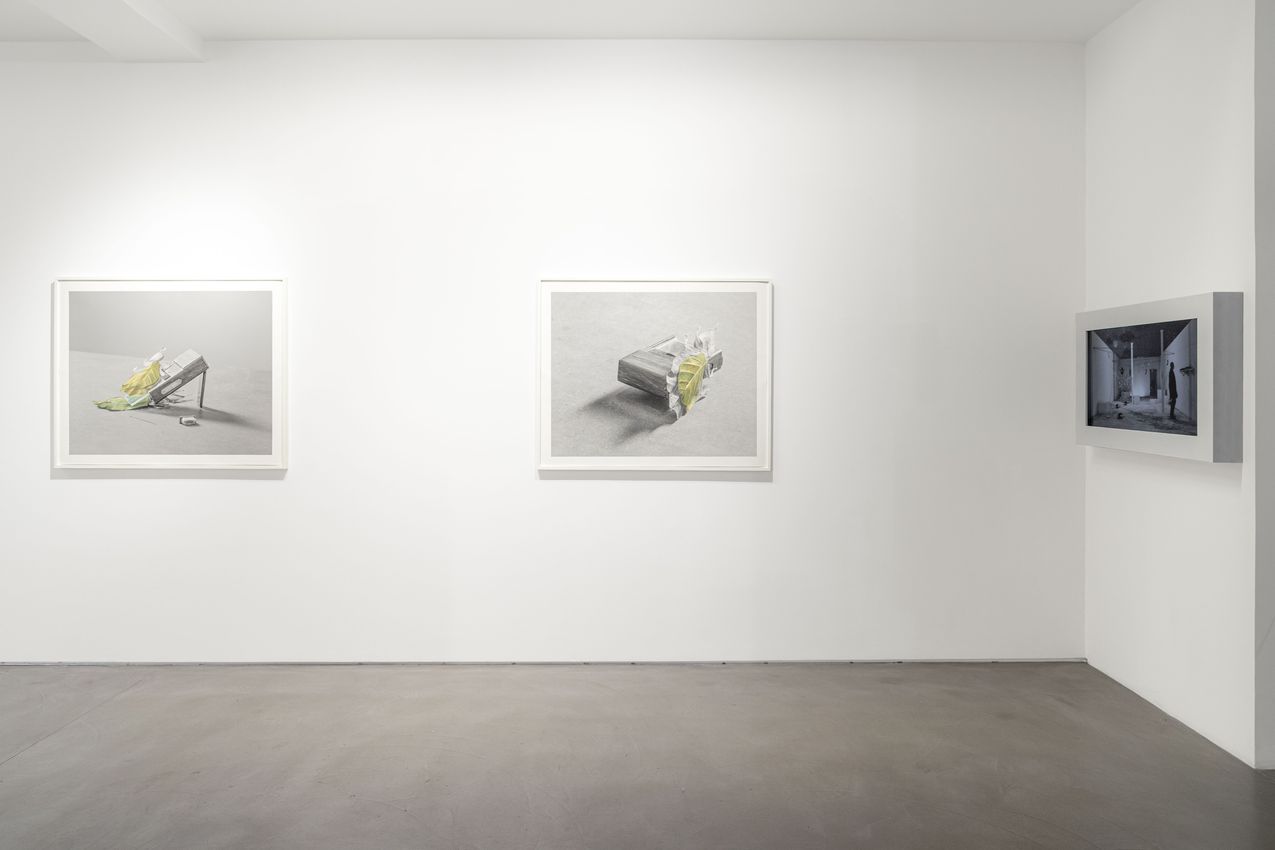
Muyeong Kim (1995) explores the dynamics of conflicting desires as well as structures of surveillance and confinement through staging, photography, cinema and installation. In order to study the positioning of subjects caught in situations of control, he uses box- like devices. The artist presents two large prints organized around a cricket cage acquired during a trip to China, which evokes a range of heterotopic, architectural and psychic spaces: the inside of a camera, a theater, a hospital, a prison or a bedroom.

A polymath passionate about the history, arts and techniques of Europe, Japan and Brazil, as well as costumes, fashion, ceramics, staging and queer performance, Matthew Lutz- Kinoy (1984) develops a body of work that runs counter to current trends. Collective biographical memory around a place nourishes his large paintings, narrative set fragments and exhibition projects. He produces his works almost alone, and when he collaborates, it is to deepen his technical knowledge and develop his working methods. Matthew Lutz- Kinoy presents a set composed of a painted paper lantern and a majestic painting featuring a white tiger on a pink ground.

Artist and actress, Ji-Min Park (1988) is fascinated by underground movements, discreet and silent communities, invisible forms of resistance and encrypted languages. Ji-Min Park presents two mixed-media paintings, one of which reveals the message HARD ƎVO⅃. She says: “The paper I use is almost exclusively hanji, traditional Korean paper, and my painting is very sexual, very sensual. I fully embrace that. There are ambiguities; it speaks of love, desire, bodies. Everything is intertwined.”

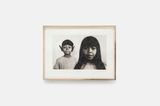
Collaborations, quotations, slogans, appropriations, performances, communal meals,ping-pong games and T-shirt printing all contribute, in Rirkrit Tiravanija’s (1961) work, toan undisciplined practice inspired by Wittgenstein’s proposition that “meaning is use,”continually shifting the boundaries between everyday reality and institutional staging.untitled 2025 is a photograph of the young Rirkrit wearing makeshift prosthetics to imitatethe pointed ears of Spock, the character from Star Trek.

Leïla Vilmouth (1999) creates sculptural devices in dialogue with architecture, interventionsand projections that shift the viewer’s gaze, drawing the audience into a state of emotionaldiscomfort that is both strange and stimulating. Humor, melancholy and absurdityorganize the unsettling encounter between collective catastrophe and intimate experience,as if the contemporary disaster could only be approached through gestures of derision andvulnerability. The artist presents Mucus lotus, a group of colorful handkerchiefs scatteredon the floor, as well as the sound loop Lip2Lip (Hannah&Leïla, Hambourg, 2025).

—Tristan Bera.

Dominique Gonzalez-Foerster

Born in 1965 in Strasbourg, France.

Lives and works in Paris, France.

Dominique Gonzalez-Foerster has had solo exhibitions at the Pinacoteca de São Paulo, São Paulo (2025); Pinacoteca Agnelli, Turin (2023); Serpentine, London (2022); Vienna Secession, Vienna (2021); Academy of Media Arts Cologne, Cologne (2019); Museum of Art, Architecture and Technology, Lisbon (2016); Musée National d’Art Moderne, Centre Georges Pompidou, Paris (2015); Museum of Modern Art, Rio de Janeiro (2015); Museo Nacional Centro de Arte Reina Sofía, Madrid (2014); Stedelijk Museum, Amsterdam (2013); Kunsthalle Zürich, Zürich (2012); Tate Modern, London (2010); Dia Art Foundation, New York (2009); Musée d’Art Moderne de Paris, Paris (2007); deSingel International Arts Centre, Antwerp (2004); Museum Boijmans Van Beuningen, Rotterdam (2003); Contemporary Arts Center, Cincinnati (2001); Le Consortium, Dijon (2001); MAMCO, Geneva (2000), among others.

She was also featured in several international group shows: MAXXI, Rome (2025, 2021); Centre Pompidou-Metz, Metz (2023); Bourse de Commerce — Pinault Collection, Paris (2022); Museum of Art and Design, Miami (2019); Museum of Contemporary Art, Toronto (2019); La Biennale di Venezia, Venice (2019); Witte de With, Rotterdam (2018); Fondation Louis Vuitton, Paris (2018); Red Brick Art Museum, Beijing (2017); Nouveau Musée National de Monaco — Villa Sauber, Monaco (2017); Whitney Museum, New York (2016); Villa Empain — Boghossian Foundation, Brussels (2016); Barbican Centre, London (2016); Kyoto International Festival of contemporary Culture, Kyoto (2015); National Museum of Modern and Contemporary Art, Seoul (2014); Solomon R. Guggenheim Museum, New York (2014); Swiss Pavilion, Venice Architectural Biennale, Venice (2014); MAM, Museu De Arte Moderna, Sao Paulo (2013); LUMA Foundation, Arles (2012); Performa 09, New York (2009).

Her works have joined the collections of the 21st Museum of Contemporary Art, Kanazawa; Musée d’art moderne de Paris, Paris; Musée National d’Art Moderne, Centre Georges Pompidou, Paris; Dia Art Foundation, New York; Fondation Louis Vuitton, Paris; The Israel Museum, Jerusalem; La Caixa Foundation, Barcelona; Les Abattoirs, Toulouse; M+ Museum, Hong Kong; MAMCO, Geneva; Moderna Museet, Stockholm; Museum of Modern Art, Rio de Janeiro; Museo Nacional Centro de Arte Reina Sofía, Madrid; Sammlung Goetz, Munich; Solomon R. Guggenheim Museum, New York; Tate Modern, London; Van Abbemuseum, Eindhoven.

Read More

Installation Views

About the Artist

Born in 1965 in Strasbourg, France. Lives and works in Paris and Rio de Janeiro. In 2002, Dominique Gonzalez-Foerster was awarded the Prix Marcel Duchamp. Before that, she also was the recipient of the Prix Mies van der Rohe (1996–1997).

View Artist Profile

Also Exhibiting at Galerie Chantal Crousel

About the Gallery

Located on rue Charlot in the 3rd arrondissement in Paris, Galerie Chantal Crousel presents a selection of artists highly diverse in their national and cultural origins and mediums who together contribute to a universal visual language.

View Gallery Profile
Address
10 rue Charlot
Paris
France
Opening Hours
Tuesday - Friday, 10am - 6pm
Saturday, 11am - 7pm
(1)
Paris 10 rue Charlot
Galerie Chantal Crousel
10 rue Charlot, Paris, France
+33 142 773 887
http://www.crousel.com

Opening hours
Tuesday - Friday, 10am - 6pm
Saturday, 11am - 7pm
The art world in focus