



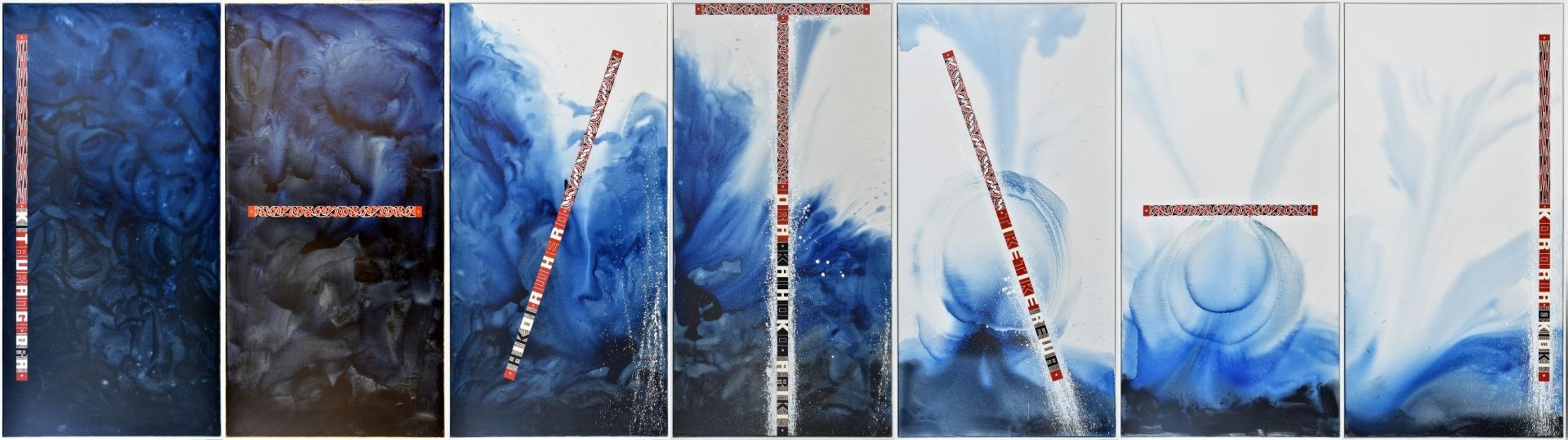
The genre of history painting was first introduced by the French Royal Academy in the seventeenth century and is considered one of the most important genres in the grand scheme of art history. These masterpieces were not focused on their artistic prowess despite being meticulously painted, but instead, the focus was on portraying a certain heroic event, religious, historical or mythical, through precise detail and immense scale. Christchurch based artist Darryn George’s new exhibition Hikoi approaches history painting from a contemporary, New Zealand perspective.
The namesake of the exhibition and the main focus is the seven-paneled work Hikoi (2018). At over seven meters in length, this work is an abstract representation of an aerial view over the Red Sea as the waters are being blown back. Combining gestural abstraction with the intricate patterning of kōwhaiwhai, George overlays Māori text onto plumes of painted canvas to depict the journey of Israel from slavery through the Red Sea to the Promised Land; a journey from darkness to light.
The reading of each panel from left to right allows the viewer of the work to also take this journey. The first panel introduces the journey; Ki Taurangi translates to promise, guarantee, oath, and Ora means life. The kōwhaiwhai of Puhoro represents speed and dictates the journey that is about to progress. Panel two contains only the kōwhaiwhai of Mangopare; a design based on the hammerhead shark that represents leadership, courage and power. This pattern design is also evident in panel four, and panel six. Panel three reads awhero (hope) and hikoi (to step, stride, march, walk, hike, journey). The dominant T-shape that runs directly through the middle of panel four reads kaihoko (redeem, redeemer), ariki (chief) and ora (life). This anchors the work as a symmetrical visual element and initiates the journey into the lighter panels that follow. The text used on panel five and seven provides an uplifting reading as the journey comes to an end. Tiketike translates to exalted, high, important, and rewa means to rise. The final panel proclaims kororia (glorious, glory) with the final word okioki (rest) as the finishing point of this journey.
The overall work has strong underlying influences of spirituality. George draws upon references to Colin McCahon’s The Fourteen Stations of the Cross (1966), Practical religion: the resurrection of Lazarus showing Mount Martha (1969-1970), and On Building Bridges (1952). Each of these works has had a profound effect on the way in which George incorporates ideas of religion into these abstract paintings. Further art historical references through the composition of the words and patterning come from Tintoretto’s The Crucifixion of Christ (1565), a Renaissance masterpiece. Christ upon the cross is central to this painting, as is the abstracted cross depicted in George’s Hikoi.
George’s Hikoi, through its seven large panels, is able to incorporate the spiritual, figurative, and literal interpretations of hikoi, whilst providing art historical context and representing his own religious beliefs and Māori heritage. The smaller works in this exhibition also develop upon these themes. George’s own Gate series of paintings reference that of Colin McCahon’s. McCahon’s Gate paintings used abstract dark shapes and elements to symbolise barriers that need to be overcome. George’s hometown of Christchurch was deeply affected by devastating earthquakes and through his own interpretation, these Gate paintings become metaphors for the obstacles that Cantabrians navigate on a daily basis, both physically and mentally. George’s Satellite series are extensions on his Gate paintings and are abstract representations of aerial views over the Red Sea from God’s eye, much like the larger Hikoi.
The geometric, abstract forms of Darryn George’s paintings embrace international arts practice and traditional Māori art, simultaneously referencing the minimalism of Barnett Newman and patterns from tukutuku panels (symbolising steps to knowledge). Darryn completed an MFA at the Royal Melbourne Institute of Technology (1998) and has work in the collection of the Christchurch Art Gallery.

Gow Langsford is a commercial art space committed to fostering and promoting the best contemporary art from New Zealand and abroad. Located directly opposite the Auckland Art Gallery, Gow Langsford Gallery represents over thirty established New Zealand and international artists. Gow Langsford is one of the country’s most established galleries and is widely regarded as its most influential dealer gallery. Alongside a regular and varied exhibition schedule, Gow Langsford is a market leader in works on the secondary market.

A respected voice in contemporary art discourse.
Focusing on ambitious storytelling and insightful art-world commentary. Ocula Magazine publishes in-depth interviews, critical essays and timely analysis on the artists, exhibitions and ideas driving the global art world.
Learn more about Ocula Magazine
Showcasing the best of the art world.
Ocula partners with galleries from around the world to highlight their artists, artworks and exhibitions. Gallery membership is by application and invitation, with each member vetted by an independent panel.
Learn more about Ocula Membership

Specialises in the sale of major artworks.
Led by a team with deep ties to the world’s leading auction houses, galleries and collectors. Ocula’s advisory team offers bespoke services to high-net-worth clients from around the world who are looking to acquire the best of contemporary and modern art.
Learn more about our team and services