The art world in focus
Subscribe to our newsletter for news and insights on artists, galleries and exhibitions.

Bu’roSar’gedik, Frieze Abu Dhabi 2026. Photo: Nino Consorte of Seeing Things. Courtesy Frieze.
Yesterday at Manarat Al Saadiyat, a minimalist, low-rise building on Abu Dhabi’s museum island, Frieze made its Middle Eastern debut. Running through Sunday, the art fair arrived amid a busy month for culture in the UAE, coinciding with a cornucopia of events including the art and design showcase NOMAD, the ongoing Public Art Abu Dhabi Biennial, and a packed VIP programme.
However, the inaugural edition did not open against an ideal backdrop. The US and Israel’s war in Iran has continued to escalate military tensions across the Gulf, leading to the disruption of some key regional flight paths during recent weeks. Various foreign travel advisories have warned of the “unpredictable” security situation on the ground, and questions have hovered in particular around American attendance, with the US government advising citizens to “reconsider” travel to the emirate.
Still, the installation of the fair went without incident. “It’s very much business as usual,” Frieze director Dyala Nusseibeh told Ocula. The continuity figure, who previously directed the state-backed fair Abu Dhabi Art—now overseen by Frieze in partnership with the emirate’s Department of Culture and Tourism—added that, despite the regional conflict, Abu Dhabi is “a very safe and secure place”.
Jaewoo Choi, president of Busan’s Johyun Gallery, echoed her sentiments. Speaking ahead of the fair, he told Ocula that the gallery was approaching the event “with both enthusiasm and a strong awareness of the current situation in the region”. While acknowledging that the war has raised overall transportation and logistics costs, he said the gallery, which displayed a solo presentation from Lee Bae, was committed to broadening the understanding of Korean contemporary art in the Middle East.
Indeed, while there were some cancelled plans, first-day attendance was better than expected both regionally and internationally. Curators from international museums including LACMA chief executive Michael Govan were spotted alongside prominent international collectors such as South Africa’s Lana de Beer David, the Silicon Valley-based Komal Shah, Brazilian conceptual art collector Pedro Barbosa, as well as the British-Iranian collector Mohammed Afkhami. Influential Gulf patrons from Dubai’s Abdelmonem Bin Eisa Alserkal to Saudi collector Sara Alireza and Emirati Lateefah Bin Hamoodah were also seen browsing the aisles, alongside celebrities including tennis champion Venus Williams and Bollywood actress Sonam Kapoor.
Some of the most extravagant opening-day sales came courtesy of Frieze Masters, which included art and objects from antiquity to the early 20th century themed around the Indian Ocean. David Aaron was quick to announce the pre-agreed, seven-figure sale of a yellow-calcite alabaster stele from ancient Yemen. Daniel Crouch Rare Books also sold the first map to name Abu Dhabi dated to 1832, for an undisclosed asking price understood to be in excess of $1 million.
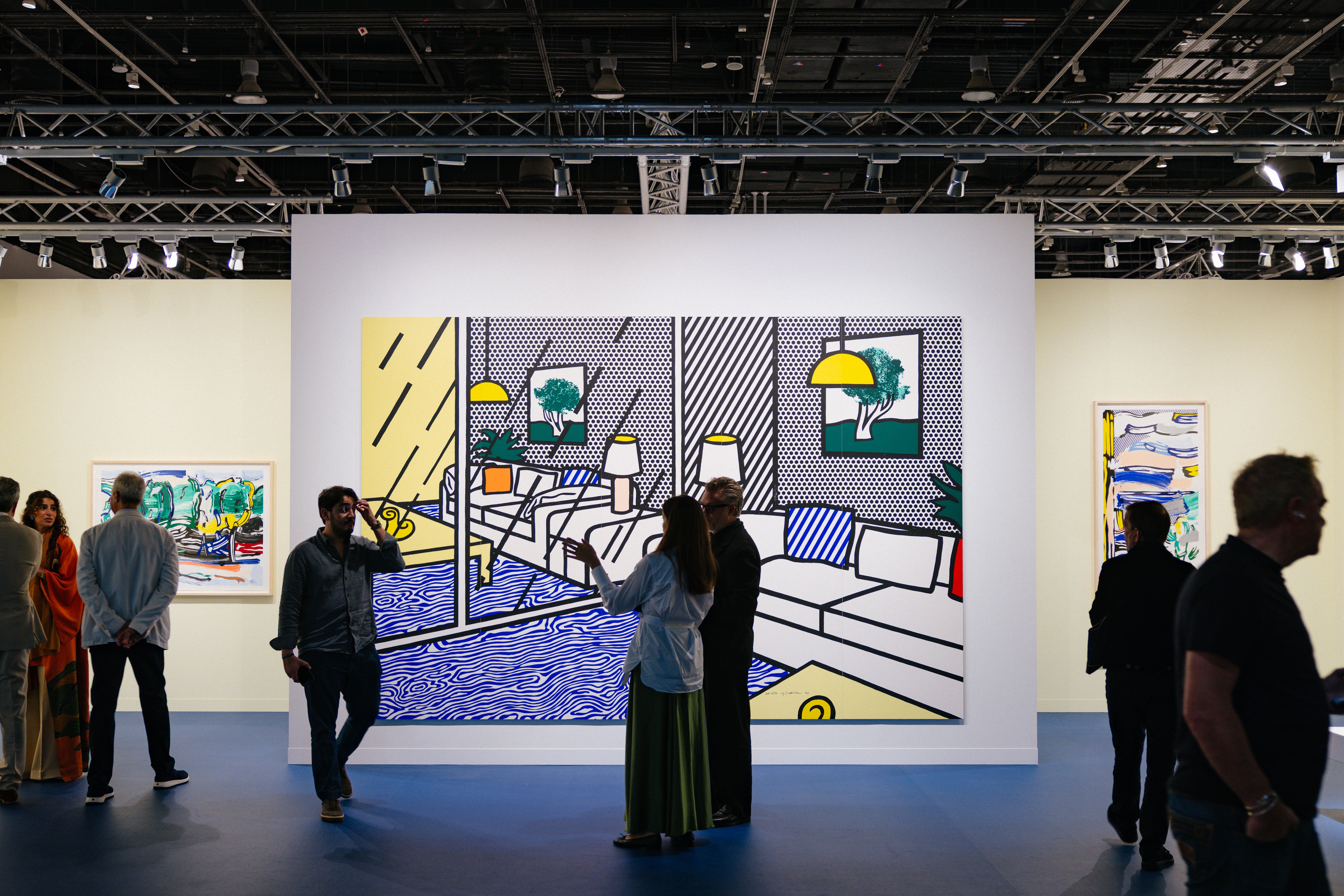
In the main fair, Timothy Taylor sold out its solo presentation of in-demand painter Hilary Pecis, which was priced between $65,000–$205,000. The Paris-based galerie frank elbaz, an Abu Dhabi first-timer, sold a $350,000 textile work by Sheila Hicks to a private collection in the region, and Vito Schnabel Gallery parted ways with a Francesco Clemente watercolour on paper for $180,000. Gagosian sold several Roy Lichtensteins for undisclosed asking prices, with a range of works on offer estimated between $20,000–$300,000.
Bucking a cultural tendency in the UAE to take more time over purchasing decisions, the pace of selling was perhaps helped along by the compressed timeline of the fair, which runs two days shorter than its predecessor, Abu Dhabi Art. The competitive spirit brought by Frieze’s network of global collectors may also have played a role.
Contemporary art referencing the decorative traditions of the region generally performed well. Thaddaeus Ropac placed three sculptures by Pakistani artist Imran Qureshi, priced at $60,000 each, with UAE-based collections. Quereshi’s Water Bodies series, one of which is included in Frieze’s sculpture walk, uses delicate Mughal-inspired tilework to transform blue plastic water tanks.
Also taking inspiration from the Mughals were Hamra Abbas’ decorative marble slabs inlaid with colourful stones. Rumour has it they were snapped up at Lawrie Shabibi by Abu Dhabi’s royal family for an undisclosed asking price. Performance during the first day led the gallery’s cofounder William Lawrie to remark that the fair had “gone up a few notches” under its new owners.
Aside from military disruption, the wider context for this inaugural edition of Frieze is the growth trajectory of the art market in the UAE and wider Gulf. Over the past five years, Sotheby’s reported a 70 percent increase in bidding from the Middle East, with the total value spent by buyers almost doubling. Much of this buying has been driven by a younger demographic that defines the region. Earlier this month, Christie’s first-ever fine art auction in Abu Dhabi brought in $8.9 million; next month, Sotheby’s will follow suit with its own.
“The market, as you see it today, has taken really two decades of nurturing,” Nusseibeh explained, pointing to the careful development of world-class museums, including the soon-to-be-inaugurated Guggenheim Abu Dhabi, alongside private foundations and a growing gallery scene. “There’s a growing awareness amongst the more financially-minded collectors that we have the institutional support now on the ground to see a much-deserved growth in the value of art from the region.”
At the same time, collectors from the region, the fair director said, don’t tend to follow market trends and prefer to buy work they intend to live with. Spending thresholds are therefore lower than in major market centres, with the upper range hovering around the $1 million mark, and the average being in the $50,000–$250,000 bracket. Still, there are signs on the horizon of a new wave of investment-minded buyers, aided no doubt by an influx of European high-net-worth individuals who have been attracted by Abu Dhabi’s favourable tax regime.
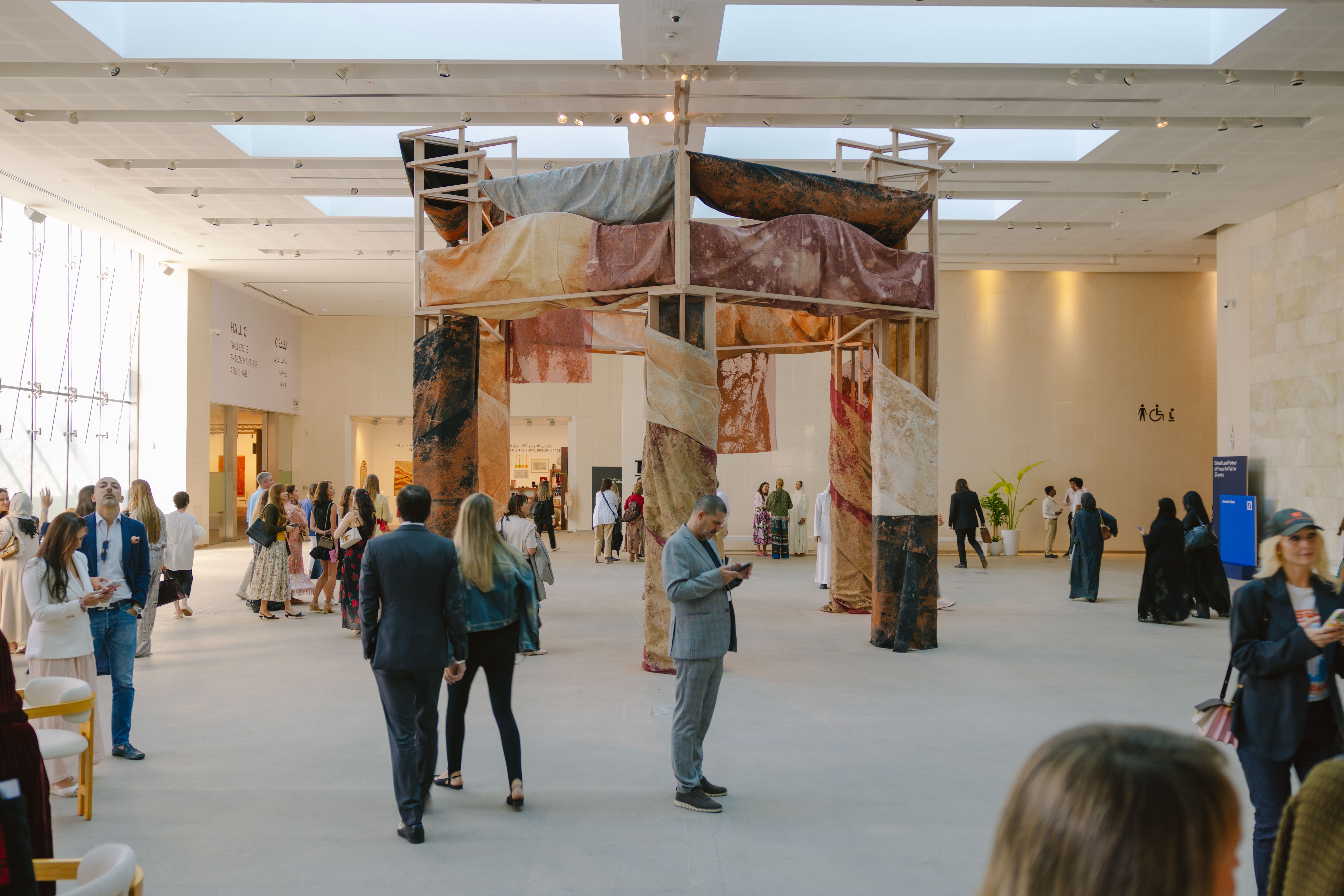
Frieze Abu Dhabi intends to be “grounded in the region”, which it defines using the slightly unwieldy acronym WENASA (West Asia, North Africa and South Asia). The fair has cemented this outlook through a monumental new commission by the Lebanese artist Dala Nasser, for which the winner of the Frieze Abu Dhabi Artist Award has encased a recreation of an architectural ruin in southern Lebanon in earthen-hued textile paintings, referencing the layered histories of the region.
Many of the 89 exhibitors also have longstanding relationships in the region, though the Frieze brand has attracted some high-profile global exhibitors for the first time. These include Victoria Miro, whose Yayoi Kusama Infinity Mirror Room, replete with a glittering cluster of rotating crystal chandeliers, was a common feature of art-world social media posts from the fair. Frieze has also managed to bring galleries including Gagosian and Thaddaeus Ropac back to Abu Dhabi after a hiatus.
Diane Abela, adviser to the fair and director for the Middle East at advisory Gurr Johns, was in attendance with 20 clients, including first-timers from the US, Paris, London and Switzerland. “Everyone’s very happy to be in Abu Dhabi,” she said. “People are blown away by the museum scene and there is also a very good VIP programme with collectors’ homes [to visit] and other events.”
While many of Abela’s clients are regulars at Art Basel in Switzerland and other Frieze fairs, she said they found the Abu Dhabi fair’s distinctive regional focus “refreshing”. At the end of the first day, her collectors were already making acquisitions. She herself was impressed with the curation, and said galleries had brought work that was well-pitched to sell in the region.
Overall, the sentiment among galleries was positive. They highlighted increased international attendance, the growing sophistication of Abu Dhabi’s collecting community and the emirate’s expanding institutional infrastructure. Galleria Continua cofounder Lorenzo Fiaschi declared the first day a “burst of fireworks”—a sense of optimism shared by many across the art world who see the fair’s inaugural edition as laying strong foundations for its future.


A respected voice in contemporary art discourse.
Focusing on ambitious storytelling and insightful art-world commentary. Ocula Magazine publishes in-depth interviews, critical essays and timely analysis on the artists, exhibitions and ideas driving the global art world.
Learn more about Ocula Magazine
Showcasing the best of the art world.
Ocula partners with galleries from around the world to highlight their artists, artworks and exhibitions. Gallery membership is by application and invitation, with each member vetted by an independent panel.
Learn more about Ocula Membership
Specialises in the sale of major artworks.
Led by a team with deep ties to the world’s leading auction houses, galleries and collectors. Ocula’s advisory team offers bespoke services to high-net-worth clients from around the world who are looking to acquire the best of contemporary and modern art.
Learn more about our team and services