The art world in focus
Subscribe to our newsletter for news and insights on artists, galleries and exhibitions.
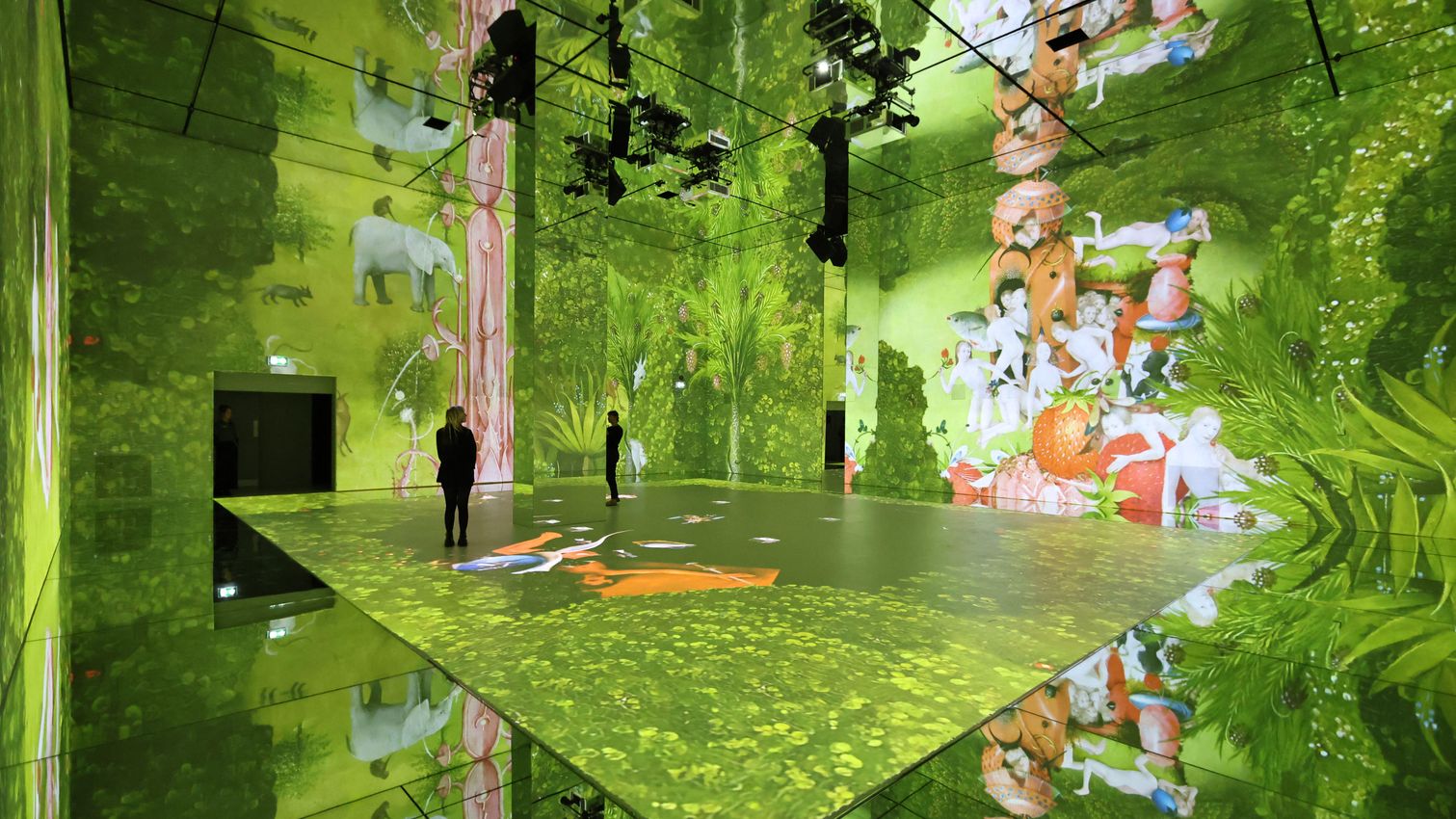
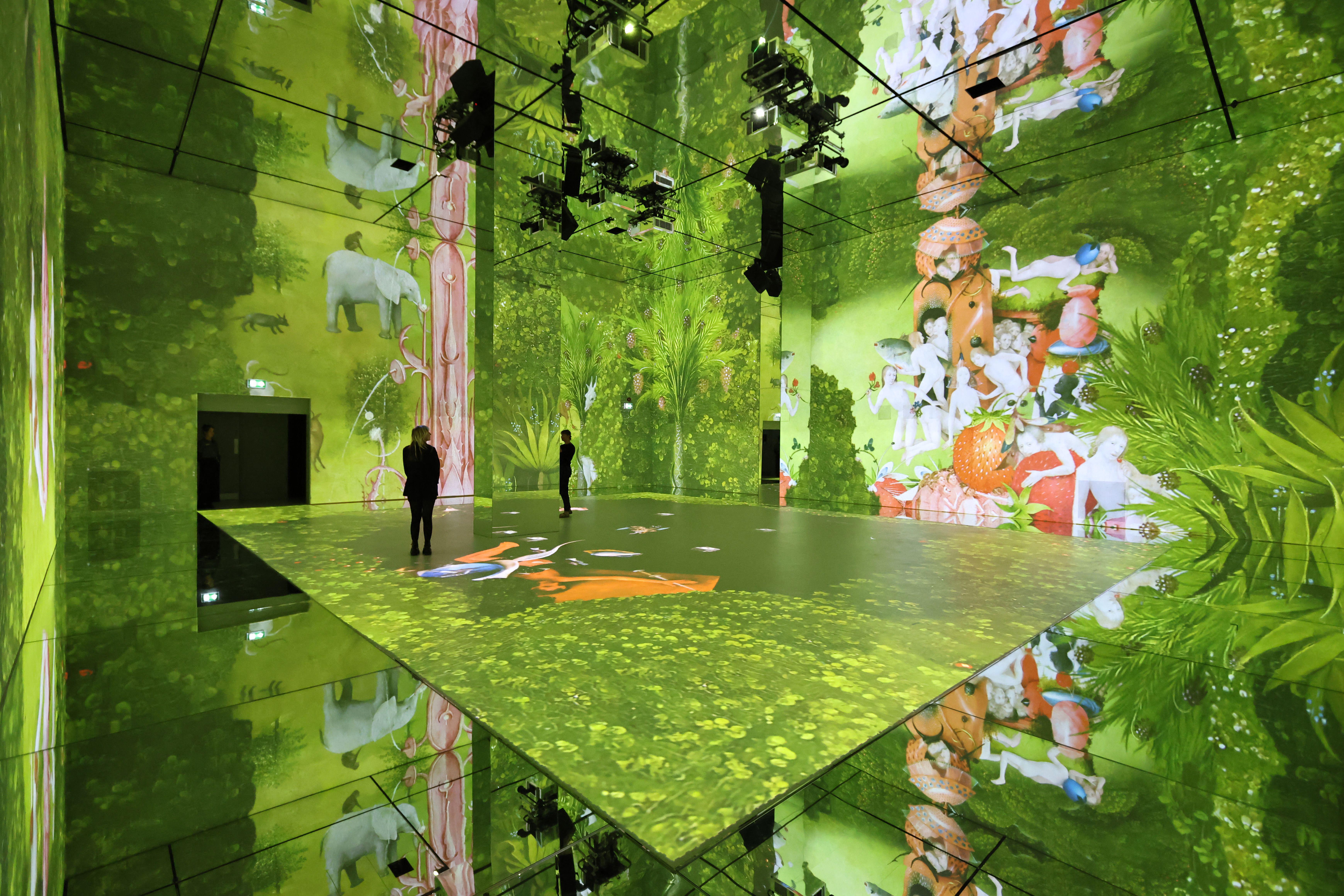
Is art ever equivalent to entertainment? That’s the question I’ve been grappling with ever since observing a boom in the number of “immersive art experiences” popping up in major cities. A few years ago, thinking that the real thing was on loan from the Prado, I accidentally ended up at one such attraction in Berlin: a The Garden of Earthly Delights “experience” called Bosch, Visions Alive. I bought my ticket from the front desk and walked along a black-curtained corridor, entering a room where various elements of the 15th-century depiction of heaven and hell by Hieronymus Bosch (the elephant, the people swimming in the lake, Adam and Eve) were being projected on to the walls; bouncing around me like characters from children’s TV.
As it started to dawn on me that this was not some elaborate introduction to the painting itself, but the sum total of what I’d paid for, a few feelings came up. The first was disappointment. The second was a kind of guilty pleasure. It was cold in Berlin, and there were worse ways to spend an afternoon than sitting in a warm room with gentle animations and soft music playing. So why couldn’t I sit there and enjoy it?

Was my guilt misplaced? Was it silly and pompous of me to try to hold this new activity to the same standards of an art gallery? Or was that precisely what the “art experience” was asking me to do, from the very ambiguous promotional material that surrounded it, and the price of the ticket, which was a lot more expensive than those being sold at the nearby museums?
In trying to answer that question, I realised it was probably useful to look back and find precedents for these attractions. Take the panorama, a strange leisure activity of the 18th and 19th centuries. The first of these, at least in a Western context, was created by the Irish painter Robert Barker. It was a 25-foot-long watercolour that showed a view of Edinburgh from Calton Hill, and was first exhibited in the Scottish capital during the 1780s, where it attracted large crowds.
“Was it silly of me to try to hold this new activity to the same standards of an art gallery?”
The panorama was so popular that, in 1787, Barker brought the technology to London, exhibiting a new painting, drafted by his teenage son Henry Aston Barker, of the view from Blackfriars Bridge. It was housed in a purpose-built structure in Leicester Square. Skylights, hidden from view behind a canopy, illuminated the work from above. Tickets cost one shilling—the equivalent of about £11 in today’s money—making it prohibitively expensive to the poorest families, but still broadly accessible to the middle classes.
Henry Aston Barker was then sent to different parts of the world to create panoramas of exotic new locales. In this sense, the panorama evolved to become a sort of virtual tourism, allowing the managerial class a chance to experience something of the outside world.
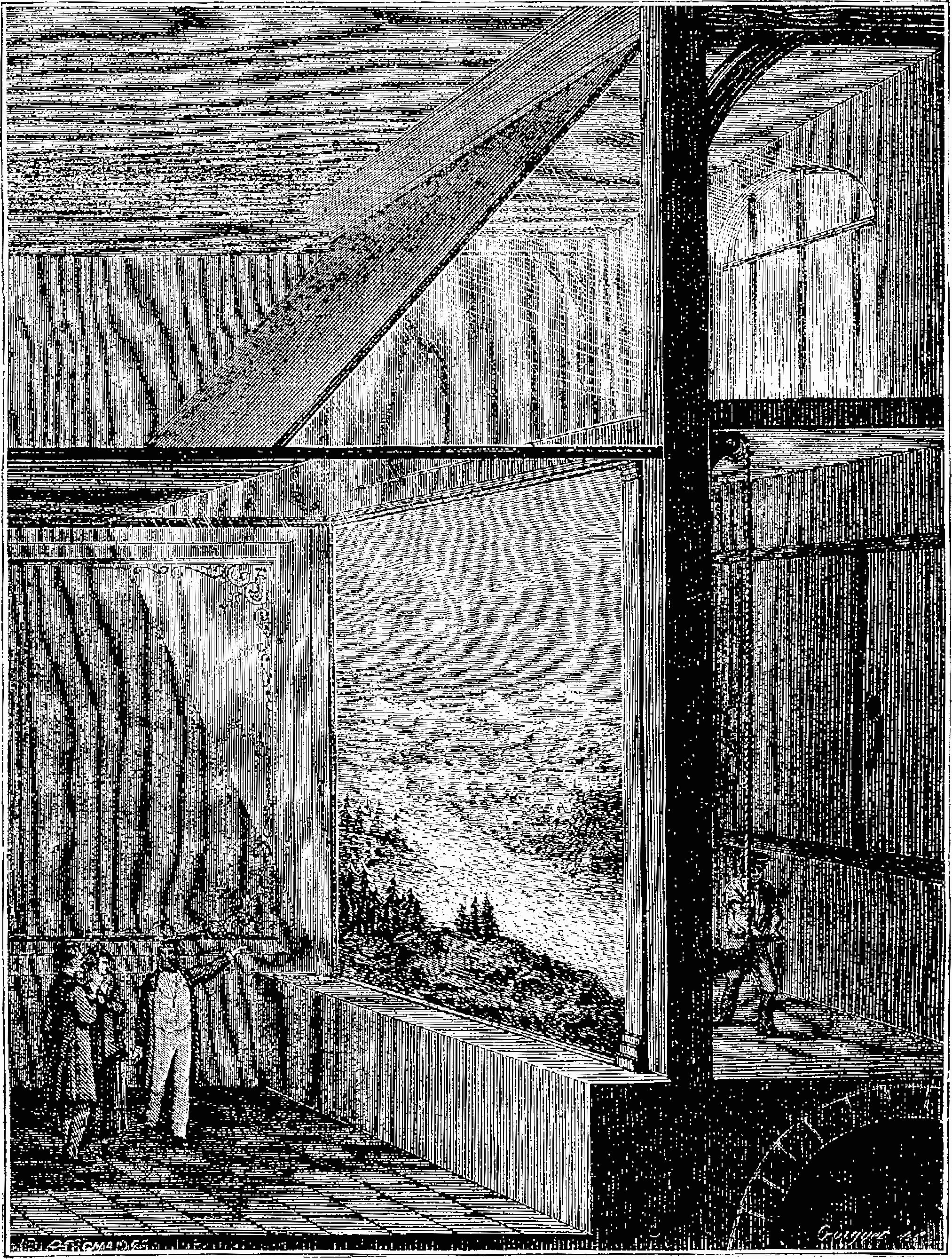
By the 1830s, Louis Daguerre, working in Paris, had created a panorama that moved. The Diorama, as he called it, was a continuous painting on translucent fabric that could be passed through a reel and illuminated. This allowed Daguerre to emphasise different parts of the scene, and would be viewed by many as a precursor to cinema. Daguerre would also create the Daguerreotype, one of the first forms of commercial photography. Large- and medium-format photography allowed artists to create images on a similar scale to the panorama but at a fraction of the cost and the labour. The movie camera of course, introduced the fourth dimension of time.
This produced two concurrent histories. The popular version is the one charted by Guy Debord, Susan Sontag and Jean Baudrillard in their critical writing. It is the supplanting of a complex and ultimately illusive world, with ever more extravagant and elaborate spectacles, and from the beginning it was imbricated with colonial enterprise. As Tim Barringer, author of On the Viewing Platform: The Panorama Between Canvas and Screen (2020), observes, it became popular during a period of warfare between rival empires, offering 19th-century audiences “a place at the centre of spectacular landscapes and historical events”. The panorama, he writes, “provided an insistent, phantasmagorical juxtaposition of “here” and “there”—home and abroad; familiar and exotic; imperial centre and periphery; metropole and province; civilisation and its alleged others. What the global panorama could do better than any other medium was to supply an experiential equivalent—a sublime simulacrum—of distant events, experienced in the round.”
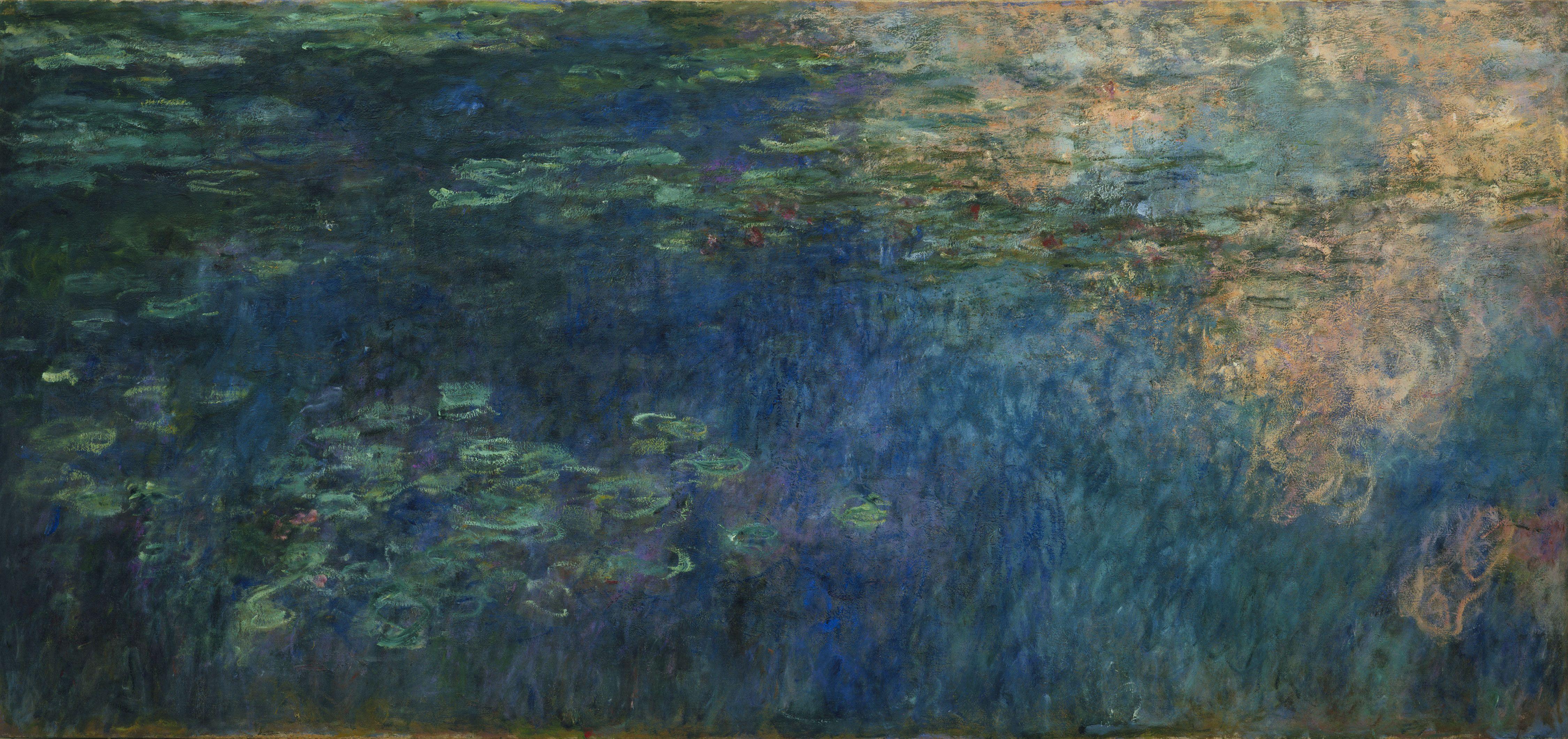
On the other hand, you had practitioners who were devoted to weirding every form that emerged from these technologies. These are generally considered to be the “artists”, working to oppose the more mercenary culture-industry workers, and included photographers such as André Breton, André Kertesz, Nan Goldin, James Van der Zee and Gordon Parks, and filmmakers including Andrei Tarkovsky and Stanley Kubrick. Claude Monet’s Water Lilies paintings, gifted to the French state in 1918 and now housed at the Musée de l’Orangerie in Paris, are arguably another example that tried to resist the panorama’s forward march. Monet subjected it to the principles of Impressionism, which was an attempt to deny the universal worldview put forward by realism.
The “art experience”, then, seems to be an attempt to conflate these two histories, or at least bring them together. If the result is unsettling, it’s because we know that the two sides are not equally weighted, and that technology always wins, supplanting and discrediting the thing represented by it. Reflecting on Barker and Daguerre, I was left wondering if the “art experience” is an attempt to do to art what the panorama did to reality.
I decided to visit Frameless in London to make up my mind. Alongside places like the Van Gogh experience in New York and Dataland in LA, co-founded by artist Refik Anadol, it’s part of an immersive art industry which was last year valued at $1.2 billion, according to Credence Research. Stood at the intersection of Oxford Street and Edgware Road, Frameless was created by Richard Relton, a man who had previously worked in sports and event management. Inside, hundreds of people had paid the £30 ticket to mill around in its underground network of rooms projecting animated versions of work by Salvador Dali, Gustav Klimt, Edvard Munch, Henri Rousseau, Odilon Redon and Bosch; exceeding the price of Barker’s attraction and, to my mind, making a mockery of the claim made on one of the lightboxes that Frameless sought to “encourage wider engagement with art and culture”.
In the first room, the enlarged head of Munch’s The Scream (1893) rushed towards me with its outstretched mouth, prompting yelps of delight from the children running around in every direction. Nice distraction, if you can afford it. In the next room, even more children had gathered to dance around the interactive display of leaves that had fallen from what seemed to be a Monet painting of a willow tree. Most adults were viewing this through their phones. I experienced a feeling similar to that caused by the animated screensaver of the family computer growing up: a trance-like and disembodied state. Pleasant, maybe even relaxing, but certainly not a feeling of immersion, as the text on the walls kept promising: “We invite you on a deeply immersive journey across four spectacular galleries, where you can step inside iconic artworks and see and FEEL MORE from the art than ever before.”
In the last room was another attempt to animate Bosch’s Garden of Earthly Delights. This time, instead of trying to unriddle what I was seeing, my head became flooded with thoughts about the rest of my day. “Did I have the right food in for dinner? Who would cat-sit while I was travelling next week?” The bigger the painting became, the easier it was to ignore.
“The bigger the painting became, the easier it was to ignore”
If spectacle crowds the senses, leaving little room for anything else, then true immersion, or enchantment, or inspiration, or however else we might want to characterise the thing that art does comes from the gap. It is what philosopher Jacques Derrida called the “trace”, or what psychoanalyst Jacques Lacan called the “sliding signifier”: that thing that is not said directly or even present in the work, but which we are left to imagine, bringing our own references and ideas to bear on the thing in front of us.
If artworks are reduced to the surface—beautiful shapes and objects, pretty patterns—then there is no space through which we can enter. We cannot stare for a long time at a mysterious Bosch painting, to ask how the peach might have tasted to the people who were floating inside of it, or how a leg happened to have pierced its soft flesh. Or spend time pondering the many gleaming towers in the background of Bosch’s painting and to ask ourselves how they came to be constructed; why it is that they look more like something from a sci-fi film of the 1970s than the lowlands of the late 15th century? We are not meant to ask ourselves what it would be like to fornicate with birds and converse with fish. Instead, these things become decorative oddities: swirling, disembodied emblems meant to inspire sniggers or gasps.

Since industrial times, opportunists have fed the very human need for imagination, speculation and creativity with degraded versions of all three: light forms of entertainment masquerading as art, creating the illusion that the world really can come to us, while we sit back and enjoy the temporary pleasures they provide and, in the long run, learn to feel not much at all. Entertainment is the word usually given to such disposable pleasures, and that’s fine, but I wonder what the long-term effects will be of deliberately confusing this with art. I’m not immune to those effects, as proven by the fact that on both occasions I visited these immersive experiences I could have stayed for much longer, and enjoyed several hours of being slowly lulled to sleep by their gently moving images.
I would never suggest that I was above these places or judge anybody else for visiting them, but Frameless and attractions like it are created by private investors looking to make a quick buck. Materially, they are no different to Barker’s invention two centuries earlier, but they have evolved in their capacity to conquer our imaginations, which are precious, and our time and our money, which would be better spent elsewhere.—[O]
A respected voice in contemporary art discourse.
Focusing on ambitious storytelling and insightful art-world commentary. Ocula Magazine publishes in-depth interviews, critical essays and timely analysis on the artists, exhibitions and ideas driving the global art world.
Learn more about Ocula Magazine
Showcasing the best of the art world.
Ocula partners with galleries from around the world to highlight their artists, artworks and exhibitions. Gallery membership is by application and invitation, with each member vetted by an independent panel.
Learn more about Ocula Membership
Specialises in the sale of major artworks.
Led by a team with deep ties to the world’s leading auction houses, galleries and collectors. Ocula’s advisory team offers bespoke services to high-net-worth clients from around the world who are looking to acquire the best of contemporary and modern art.
Learn more about our team and services