Birds have long been associated by humans with the ethereal. Appearing globally in lore as omens and symbols, they act as airborne messengers traversing the corporeal and incorporeal worlds. Flowers too have historically been ascribed a symbolic meaning, regularly employed in art and literature to express a hidden narrative, or gifted as traditional expressions of love and loss.
The metaphorical significance of the two might seem tethered to the past – yet our contemporary world abounds with birds and flowers used as emblems for cultures, countries, and companies. But what happens when we lose the icon itself? The Poignancy of Absence, Paul Dibble’s exhibition of new sculptures, considers the impact of extinction on our cultural ecosystem, and presents a eulogy to New Zealand’s own lost fauna.
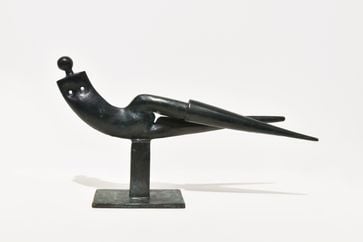
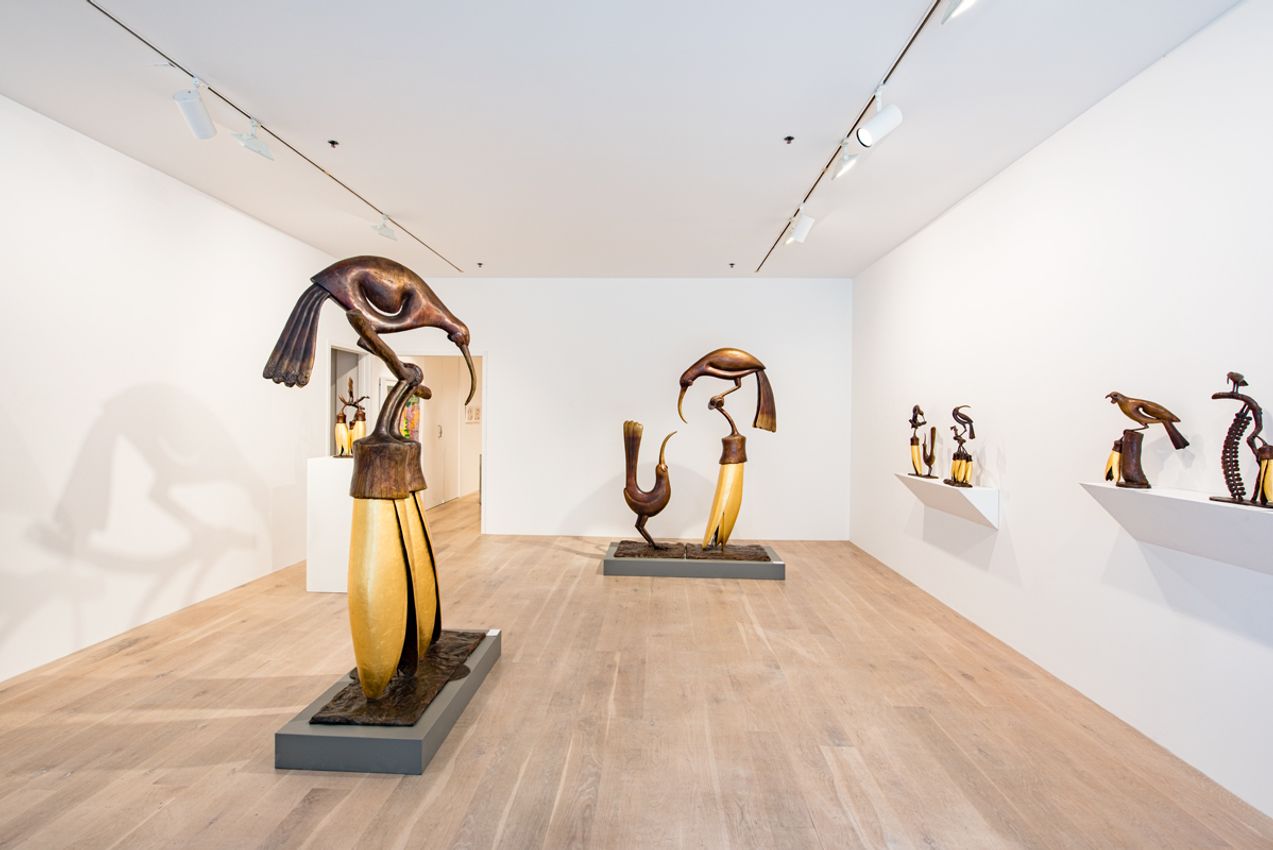
The sculptures in The Poignancy of Absence feature native New Zealand birds atop branches, their bills suggestively in reach of New Zealand’s iconic Kōwhai flower. Like a caricature, Dibble’s birds are instantly recognisable though greatly abbreviated, as they have been condensed down to their lively essence: the fan-like spread of the Pīwakawaka’s tail, the elegantly curved bill of the Huia, and the long straight tail of the Tui, referencing its direct flight. Birds have been a recurring motif in Dibble’s practice for over a decade, darting in and out of his sculptures as a real bird might. Previous series have seen bronze birds perched on immense geometric forms in Corten steel, as if playfully desecrating the great minimalist sculptures by Richard Serra or Donald Judd. Dibble’s most recent works represent a shift to a more solemn tone. The Huia, in particular, resonates with Dibble. The Palmerston North foundry run by the artist is close to the Tararua Ranges, where the last sighting of the native wattle bird was recorded in 1907.
Once prized by Māori and settlers alike for their white tipped tail feathers, the Huia faced inexorable extinction caused by widespread deforestation and over hunting. The Huia is a morality tale for colonial exploit and environmental neglect. Dibble resurrects the lost bird, instilling his oversize bronze Huia with an inherent duality: at once omen and tribute. This duality is underscored by the artist’s masterful grasp of bronze, a medium both wholly malleable in its liquid form, and indelible when solid. This is most discernible in Waterfall, 2018, where Dibble captures the viscous fluidity of molten bronze to form the cascading water, and contrasts it with a solid slab cliff recalling an ingot. Dibble’s concern with the materiality of his chosen medium is shared with European modernist sculptors Henry Moore and Barbara Hepworth, and situates his practice alongside those who endeavour to maintain simplicity and truth to material. The Tui and Huia studies further explore the possibilities of bronze, incorporating negative space. A void becomes a wing, or belly, as curved cavities articulate the birds’ anatomies in an otherwise paraphrased form.
Dibble’s bronze is patinated a sombre brown, which offsets the 24-carat gilding of his Kōwhai, akin to the riotous dumping of yellow in the otherwise uniform New Zealand bush. Kōwhai are our national herald of Spring, bursting into flower and providing nectar for our native birds. Once included in a poem lamenting the loss of New Zealand’s flora and fauna by statesman William Pember Reeves, the Kōwhai in Dibble’s sculptures are a lively celebration of their endurance. Much like a bouquet of flowers gifted to express condolences, Dibble’s gold flowers become gestures to the birds they accompany: a rally cry to conservation, and a lasting tribute to our New Zealand ecosystem.
Gabriella Stead, 2018
From a foundry in Palmerston North, Paul Dibble casts his work with the help of a small team of highly skilled assistants. His sculptures vary in size from 350 millimetre high maquettes to large works of over 5.5 metres in height. The casting processes that Dibble has used for his more recent works are based on two methods; ceramic shell, lost wax and sand casting. The human figure, objects drawn from contemporary life, and the history of New Zealand and the Pacific form the subjects of his work. These objects and figures form fragments of many narratives. Ideas which begin as beautiful fluid line drawings are worked and reworked to a point of perfect balance before being modelled and cast.

Gow Langsford is a commercial art space committed to fostering and promoting the best contemporary art from New Zealand and abroad. Located directly opposite the Auckland Art Gallery, Gow Langsford Gallery represents over thirty established New Zealand and international artists. Gow Langsford is one of the country’s most established galleries and is widely regarded as its most influential dealer gallery. Alongside a regular and varied exhibition schedule, Gow Langsford is a market leader in works on the secondary market.

A respected voice in contemporary art discourse.
Focusing on ambitious storytelling and insightful art-world commentary. Ocula Magazine publishes in-depth interviews, critical essays and timely analysis on the artists, exhibitions and ideas driving the global art world.
Learn more about Ocula Magazine
Showcasing the best of the art world.
Ocula partners with galleries from around the world to highlight their artists, artworks and exhibitions. Gallery membership is by application and invitation, with each member vetted by an independent panel.
Learn more about Ocula Membership

Specialises in the sale of major artworks.
Led by a team with deep ties to the world’s leading auction houses, galleries and collectors. Ocula’s advisory team offers bespoke services to high-net-worth clients from around the world who are looking to acquire the best of contemporary and modern art.
Learn more about our team and services