Press Release
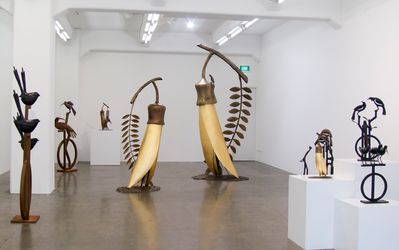
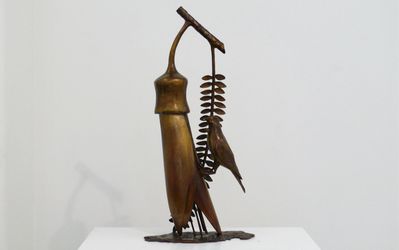
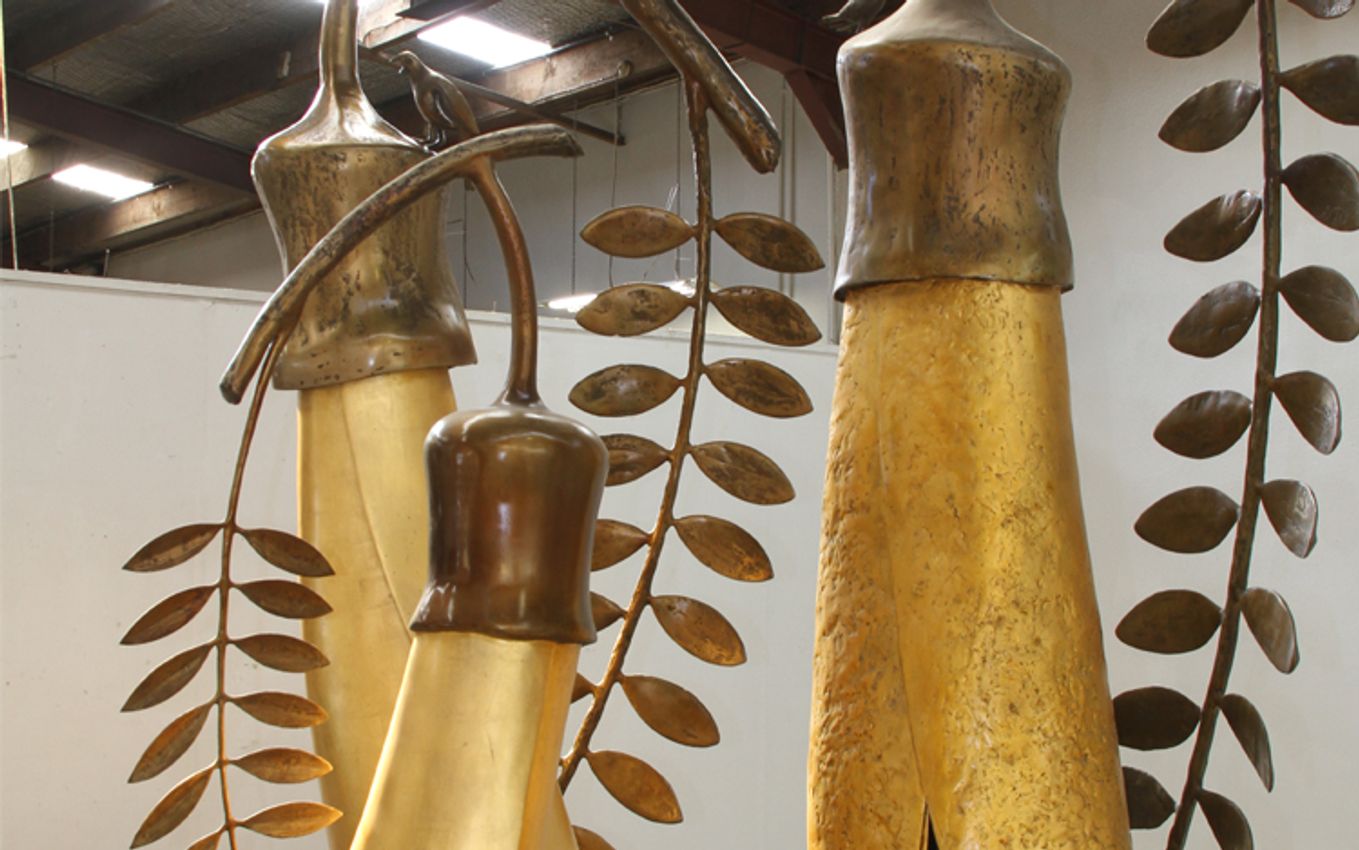
Its part lament, this exhibition by Paul Dibble at Gow Langsford Gallery in November 2014, titled The Gold of the Kowhai. Okay on the one hand it can be viewed as tribute – one giant, one absolutely gargantuan kowhai flower at 3.7 metres, blown up from their normal two or three centimetres, painstakingly modelled and cast in bronze and then gilded in 24 carat gold and lacquered to produce a glowing yellow. For certain these are memorials to the New Zealand forest, ‘bush’ as we so succinctly understate it, to describe its “fuller” quality from the forests of Europe and North America, a rich density in all those shades of green, the absence of colour making it all the more beautiful. This is why the kowhai flower is so special. It is one of the few natives with colour, coming across a kowhai tree in full flower in the early spring amidst the backdrop of green is what makes it so arresting. They are rich suppliers of nectar, feeding many birds that then populate the forest.

But as large emblems they also suggest the concerns of loss, a worry that one day in native setting, not as those straggly specimen trees in the domestic garden, that they might be few. Conservation is always deemed an issue of today, a cause for election slogans and the rallying of new generations. It seems a new found tragedy. But these concerns and where the title, The Gold of the Kowhai, are drawn is a poem penned and published in 1898 where William Pember Reeves – statesman, lawyer, High Commissioner and part time poet – wrote in London thinking of home and the felling of trees that was destroying native woods. In faraway foreign lands he worried on the loss of “those gentle forest-haunting things” that “lived with their trees … and passed away.”

Kowhai became part of Dibble’s sculpture vernacular when he began his researches for the New Zealand memorial at Hyde Park Corner in London in 2006. The brief was to create, not just a memorial to the lives of soldiers lost but to acknowledge the shared history with Britain and as a place to illustrate the identity of New Zealand. Thus on standard ten, a tall one at the back that was devoted in theme to flora is illustrated part of Pember Reeves’ poem (mention of the “blood red rata” another rare case of colour) with the relief modelling of part of a forest scene partly abstracted, a coil of tree fern and kowhai blossoms hanging down.

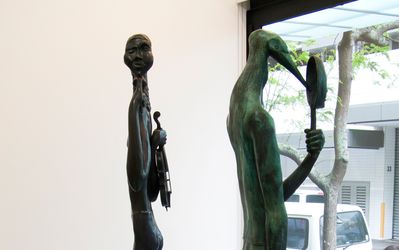
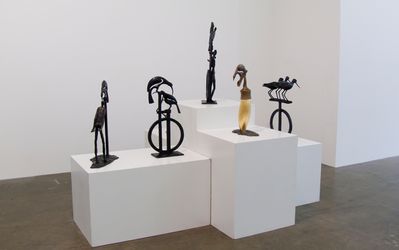
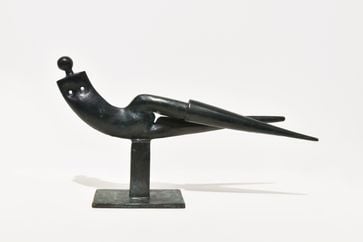
Dibble’s mock forest isn’t empty. Small models dot the room with birds, the “whir of the wood pigeons”, the tui and bell bird “he who rings”, the “eaters of honey, honey-sweet in song”, to again borrow the poet’s descriptions – positioned on geometric stands, even the huia, now extinct, in profusion. Two odd characters are also lurking, behind masks, bird-man figures – a heron and a tui, giving the game away with their titles of “I am”. If they have been lured by the nectar from the kowhai it is more than ‘super-sized’. Through their bird eyes we can try to see the world of the New Zealand forest.

Installation Views

About the Artist

From a foundry in Palmerston North, Paul Dibble casts his work with the help of a small team of highly skilled assistants. His sculptures vary in size from 350 millimetre high maquettes to large works of over 5.5 metres in height. The casting processes that Dibble has used for his more recent works are based on two methods; ceramic shell, lost wax and sand casting. The human figure, objects drawn from contemporary life, and the history of New Zealand and the Pacific form the subjects of his work. These objects and figures form fragments of many narratives. Ideas which begin as beautiful fluid line drawings are worked and reworked to a point of perfect balance before being modelled and cast.

View Artist Profile Paul Dibble contemporary artist
About the Gallery

Gow Langsford is a commercial art space committed to fostering and promoting the best contemporary art from New Zealand and abroad. Located directly opposite the Auckland Art Gallery, Gow Langsford Gallery represents over thirty established New Zealand and international artists. Gow Langsford is one of the country’s most established galleries and is widely regarded as its most influential dealer gallery. Alongside a regular and varied exhibition schedule, Gow Langsford is a market leader in works on the secondary market.

View Gallery Profile
Address
28-36 Wellesley Street East
Auckland
New Zealand
Opening Hours
Monday – Friday, 10 am–5 pm
Saturday, 10 am – 4 pm
Closed Sunday
(1)
Auckland 28-36 Wellesley Street East
Gow Langsford Gallery
28-36 Wellesley Street East, Auckland, New Zealand

Opening hours
Monday – Friday, 10 am–5 pm
Saturday, 10 am – 4 pm
Closed Sunday
The art world in focus