Press Release

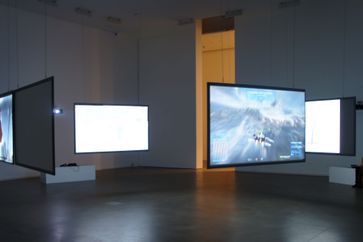
Harun Farocki occupies a singular place in the history of post-war cinema, using filmic means to dissect how images uphold or unsettle political power. His five-decade career resulted in over 100 works—from agitprop shorts to multichannel installations—that mount a trenchant critique of the ethics of seeing. Farocki was among the most prolific filmmakers to emerge from WestGermany in the 1960s, coming of age alongside stars of the New German Cinema like Rainer Werner Fassbinder, Werner Herzog, and Wim Wenders. Yet he forged his own style that deconstructed the genres of documentary and narrative alike, mobilising found imagery to extract meaning that the archive would otherwise occlude. Farocki’s fourth solo exhibition atGreene Naftali treats depictions of war and their distancing effects, through a cluster of works that trace the seepage of the military industrial complex into every sphere of life.

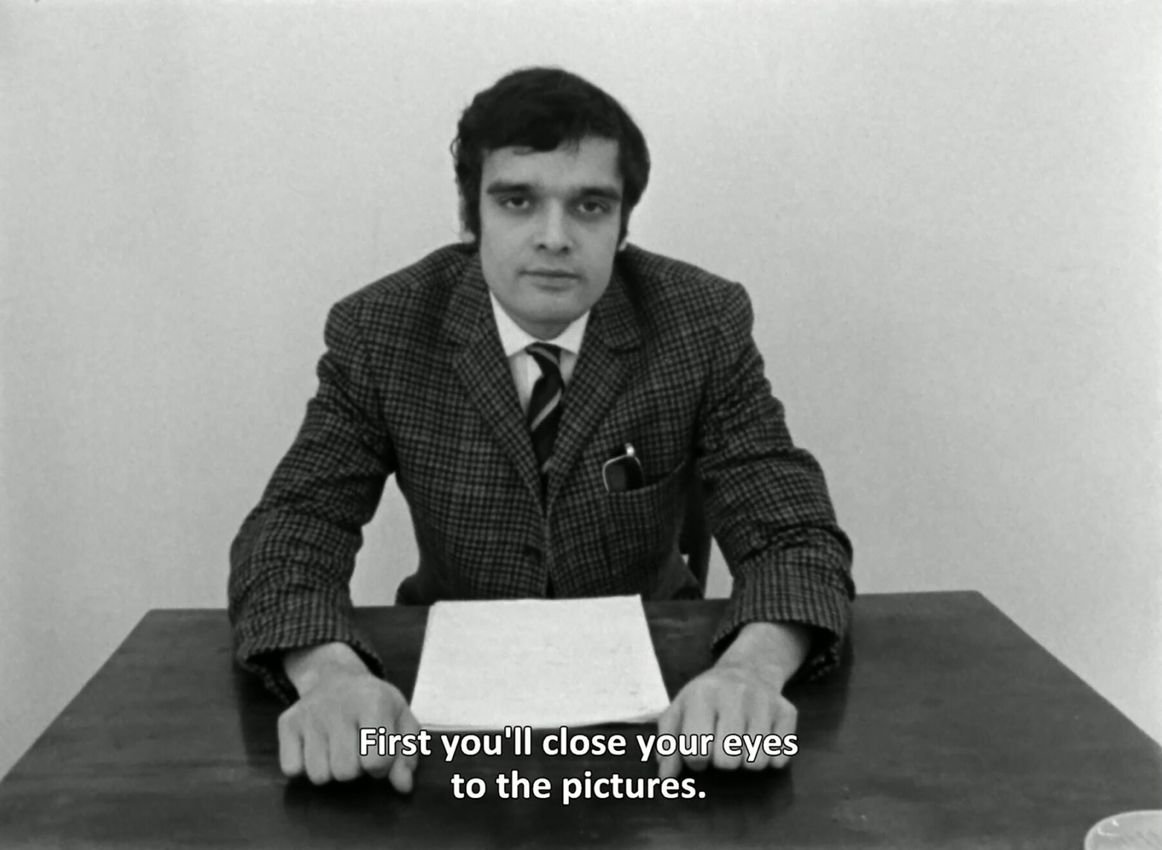
Born in German-annexed Czechoslovakia in 1944, Farocki spent much of his childhood in India before settling in Berlin, where his skepticism was forged amidst the schisms and protests of 1968. Several of his earliest films explicitly target the VietnamWar: White Christmas punctures the kitsch nostalgia of the holiday with footage of bombs that fall like snow; Their Newspapers skewers the role of print media in manufacturing public consent. Farocki’s first feature, Inextinguishable Fire, positions its director in front of the camera, adopting the guise of the TV anchors who brought the war home on the evening news. His voiceover weighs the moral and aesthetic dilemmas of presenting images of suffering, as complacent viewers will avert their eyes from what they do not wish to see. Rather than showing victims burned by Napalm, Farocki puts out a lit cigarette on his own arm, then segues to fictional scenes set in the offices of Dow Chemical. The acclaimed essay film exposes the mechanisms by which accountability is deferred, as well as the corporate culture and profit incentives that serve to normalise acts of war.

That imbrication of the mundane and the monstrous would occupy Farocki for the next forty years, as the media landscape became ever more saturated with battlefield imagery made routine or abstract. Respite recovers eerily banal raw footage from inside a Nazi transit camp; A Way intercuts Gulf War-era computerised surveillance with shots of civilian goods that rolloff assembly lines. The film ends with Bertolt Brecht’s stark adage—‘War always finds a way’—and links the automation of production and destruction: new weapons technologies create the need for new enemies at which to aim them.

The causal role of the camera’s eye was manifest in Farocki’s first work for German television, titled Two Paths, which slowly pans across a medieval map of the routes to heaven and hell. That technique of enlivening a still image recurs in the two-channel video The Silver and the Cross: one sequence examines an 18th-century oil painting of a Bolivian mining town decimated by colonial rule, while the other documents the same locale in the present, still touched by the long arm of capital. The violence encoded in ideology becomes literal in Words of the Chairman, an early short in which Mao’s Little RedBook is torn up and folded into a paper dart—words weaponised against global imperialism. In our own time, sloganeering tends to bypass the manifesto to reach us where we live, as seen in a group of T-shirts on view from Farocki’s personal collection. Their strident messaging attests to a politics that extended beyond the studio and into the streets, in a lifelong project that combined formal daring with an activist’s resolve for change.

Read More
About the Artist

Harun Farocki lived and worked in Berlin (d. 2014). Recent solo exhibitions include Kemper Art Museum, Washington University in St. Louis (2021); Art Encounters Foundation Timișoara, Romania (2020); Instituto Moreira Salles, Rio de Janeiro and Sao Paulo (2019); National Museum of Modern Contemporary Art, Seoul (2018); Neuer Berliner Kunstverein, Berlin (2017); Arsenal — Institut für Film und Videokunst e.V., Berlin (2017); Harun Farocki Institut, Berlin (2017); Savvy Contemporary, Berlin (2017); Tàpies Foundation, Barcelona (2016); Whitechapel Gallery, London (2016); CAPC musée d’art contemporain, Bordeaux (2015); Haus der Kulturen der Welt, Berlin (2015); Center for Contemporary Art FUTURA, Prague (2015); Museum für Gegenwart, Hamburger Bahnhof, Berlin (2014); Greene Naftali, New York (2014); Museum Folkwang, Essen (2014); Museo Universitario Arte Contemporáneo, Centro de Cultura Digital, Mexico City (2014); Moderna Museet, Stockholm (2013); ARGOS Center for Art and Media, Brussels (2013); Tel Aviv Museum of Art, Tel Aviv (2013); Museum of Fine Arts, Houston (2012); The Museum of Modern Art, New York (2011); Center for Contemporary Arts, Glasgow (2011); and Tate Modern, London (2009).

View Artist Profile Harun Farocki contemporary artist
About the Gallery
Founded in 1995, Greene Naftali was among the first contemporary art galleries in New York’s Chelsea neighbourhood. With artists exhibiting worldwide in museums and arts institutions, the gallery has a diverse and influential roster of artists demonstrating a strong conceptual foundation and dedication to art’s discourse and history. Significant contemporary artists include painters Monika Baer, Jana Euler, and Jacqueline Humphries; sculptors Rachel Harrison and Simone Fattal; and new media artists Tony Cokes, Paul Chan, and Cory Arcangel. The gallery’s program also includes critical historical figures Tony Conrad, Konrad Lueg, and Harun Farocki, and a group of innovative emerging artists of a younger generation – Justin Caguiat, Aria Dean, and Walter Price.
View Gallery Profile
Address
508 West 26th Street
Ground Floor & 8th Floor
New York
United States
Opening Hours
Tuesday – Saturday
10am – 6pm
(1)
New York 508 West 26th Street, Ground Floor & 8th Floor
Greene Naftali
508 West 26th Street, Ground Floor & 8th Floor, New York, United States

Opening hours
Tuesday – Saturday
10am – 6pm
The art world in focus