From October 8 through November 7, Ivan Gallery presents the second part of the group exhibition „Urban Realograms. Artistic Practices for Shared Spaces”, curated by Daniela Custrin, which brings together the works of four young artists - Matei Alexandrescu, Clara Caradimu, David Pricob and Eliza Trefaș.
”A few years ago, a house on Plantelor Street—where I used to work—was demolished. It had yellow walls and very tall windows, and it seemed to stand upright with some difficulty. I didn’t like passing by it; I often took a detour along the parallel street. After the demolition, an empty lot remained, and it seemed to me that at times—especially after the rain—it still held the scent of the house. I continued to avoid that spot for a long time, even though the house was no longer there. For me, this is the definition of Bucharest: places I can no longer see, yet still pass by with the utmost care. A succession of rooms without walls that I keep stepping into for a while, even though they have long since ceased to exist.
A city becomes intelligible through the systems we build to read it, and it becomes ours through the errors we make within them. To know it means moving not from one place to another, but from one possible description of it to another. The four artists—Matei Alexandrescu, Clara Caradimu, David Pricop, and Eliza Trefaș—construct these forms of orientation in distinct ways. This cartographic instability emerges in the space between what the city promises to be and the experiences lived within it. Bucharest allows itself to be co-produced by these four perspectives, translated through a series of imagined, solemn, and possible architectures.” (Daniela Custrin)
”I do not know if Bucharest was ever a quiet city, but I believe there were times when people valued peace more and allowed themselves more time for it. Perhaps this patience and tranquility are the things Bucharest needs to remember in order to envision its future.” (Matei Alexandrescu)
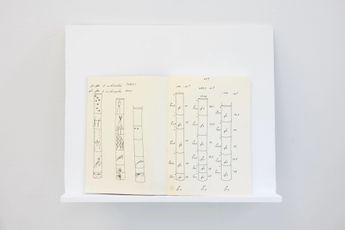
Based in Vienna, Matei Alexandrescu (b. 2000, Bucharest) notes that returning to Bucharest creates a sense of the “uncanny familiar”: things that once seemed too ordinary to warrant a second look now—through the lens of distance—form an image. The drawings he recovers are commonplace enough to circulate across different experiences, generations, and bodies; their meaning lies not in what we see within them, but in the affects they set in motion—anticipation, encounter. The columns do not monumentalize what we know about Bucharest, but rather a possible, shared memory—a visual experience that, without ever having been ours, convinces us that it could have been.
”You tear everything down, extend Herăstrău Park to connect with Cișmigiu, and set the deer loose.” (Clara Caradimu)
In the work In Search of Cărăbușului Street by Clara Caradimu (b. 2001, Bucharest), the starting point is the quest for Cărăbușului Street—a street that exists initially only as a memory. Her piece stems from the story of the artist’s grandfather, who recalls that around 1945, his family settled on this street near Vitan—in the Dudești-Cioplea neighborhood, at the terminus of the former tram line 14. However, street name archives, historical maps, and tram routes do not confirm the street’s existence. Clara traverses the city with a “reverie map,” allowing the city to guide the intensity with which the names of streets and places draw from reality—taking only what is needed to construct a different kind of geography, one where two points can draw close to each other even if they are not neighbors.
”Gara de Nord (North Station) is significant for its status as an intermediary space. For those arriving by train, it represents the first point of contact with the city—the moment one begins to perceive its rhythm, its people, and its contradictions. Even for Bucharest residents, passing through the station upon return can reawaken this experience of arrival, momentarily rendering the city unfamiliar once more.” (David Pricob)
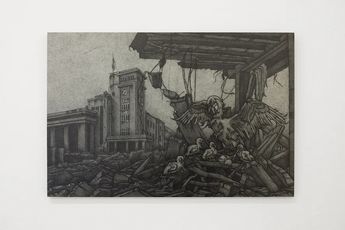
David Pricob (b. 2001, Petrila) developed his drawing practice in close connection with Petrila, the post-industrial town where he was born and raised. For a long time, Bucharest existed for him only from a distance—a city seen online, known more through the images it generated than through the direct experience of living there. After moving to Bucharest, he began to recognize fragments of his own parasocial imagery within the city: abandoned buildings, dilapidated spaces, and vacant lots nestled not on the outskirts, but right in the center—wedged between apartment blocks, streets, and new developments. In the work Wet Feather Hanging From a Rusty Wire, the relationship between a swan and its cygnets—spotted near Gara de Nord—introduces a different kind of time: a time of gestation, brooding, birth, and nurturing. This rhythm cannot be rushed or synchronized; instead, it slows the city down enough for us to reimagine dystopian infrastructures not merely as sites of decay, but as potential conditions for life.
”The Ministry of Defense is, therefore, the Ministry of Offense. The Ministry of Justice—the Ministry of Injustice. The Ministry of Culture—the Ministry of Hunger, or the Ministry of Anti-culture, the Ministry of Entertainment Management. The Ministry of the Environment—the Ministry of Deforestation. The Military Academy—military brainwashing. And so on. Most powerful state institutions do not work for the people; instead, they operate to hermetically preserve their own internal power, detached from any contact with the ordinary citizens who sustain them. For me, Bucharest is currently associated with pessimism; it could be an excellent city, yet it is patched-up, suffocated, and bursting with a consumerist mentality and dubious policies.” (Eliza Trefaș)
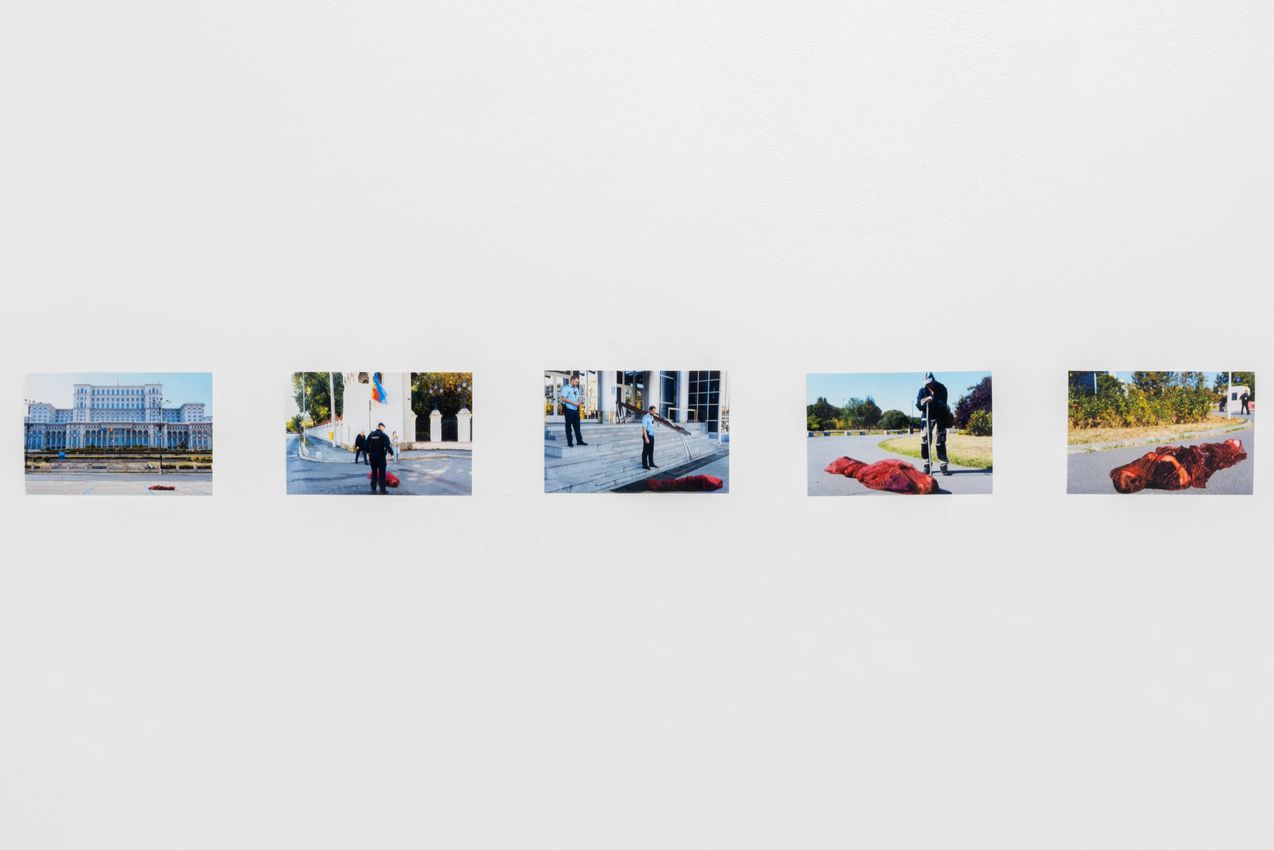
Eliza Trefaș (b. 1998, Bacău) admits that, despite living in Bucharest for a long time, she has been unable to truly connect with the city. Her work begun in 2024, Clothes for Silence, transforms this difficulty into a form of presence. The artist covers her body with a taffeta veil and, lying horizontally, constructs a sort of cocoon within which she remains motionless. This performance often takes place in front of buildings charged with political significance, creating a tension between the body’s immobility and the space’s public and symbolic function. The body does not disappear; rather, it suspends its usual ways of moving, responding, and occupying space, thereby opening itself up to unforeseen relationships. The intervention of the other becomes part of the work’s duration, and the performance creates the conditions for a co-presence in which what is shared is not a common experience, but the very possibility of being affected by one’s surroundings.
Cultural project co-financed by the Bucharest Municipality through ARCUB, as part of the “București în premieră” (Bucharest Premiere) 2026 Cultural Program.
Ivan Gallery is a contemporary art gallery founded in Bucharest in 2007 as a private initiative by Marian Ivan. Its program is diverse, featuring established artists such as Geta Brătescu, Paul Neagu, Ion Grigorescu, Lia Perjovschi, Horia Bernea, and Simona Runcan, alongside younger- generation Romanian artists like Iulia Toma, Cristina David, Giulia Crețulescu, and Gavril Pop. The gallery also collaborates with Romanian artists based abroad, such as Sándor Bartha and Mădălina Zaharia, as well as international artists like Elijah Burgher, Ross Taylor, and Jaro Varga.

A respected voice in contemporary art discourse.
Focusing on ambitious storytelling and insightful art-world commentary. Ocula Magazine publishes in-depth interviews, critical essays and timely analysis on the artists, exhibitions and ideas driving the global art world.
Learn more about Ocula Magazine
Showcasing the best of the art world.
Ocula partners with galleries from around the world to highlight their artists, artworks and exhibitions. Gallery membership is by application and invitation, with each member vetted by an independent panel.
Learn more about Ocula Membership

Specialises in the sale of major artworks.
Led by a team with deep ties to the world’s leading auction houses, galleries and collectors. Ocula’s advisory team offers bespoke services to high-net-worth clients from around the world who are looking to acquire the best of contemporary and modern art.
Learn more about our team and services