




LUCIA DI LUCIANO
1933-2026, ItalyLucia Di Luciano was an Italian painter whose rigorously systematic yet increasingly free abstract artworks have made her a pivotal figure in Arte Programmata and post-war Italian contemporary art.
Early life and background
Born in Syracuse in 1933, Lucia Di Luciano moved to Rome, where she studied painting at the Accademia di Belle Arti and met her future husband and close collaborator, Giovanni Pizzo. In the early 1960s in Rome, Di Luciano and Pizzo co-founded experimental groups Gruppo 63 and later Operativo R, through which they developed a rational, research-led approach to art grounded in mathematics, Gestalt psychology, and linguistic theory.
Lucia Di Luciano Artworks
Lucia Di Luciano’s artworks explore programmed abstraction, optical effects, and systems-based composition, moving from black-and-white grids to increasingly liberated colour fields over a career spanning nearly seven decades.
Across painting, works on Masonite, and works on paper, Di Luciano’s practice aligns art with logic, rhythm, and seriality, while ultimately opening these structures to chance, intuition, and a broader history of abstract art.
Programmed grids and Arte Programmata
In the late 1950s and early 1960s, Di Luciano produced early abstract paintings structured around black-and-white grids and modular units, often painted on industrial supports such as Masonite using commercial paints. These programmed compositions—articulated in series such as the Irradiazioni works from the mid-1960s—deploy mathematical sequences and Gestalt principles to generate dynamic visual vibrations that challenge fixed perception.
From 1963 onwards, within Operativo R, Di Luciano aligned her work with the Italian Arte Programmata movement, in which artists conceived artworks as systematic ‘programmes’ rather than individual expressions. Through serial permutations of lines, grids, and modules, her artworks propose painting as a field of verification, where visual hypotheses are rigorously tested rather than intuitively improvised.
Colour, variation, and late abstraction
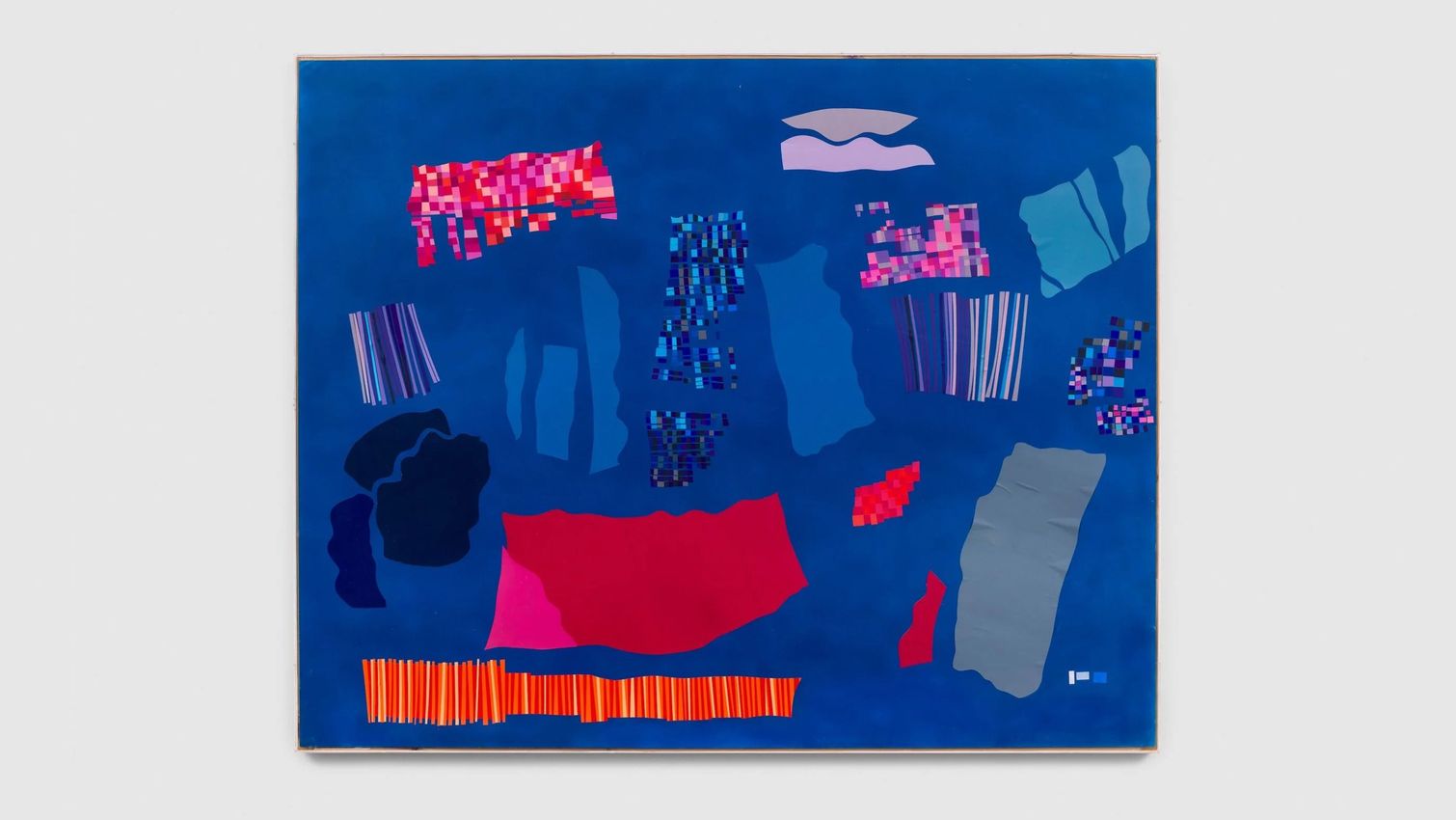
From the 1970s through the 1990s, Di Luciano expanded her research into colour, progressively softening the strictness of her earlier black-and-white regimes while retaining a controlled, modular logic. In later bodies of work, including series such as Gradients, Minimal, and Senza titolo, colour bands, broken grids, and irregular chromatic blocks loosen the earlier programme, creating rhythmic, open structures.
After Di Luciano and Pizzo moved to Formello, outside Rome, in the 1990s, she devoted herself almost exclusively to painting, producing works in which the grid dissolves and colour becomes the primary vehicle for spatial and perceptual experimentation.
Di Luciano recent paintings, many produced after her inclusion in the 59th Venice Biennale in 2022, have been described as condensing the history of abstract painting while remaining rooted in the disciplined, analytical methods that defined her early career.
Select public collections and recognition
Di Luciano’s artworks are held in major public collections, including Tate Modern, London; the Galleria Nazionale d’Arte Moderna e Contemporanea, Rome; and the Chrysler Museum of Art, Norfolk. Her recognition has expanded significantly in the 21st century, with institutions and galleries revisiting Arte Programmata and New Tendencies, and repositioning her as a key protagonist within the last avant-gardes of 20th-century art.
Di Luciano Exhibitions
Di Luciano has been the subject of solo exhibitions and included in important group exhibitions at museums and galleries in Italy and internationally. The following selection highlights key institutional and gallery presentations that have shaped the reception of her work.
Select solo exhibitions
- Lucia Di Luciano. Works from the 60s to 2024, 10 A.M. ART, Milan, 2024.
- Lucia Di Luciano, Herald St, London (two-part exhibition across Bethnal Green and Museum Street), 2025.
- Lucia Di Luciano, Lovay Fine Arts, Geneva, 2023.
Select group exhibitions
- 59th International Art Exhibition, The Milk of Dreams, Central Pavilion, La Biennale di Venezia, Venice, 2022.
- Electric Dreams: Optical, Kinetic, Programmed, and Digital Art, Tate Modern, London, 2024.
- New Tendencies exhibitions, Zagreb, 1960s.
- Quadriennale di Roma, multiple editions, Rome, 1960s–1970s.
To be kept up to date with upcoming exhibitions featuring Lucia Di Luciano, follow her on Ocula.
Lucia Di Luciano FAQs
Who is Lucia Di Luciano?
Lucia Di Luciano was an Italian painter born in Syracuse in 1933, celebrated as a leading figure of Arte Programmata and a major voice in post-war abstract art in Italy. You can follow Lucia Di Luciano on Ocula to learn more about her work, find out about art for sale, contact her gallery, and keep up to date with upcoming exhibitions.
Where can I see work by Lucia Di Luciano?
Works by Lucia Di Luciano are held in institutions including Tate Modern, London; the Galleria Nazionale d’Arte Moderna e Contemporanea, Rome; and the Chrysler Museum of Art, among others. You can follow Lucia Di Luciano on Ocula to receive alerts on upcoming exhibitions by the artist and see which galleries are currently showing her artworks.
Where did Lucia Di Luciano live?
Lucia Di Luciano lived and worked in Rome for much of her life, and from the 1990s she and Giovanni Pizzo were based in Formello, a village outside Rome, where they focused intensely on painting. You can follow Lucia Di Luciano on Ocula to learn more about the contexts in which her artworks were created.
How is Lucia Di Luciano’s name pronounced?
Lucia Di Luciano is typically pronounced ‘Loo-CHEE-ah Dee Loo-CHEE-ah-no’ in Italian.
Where can I buy Lucia Di Luciano’s work?
Lucia Di Luciano is represented in leading contemporary art galleries and appears regularly in specialised contemporary and post-war art fairs and auctions. You can explore Ocula to find out which Ocula galleries represent the artist and enquire directly about buying art by Lucia Di Luciano, and follow them and their gallery to keep up to date. You can also get in touch with Ocula’s art advisory team to find out more about buying or selling work by Lucia Di Luciano.
Ocula | 2026


Explore and Follow Artists Shaping Contemporary Art
A respected voice in contemporary art discourse.
Focusing on ambitious storytelling and insightful art-world commentary. Ocula Magazine publishes in-depth interviews, critical essays and timely analysis on the artists, exhibitions and ideas driving the global art world.
Learn more about Ocula Magazine
Showcasing the best of the art world.
Ocula partners with galleries from around the world to highlight their artists, artworks and exhibitions. Gallery membership is by application and invitation, with each member vetted by an independent panel.
Learn more about Ocula Membership
Specialises in the sale of major artworks.
Led by a team with deep ties to the world’s leading auction houses, galleries and collectors. Ocula’s advisory team offers bespoke services to high-net-worth clients from around the world who are looking to acquire the best of contemporary and modern art.
Learn more about our team and services