“I’m looking for the face I had / Before the world was made”, wrote W. B. Yeats in 1929. In his celebrated poem, a speaker reflects on the act of applying makeup in front of a mirror, the beauty ritual treated as an attempt to paint away the masks of everyday life and recover a timeless, pre-creation soul or “thing that was”.
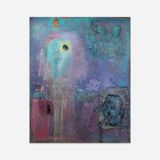
Alexander Dik’s new series of paintings, presented at JARILAGER Gallery Seoul, taps into a similar fascination. Canvas turned into a mirror, though with no trace of vanity, the artist searches for the face he had before his world was made - before migration, hardship, violence and the weight of social expectations shaped who he became. Yet the face he is looking for belongs less to personal recollection than to the depths of ancestral memory and imagination. And it is hardly one face, or even a face at all. Before Memory is the story of many faces, a collective resonance, a longing suspended between languages and borders. It is figures dissolving into melancholic landscapes and dreamy, humid, swamp-like atmospheres. The Kazakh steppe merging with Berlin’s ancient marshland. In Dik’s world, before memory is everywhere at once.
This collision of places and times has roots in Dik’s family diaspora. Descended from Volga Germans deported to Kazakhstan under Stalin during World War II, Dik later migrated with his family to Germany following the Soviet collapse. Questions of dispossession and fractured identity have followed him throughout his artistic practice, fuelling an instinctive resistance to conformity and cultural erasure. This time, though, the reference is direct and the stakes more existential. Titles such as Displaced, Exil and Out of My Village, to name a few, speak for themselves. There is an urgency to give that history a visible form, to find a kind of reconciliation. This is where painting comes into its own. Where the thread of memory breaks, leaving gaps and missing chapters, or stretches into latitudes that were never Dik’s in the first place, he pieces it all together through expressionist means: not as a linear narrative, but as a mood, a specific combination of colours, an unease that is hard to name. Awakening, for instance, resembles an old family portrait in which every identity has been blurred beyond recognition; only the sense that what we are looking at once meant something very specific remains intact. As the artist puts it, “some things are clear; others remain inaccessible. What is missing also has an effect.”
Dik’s painting sits firmly within the expressionist and neo-expressionist traditions that have shaped much of contemporary German art, with their raw gestures, distorted figures and ruthless dissection of social reality. For this body of work, he coins a term of his own - toxic expressionism. The toxicity runs on several levels. First, there is colour. Acidic greens, electric blues, sickly pinks and bruised purples glowing against murky, contaminated backgrounds. Dik literally “poisons” his canvases with a greyish-violet essence collected from dirty brushes left soaking in a bucket. Then there is the artist himself, his state of mind, the thin line between heightened sensibility and hallucination. Seeing things differently always comes at a cost. Finally, toxicity speaks to Dik’s lifelong commitment to art as a social agent. For him, art works like a virus injected into the social body, a vaccine in which poison and cure are inseparable. Good and evil are not opposites here; they coexist, and one is needed to confront the other.
Dik is a master of contradictions and unlikely turns. German by descent, Russian by tongue; a businessman and an athlete; a family man and a firebrand. A born misfit, always slightly off-centre, with no obvious place to return to. The man and the painting are much the same. Take Easter to Christmas, the centrepiece of the exhibition and the work that sparked the whole series, a remarkable study in loss, dislocation and the strange overlap of things that should never meet. The title comes from an old photograph of Dik as a child, dressed as the Easter Bunny for a Christmas dinner. There is something painful about this mix-up of seasons and rituals. Then there is the painting itself. A head, or what is left of one, slumps into a chair in the lower right, almost swallowed by the upholstery. Uprooted, helpless, barely holding its shape. A dizzying diagonal draws the eye towards the upper left, where a spectral presence looms over the composition. Could this be the ghost of an entire lineage? At its centre, an eye, perhaps a sun, perhaps an egg. An Easter egg turning up at Christmas, of all places. Birth and death caught in the same loop.
There is no neat ending to this story. Some wounds cannot be healed, some declarations of love cannot be spoken. But painting gives them a place to exist and, hopefully, a way to live with them without losing oneself. So Dik stays true to the canvas, sometimes attacking it, sometimes tending to it with the smallest, gentlest strokes. For where your treasure is, there your heart will be also.


Since its establishment in 2012, JARILAGER Gallery (Cologne/Seoul) has played a pivotal role as the holding company for UNION Gallery (London) and has expanded its reach with the recent opening of its doors in Seoul’s Gangnam district in 2023. Jari Lager serves as the director of both entities. Over the course of a decade, JARILAGER Gallery (Cologne/Seoul) has evolved into a distinct entity while maintaining collaborative ties with its sister gallery, UNION Gallery, located in London and managed by William Gustafsson.

A respected voice in contemporary art discourse.
Focusing on ambitious storytelling and insightful art-world commentary. Ocula Magazine publishes in-depth interviews, critical essays and timely analysis on the artists, exhibitions and ideas driving the global art world.
Learn more about Ocula Magazine
Showcasing the best of the art world.
Ocula partners with galleries from around the world to highlight their artists, artworks and exhibitions. Gallery membership is by application and invitation, with each member vetted by an independent panel.
Learn more about Ocula Membership
Specialises in the sale of major artworks.
Led by a team with deep ties to the world’s leading auction houses, galleries and collectors. Ocula’s advisory team offers bespoke services to high-net-worth clients from around the world who are looking to acquire the best of contemporary and modern art.
Learn more about our team and services