Press Release

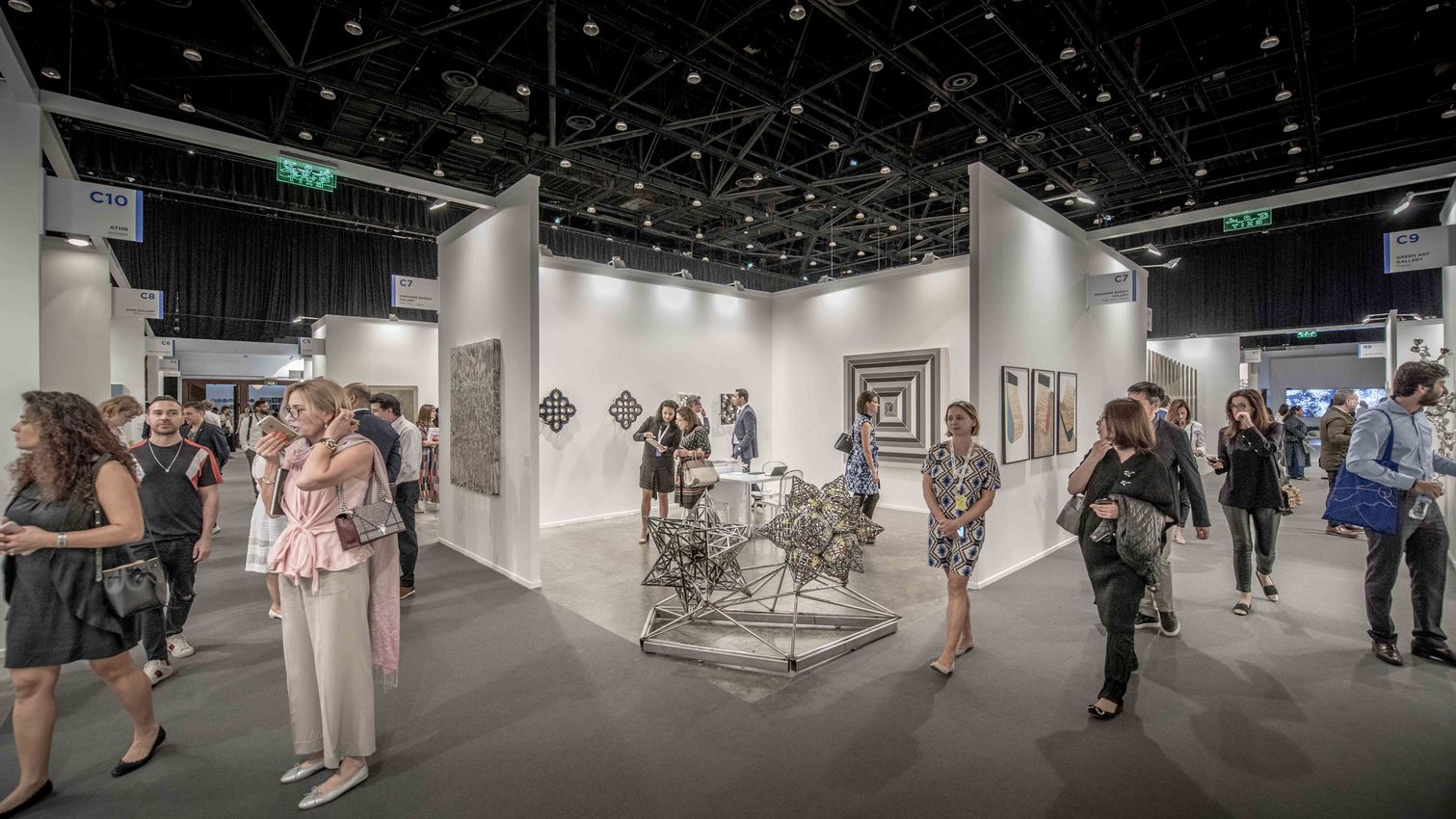
Jhaveri Contemporary returns to Art Dubai with a monochrome stand featuring four women of the South Asian diaspora. The artworks on view encompass a range of techniques and materials and, taken together, strive to mine both personal and collective histories.

Referring to her ongoing practice as ‘geometry in nature’, Amina Ahmed (b.1964, Busembatia. Lives and works in New York) explores the relationships between line and form, shadow and substance, lightness and darkness through multimedia drawings. Ahmed draws from a range of philosophical practices, calling attention to the transformations of meaning that take place when a mark moves from a solid form to reflected or shadow states. The deftly named Pitch Prieta, a series of etchings on carbon paper ricochets off a triple meaning of ‘pitch’: the tar-like substance behind the adjectival ‘pitch’ black; a measure of inter-line or inter-dot spacing in industrial printing; and the rate of vibrations impacting the quality of a sound. In the series, the artist etches repetitive marks into the front of the carbon-coated paper, inverting the normal process whereby a printmaker would etch from the reverse side. Ahmed, with minute insistence, incises into the coated matter, unearthing the flat ‘substructure’ of the paper, as ink—the very substance that would typically form the printed image—is removed. This newly excavated non-surface reveals itself in a cacophony of marks that are legible as encoded musical scores.

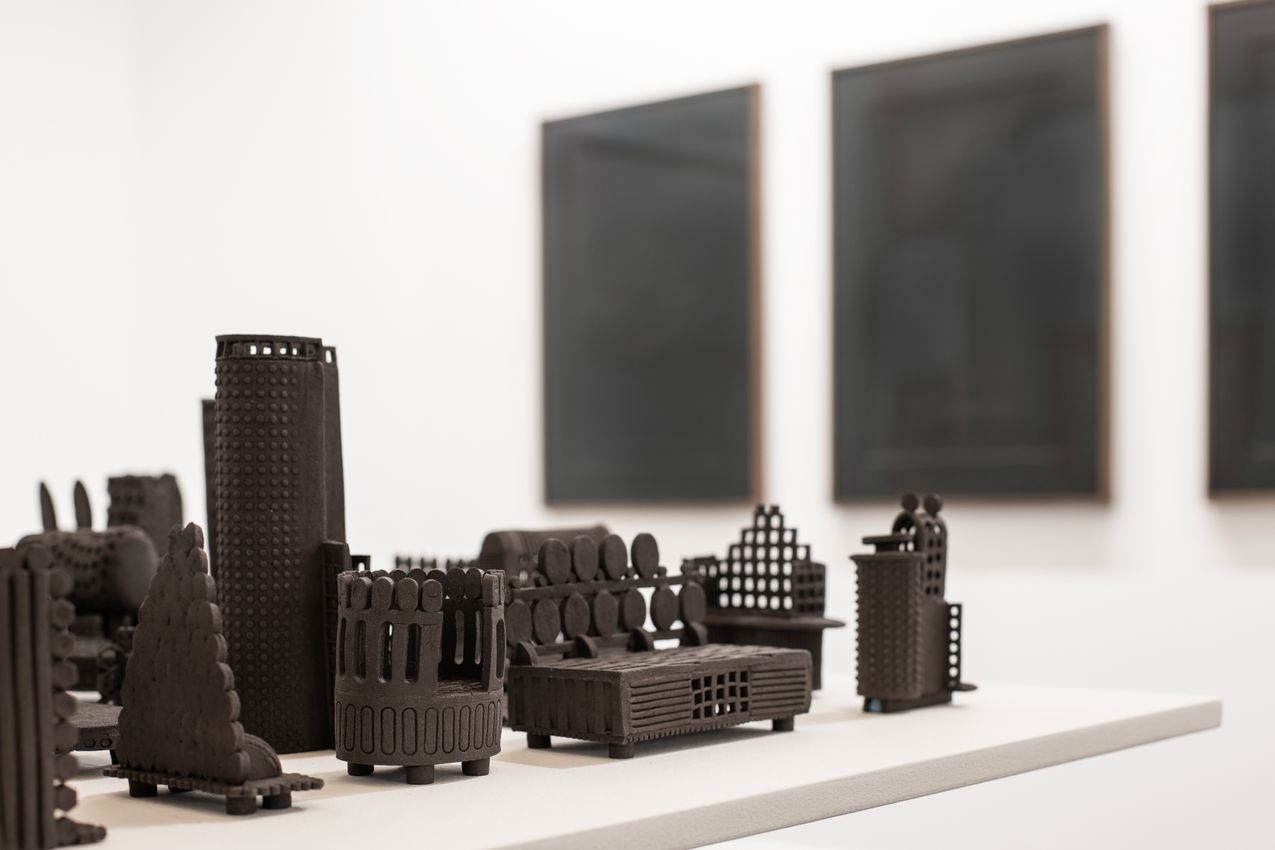
Lubna Chowdhary (b.1964, Dodoma. Lives and works in London) subverts the traditional context and utility of her chosen medium – clay – to address a longstanding preoccupation with urbanisation and material culture. Her work assimilates ideas and aesthetics from her western art school education and her Asian heritage. In Disobedient typologies 2, Chowdhary has constructed a utopian cityscape with 36 unique, unglazed and hand-crafted ceramic elements, each about the size of a hand. These are conceived by the artist as maquettes or ‘micro-architectures’ — small-scale built objects that one can inhabit. Featuring medieval forts alongside futuristic urban structures, these intricate sculptural landscapes evoke buildings and furniture from disparate realms, although the pared-down forms are united in their patterned surfaces and embellished contours. Lubna’s work will be presented in a solo exhibition at Middlesbrough Institute of Modern Art (MIMA) in June.

A swarm of fingerprints evokes a horizon line in Rana Begum‘s (b.1977, Sylhet. Lives and works in London) No. 999 Painting. Akin to large Asian scrolls, and made in the early days of lockdown in 2020, the works in this series draw directly from Begum’s immersive, participatory site-specific installation, No. 972 Wall Painting, commissioned for the 2020 edition of Dhaka Art Summit (DAS). Made with ink directly on the walls of the Shilpakala Academy, thousands of fingerprints of the individuals who came together to build DAS form an abstract portrait of the collective energy of the Summit and city. A site-responsive wall-drawing – No.1105 Wall Drawing – is currently on view at Mead Gallery, Warwick, featured in the solo exhibition Dappled Light alongside paintings, sculptures, and installations by the artist.

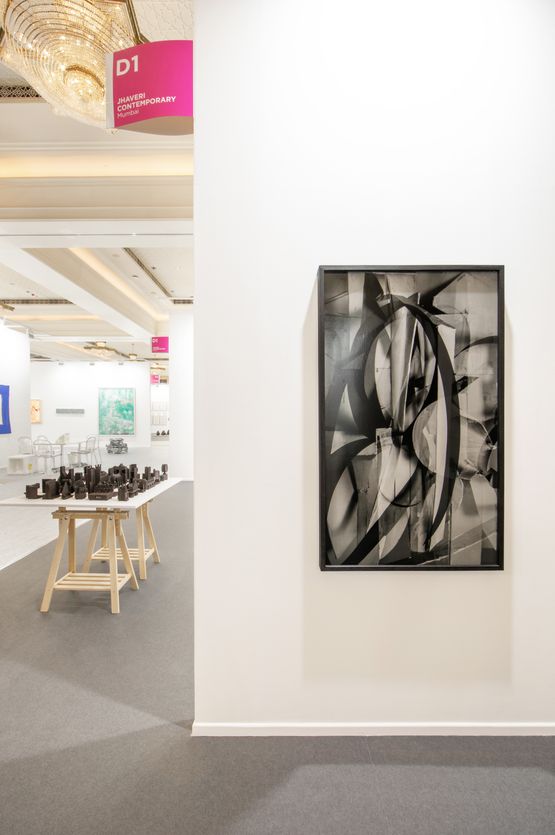
Working at the intersection of sculpture and photography, Yamini Nayar (b.1975, Detroit. Lives and works in New York) builds stand-alone and wall-based sculptures, which, through the eyes of the camera, are turned into multidimensional visual spaces reminiscent of architecture. Dual Nature and Parallel Mapping (both 2020) are made by photographing constructions of wood and paper in multiple moments on a single piece of black-and-white film. In this way, time becomes material as elements are recorded as half-lives and echoes. The artist writes:

Parallel Mapping and Dual Nature are multiple exposure photographs that document the construction process on a single piece of film. Through a recording of actions through time, there is an accumulation of marks: I think of light burning into the film like drawing in space. Parallel Mapping is based on a hand, with architectural elements within the solid black form. I wanted to visualize a process of mapping within the body, as a way of ‘knowing’. In Dual Nature, there is a buildup and breakdown of form through time, which is made visible through the photographic process. I was very much thinking of duality and how to hold the opposites.’

Courtesy Jhaveri Contemporary.

Read More

Installation Views

Also Exhibiting at Jhaveri Contemporary

The art world in focus