Kerlin Gallery is pleased to return to Frieze London with work by Kathy Prendergast, Callum Innes, Siobhan Hapaska, Aleana Egan, Dorothy Cross, Mark Francis, Ailbhe Ní Bhriain, and Aleana Egan. We are delighted to present a diverse range of media, with a particular emphasis on five female Irish artists.
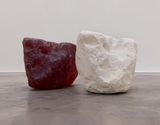
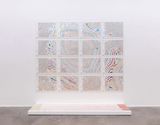
Kathy Prendergast has been employing maps in her practice since the beginning of her career in the late 80s. Reimagining maps through artistic intervention, Prendergast subverts historic symbols of power, identity and exploration, creating works that reflect more personal and emotional narratives. Presented at Frieze London are a series of hand-coloured works which invite viewers to reflect on human connections to land, borders, and the histories they carry. Prendergast has merged handmade objects with collected cartography. She pairs these objects together in ‘Falling Awake’, which is compiled of a 16-part map of Mount Fuji and grounded by a plinth covered in a woven sculptural element. The gouache and watercolour on the maps create a saturated geological installation. Through colour, the static arial views radiate an energetic sense of movement. Following Prendergast’s theme of merging pairs, we will also be presenting a set from her ‘Duplicity’ series. The artist uses chalk and glass moulded exactly to mimick each other’s forms, while in turn emphasising the contrast between the materials.
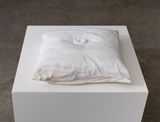
Dorothy Cross was born in Cork, Ireland, in 1956. Working in sculpture, film and photography, Cross examines the relationship between living beings and the natural world. Living in Connemara, a rural area on Ireland’s west coast, the artist sees nature, the ocean and the body as sites of constant change and flux. ‘Pillow’ presents a hand-carved marble pillow resting in quiet stillness, its surface soft in appearance but its form is solid, an ancient stone with the telling grain of geological time. From its center emerges an ear, delicately formed, as though the object itself is listening, a place of rest and dreams, is transformed into something alert, almost sentient. Her works harness this fluidity and generative power, staging unexpected encounters between plants, animals, body parts and everyday objects, resulting in strange, hybrid forms that range from the lyrical, sublime and meditative, to the erotic, humorous and playful. Cross’ work draw upon a rich store of symbolic associations across cultures to investigate the construction of religious, social and sexual mores, subjectivity, memory and vulnerability.
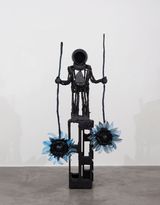
Following Siobhan Hapaska’s (b. 1963, Belfast, Northern Ireland) solo exhibition The Weight of Nothingness at Kerlin gallery June 2026, we are thrilled to bring her distinctive aesthetic to a wider international audience at this year’s art fair. The upcoming showcase features a piece from her new concrete cloth sculpture series. This wall-mounted sculpture Cosmocytes on concrete, is meticulously constructed from twisted concrete cloth with resin and jesmonite. Concrete cloth — a material associated with reinforcement and containment — is manipulated by Hapaska into forms that appear bodily. This series of work has its own glass like forms escaping from the folds or growing on its surface, some red, like enlarged blood platelets, others black, each a dark lens into another infinite universe. In The man with a stone in his stomach inverts sunflowers a lone figure stands on a makeshift plinth. Their core is hollowed out and filled with a stone, the identity is obscured or they are without one. The darkened skeletal framework is a precarious one, simultaneously devotional and exhausted, its offering of inverted blue sunflowers are denied their upright sunny, optimistic disposition. There is a heavy stone, a weight of nothingness at its core. Across these works, Hapaska continues to transform industrial materials and fragile bodily forms into meditations on weight, identity, containment, and the tension between vulnerability and resilience.
Ailbhe Ní Bhriain (b. 1978, Clare, Ireland) works with film, computer-generated imagery, collage, tapestry, print and installation. Originating in digital collage, Ní Bhriain expertly digitally stitches together archive images from a variety of different sources, blending fragments of history and geography. In Familiar Sun (II), an uneasy and dreamlike image woven with a luxurious blend of silk, wool and lurex. Ní Bhriain invites viewers to consider collective memory not as a fixed record but as something defined by gaps, ruptures, and silence. Past and present collapse into one another, revealing the instability of memory and the politics embedded in acts of representation. Ní Bhriain’s work is rooted in an exploration of imperial legacy, human displacement and the Anthropocene. These intertwined subjects are approached through an associative use of narrative and a painstakingly crafted visual language that verges on the surreal. She sidesteps directive positions and familiar binaries, exposing instead the layers of ambiguity and contradiction embedded in these fraught issues. The resulting worlds she creates are at once idiosyncratic, irresistible and unsettling.
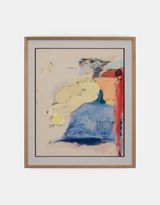
In Aleana Egan’s work, traces of psychological states and experience are harvested and expressed through material objects, colour, and form, blending fragmented interior visions with observations from the world at large. The works are deeply personal yet not biographical. Her practice is shaped by her deep engagement with works of literature and cinema: never opting for direct representation, she uses this source material as an entryway, absorbing the moods and tones it evokes. Egan engenders psychological states and memories through enigmatic arrangements of objects and forms. Her sculptural works appear restrained, but are laden with subtle references to the built environment. An airy, slender metal structure might echo an architectural form plucked out of the landscape, while her use of simple household materials – plaster, cardboard, matte paint and various fabrics – speak to the domestic. Egan’s forms and shapes act as traces or shifting responses, tentative articulations of remembered places or everyday moments. A meandering, sensuous line and sense of fluidity is carried from her sculptures into her film and painting, giving form to a sense of flux, openness and mutability.
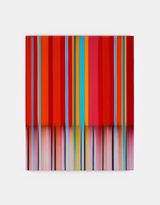
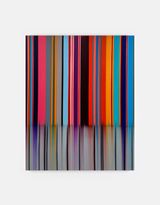
Mark Francis (b. 1962, Northern Ireland) makes powerful, optically intense paintings that are driven by the revelatory insights of contemporary science. Filled with a sense of movement and vibrational energy, his paintings combine electric colour contrasts with dynamic patterns and precise brushwork. Fields of colour are shot through with orbs or pulsating linear forms that dissolve or disintegrate, mimicking streams of light, sonic vibrations, or graphs of seismic patterns. Francis’s longstanding fascination and engagement with science provides rich territory for his painting, making striking imagery out of what is normally invisible, he explores the visual worlds made accessible by electron microscopes, or sonic data gathered from outer space. But while the feats of manmade technology inform Francis’s work, the thing of wonder remains the unknowable quantities beyond their reach. This is what Francis uses his imaginative power and painterly skills to conjure – sparking a tension between order and chaos, knowledge and mystery that is at the heart of his work. Mark Francis is currently representing the Republic of San Marino at the 61st Venice Biennale.
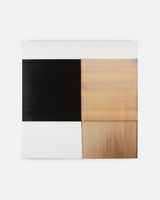
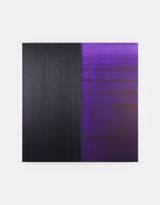
Callum Innes (b. 1962, Scotland) Callum Innes creates abstract paintings that carry a powerful tension between control and fluidity. Dissolution is central to his practice: layers of deep pigments are brushed over with turpentine, breaking down sections of paint and leaving watery, trace elements, before being painted over again. Repeating this process of painting, dissolving and repainting multiple times, Innes builds depth and a sense of history: oblique panels of dense pigments become embedded and fortified, while tiny trickles or rivulets of liquified paint point to their underlying fragility. Though Innes’s works may seem minimal or geometric at first glance, they are in fact always slightly “off kilter”, governed by imperfectly drawn lines and slightly softened shapes. This fallibility and humanity, put in contrast with the artist’s skill and precision as a painter, results in works of great poetic and contemplative power, cementing Innes’s place as one of the most significant abstract painters of his generation.
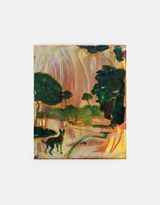
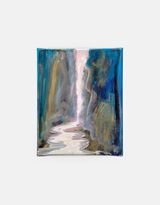
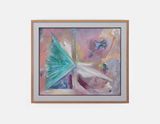
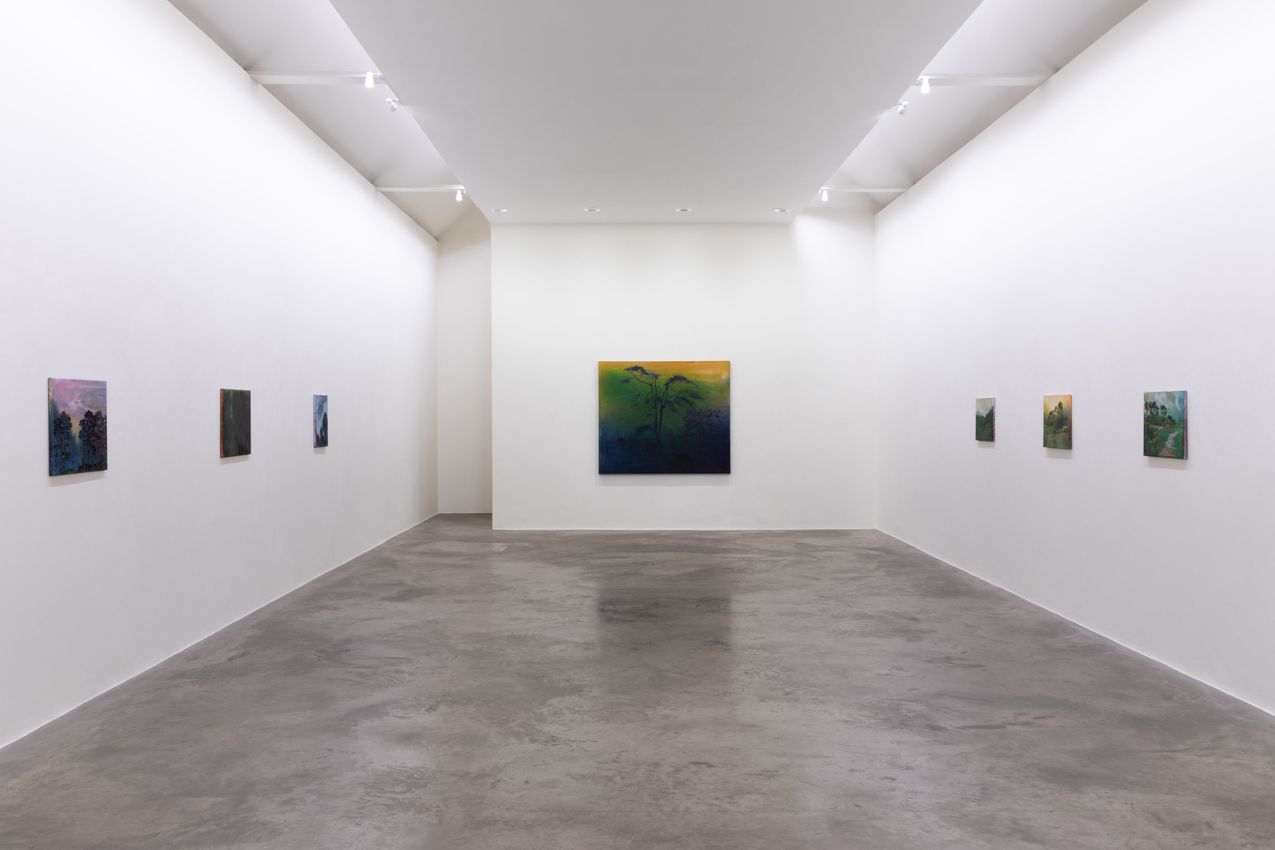
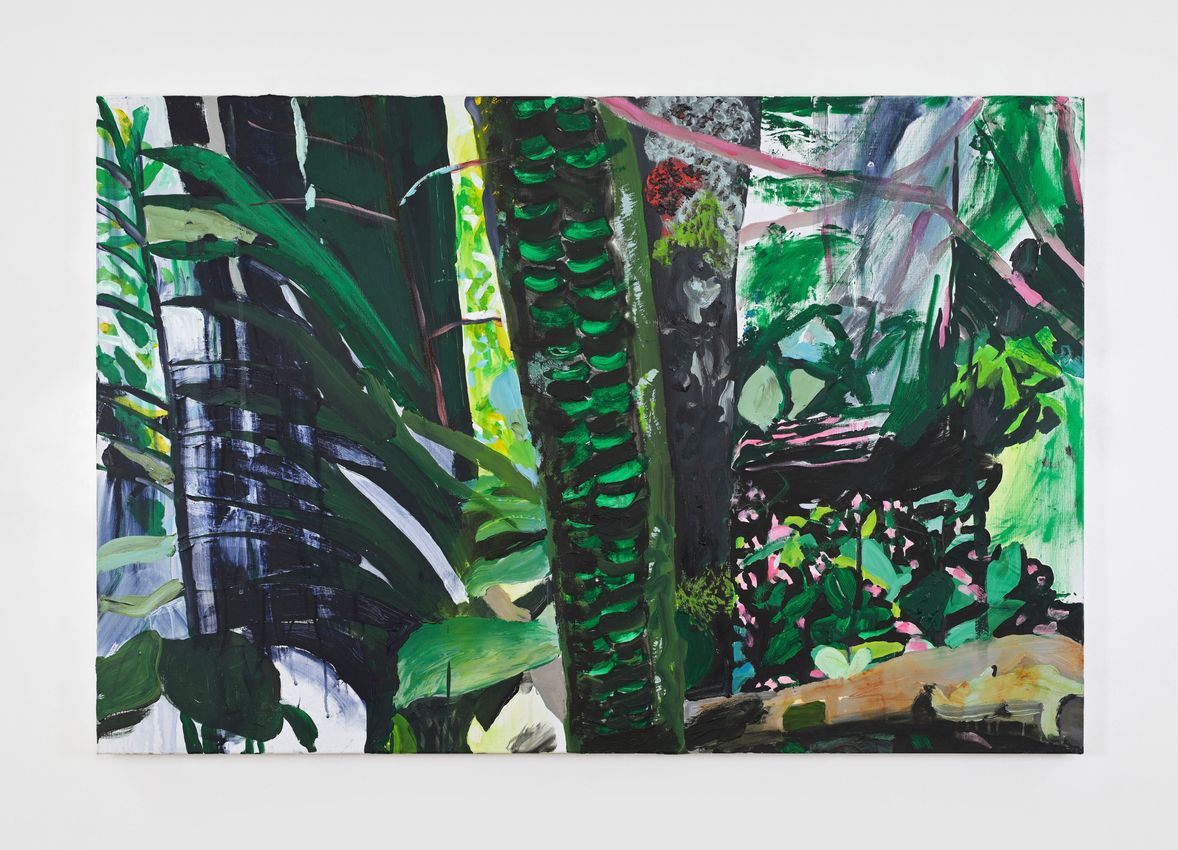
Elizabeth Magill (b. 1959, Canada). Described by critic Isobel Haribson as “epic, enigmatic and evocative”, Elizabeth Magill’s highly idiosyncratic paintings present subjective and psychological takes on the landscape genre. Rich with kaleidoscopic patterning and fragmented forms, these vistas are embedded in place – usually rural settings on the edges of settlements – but transported through the artist’s imagination, memories, photographs or moods to be presented as something other: lush, visionary recollections of hills, lakes, hedges and skies glowing with ambient light. The term ‘inscape’ has been used to describe Magill’s practice: landscapes not based on direct observation but imbued with a sense of interiority and reflection. Though they have a cinematic beauty, her paintings can also be eerie or unsettling: trees or telephone wires conceal the view; birds are silhouetted in the dark; rare human figures feel distant, phantasmal; colours feel subdued, or occasionally toxic. Magill’s complex and densely layered paintings are produced using various techniques, at times incorporating stencilling, screenprinting and collage, as well as the pouring, blending, dripping, splashing and scraping away of paint. Film and photography are also central to her research, shaping the way the artist looks at landscape, and infusing her approach to light, tone and atmosphere.
Courtesy Kerlin Gallery.
A respected voice in contemporary art discourse.
Focusing on ambitious storytelling and insightful art-world commentary. Ocula Magazine publishes in-depth interviews, critical essays and timely analysis on the artists, exhibitions and ideas driving the global art world.
Learn more about Ocula Magazine
Showcasing the best of the art world.
Ocula partners with galleries from around the world to highlight their artists, artworks and exhibitions. Gallery membership is by application and invitation, with each member vetted by an independent panel.
Learn more about Ocula Membership

Specialises in the sale of major artworks.
Led by a team with deep ties to the world’s leading auction houses, galleries and collectors. Ocula’s advisory team offers bespoke services to high-net-worth clients from around the world who are looking to acquire the best of contemporary and modern art.
Learn more about our team and services