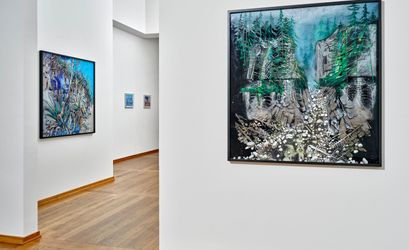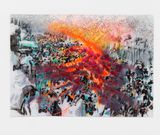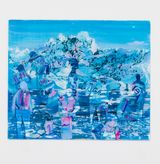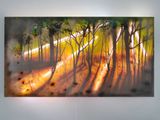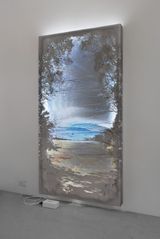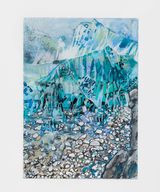




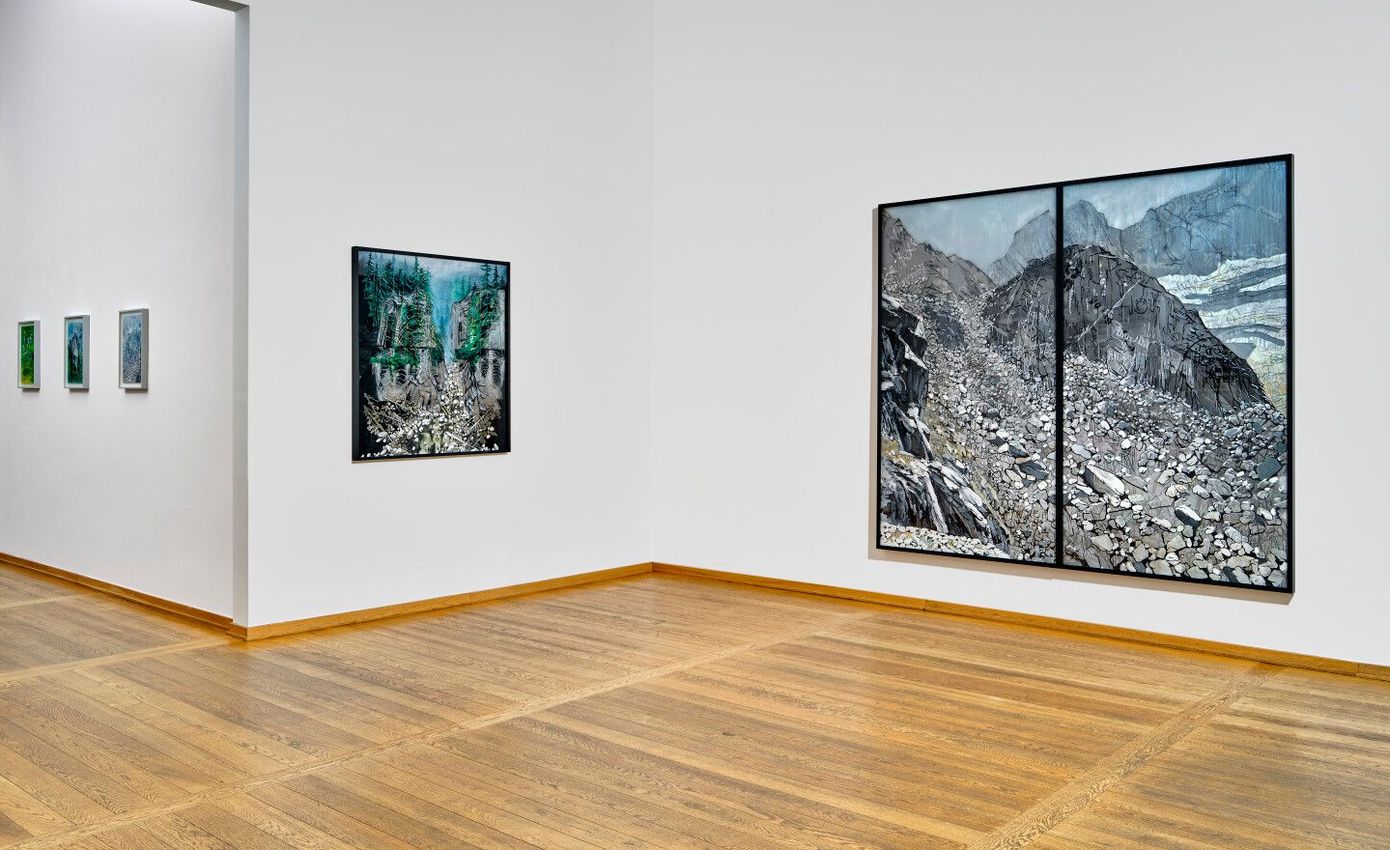
In the title image Survival of Philipp Fürhofer’s exhibition Permaschicht you can see a field of rubble with slogans such as “Sexy” or “natural beauty” that can be seen in fragments on the rocks behind it on closer inspection. Is it about life? Or just survival? In his works he repeatedly addresses not only the beauty of nature but also the destruction of nature by humans. Overconsumption, the pressure to self-optimise and artificiality flow subtly into his works in terms such as “forever” or “hot”, even if they also represent beautiful, sometimes even sublime places of longing.
Man fights against his own transience and is ultimately forced into the natural cycle of growth and decay. Would it not be advisable to appreciate what is given? To celebrate the natural beauty of flora and fauna, as Fürhofer does in works such as Lampedusa? The commercial growth that he critically addresses in his works destroys what grows naturally.
In addition to this critical attitude, Philipp Fürhofer also celebrates the beauty, fragility and romance of nature in his pulsating light boxes and densely placed, colourful images. As a viewer, you are inspired and are reminded of his magical stage sets and museum exhibition productions. Through Philipp Fürhofer’s special, complex technique of multi-layered painted, scratched and mirrored interior and exterior surfaces, he creates a diverse, magical world of images whose fascination is hard to resist. A series of smaller formats that are thematically based on the larger works—with exotic titles such as Damascus, Phuket, Wyoming or Casablanca—also show the branched structures, flowers, leaves and roots typical of his work, which seem to merge into human cells, veins and bones like a hybrid.
From October 24th, a large three-part work by Philipp Fürhofer will also be shown in the Pinakothek der Moderne in Munich as part of the exhibition Eccentric—Aesthetics of Freedom. In both geographical and thematic proximity, a thematic bridge is created in Munich between these two simultaneous exhibitions in which his work can be seen alongside works by artists such as Mickalene Thomas, Andy Hope and Jonathan Meese.


“In me there are two souls, alas...”, Faust’s famous inner conflict also applied to young German artist, Philipp Fürhofer. In love with both art and music, Fürhofer grew up torn between pursuing a career as an artist, and as a pianist. Though he decided on art, music, and most notably opera, remain extremely important in his life and influential for his art practice.
Knust Kunz Gallery Editions was founded in 1982 under the name Galerie Sabine Knust. Continuous collaborations with artists like Georg Baselitz, Per Kirkeby, A.R. Penck, Markus Lüpertz, Jörg Immendorff, and Imi Knoebel formed an ongoing presentation of their print and graphic œuvre for over 30 years. In 1998 Matthias Kunz joined as partner.

A respected voice in contemporary art discourse.
Focusing on ambitious storytelling and insightful art-world commentary. Ocula Magazine publishes in-depth interviews, critical essays and timely analysis on the artists, exhibitions and ideas driving the global art world.
Learn more about Ocula Magazine
Showcasing the best of the art world.
Ocula partners with galleries from around the world to highlight their artists, artworks and exhibitions. Gallery membership is by application and invitation, with each member vetted by an independent panel.
Learn more about Ocula Membership

Specialises in the sale of major artworks.
Led by a team with deep ties to the world’s leading auction houses, galleries and collectors. Ocula’s advisory team offers bespoke services to high-net-worth clients from around the world who are looking to acquire the best of contemporary and modern art.
Learn more about our team and services