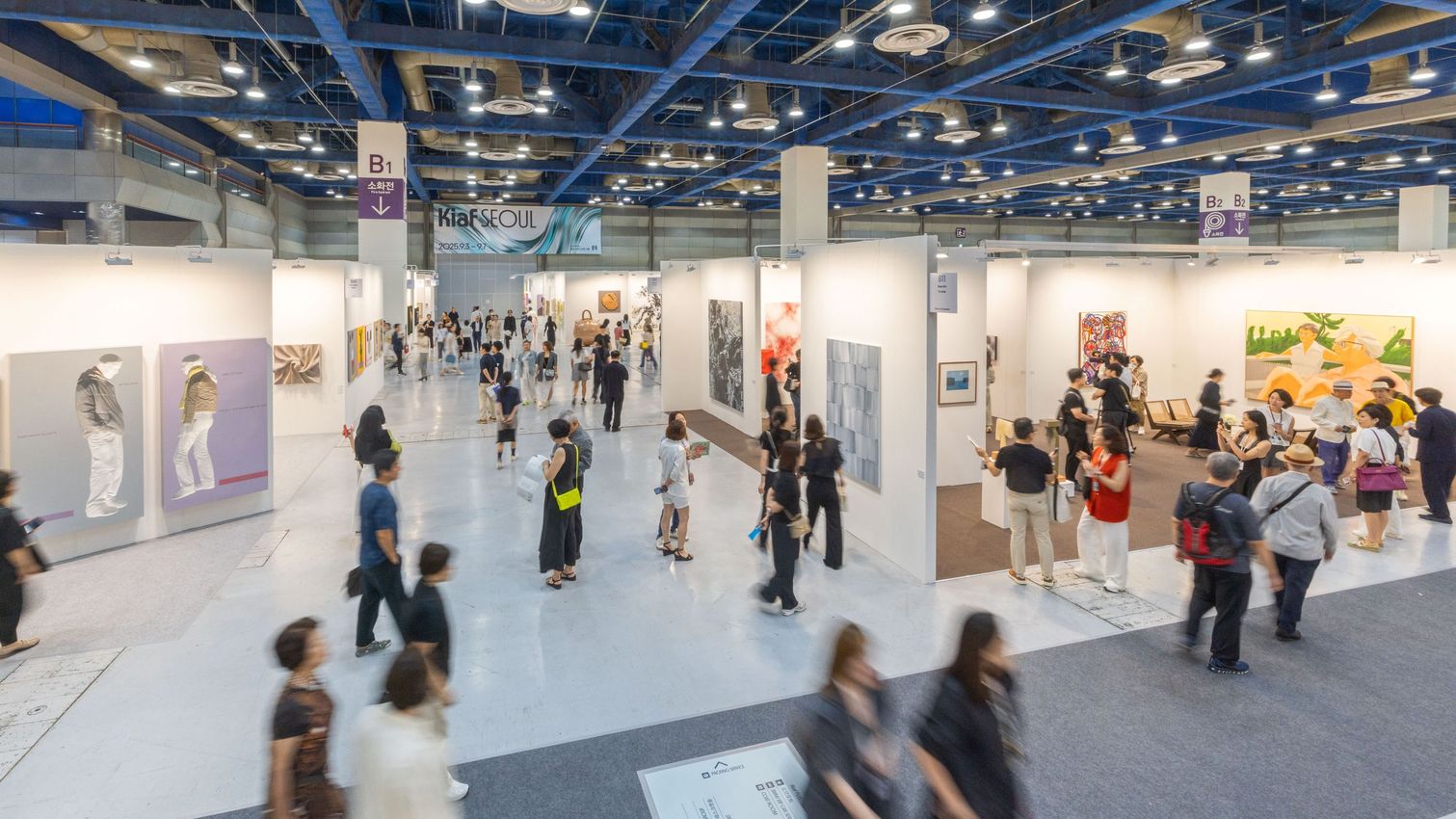
Kiaf SEOUL, establishing itself as the largest art fair in Korea, celebrates its 25th anniversary this year. Introducing a broad spectrum of contemporary art to the domestic and international collectors around the world, this year’s edition brings together 175 galleries from 18 countries under the theme of “Coexistence.” The fair will reflect on the unique value of human perception and creativity at a time of rapid advances in artificial intelligence (AI) and digital technologies, while exploring new ontological balances for coexistence. The special exhibitions HUMAL and VIRTUAL VITAL offer multifaceted perspectives on the relationship between humans and technology through distinct formats.
The fair also welcomes the audience with an expanded program of events, including a series of talks jointly organized by Kiaf, the Korea Arts Management Service (KAMS), and Frieze Seoul, as well as “Kiaf Classic,” featuring a performance by world-renowned pianist Seong-Jin Cho.
For this year’s Kiaf SEOUL, Kukje Gallery presents a curated presentation of the acclaimed French contemporary artist Jean-Michel Othoniel. Renowned for a practice that moves fluidly across sculpture, installation, and painting, Othoniel unveils a new body of work created between 2025 and 2026, exploring the symbolic depth and ephemeral beauty of the beotkkot (cherry blossom).
Centered on his new Sakura paintings rendered in a bluish color palette on white gold leaf, alongside a monumental sculpture crafted from giant mirror-polished metal pearls and floral forms cast in aluminum and finished with gold leaf, the presentation reflects on nature as a mirror of the soul. Othoniel describes the narrative behind these works as follows: “After the lotus, the cherry blossom is undoubtedly one of the deepest symbols in the Asian imagination. In Japan, it marks a time of contemplation, where beauty reveals itself through impermanence. In Korea, the beotkkot accompany the return of spring, quiet walks, and those suspended moments when human beings reconnect with nature.
This moment of emotion has travelled far beyond its lands of origin. It has been passed on through Asian gardens created around the world, places where the landscape becomes a meditation and every blossom invites us to reconnect with ourselves. It was in one of these gardens in San Francisco that I encountered, for the first time, the grace of cherry blossoms.
Their blooming is a lesson in gentleness and wonder. The petals emerge in a fragile light before surrendering to the wind, reminding us that beauty does not lie in what endures, but in what gives itself completely before disappearing. Where the lotus evokes spiritual elevation, the cherry blossom celebrates the miracle of presence: the lived moment, renewal, and the awakening of the heart.
Within it converge the delicacy of Japanese silence, the Korean poetry of spring regained, and that Asian sensibility which recognizes nature as a mirror of the soul.
A beauty that does not seek to hold back time, but to reveal its grace.
It is this presence that I seek to convey through my sculptures. Metal altars suspended on the wall, imaginary sanctuaries where petals, frozen in gilded matter, become offerings.
Meanwhile, Othoniel is set to open the solo exhibition In the Labyrinth of Love at F1963, a multicultural complex in Busan, on August 28. The exhibition marks his first solo presentation in Busan and builds upon his large-scale exhibition OTHONIEL COSMOS or the Ghosts of Love, which was held across the city of Avignon, France, last year, reconfigured specifically for the spaces of F1963. By showcasing more than 100 major works created over the past two years, the exhibition offers a comprehensive overview of Othoniel’s oeuvre, which begins with love—the most personal yet universal emotion—and expands toward nature and the cosmos.
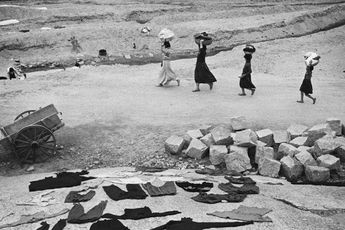
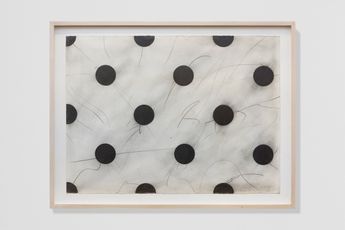
Moreover, Kukje Gallery’s booth also brings together other artists who represent Korean modern and contemporary art. Among them is Han Youngsoo, a pioneer of Korean modern photography, whose work, Joongang Cinema, Myeongdong, Seoul 1957 (1957, Printed in 2025), is presented at the booth. This silver gelatin print captures the urban landscape of Myeongdong in the 1950s, conveying a sense of human vitality and a modern sensibility amid the social turmoil that followed the Korean War. Furthermore, Kukje Gallery highlights artists currently featured in the major group exhibition This is (Not) Conceptual Art at the National Museum of Modern and Contemporary Art, Seoul. Kim Yong-Ik’s Exhausting Project 23-22: Conceptual Painting Disguised as a Retinal Painting (2023) questions the essence of art beneath the visual pleasure of modernist painting by exhausting the paint. Drawing on principles from the well-known Chinese philosophical text, the Book of Changes (or I Ching; 周易), Kim paints circles and squares on canvas and applies paint in thin layers, conveying the aesthetics of restraint and emptiness. Ahn Kyuchul—an artist who uses writing as an essential means for contemplation—showcases Things in the World (2024), a work filled with handwritten, contemplative sentences. By listing values that cannot be measured in monetary or visual terms, the work invites viewers to reflect on the essence hidden within everyday life.
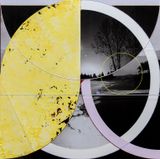
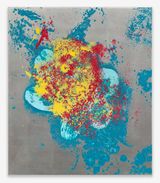
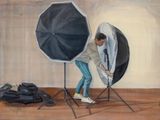
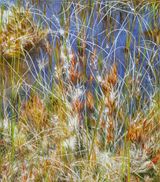
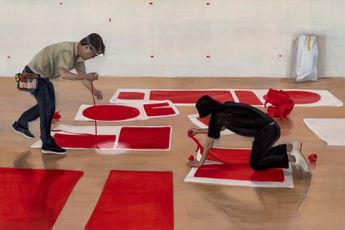
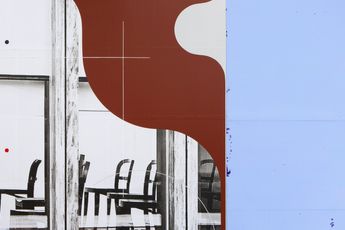
Lee Kwang-Ho, who has reinterpreted enlarged landscape photographs of wetlands and bushes as figurative paintings, presents his new work Untitled 4709-1 (2026). Rather than simply reproducing the subjects, the work amplifies the artist’s inner imagery, drawing the viewer’s gaze into the canvas through his distinctive tactile brushwork and abstraction. Jina Park’s Setting Up Lights 01 (2025) captures the unguarded moment of staff preparing for a shoot behind the scenes of an exhibition space, translating them onto canvas. By reconstructing the fleeting moment captured in a snapshot into an oil painting, Park imbues it with a new narrative and painterly materiality. Na Kim brings Piece 9-1 (2020) to the booth, exploring and breaking down the boundaries between graphic language and fine art through the combination of geometric forms and vivid color blocks. Precisely arranged lines and planes create a sense of visual rhythm and formal balance across the flat surface. Jang Pa, who expresses the female body and interiority through a primal painterly language, presents Gore Deco – The Laughing Orifice #1 (2025), where grotesque body fragments collide with decorative elements to exude a powerful energy. In particular, this work is characterized by its emphasis on the vibrant, patterned background over the organic form at the center, thereby subverting the conventional hierarchy between figure and ground. Finally, the booth presents Overlapping Horizons (2026) by Heejoon Lee, who is expecting a solo exhibition at Kukje Gallery Seoul in late November. Lee combines and reinterprets images collected from urban landscapes and everyday life through photographic collage and acrylic techniques, constructing a distinctive visual order across the flat surface of the canvas.


A respected voice in contemporary art discourse.
Focusing on ambitious storytelling and insightful art-world commentary. Ocula Magazine publishes in-depth interviews, critical essays and timely analysis on the artists, exhibitions and ideas driving the global art world.
Learn more about Ocula Magazine
Showcasing the best of the art world.
Ocula partners with galleries from around the world to highlight their artists, artworks and exhibitions. Gallery membership is by application and invitation, with each member vetted by an independent panel.
Learn more about Ocula Membership

Specialises in the sale of major artworks.
Led by a team with deep ties to the world’s leading auction houses, galleries and collectors. Ocula’s advisory team offers bespoke services to high-net-worth clients from around the world who are looking to acquire the best of contemporary and modern art.
Learn more about our team and services