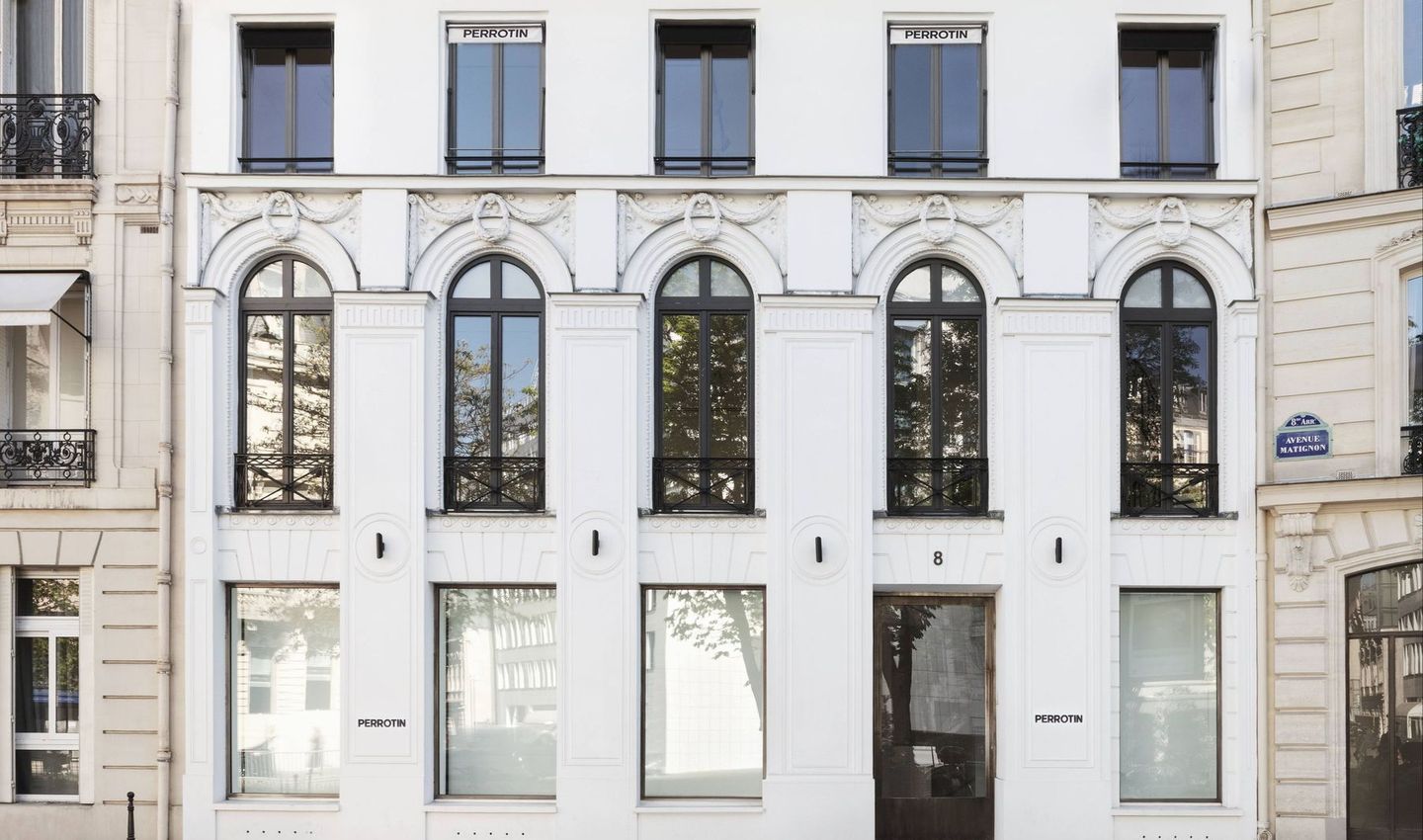
Perrotin London is delighted to host Iván Argote’s new exhibition, Mamarrachos: Quinceañera, marking his ninth solo show with the gallery and his first in Perrotin London Celebrating fifteen years of his eponymous series of paintings and sculptures originating from digital scribbles, the exhibition explores the notions of constraint and freedom while actively inviting the public to participate within the gallery space. This exhibition also marks fifteen years of collaboration between the artist and the gallery.
Argote calls Mamarrachos: Quinceañera — his 2026 exhibition at Perrotin’s London gallery — “a special show”, describing an intimacy that’s unusual in his practice. “It’s particular because it’s not a very big show - it’s one room,” he tells me. “It’s also a rare show for me, because most of the time I’m working on large-scale installations.” The exhibition marks fifteen years since he first exhibited his Mamarrachos paintings. This is a coming-of-age moment for the series itself, a chance for Argote to look back at a body of work without yet being finished with it.
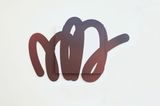
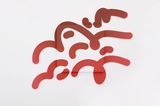
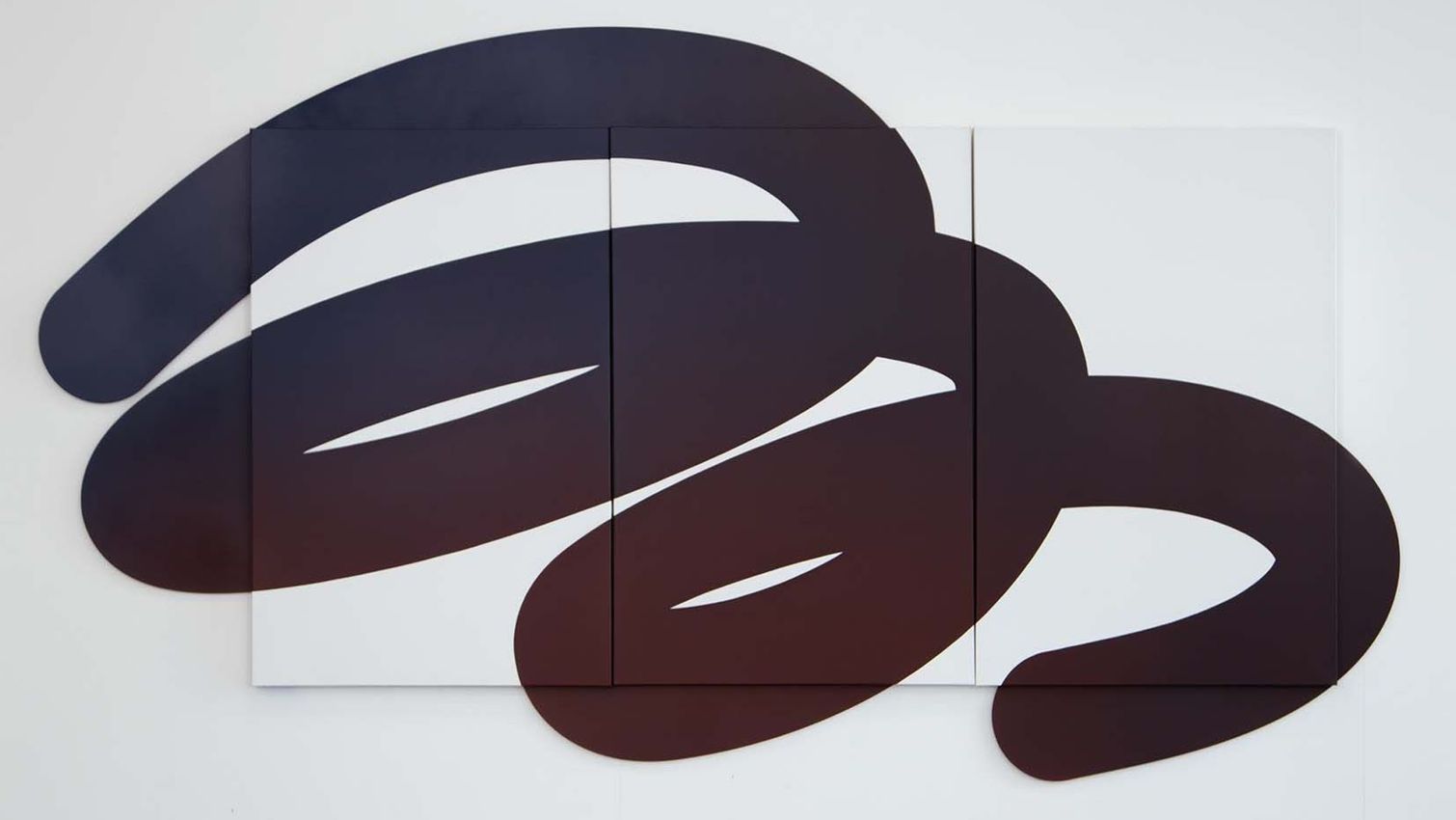
Argote’s Mamarrachos deal with dynamics of constraint (and his escape from it) that guide much of his working principles. For the series, it’s the confines of the canvas’s rectangle that Argote absconds from. They start with digitally rendered marks created in seconds — the kind of scribbled line one might make on a phone screen with a careless finger — that are enlarged by a factor of a thousand in the works. The canvas is the ground for these augmented lines, but they refuse to be boxed in; reaching beyond the rectangle, their MDF extensions resisting the categorisation of these works simply as paintings.
The very nature of a gallery exhibition requires a certain level of unavoidable slickness. In Colombia, mamarracho might describe someone who appears messy in a situation where they should be more put together — a child with unkempt hair and an untucked shirt in their grandmother’s house. In the refined environment of Perrotin’s London gallery, Argote’s work is that scruffy kid. His Mamarrachos walk a tightrope: in ways, they’re sleek in appearance — at home in the environment in which they hang — whilst still faithful to the scrappy methodologies that birthed them.
The ideas that would later develop into his Mamarrachos first emerged in 2008, in Argote’s video Retouch, which centres on two quintessential Mondrian paintings — Composition en rouge, bleu et blanc II (1937) and New York City (1942) — both in the collection of the Centre Pompidou. The twelve-second clip, made while Argote was still a student at the École des Beaux-Arts in Paris, begins with the camera placed on the floor of one of the Pompidou’s galleries. A young Argote crosses the room to the Mondrians and, without hesitation, draws a meandering line in black spray paint across the two canvases. The integrity of the paintings appears saved only by the glass of their frames.
Each of the uniform coloured lines in New York City exactly matches the width of the canvas frame. The Dutch painter was living in exile in New York when he painted the work, which the critic Charmion von Wiegand — who was present for its creation — compared to “the geometric rhythm of the city’s traffic”. It took Argote all of three seconds to fracture Piet Mondrian’s meticulous geometry, an act of protest and social commentary that birthed his Mamarracho paintings in their foregrounding of the split-second scribble as a gesture. Uploaded to YouTube, a comment by @trolldoncod under Argote’s video of the act reads, “This kid did a good job that wasn’t even art. It was just red and yellow lines.”
Retouch was exhibited in Caliente, Argote’s first show with Perrotin in 2011, and, fifteen years later, the artist has chosen to exhibit the work in his Mamarrachos: Quinceañera. Its original inclusion in Caliente—less than a mile from the Pompidou—succeeded in ruffling feathers, with Le Monde writing, “Argote sought the ultimate escalation, the ultimate desecration that would make him truly famous... But he took the precaution of choosing canvases protected by glass. Obviously, we’re happy for Mondrian. But this prudence reduces his modern-day Herostratus gesture to the level of a very minor publicity stunt.” The reality behind the action’s conception was, at the time, withheld, or at least not made immediately obvious. “Retouch is a digital retouch — I made it frame by frame,” Argote tells me. “It took a month; it wasn’t as easy back in 2008 as it would be today, where you could do it in half a second with a prompt. It’s a piece I made for the internet.” What appears, at first, to be a fleeting act of unbridled free will was in fact conceived digitally through a process just as fastidious as Mondrian’s own line work.
Constraint, for Argote, has been a constant in his practice from the very beginning: deployed in opposition to, or existing symbiotically with, the artist’s own liberty. It stands to reason that, for a young artist hailing from Bogotá, Colombia in Paris on student visa, it would be unwise to desecrate works by one of the pioneers of European abstraction in France’s national centre for art and culture. Retouch, as a digital provocation, was the artist’s solution to these circumstantial limitations. Argote has spoken elsewhere about the terms under which artists like him are permitted to speak in Europe at all. “When you’re a migrant,” he told the artist Roméo Mivekannin in a 2024 conversation for BOMB Magazine, “you’re compelled to speak or act in a certain way — especially in Europe, which, for an artist, means speaking about one’s origins.” Le Monde failed to consider in their review Argote’s own condition: a critique of the Western canon has to be carefully veiled or, in the case of an action as extreme as that presented in Retouch, an outright illusion.
For Argote’s interventions in public or his video works uploaded to the internet, the rules of engagement are few. That is the strength of the work. Democratised online or outdoors in civic space, Argote’s work persists unrestricted: available for common use, open to critique and functioning alongside day-to-day life. The controlled environment of the gallery space therefore presents a challenge for the artist: how can his exhibition-making escape the restrictions of the gallery? “I do exhibitions in galleries,” Argote explains, “but the exercise of the gallery is sometimes harder for me because somehow I have to contain the works into certain dimensions.” His work Circles, installed early on in his career in multiple project spaces and also shown in his 2011 Perrotin exhibition, directly acknowledges the limitations of viewership and audience participation in the context of a gallery exhibition. In Circles, a spray can hangs from a chain in the centre of the gallery; its audience are permitted to use it as intended, but the chain is only just long enough to reach the wall – its leash dictates the possibilities of mark making. “People try to draw, but they always end up drawing circles, because they can’t go farther than the chain,” the artist recalls.
The re-exhibition of Circles for Mamarrachos: Quinceañera introduces Argote’s ongoing commitment to troubling the gallery’s static environment. Only the choice of paint colour has changed since the work was first shown — purple now, indicative of the ambiguity between the politicised colours of blue and red. His audience are again invited to exercise their free will, painting the walls of Perrotin until the can runs out, at which point it will be left hanging as a trace of spent self-determination.
A slew of institutional exhibitions and public sculpture commissions in recent years have moved the goal posts for Argote: success in these arenas has brought with it a new set of constraints. Public commissions come with mandatory permits and engineering sign-offs — the careful navigation of which earns Argote permanence, something his early works never had. Un Chemin Commun (“a common path”) — his contribution to the 2024 Lyon Biennial — begins with the same gestural structure as his Mamarrachos: a fast, unbroken line indifferent to the space it occupies. Only in Lyon, the gesture is immortalised in concrete and runs for over fifty metres. Scaled up, Argote’s line becomes utilitarian as well as aesthetic: standing at the height of a bench, the work has a second identity as a site for play, leisure or contemplation — the strip of forgotten brownfield land on which it sits now a meeting point for the people of Lyon.
Un Chemin Commun’s dusty pink tone is itself a product of constraint. Following a period of research into the role colour plays in political propaganda, Argote embarked on a city-wide installation as part of the La Place de l’Humain art triennial in Douala, Cameroon. He arrived expecting to find a colonial history closer to that of Colombia — where the Spanish had settled, built infrastructure and considered it home — instead he found what he described as “a greater sense of plundering”. A purely extractive brand of colonialism. It was this specific history that shaped the work, for which Argote fabricated dallettes: small concrete slabs, designed to cover exposed sections of the city’s sewer system. Each slab was debossed with slogans both political and galvanising: “We are strong,” or “We have dignity.” “I wanted to make the slabs red,” Argote tells me. “But there was no pigment available in Cameroon, so I had to bring a suitcase full of pigment from Paris. The pigment wasn’t enough for the quantity of slabs, so it became this soft pink — and I really loved it. It became part of my work itself.”
A printed carpet covering the floor of Perrotin’s London Gallery connects the logic of Argote’s permanent outdoor installation with the dynamics of viewership in the gallery environment. The carpet is printed to mirror the exhibition above it — ceiling, walls and artworks are all reproduced underfoot. The dimensions of the gallery are not dissimilar to those of Argote’s studio, a coincidence that allowed him to experiment with the layout before the works entered the space. “I like to work sitespecific,” Argote tells me, “so site-specific that it doesn’t work again anywhere else. It’s just a portrait of that moment, of that show.” The printed carpet functions as a kind of leveler: as with Argote’s public interventions in Lyon and Cameroon, stepping on this work becomes a way for the audience to relate to Argote and his output. The artist’s invitation to walk on his work breaks the assumed sanctity of the gallery space. It’s a reminder - alongside the spray can hanging on the chain — that the audience are not outsiders looking in at Argote’s practice but active participants, essential to the realisation of the artist’s own ideas and ethics.
What Argote is celebrating at Perrotin — a Quinceañera for his Mamarrachos — is not a change in the way he works or a kind of ‘growing up’ but instead a commitment to the methodologies through which he has always operated. The embrace of contradiction — fugitivity versus stability, constraint versus freedom — is omnipresent, inescapable both in his work and his own circumstance as an artist from Colombia living in Paris. Even in the elegant environment of the commercial gallery space the works resist — quietly defying containment or categorisation.
— Ben Broome, Curator
Courtesy Perrotin.
Born in Bogotá, Colombia, in 1983, Iván Argote settled in Paris in 2006. Argote creates videos, photographs, sculpture, public interventions and performances, as a way to explore our inextricable links to history, tradition, art, politics and power. Argote investigates the city as a place of transformation and potentiality, traveling the world in search of vestigial signs of fallen power, studying the indirect manifestations of control, and observing the conventions that gain acceptance in order for one vision of history to become the official version. Public monuments and sculpture are also recurring themes in the artist’s work. Through his personal narratives, and their connections to history, ideology, and consumerism, Iván Argote questions a Western perspective of history. Emmanuel Perrotin met Iván Argote in 2008 while the artist was a student at Paris Fine Arts School. Perrotin has represented Argote since 2009.

A respected voice in contemporary art discourse.
Focusing on ambitious storytelling and insightful art-world commentary. Ocula Magazine publishes in-depth interviews, critical essays and timely analysis on the artists, exhibitions and ideas driving the global art world.
Learn more about Ocula Magazine
Showcasing the best of the art world.
Ocula partners with galleries from around the world to highlight their artists, artworks and exhibitions. Gallery membership is by application and invitation, with each member vetted by an independent panel.
Learn more about Ocula Membership

Specialises in the sale of major artworks.
Led by a team with deep ties to the world’s leading auction houses, galleries and collectors. Ocula’s advisory team offers bespoke services to high-net-worth clients from around the world who are looking to acquire the best of contemporary and modern art.
Learn more about our team and services