



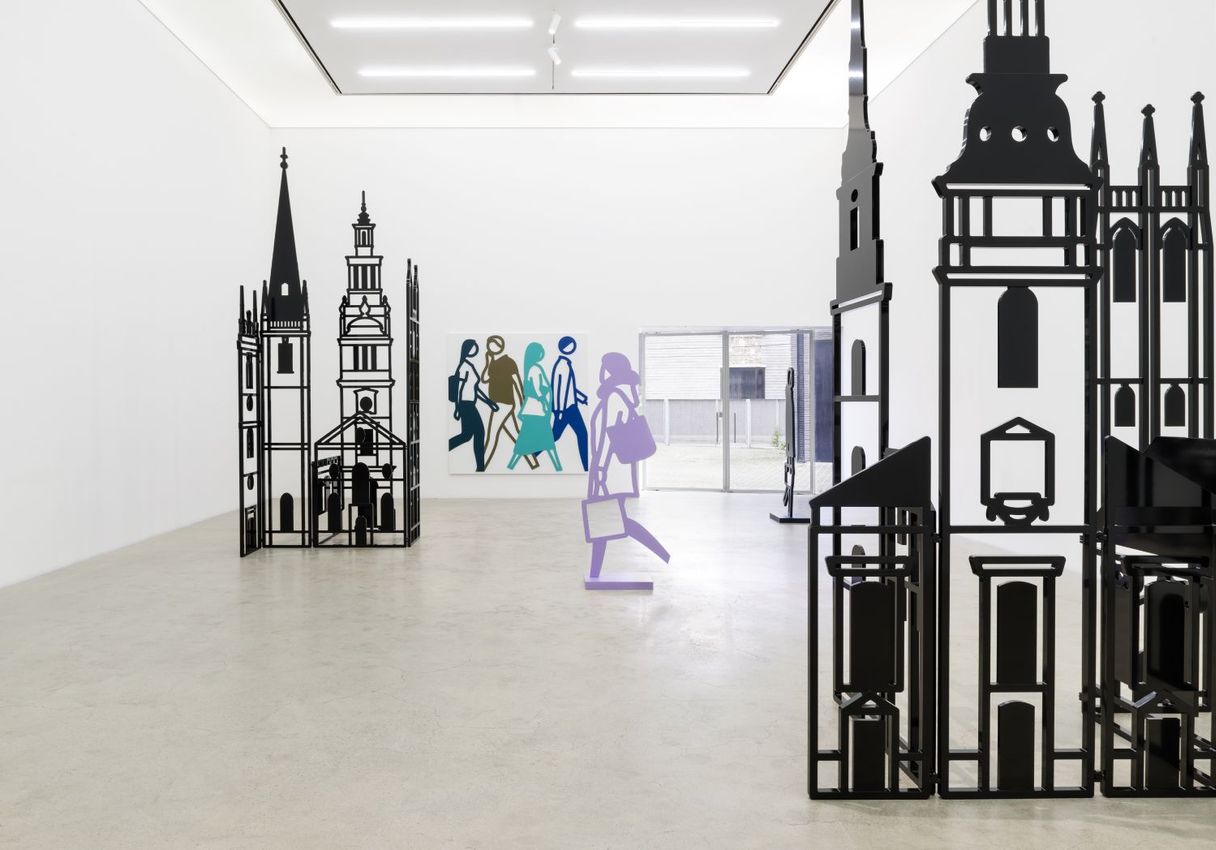
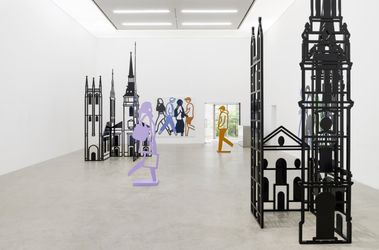
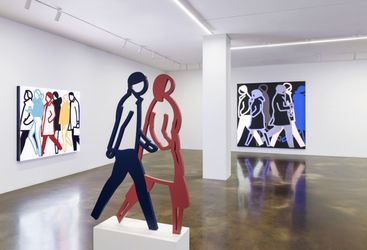
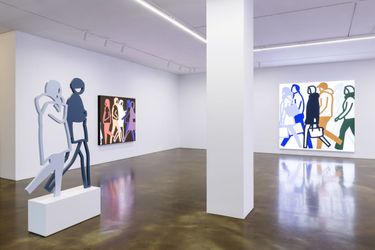
Kukje Gallery is pleased to present a solo exhibition of work by the British artist Julian Opie, on view from 2 October to 28 November 2021. Through solo museum exhibitions at the Suwon Museum of Art (2017) and F1963 (2018), and permanent installations in Seoul, Busan, Daegu, Jeonnam, and Gimpo, Opie has continuously maintained a strong presence in Korea. Following his last presentation in 2014, the show marks Opie’s third solo show at Kukje Gallery, his largest to date. Spanning K2, K3, as well as the garden, Opie creates a walk-through environment inhabited by 31 statues and paintings of buildings, people, and animals. Using a variety of familiar materials and techniques, the show references the visual language of the modern city while taking inspiration from art of the past.
As one of Britain’s most prominent artists, Julian Opie and his works are known throughout the world. Opie’s distinctive formal language is instantly recognizable and reflects his artistic preoccupation with the idea of representation, and the means by which images are perceived and understood. He captures familiar, ubiquitous subjects from everyday life—people, animals, buildings, and landscapes—but transforms them into simplified, modern images that easily and powerfully resonate with the audience. The images drawn from the artist’s observations come to life as sculptures and paintings of various mediums and techniques, both modern and ancient. Inspired by classical portraiture, Egyptian hieroglyphs, Japanese woodblock prints, as well as public signage, logos, and traffic signs, his graphic style connects visuals of the cosmopolitan city with more traditional forms of visual art.
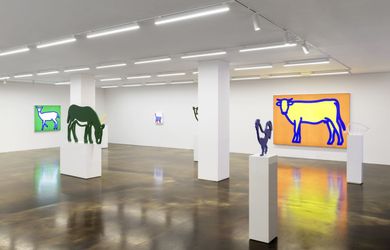
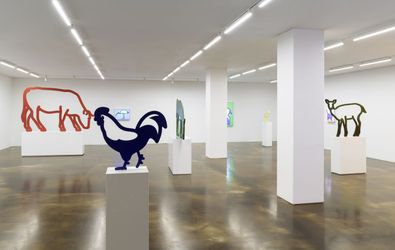
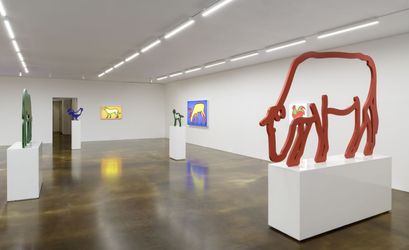
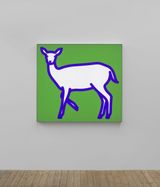
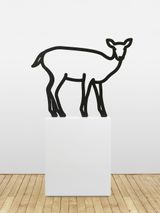
The majority of the works have been made specifically for this exhibition, allowing a tight and legible narrative that plays with the variety of spaces. The second floor of K2 is inhabited exclusively by animals of various shapes, sizes, and colors that are as compelling and lively as people. Animals have long been a central subject in the artist’s oeuvre. Images of deer, roosters, cows, and dogs—commonly encountered in nature—are rendered in artificial primary colors associated with industrial environments. The animals decorate the walls in the form of brightly-lit lightboxes, reminiscent of familiar public signage and corporate logos easily seen across the modern city. Depictions of animals rendered in Opie’s distinctive formal language float in and around the space as aluminium sculptures elevated on plinths, transforming into symbols. The hard, bright fabrication balances and contrasts with the natural empathy and innocence of nature.
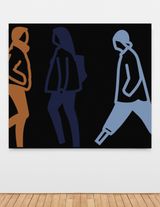
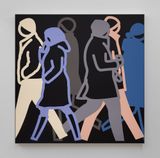
The first floor below is given over to human city dwellers. Strangers, drawn from the area of East London around Opie’s studio, plough through the streets in protective winter clothing as animated LED films, backlit paintings and aluminium statues. In contrast to the vivid colors upstairs, a naturalistic palette of colors emerges based on the clothes, skin, and hair of the individuals. Diverging from the artist’s familiar primary colors, the muted tones of the figures reflect the wintry atmosphere, enhanced by the black and white backgrounds. The light passing through the black background of the lightbox emphasizes the color of each line. Opie delineates the individuality of each fleeting passerby with keen observation, which has always been central to his practice. By depicting figures in the act of “walking,” the artist captures the natural beauty of such ordinary movement into art.
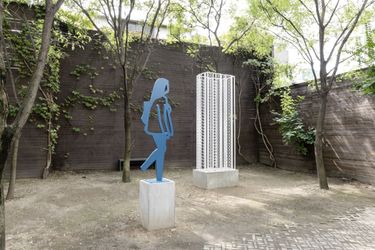
In K3, citizens begin to inhabit a virtual city conjured by three-dimensional metal installations of modern and ancient architecture. Here, more people, drawn from the artist’s travels to the Belgian town of Knokke this year, emerge as sculptures. With more time in London due to the lingering pandemic, Opie took a fresh look at the city’s modern and historical buildings, reinterpreting them as three-dimensional metal sculptures. Fabricated with meticulous detail, two sets of installations from the City series, each standing over four meters, harmonize with life-size sculptures, demonstrating Opie’s command and sense of space. The historic buildings from the City of London create delicate, lacy, folded screens, while in the garden, a generic apartment block from nearby Incheon dazzles the eye with its hundreds of welded steel windows and sky-scraping lines. The artist typically includes works drawn from local images in his exhibitions, as he had done during his last show with the gallery in 2014, where he portrayed walking figures around Seoul, such as in Walking in Sadang-dong in the rain. (2014). Opie instead gathered inspiration by virtually traveling through the streets of Incheon via 3D Google maps in lieu of his travels. An ordinary apartment building in Incheon manifests into a sculpture of hundreds of windows and distinct geometric lines and placed in the garden, emulates the abstract and ubiquitous nature of the urban landscape.
‘I like to keep the viewer interested and guessing, making connections and being surprised,’ Opie explains, ’...using the qualities of the spaces on offer to create the most powerful and successful experience possible for the visitor.’ The artist curated the show using an interactive VR model, meticulously planning and placing each work while viewing the space through VR goggles. Drawing, color, scale, subject, movement, and material energetically bounce from wall to floor, from painting to sculpture, inviting the audience to explore and read the show as one might a new town. From large-scale installations to smaller two-dimensional paintings, the exhibition will provide an opportunity for viewers to walk through the various spaces and engage with the familiar world around them, distilled into its essence through Opie’s minimalist approach.


Julian Opie was born in 1958 in London. He graduated from Goldsmith’s School of Art, London in 1982. While at Goldsmith’s, he studied with prominent artists Richard Wentworth and Michael Craig-Martin both of whom influenced his ideas about the nature of visual art. Shortly after graduating, Opie began exhibiting in galleries and museums across Europe and his works are now in the collections of major institutions around the world including the Arts Council, England; British Museum, London; Carnegie Museum, Pittsburgh; IVAM Museum of Modern Art, Valencia, Spain; National Museum of Modern Art, Tokyo; National Gallery of Victoria, Melbourne; National Portrait Gallery, London; Städtische Galerie im Lenbachhaus, Munich; Stedelijk Museum, Amsterdam; Tate Collection, London and the Victoria and Albert Museum, London.


Established in the heart of Seoul in 1982, Kukje Gallery is a leading Korean gallery dedicated to showcasing works by Korean and international artists and promoting modern and contemporary art. At 54 Samcheong-ro, Jongno-gu, the gallery has 3 key exhibition spaces, respectively named K1, K2, and K3. In 2018, the gallery opened a second location in F1963, a cultural complex housed in a former wire factory in Suyeong-gu, Busan.

A respected voice in contemporary art discourse.
Focusing on ambitious storytelling and insightful art-world commentary. Ocula Magazine publishes in-depth interviews, critical essays and timely analysis on the artists, exhibitions and ideas driving the global art world.
Learn more about Ocula Magazine
Showcasing the best of the art world.
Ocula partners with galleries from around the world to highlight their artists, artworks and exhibitions. Gallery membership is by application and invitation, with each member vetted by an independent panel.
Learn more about Ocula Membership

Specialises in the sale of major artworks.
Led by a team with deep ties to the world’s leading auction houses, galleries and collectors. Ocula’s advisory team offers bespoke services to high-net-worth clients from around the world who are looking to acquire the best of contemporary and modern art.
Learn more about our team and services
