




KARLO KACHARAVA
Karlo Kacharava was a prolific artist, poet, and art critic whose unique style helped pioneer a new wave of Georgian avantgarde expression.
Created amidst the turmoil of the 1980s and 90s, Kacharava’s vast oeuvre of paintings, drawings, and texts—made up until his premature death at 30—is a unique expression of life in flux as Georgia struggled to preserve its identity in the face of bigger powers.
Through his writing for publications like Literature and Art, for which he was also an editor, Kacharava acted as a bridge between the Western cultural sphere and the Georgian artists of his generation.
Early Years
Born in Samtredia, Georgia, Kacharava graduated from the Tbilisi State Academy of Arts with a BA in Art History in 1986. He subsequently worked as a research fellow at the Giorgi Chubinashvili Institute of Art History until his death in 1994.
Karlo Kacharava Artworks
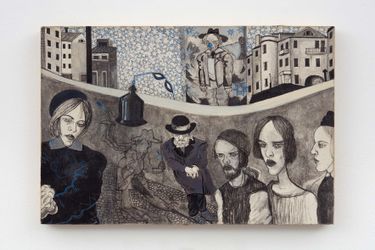
Karlo Kacharava’s artwork assimilates a wide range of influences, from Georgian art history to Western philosophy and rock ‘n roll. His visual style is heavily influenced by pre-war German painting—particularly that of Ernst Ludwig Kirchner—as well as the work of Neo-Expressionist Jean-Michel Basquiat. Themes of love, youth, and identity compete with elements of anarchy and dislocation, referencing the turbulence in Georgia at the time.
Bold colours and sharp contrasts accentuate typically melancholy and self-absorbed characters from Kacharava’s Munchian bohemia, who appear against the backdrop of various urban and industrial environments. Emerging frequently throughout his work, angels can be considered a central motif; many of Kacharava’s paintings also employ the artist’s unique brand of textual iconography, featuring script that oscillates between Georgian and Latin.
English Romanticism
A large oil painting rendered predominantly in a palette of cadmium orange and scarlet, English Romanticism (1992) depicts a haunting, bohemian-looking couple walking side-by-side. The woman is likely to be Helena Lundberg, Kacharava’s life partner and a Swedish authority on Russian literature, while the slight male figure is thought to represent Kacharava himself, although his features more closely resemble the black-haired, rake-thin musician Nick Cave than the robust, bearded figure in the artist’s later self-portraits.
Kacharava’s visual world is often punctuated with references to his fandom of Western culture, ranging from the likes of the Australian-born Cave and American essayist Susan Sontag to comic books and films.
Sentimental Journey
Kacharava’s paintings are often whimsical, playfully manipulating form and scale through the fusion of text and image, but they also depict a sense of deep yearning and melancholy.
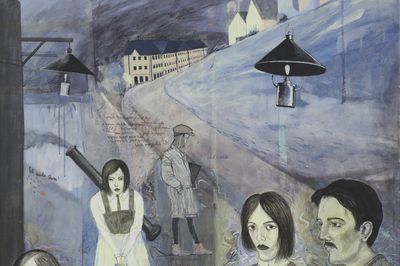
Sentimental Journey (1993) features a cast of the artist’s archetypal characters in a grim, wintry milieu. Behind one woman, a cannon smokes. Above another, a gas lamp swings in mid-air. The painting’s cool tonal palette of greys and blues emphasises the frozen emotional landscape of ‘a country full of love and disgust,’ as Kacharava once described his homeland. While he welcomed the collapse of Soviet rule, the painter despaired over the new Georgia that was beginning to emerge in the early 1990s. Various scripts overlap across the canvas, dedicated to sentimental travellers: Ida Applebroog, Karen Blixen, Bertolt Brecht, Gerard Mayo, Carson McCullers, and the artist’s muse and beloved, Lundberg.
Awards and Accolades
Kacharava was the first researcher to be posthumously awarded the 1997 Giorgi Chubinashvili State Prize for his contribution to Georgian art history.
Exhibitions
Solo exhibitions of Karlo Kacharava’s work include Karlo Kacharava: People and Places, Modern Art, London (2021); Karlo Kacharava Today, Georgian National Museum, Tbilisi (2017); Für Karlo: Works on Paper by Karlo Kacharava, Newman Popiashvili Gallery, New York (2012); and a posthumous presentation at the Georgian National Museum, Tbilisi (1994).
Group exhibitions include State of Play: Art in Georgia in 1985–1999, Tbilisi History Museum (2017) and Heydar Aliyev Centre (2018); Sputterances, Metro Pictures, New York (2017); and Reframing the 80s: Georgian Art at the End of the 80s and the Beginning of the 90s, Dimitri Shevardnadze National Gallery, Tbilisi (2012).
Fay Janet Jackson | Ocula | 2022

Representative Artworks
View story


Explore and Follow Artists Shaping Contemporary Art
A respected voice in contemporary art discourse.
Focusing on ambitious storytelling and insightful art-world commentary. Ocula Magazine publishes in-depth interviews, critical essays and timely analysis on the artists, exhibitions and ideas driving the global art world.
Learn more about Ocula Magazine
Showcasing the best of the art world.
Ocula partners with galleries from around the world to highlight their artists, artworks and exhibitions. Gallery membership is by application and invitation, with each member vetted by an independent panel.
Learn more about Ocula Membership
Specialises in the sale of major artworks.
Led by a team with deep ties to the world’s leading auction houses, galleries and collectors. Ocula’s advisory team offers bespoke services to high-net-worth clients from around the world who are looking to acquire the best of contemporary and modern art.
Learn more about our team and services