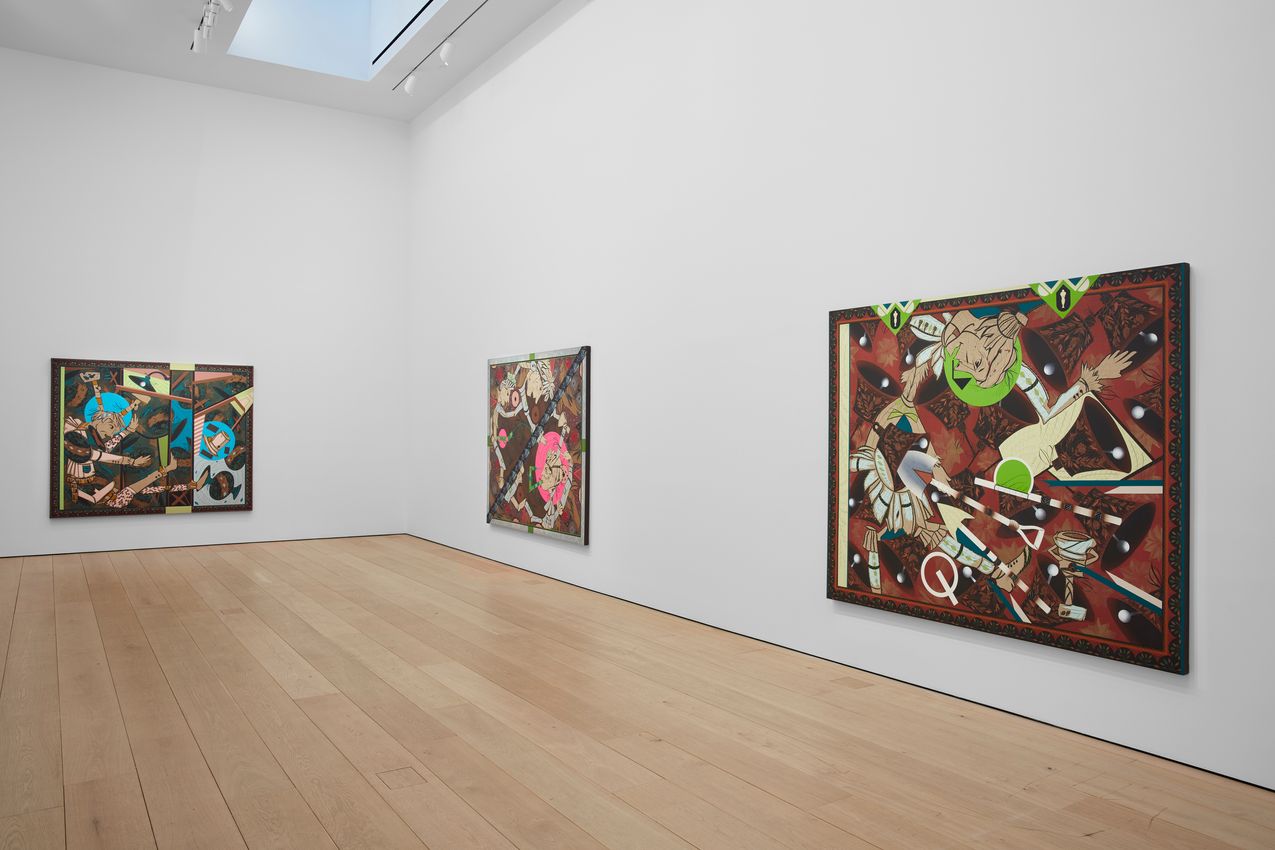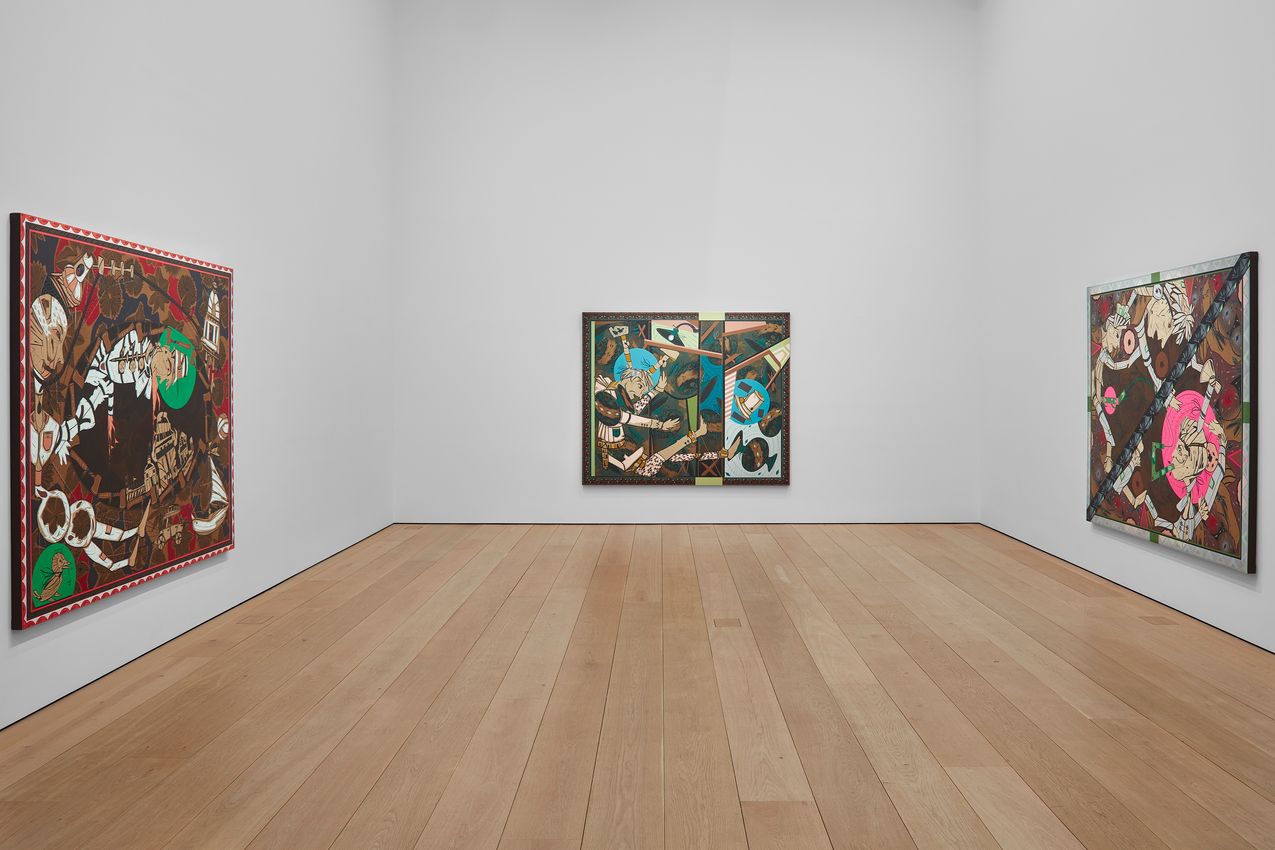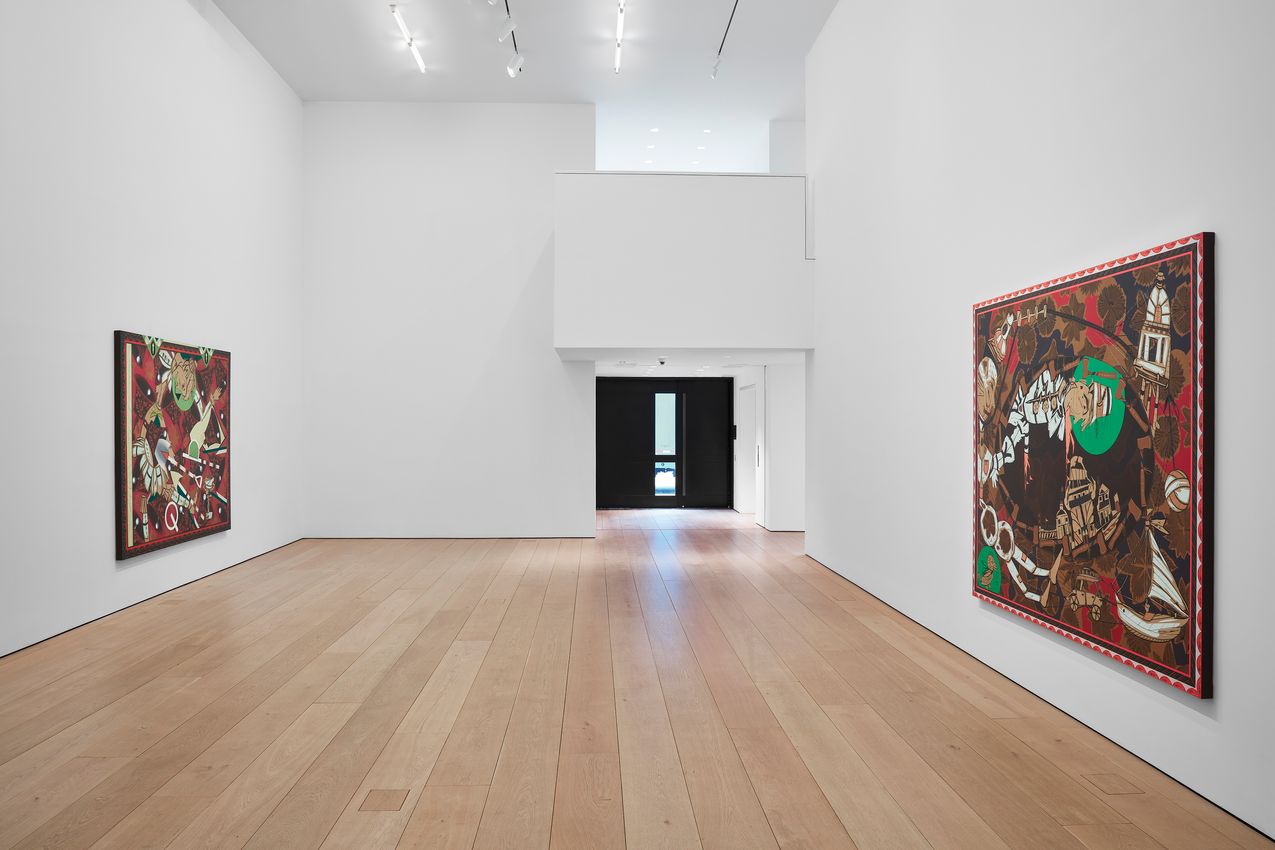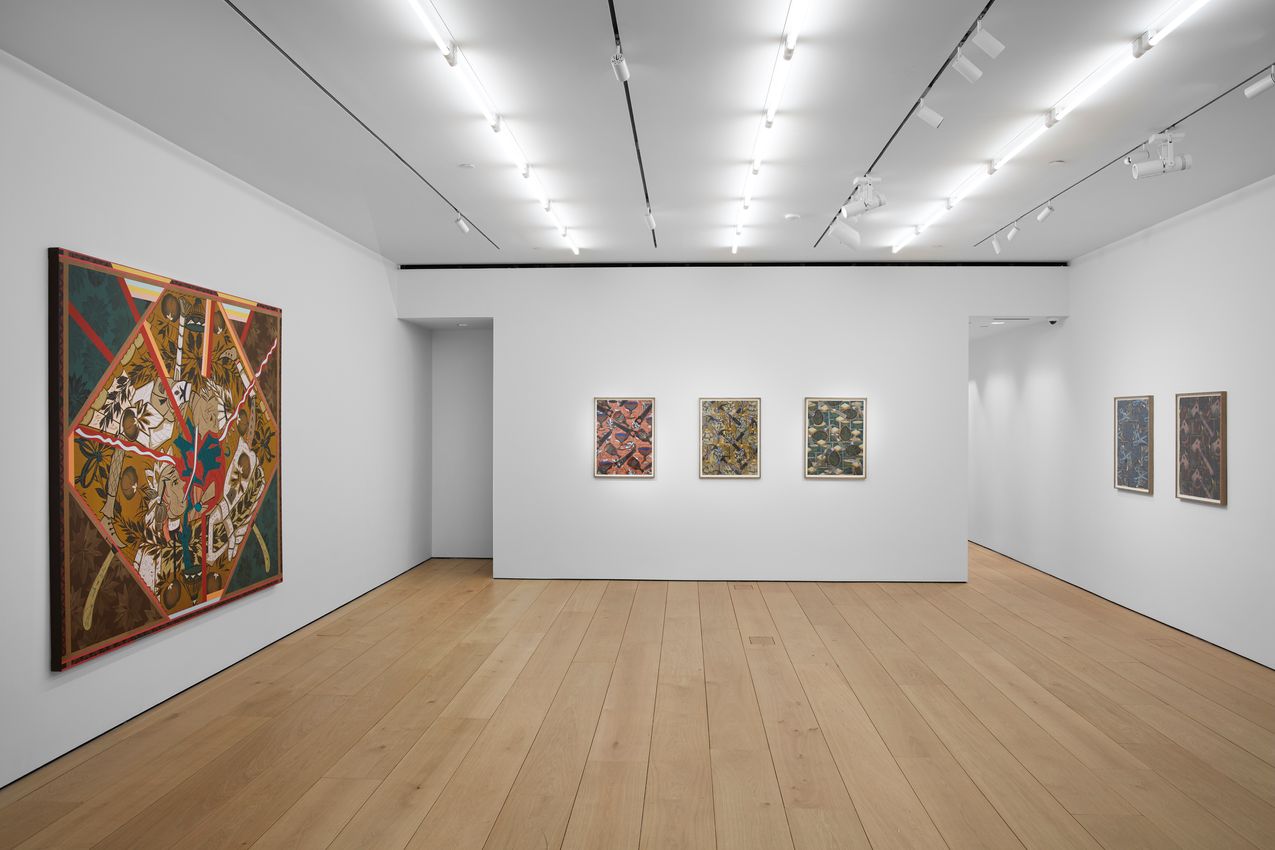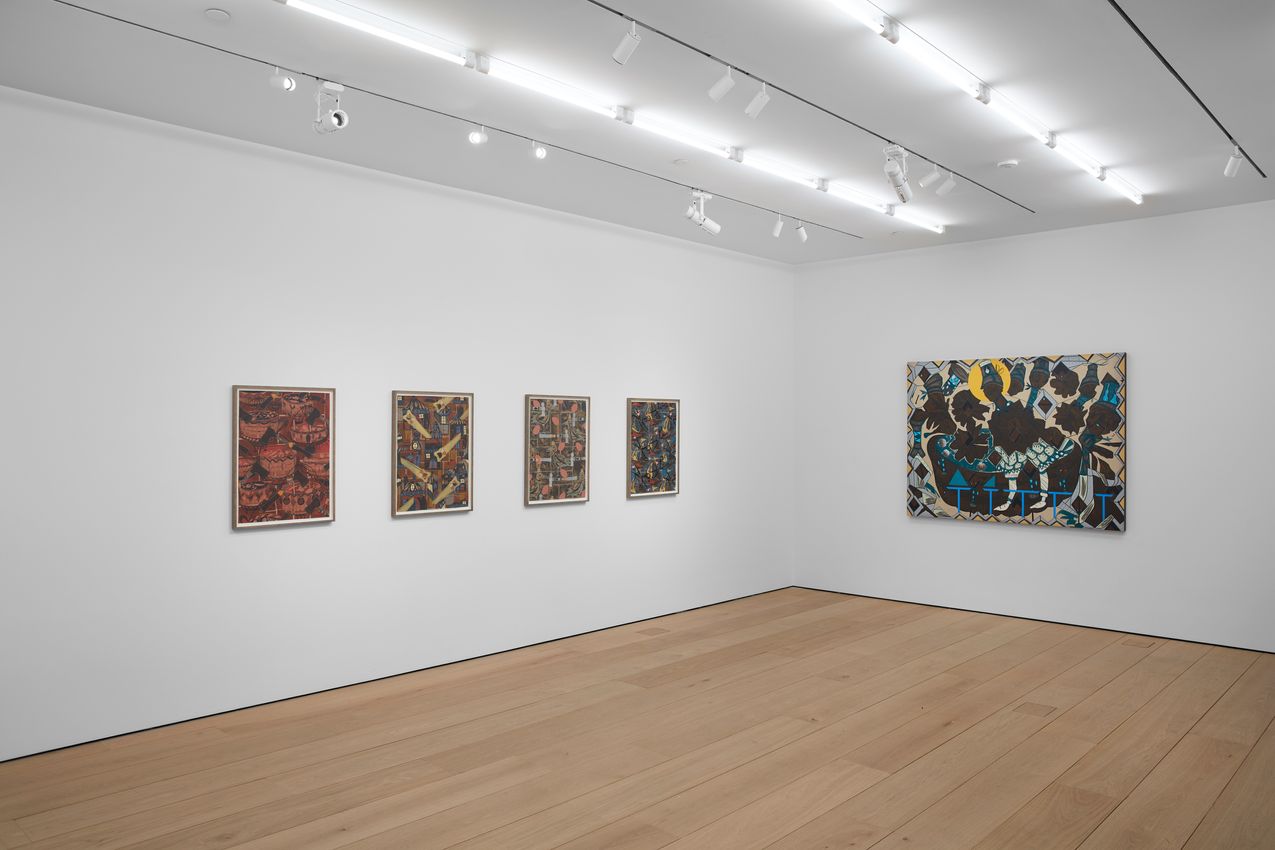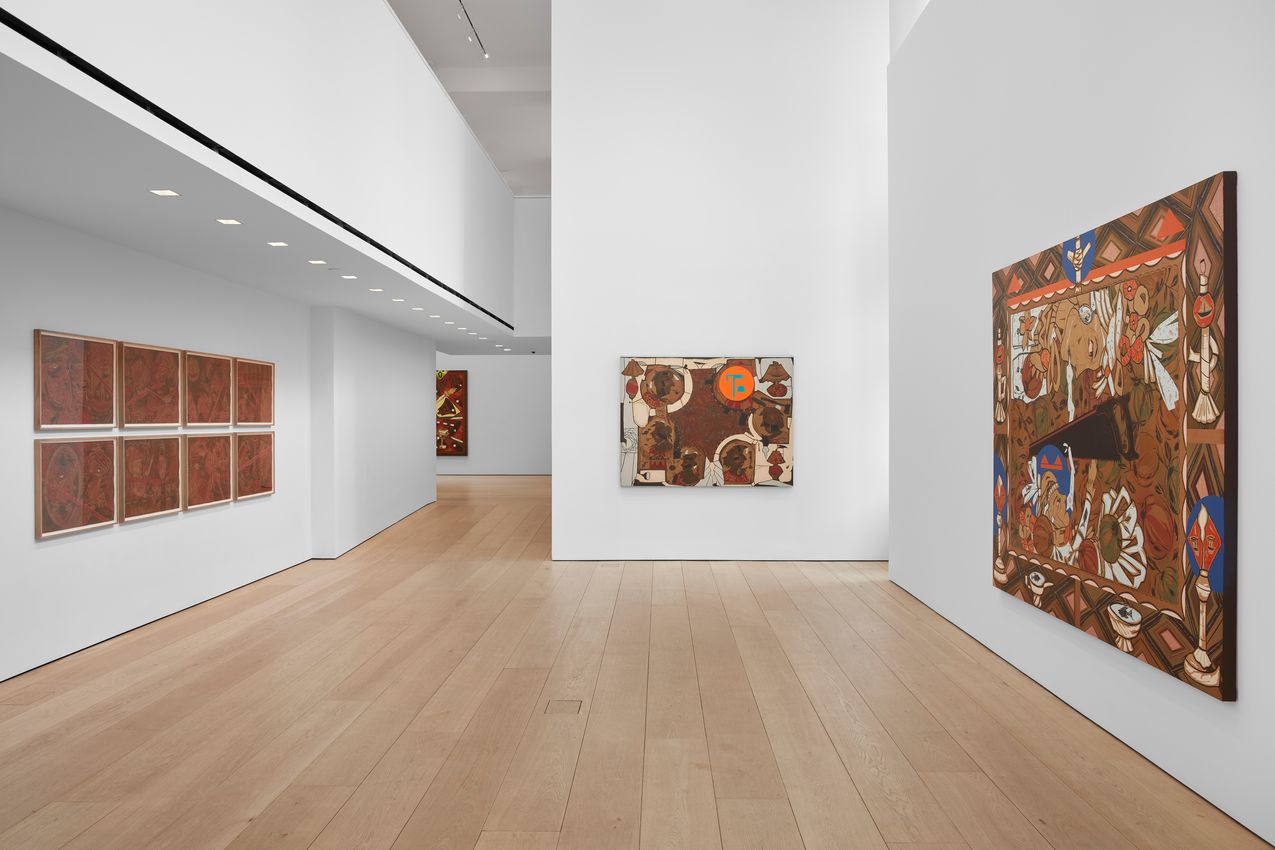
Lehmann Maupin is pleased to announce Found Buried, Lari Pittman‘s first solo exhibition with the gallery. For this body of work, the Los Angeles-based artist will present a series of new paintings and works on paper that combine the genres of landscape, portraiture, and still life. Pittman continues to address the histories of identity, violence, class, and human nature through the polemicised lens of decoration, decor, and the decorative embodied in the memento mori and other forms of commemoration. Pittman is best known for his unique visual aesthetic that has established him as one of the most significant painters of his generation. In this exhibition, he continues his signature, densely-layered painting style that includes a lexicon of signs and symbols, a compilation of varied painting techniques, and a clear homage to the applied and decorative arts. There will be an opening reception with the artist on Thursday, March 5th, from 6 to 8 PM at 501 24th Street, New York, NY 10011.
During the mid-1970s, Pittman attended California Institute of the Arts in Valencia, California, completing a BFA and an MFA. The institute’s strong feminist arts program challenged the devaluation of art forms traditionally associated with craft, and it was his engagement with this program that inspired Pittman’s interest in undermining aesthetic hierarchies and embracing the decorative arts. Pittman’s strong affinity for the decorative can be seen throughout his many bodies of work and it has contributed to his singular visual style. While Pittman’s early works were informed by the socio-political struggle resulting from the AIDS epidemic, racial discord, and LGBTQ+ civil rights struggles that defined the last two decades of the 20th century, his later paintings evince more subtle political gestures through a focus on interior spaces, including domestic and psychological subjects.
The title of the exhibition, Found Buried, relates to ideas of excavation—personal, political, and historical. This alludes both to the way one experiences his work as well as Pittman’s approach to painting. For each work, Pittman builds complexly layered compositions that mediate the tension between colour, text, and imagery; figure, landscape, and decoration; and chaos, order, and clarity with remarkable dexterity. He has an innate ability to give each element within a painting equal space and significance. This creates multiple entry points for the viewer, who is invited to do their own excavation of sorts, reading and interpreting the various layers of each work in their own way.
The works in the exhibition feature symbols such as pomegranates (which are often connected to power and imperialism) and tools related to labor and potential violence, as well as decorative objects such as vases, chalices, lamps and an assortment of objets de vertu. Human figures are adorned with theatricalised, imaginary garments and insignia that destabilise expectations of Colonial American, European, and indigenous cultural aesthetics. By merging these seemingly opposing signifiers, Pittman complicates our understanding of colonial identity and its contemporary legacy. In one painting, Piittman portrays a scene comprised of three figures adorned with indigenous headdresses and colonial era garments, fragmented and rendered amidst abstracted patterns of pomegranates and chalices. This painting presents a conceptual reading of violence—self-imposed, physical, and psychological—surrounding oppositional identities, class, and place. In his works on paper, Pittman depicts tools of labor in relation to decorative objects that signify wealth and power. In one work, the image of a hammer is superimposed against a patterned background of chalices, allowing for two seemingly oppositional realities (labor and wealth) to exist simultaneously. Taken together, the works in Found Buried are literally and figuratively a practice in uncovering (i.e. unburying) the codex of signs and symbols Pittman has developed over the course of his career that give unique perspective into past and present political realities.
About the artist
Lari Pittman, (b. 1952, Los Angeles, CA, lives and works in Los Angeles, CA) received a BFA from California Institute of the Arts, Valencia, CA in 1974 and an MFA from California Institute of the Arts, Valencia, CA in 1976. Solo exhibitions of his work have been organised at the Hammer Museum, Los Angeles, CA (2019), Huntington Library, Art Collections, and Botanical Gardens, San Marino, CA (2016); Le Consortium, Dijon, France (2013); Museum of Contemporary Art St. Louis, St. Louis, MO (2013); Villa Arson, Nice, France (2005); Los Angeles County Museum of Art, Los Angeles, CA (1996); Contemporary Arts Museum, Houston, TX (1996); Corcoran Museum, Washington, D.C. (1997); Hammer Museum, Los Angeles, CA (1996); and University Art Museum, University of California, Santa Barbara, Santa Barbara, CA (1996). Select group exhibitions featuring Pittman’s work include Waking Dream, Ruby City, San Antonio, TX (2019); Less Is a Bore: Maximalist Art & Design, ICA Boston, Boston, MA (2019); Give a Damn., the Frances Young Tang Teaching Museum and Art Gallery, Skidmore College, Saratoga Springs, NY (2018); The Long Run, Museum of Modern Art, New York, NY (2017); Between Two Worlds: Art of California, San Francisco Museum of Modern Art, San Francisco, CA (2017); Inaugural Installation, the Broad, Los Angeles, CA, (2015); The Art of Our Time, Museum of Contemporary Art, Los Angeles, Los Angeles, CA (2015); Art AIDS America, West Hollywood Library and One Archives Gallery and Museum, Los Angeles, CA (2015), Tacoma Art Museum, Tacoma, WA (2015), Zuckerman Museum of Art, Kennesaw, GA (2016), the Bronx Museum of the Arts, New York, NY (2016), Alphawood Gallery, Chicago, IL (2017); America is Hard to See, Whitney Museum of American Art, New York, NY (2015); Earthly Delights, Museum of Contemporary Art Chicago, Chicago, IL (2014); and Comic Future, Ballroom Marfa, Marfa, TX (2013), Wexner Center for the Arts, Columbus, OH, (2014). Pittman has participated in multiple biennial exhibitions, including documenta X, Kassel, Germany (1997) and the 1997, 1995, 1993, and 1985 Whitney Biennial exhibitions.
Pittman’s work is in numerous public and private collections, including the Albright-Knox Art Gallery, Buffalo, NY; the Art Institute of Chicago, Chicago, IL; the Broad, Los Angeles, CA; the Carnegie Institute of Art, Pittsburgh, PA; the Fondazione Sandretto Re Rebaudengo, Torino, Italy; the Frances Young Tang Teaching Museum and Art Gallery, Skidmore College, Saratoga Springs, NY; Harvard Art Museums, Cambridge, MA; Los Angeles County Museum of Art, Los Angeles, CA; the Marciano Art Foundation, Los Angeles, CA; the Museum of Contemporary Art Chicago, Chicago, IL; the Museum of Contemporary Art, Los Angeles, CA; the Museum of Contemporary Art, Monterrey, Mexico; the Museum of Modern Art, New York, NY; the National Gallery of Art, Washington, D.C.; the Peter Norton Family Foundation, Santa Monica, CA; the Phoenix Museum of Art, Phoenix, AZ; the Rhode Island School of Design Museum, Providence, RI; the Rose Art Museum, Brandeis University, Waltham, MA; the San Francisco Museum of Modern Art, San Francisco, CA; the Santa Barbara Museum of Art, Santa Barbara, CA; the Hammer Museum, Los Angeles, CA; the Whitney Museum of American Art, New York, NY; Yale University Art Gallery, New Haven, CT.
Lari Pittman, (b. 1952, Los Angeles, CA, lives and works in Los Angeles, CA). Over the course of his decades-long career, Lari Pittman has developed a unique visual aesthetic that has established him as one of the most significant painters of his generation. Pittman’s signature, densely-layered painting style includes a lexicon of signs and symbols (such as bells, eggs, animals, ropes), a compilation of varied painting techniques, and a clear homage to the handmade, craft, and the decorative. Pittman creates complex compositions that mediate the tension between colour, text and imagery; landscape and decoration; and chaos and order with remarkable dexterity and often on a large scale, and he has an innate ability to create compositions in which each element within a painting is given equal space and significance.


Rachel Lehmann and David Maupin founded Lehmann Maupin in 1996. The gallery represents a diverse range of American artists, as well as artists and estates from across Europe, Asia, Africa, South America, and the Middle East. It has been instrumental in introducing numerous artists from around the world in their first New York exhibitions.

A respected voice in contemporary art discourse.
Focusing on ambitious storytelling and insightful art-world commentary. Ocula Magazine publishes in-depth interviews, critical essays and timely analysis on the artists, exhibitions and ideas driving the global art world.
Learn more about Ocula Magazine
Showcasing the best of the art world.
Ocula partners with galleries from around the world to highlight their artists, artworks and exhibitions. Gallery membership is by application and invitation, with each member vetted by an independent panel.
Learn more about Ocula Membership

Specialises in the sale of major artworks.
Led by a team with deep ties to the world’s leading auction houses, galleries and collectors. Ocula’s advisory team offers bespoke services to high-net-worth clients from around the world who are looking to acquire the best of contemporary and modern art.
Learn more about our team and services