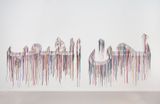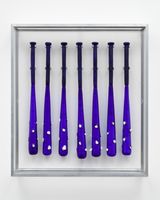
Lehmann Maupin announces I’ll Take You There; A Proclamation, an exhibition of new work by acclaimed New York City-based artist Nari Ward. Ranging in scale from the monumental to the domestic, Ward creates sculptures and installations composed from discarded material found and collected in his Harlem neighbourhood, including repurposed objects such as baby strollers, shopping carts, bottles, keys, cash registers, and shoelaces, among other materials. Ward re-contextualises these found objects in thought-provoking juxtapositions that create complex, metaphorical meanings and confront social and political issues surrounding race, gentrification, and community, intentionally leaving the meaning of his work open to allow viewers to construct their own interpretations. For this exhibition, the artist’s sixth solo presentation with Lehmann Maupin, Ward has created four text-based works constructed from shoelaces, two large-scale sculptural installations, a video work, and a series of new copper panels.
Perennial themes of memorial, remembrance, and societal relationships have permeated Ward’s practice—from his early, now iconic installation Amazing Grace (1993), composed of discarded fire hoses and hundreds of abandoned baby strollers, to the work he is creating today. In I’ll Take You There; A Proclamation, ideas of commemoration, community, and the reclamation of public space are explored through the medium of public streets. Inspired by the many sidewalk memorials that sprang up during the Covid-19 pandemic in the absence of places where people traditionally mourn, which were closed or restricted due to public health concerns, many pieces incorporate the candles, teddy bears, and liquor bottles often found at these sites. In each work, Ward nimbly combines elements of the artist studio, the art world, and street life to invite reevaluations of these spaces and emphasise the inherent fluidity and interconnection that exists between them.
The exhibition opens with the expansive Still Lives with Step Ladders, a large-scale installation comprised of bottles, candles, milk crates, suitcases, and step ladders filled with cement, all covered with dark landscaping cloth often used to separate good soil from bad. Inspired by Giorgio Morandi’s muted still lifes of bottles and jugs (echoed in the compositions on top of each ladder), Ward set out to create a deeply intentional composition, bringing these disparate elements together to form a cohesive landscape. The austere work is evocative, suggesting aerial views of a city skyline or the somber outlines of a graveyard, yet it remains abstract enough to trigger the imagination of the viewer, allowing us to superimpose our own meanings and making the work at once more personal and more universal. Despite its immersive scale, the work cannot be entered—instead, it is meant to be reflected on like any other still life, its exact topography continuously evolving as viewers shift their vantage point by walking around the installation.
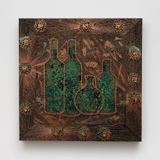
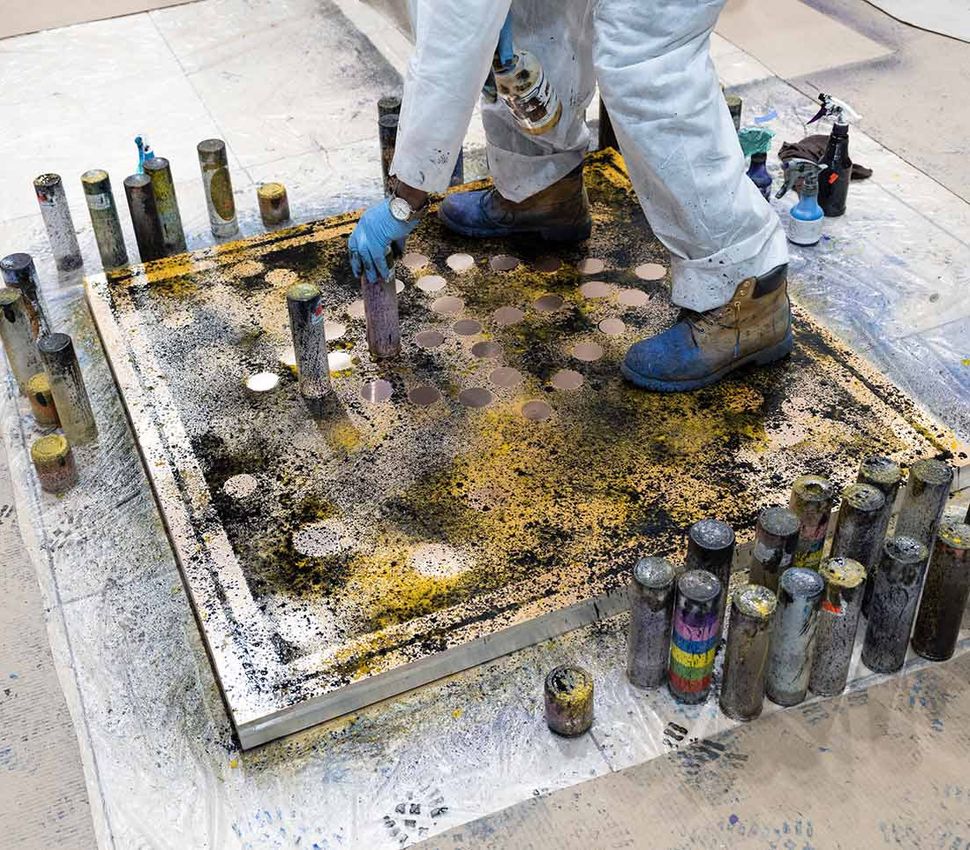
Many of the bottles and candles in _Still Lives with Step Ladder_s are arrayed in the form of the Congolese cosmogram, an ancient prayer symbol representing the cycle of birth, life, death, and rebirth and used by Ward across his Breathing series. Another throughline from previous bodies of work is seen in the large copper Peace Walk panels, which are patterned after sidewalk squares to create a cross in the centre of each composition. To make these works, Ward collected flowers, spent candles, empty liquor bottles, and other objects from various street memorials in his neighbourhood (always bringing fresh replacements for anything removed) and arranged them on the copper panels in new configurations. Ghostly outlines of each object were created by applying patina to the copper surface, with the unpredictability of the oxidation creating a dialogue with the material and leaving room for chance to play out across the structure of the sidewalk grid. Ward describes these works as being “all about the emanation of light,” and the striations from the candles and reflections and refractions from the liquor bottles allude to spirits, both spiritual and alcoholic.
Throughout I’ll Take You There; A Proclamation Ward identifies streets and sidewalks as belonging to local communities. While the works in this exhibition reclaim these public spaces as sites of grief and consolation, they also nod to their role as a stage for protest, both recent and historical. The artist’s choice of the series title ‘Peace Walk’ comes from protest terminology, referring to people coming together to walk or march against an injustice, while one part of the exhibition’s title, I’ll Take You There, references the 1972 number one hit of the same name by the Staple Singers, which asks listeners to imagine a better, more just world. Ward noted that almost every street memorial he visited while working had the phrase “Rest in Peace” incorporated in some way. Taken together, these influences point to the importance of gathering—in a period filled with incredible loss, Ward focuses on those of us who remain, and the communities we continue to nurture and create.
Nari Ward (b. 1963, St. Andrew, Jamaica; lives and works in New York) is known for his sculptural installations composed of discarded material found and collected in his neighbourhood. He has repurposed objects such as baby strollers, shopping carts, bottles, doors, television sets, cash registers and shoelaces, among other materials. Ward re-contextualises these found objects in thought-provoking juxtapositions that create complex, metaphorical meanings to confront social and political issues surrounding race, poverty, and consumer culture. He intentionally leaves the meaning of his work open, allowing the viewer to provide his or her own interpretation.


Rachel Lehmann and David Maupin founded Lehmann Maupin in 1996. The gallery represents a diverse range of American artists, as well as artists and estates from across Europe, Asia, Africa, South America, and the Middle East. It has been instrumental in introducing numerous artists from around the world in their first New York exhibitions.

A respected voice in contemporary art discourse.
Focusing on ambitious storytelling and insightful art-world commentary. Ocula Magazine publishes in-depth interviews, critical essays and timely analysis on the artists, exhibitions and ideas driving the global art world.
Learn more about Ocula Magazine
Showcasing the best of the art world.
Ocula partners with galleries from around the world to highlight their artists, artworks and exhibitions. Gallery membership is by application and invitation, with each member vetted by an independent panel.
Learn more about Ocula Membership

Specialises in the sale of major artworks.
Led by a team with deep ties to the world’s leading auction houses, galleries and collectors. Ocula’s advisory team offers bespoke services to high-net-worth clients from around the world who are looking to acquire the best of contemporary and modern art.
Learn more about our team and services