Press Release
Carr has long been fascinated by magical moments of material transformation. This can be seen as early as Air Guitar (2001), in which the artist turns from a teenage boy riffing in his bedroom to a smoke-clouded guitar god. Almost ten years later, Carr proposed another bogan transformation in Burn Out (2009), as audiences watched the hypnotic and silent action of a young man, on a West Auckland morning, jubilantly turning the rubber of his tyres into clouds of smoke, in front of a sublime New Zealand landscape.

Since Burn Out, Carr has become more focused on the complex relationships between materiality, magic, performance, and cinema that lie at the heart of his practice. One of his most radical breakthroughs has been his use of the Phantom Camera – an ultra-slow-motion tool more usually associated with nature documentaries or high-level sporting events.

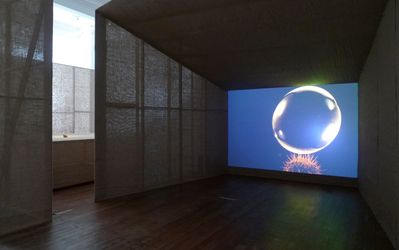
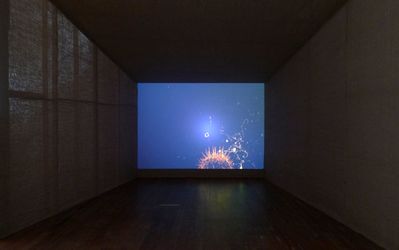
For The Science of Ecstasy and Immortality, Carr revisits the strange connections between our sense of time, our bodies, and what happens when we watch material undergoing profound transformation. In the first of two videos, Carr uses stock footage shot by a Phantom technician of a bubble popping on a cactus. Carr’s trick is to slow it down even further, turning seconds into whole minutes. In doing so, the footage morphs into a sci-fi epic, as the bubble sheds its skin, collapses on itself, and disperses into a spread of stars.

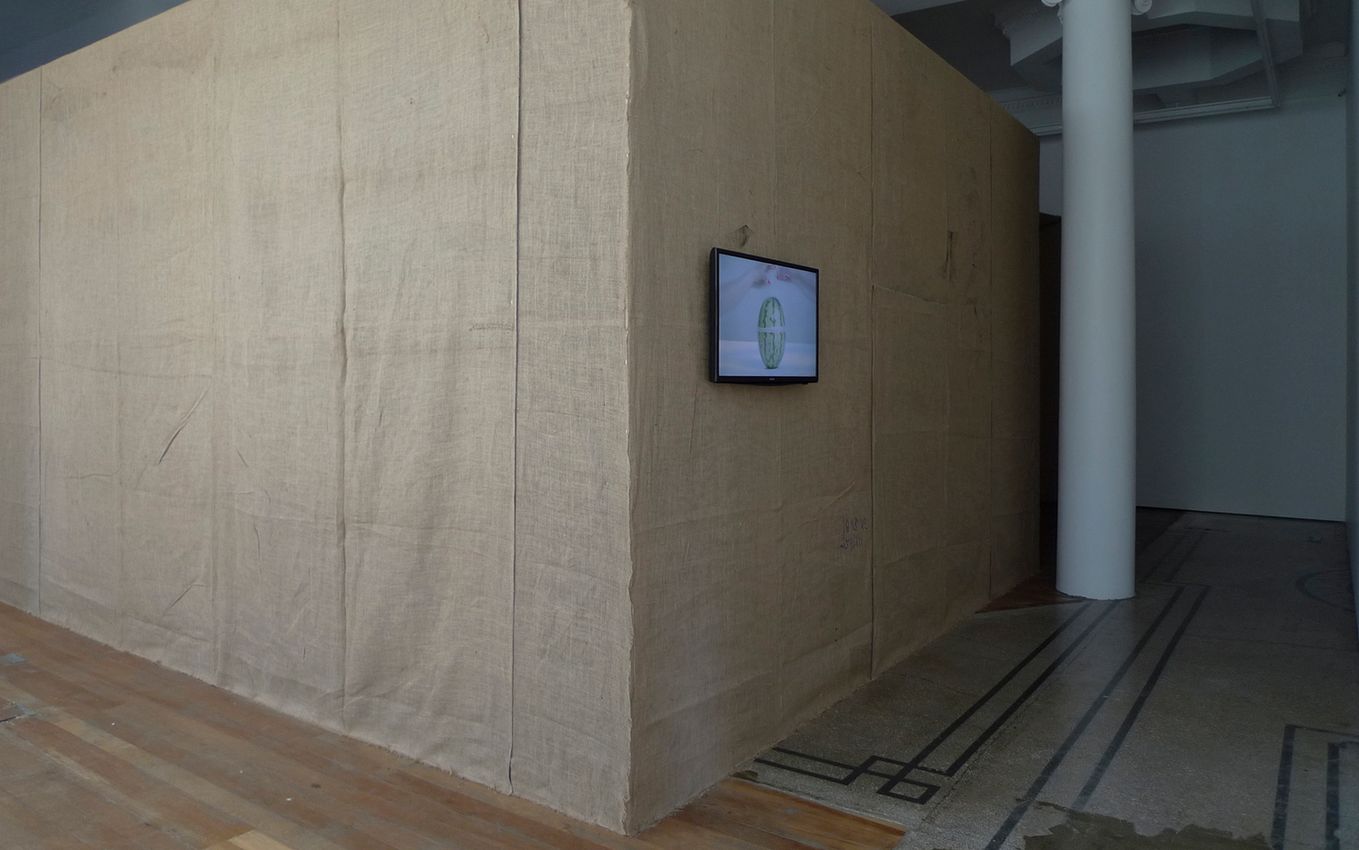
In the second video, Carr allows us to witness a similar transformation which also confuses our notions of cinematic time. Except here, there are no camera tricks. Instead we watch as two women methodically stretch rubber bands around a watermelon. Slowly the watermelon starts to change shape: first, the bands give it a vaguely hourglass form. As more are applied, things become severely pinched: a dramatic figure eight, and a brief pause before the watermelon explodes, spraying its flesh and seeds across the pristine set.

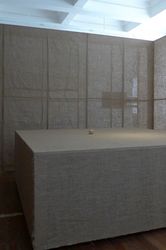
To heighten the relationships between his works and the limits of our bodies, Carr has worked with one of New Zealand's leading designers, Nat Cheshire, to create an immersive environment that draws the viewer to the centre of the space. Here they encounter the exhibitions third work; a small ball of rubber bands formed by the explosive force of the watermelon's final moment.

Steve Carr was born in Gore in 1976 and currently lives and works in Auckland. Recent exhibitions include Stretching Time, Dunedin Public Art Gallery, 2014; Burn Out, Edinburgh Arts Festival, Edinburgh, 2014; Open Studios, Headlands Centre of Contemporary Art, San Francisco, 2013; Majo, Outer Spaces Christchurch Art Gallery, 2013.

Image: Steve Carr, Watermelon (still), 2015, Sony HD Xcam, duration 33 mins 9 secs

Installation Views

About the Artist

Steve Carr was born in New Zealand and completed a masters in fine arts at the University of Auckland, (Elam), School of Fine Arts. Since then his work has been in many major New Zealand and international exhibitions including Videos of New Zealand, a touring exhibition through New Zealand, Germany and Denmark.

View Artist Profile

Also Exhibiting at Lett Thomas

About the Gallery

Lett Thomas is a contemporary art gallery in Tāmaki Makaurau Auckland. The gallery represents international and locally based artists at the forefront of contemporary practice, and presents a programme of exhibitions focused on innovative practices from the present day and preceding decades. In addition, the gallery regularly produces art publications, ranging from artist books to collected writings.

View Gallery Profile
Address
312 Karangahape Road
Newton
Auckland
New Zealand
Opening Hours
Wednesday – Friday
11am – 5pm

Saturday
11am – 3pm
(1)
Auckland 312 Karangahape Road, Newton
Lett Thomas
312 Karangahape Road, Newton, Auckland, New Zealand
+64 9 309 7848
https://lett-thomas.com/

Opening hours
Wednesday – Friday
11am – 5pm

Saturday
11am – 3pm
The art world in focus