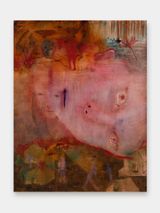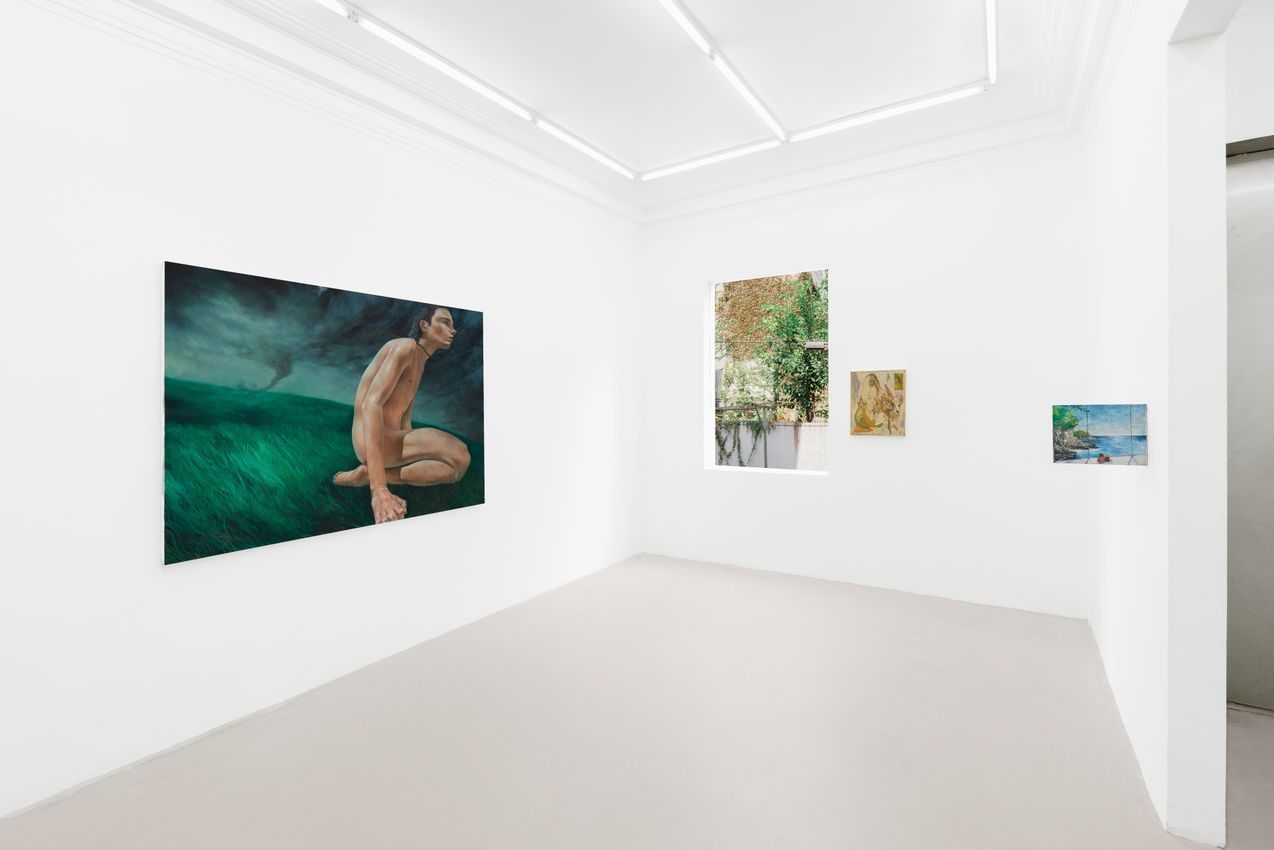


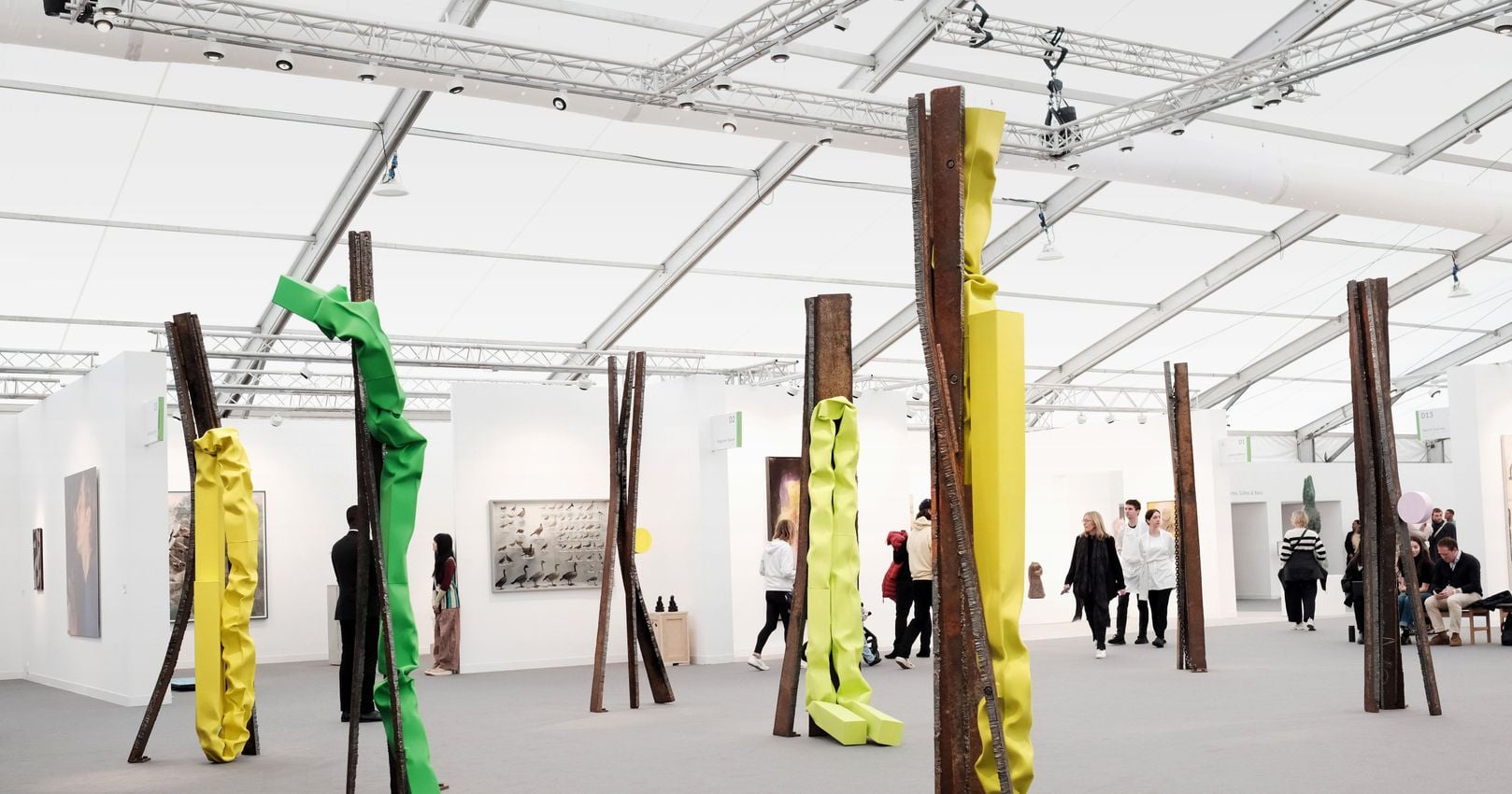
LINSEED is pleased to participate in Frieze London for the first time, presenting a solo project, Asami Shoji: Familiar Strangers ( 見慣れた 他人 ), in the Focus section of Frieze London 2026, featuring recent paintings and a spatial installation by Asami Shoji (b. 1988, Fukushima).
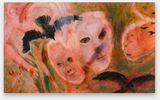
Faces emerge, figures dissolve, and scenes that draw into one another slowly unfold across the canvas, like a shifting landscape of consciousness. Shoji brings images, bodies, and memories into space, forming a realm of perception. Here, anonymous faces suddenly become familiar; through prolonged gazing, fragments of oneself begin to surface.
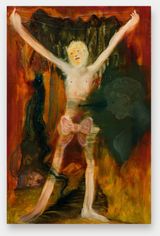
Bodies in Shoji’s work are often intertwined and permeable. These translucent, spirit-like bodies and solid skeletons seem perpetually suspended between existence and disappearance, yet strangely convey an inexhaustible vitality. In scenes that are never fully articulated, figures seem to become part of mountains and trees, on the verge of dispersing yet still held together. What lies within their extended gestures—is it pain, or ecstasy? We cannot know. As the gaze wanders, a sense of intimacy gradually gathers, while a distance remains: as though one were at once within the scene and quietly observing it from the outside. Faces, meanwhile, serve as an entry point into Shoji’s recent paintings, with each feature—the eyes, ears, mouth, and nose—concentrating a fuller range of emotion. These faces do not point to any particular individual, but instead resemble fragments of memory rising from the depths of intuition. Crossing boundaries of gender, age, and even species, they act like vessels for layered feelings.
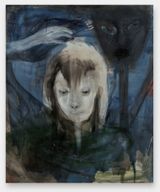
Shoji’s gestures are guided by traces and her own intuition: on smooth grounds, she allows thin layers of paint to flow across the canvas, building up four or five layers until the features finally emerge, just as faces appear in the mind. Her treatment of the face does not follow the modeled light and shadow of realism. Instead, the overall flatness recalls a mask, with certain details being carefully rendered: wideopen red pupils, defined white eyelashes, and grey-blue corners of the mouth curving down. Many of these faces meet the viewer with a slight downward gaze, evoking the nōmen ( 能面 ), the masks used in traditional Japanese theatre. Associated with an expression of emotional neutrality, nōmen appear at once impassive and enigmatic, inviting projection and reverie.
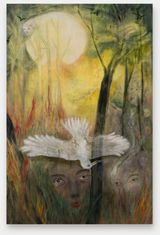
Faces, bodies, bones, landscapes...... Shoji’s endlessly interweaving visual memories and surging sensations give rise to a series of dreamlike parallel worlds—water lilies float across a dim water surface, carrying the stillness of night while reflecting the frantic cries of the day. A pale face with half-closed eyes seems to cradle its own head with both hands, while delicate faces grow between its sparse fingers; from above, another hand reaches down, as if to soothe, touch, or perhaps offer salvation. A white bird in flight plunges decisively into the shadowed mountains in numerous gaze; while the afterglow of sunset spreads across the landscape, setting a barren wilderness ablaze. As crimson curtain slowly parts, figures emerge beneath the drapery, recalling the sisters in Gabrielle d’Estrées and One of Her Sisters; beneath them, a young girl appears, light and ethereal...... Different figures seep into and absorb one another, growing from within each other until they form a whole whose boundaries are impossible to discern.
An installation at the centre of the booth is a work Shoji created on site. As she has often done while traveling: Shoji draws spontaneously on windows and other transparent surfaces. Here, she extends this way of working into the installation, layering works on paper in her everyday practice with transparent surfaces. Images flow through the gaps, while drips of oil paint gather into unpredictable traces, as though fragments of a narrative have been rearranged into something more elusive and resonant. Opening horizontally across the space, the installation divides the booth into two corresponding sets of spaces, inside and outside, above and below. At the centre, an opening is left exposed, seeming to lead into another time and space. The images that continuously extend around it are momentarily severed here, creating a pause—a blank space within the flow.
Here, Shoji’s mirage slowly drifts into view—at times distinct, at times diffuse—until self and landscape become one, impossible to separate. It is as if one were falling asleep within a dream, consciousness drifting slowly between wakefulness and reverie, depth and surface. Familiar Strangers passes through a fleeting forest of faces; figures that are constantly dissolving nevertheless become suspended in a lasting sense of eternity.
Asami SHOJI was born in 1988 in Fukushima, Japan. She obtained her MFA in printmaking from Tama Art University in Tokyo in 2012. She currently lives and works in Tokyo. Shoji’s work envisions lines, the contours of the creatures in her paintings, as a threshold that opens up dimensions characterized by their movements, rather than boundaries segregating the opposites. Instead of the border of the subject, bodies in Shoji’s work mark the flow of affections where Shoji opens up the place for permeability and connectedness to others and expands the sense of the body and the inside and outside. Painting not merely a visual image, Shoji expresses spontaneous and multilayered feelings in different surroundings against the backdrop of unprecedented mobility. The spatial experiences conjured by her paintings transcend the static realm, giving birth to a dynamic tableau where sensory perceptions intermingle and flow unrestrictedly and inviting the viewer into intricate narratives and perceptual explorations.
Her recent solo exhibitions include: “Familiar Strangers”, 2026, Frieze London, with LINSEED, London; “Fukushima Art Annual 2026: World ↔ Me — Asami Shoji / Yuki Takagi”, 2026, Fukushima Prefectural Museum of Art, Fukushima; “Azamino Contemporary vol16 Shoji Asami: From Tbilisi with Love”, 2025, Yokohama Civic Art Gallery Azamino, Yokohama; “Nutrition for Ghosts”, 2025, LC Queisser, Tbilisi; “Moment of Flowers”, 2025, LINSEED, Shanghai; “Slient Witness”, 2025, Manshuin, Kyoto; “October, Much Ado About Nothing”, 2024, Semiose, Paris; “A Stranger’s Tales”, 2024, Independent Art Fair with LINSEED, New York; “a Gait Without Foot”, 2023, gallery21yo-j, Tokyo. Her selected group exhibitions include: Basel Social Club, with LINSEED, 2026, Basel; “What Passes Is Time We are Eternal.”, 2025, Mori Art Museum, Tokyo; “Elizabeth Glaessner, Asami Shoji, Oda Iselin Sonderland”, 2025, François Ghebaly, New York; “I See My Body In Your Eyes”, 2025, Frieze LA with LINSEED, Los Angeles; “MOT ANNUAL 2024: on the imagined terrain”, 2024, Museum of Contemporary Art Tokyo, Tokyo; “Hyakunengo Art Festival”, 2024, Hyakunengo Art Festival, Chiba Prefecture; “Onsen Confidential”, 2024, LINSEED, Tokyo; “Body, Love, Gender”, Gana Art Center, Seoul; “Gestures of Resistance”, 2023, LINSEED in collaboration with AI., London; “The Way of Paintings”, 2022, SOMPO Museum of Art, Tokyo; “Tokyo Wonder Wall 2015”, 2015, Museum of Contemporary Art, Tokyo; “The 18th Taro Okamoto Memorial Award for Contemporary Art”, 2015, Taro Okamoto Museum of Art, Kanagawa.
Asami SHOJI was born in 1988 in Fukushima, Japan. She obtained her MFA in printmaking from Tama Art University in Tokyo in 2012. She currently lives and works in Tokyo. Shoji’s work envisions lines, the contours of the creatures in her paintings, as a threshold that opens up dimensions characterized by their movements, rather than boundaries segregating the opposites. Instead of the border of the subject, bodies in Shoji’s work mark the flow of affections where Shoji opens up the place for permeability and connectedness to others and expands the sense of the body and the inside and outside. Painting not merely a visual image, Shoji expresses spontaneous and multilayered feelings in different surroundings against the backdrop of unprecedented mobility. The spatial experiences conjured by her paintings transcend the static realm, giving birth to a dynamic tableau where sensory perceptions intermingle and flow unrestrictedly and inviting the viewer into intricate narratives and perceptual explorations
A respected voice in contemporary art discourse.
Focusing on ambitious storytelling and insightful art-world commentary. Ocula Magazine publishes in-depth interviews, critical essays and timely analysis on the artists, exhibitions and ideas driving the global art world.
Learn more about Ocula Magazine
Showcasing the best of the art world.
Ocula partners with galleries from around the world to highlight their artists, artworks and exhibitions. Gallery membership is by application and invitation, with each member vetted by an independent panel.
Learn more about Ocula Membership

Specialises in the sale of major artworks.
Led by a team with deep ties to the world’s leading auction houses, galleries and collectors. Ocula’s advisory team offers bespoke services to high-net-worth clients from around the world who are looking to acquire the best of contemporary and modern art.
Learn more about our team and services