





RICHARD DEACON
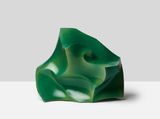
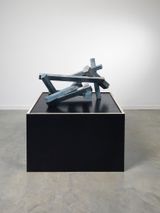
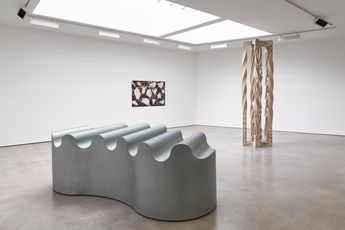
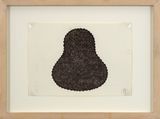
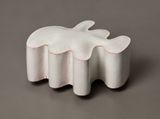
b. 1949, United KingdomRichard Deacon’s voluptuous abstract forms have placed him at the helm of British sculpture since the 1980s and, hugely influential, his works are visible in major public commissions around the world. His voracious appetite for material has seen him move between laminated wood, stainless steel, corrugated iron, polycarbonate, marble, clay, vinyl, foam and leather, as if each sculpture were defined by contrast to its successor. As he explained in an interview in 2005, “Changing materials from one work to the next is a way of beginning again each time (and thus of finishing what had gone before)”. Deacon describes himself as a ‘fabricator’, emphasising the construction behind the finished object – although many of the works are indeed cast, modelled or carved by hand – and accordingly the logic of the fabrication is often exposed: sinuous curved forms might be bound by glue oozing between layers of wood or have screws and rivets protruding from sheets of steel, wearing their hearts on their sleeves. Such transparency highlights the reactive nature of the process: it is part of a two-way conversation between artist and material that transforms the workaday into something metaphorical. The idea of ‘fabrication’ also denotes making something up, of fiction rather than truth, and this knack for wordplay surfaces in Deacon’s titles, which might establish juxtapositions or wreak new meaning from familiar sayings or clichés – see Let’s not be Stupid, 1991, No Stone Unturned, 1999, or Water Under the Bridge, 2008.
Richard Deacon was born in Bangor, Wales in 1949 and lives and works in London. He has a BA from St Martin’s School of Art, 1972, and an MA in Environmental Media from the Royal College of Art, 1977. He recently had a retrospective at the Sprengel Museum, Hannover, Germany, 2011, while a survey is opening at Tate Britain in 2014. Solo exhibitions include Musée de la Ville de Strasbourg, France, 2010, Portland Art Museum, Oregon, 2008, PS1 Contemporary Art Center, New York, 2001, MACCSI, Caracas, Venezuela, 1996, Whitechapel Art Gallery, London, 1989, and Museum of Contemporary Art, Los Angeles, 1988. He represented Wales at the Venice Biennale, 2007, and has participated in the Venice Architecture Biennale, 2012, the Glasgow International, 2006, and documenta 9, 1992. He won the Turner Prize in 1987 and the Robert Jakobsen Prize, Museum Wurth, Kunzelsau, Germany in 1995. He was awarded the Chevalier de l’Ordre des Arts et Lettres by the Ministry of Culture, France in 1996 and made a CBE in 1999.
Courtesy Lisson Gallery

Works at Lisson Gallery



Recently Exhibited


Works Elsewhere















Explore and Follow Artists Shaping Contemporary Art
A respected voice in contemporary art discourse.
Focusing on ambitious storytelling and insightful art-world commentary. Ocula Magazine publishes in-depth interviews, critical essays and timely analysis on the artists, exhibitions and ideas driving the global art world.
Learn more about Ocula Magazine
Showcasing the best of the art world.
Ocula partners with galleries from around the world to highlight their artists, artworks and exhibitions. Gallery membership is by application and invitation, with each member vetted by an independent panel.
Learn more about Ocula Membership
Specialises in the sale of major artworks.
Led by a team with deep ties to the world’s leading auction houses, galleries and collectors. Ocula’s advisory team offers bespoke services to high-net-worth clients from around the world who are looking to acquire the best of contemporary and modern art.
Learn more about our team and services