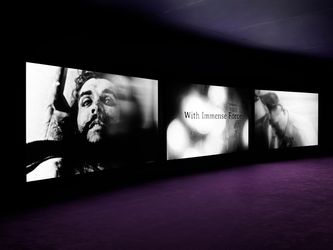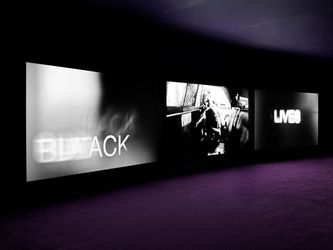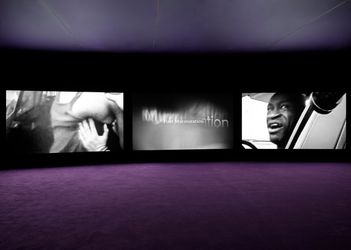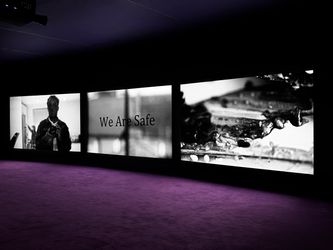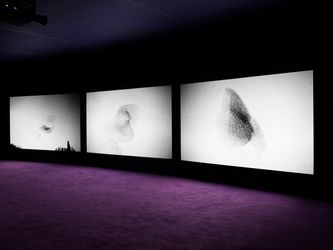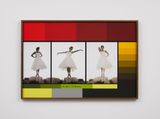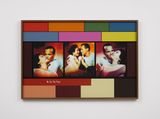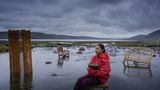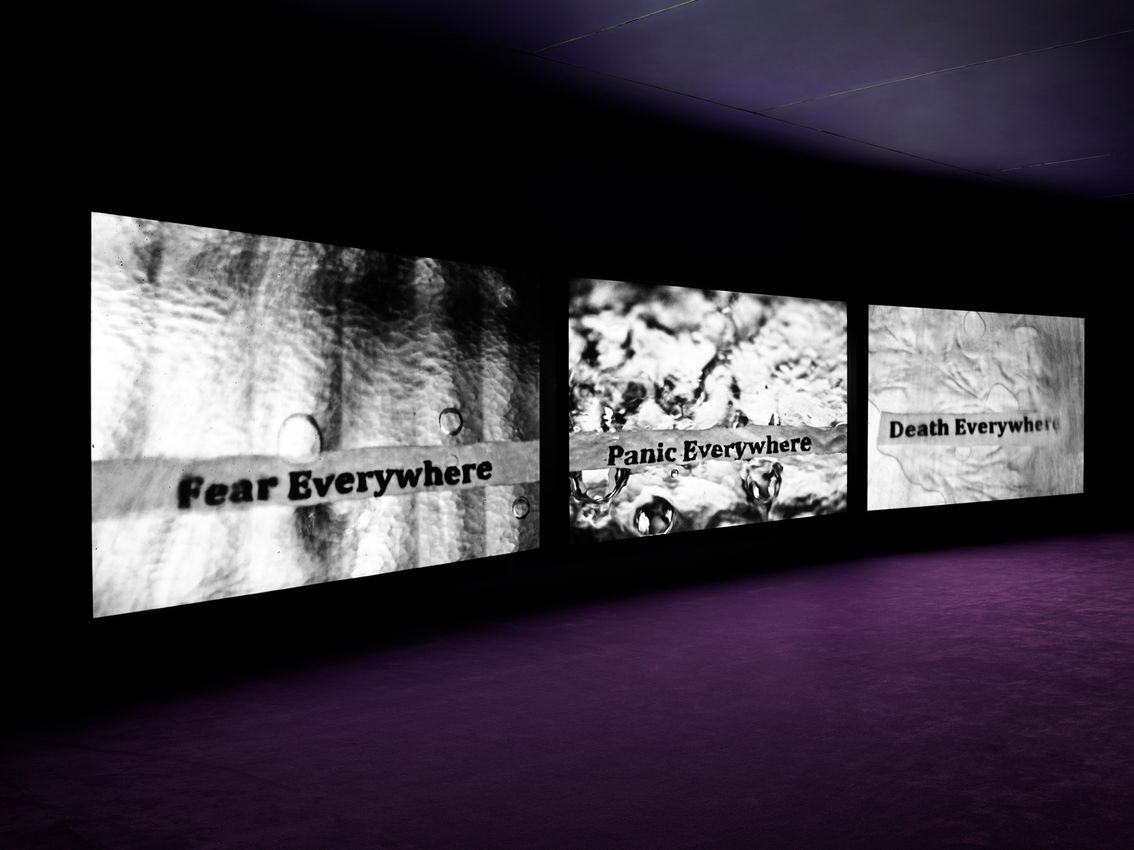
Since March 2020, the London-based artist and filmmaker John Akomfrah has been working on the longest continuous-running project of his career. Living through one of the most turbulent, monumental periods in history, Akomfrah has turned his attention to the creation of a filmic archive of today, made in real-time, documenting how individuals and communities have been coping with the pandemic, the radical mobilisation seen on the streets and the disruption of cycles of racism, and the increasingly urgent crisis of climate change. Culminating in a new three-screen video installation, this body of work is a deep exploration into our understanding of the personal within a collective consciousness of emergency, portraiture, mortality, revenge, mourning and memory.
Akomfrah has gained acclaim for engaging with the most pressing global questions concerning us today—from the destruction of our fragile global environments to post-colonialism and the spectres of those past histories; from memory as literal archive, to the temporal and spatial tropes of race in landscapes. This past year, as the world lurched from one global crisis to another, Akomfrah—like the majority of the population—was forced to shield at home. During this time, he worked remotely with his team worldwide to collect local footage in order to document and reflect the current condition. The resulting work, presented in five orchestrated murmurations, is entitled Five Murmurations, referring to when a flock of birds fly in tight, fast formation as a defense mechanism against predators. These chapters act as markers for the themes explored, resulting in a powerful reflection of our experience living today, one that is both dark and haunting yet cathartic, reminding us of how crisis can yield change. Metonymic and metaphorical in its composition, the exhibition impressionistically highlights our psychological and physical responses to the lockdowns, the incompetence of our politicians in the face of this challenge and the international reckoning of racial inequalities highlighted by the Black Lives Matter movement.
Against the backdrop of the daily shifting tectonic plates of the pandemic, Akomfrah’s new work is what he calls ‘gestalt cinema’, an exhibition that mirrors our ‘current emotional states’ as well as ‘states of emotion’ themselves. The film takes its cue from Akomfrah’s obsession with early cinema; the work is shot entirely in black and white, forming a bricolage of new and archival footage, bringing together newly shot footage, found footage and 19th-century early photography. Alongside the imagery, a sonic soundscape—designed by Akomfrah in collaboration with an ensemble of composers—poetically weaves the passages of the film together.
The thematic and formal template of this new project is founded in the two highly acclaimed and ground-breaking works by Akomfrah that featured in previous Venice Biennales: Vertigo Sea (2015) and Four Nocturnes (2019). FIVE MURMURATIONS continues the engagement of these prescient concerns, using the subjects and images as ghosts of past conversations, be it real or imagined. Recent tragic incidences and victims of 2020, including Breonna Taylor, George Floyd and 13-year-old Adam Toledo from Chicago, find their moments in Akomfrah’s portal, echoed through imagery of tragedies in art history, such as Andrea Mantegne’s Lamentation of Christ (1480).
This exhibition follows Akomfrah’s major US solo exhibitions at the Seattle Art Museum (2020), ICA Boston (2019) and New Museum, New York (2018), and precedes presentations at Whitechapel Gallery, London, UK; The Box, Plymouth, UK; Sharjah Biennial, UAE; The Hirshhorn, Washington D.C.; Baltimore Art Museum, MD; and the Menil Collection, Houston, TX, in 2022.


John Akomfrah is a hugely respected artist and filmmaker, whose works are characterised by their investigations into memory, post-colonialism, temporality and aesthetics and often explores the experiences of migrant diasporas globally. Akomfrah was a founding member of the influential Black Audio Film Collective, which started in London in 1982 alongside the artists David Lawson and Lina Gopaul, who he still collaborates with today. Their first film, Handsworth Songs (1986), explored the events surrounding the 1985 riots in Birmingham and London through a charged combination of archive footage, still photos and newsreel. The film won several international prizes and established a multi-layered visual style that has become a recognisable motif of Akomfrah’s practice. Recent works include the three-screen installation The Unfinished Conversation (2012), a moving portrait of the cultural theorist Stuart Hall’s life and work; Peripeteia (2012), an imagined drama visualising the lives of individuals included in two 16th century portraits by Albrecht Dürer and Mnemosyne (2010), which exposes the experience of migrants in the UK, questioning the notion of Britain as a promised land by revealing the realities of economic hardship and casual racism. In 2015, Akomfrah premiered his three-screen film installation Vertigo Sea (2015), that explores what Ralph Waldo Emerson calls ‘the sublime seas’. Fusing archival material, readings from classical sources and newly shot footage, Akomfrah’s piece focuses on the disorder and cruelty of the whaling industry and juxtaposes it with scenes of many generations of migrants making epic crossings of the ocean for a better life. Vertigo Sea has as its narrative spine two remarkable books: Herman Melville’s Moby-Dick (1851), and Heathcote Williams’ epic poem Whale Nation (1988), a harrowing and inspiring work which charts the history, intelligence and majesty of the largest mammal on earth.


Established in 1967 in London, Lisson Gallery is one of the most well-known galleries operating globally. Boasting an influential and continuing legacy, including playing a pivotal role in the careers of many pioneers of historically important art movements, the gallery works with some of the most significant contemporary artists today.

A respected voice in contemporary art discourse.
Focusing on ambitious storytelling and insightful art-world commentary. Ocula Magazine publishes in-depth interviews, critical essays and timely analysis on the artists, exhibitions and ideas driving the global art world.
Learn more about Ocula Magazine
Showcasing the best of the art world.
Ocula partners with galleries from around the world to highlight their artists, artworks and exhibitions. Gallery membership is by application and invitation, with each member vetted by an independent panel.
Learn more about Ocula Membership

Specialises in the sale of major artworks.
Led by a team with deep ties to the world’s leading auction houses, galleries and collectors. Ocula’s advisory team offers bespoke services to high-net-worth clients from around the world who are looking to acquire the best of contemporary and modern art.
Learn more about our team and services