Press Release

Julian Opie introduces an ambitious new series of works across Lisson Gallery’s Bell Street spaces this March. The exhibition begins with the UK premiere of a ground-breaking new virtual reality experience: the first time Lisson Gallery has presented a VR work in its 50+ year history. Using portable headsets, visitors are invited to journey through a new dimension, encompassing multiple realms spanning from intimate interactions to multi-layered experiences. The presentation also includes the reveal of a new fast-paced dance sequence, life-size and large-scale portraits, as well as landscapes and architectural works, both indoors and out.

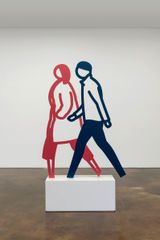
Opie is known for his distinctive distilling of imagery from everyday life into pared-back symbols, be it of people, animals or buildings, focusing on depicting our experiences, observations and sensations, remembered and then recreated. While there are familiar motifs and materials, in this exhibition we see a recent expansion of Opie’s practice, with the artist delving into a different way in which images are received in the world – via social media platforms. Since Opie began introducing movement into art in the 1980s, new innovations and technology have revolutionised the possibilities of doing so, developing from early computer monitors to wall-based flat screens, and onto LED public signage. Recently, Opie has expanded into capturing movement in a faster, shorter-form tempo, discovering a high-energy dance popular on TikTok and YouTube, seen as both a mark of celebration as well as an antidote to the quiet periods of lockdown. Collaborating with his daughter, a professional dancer, Opie gathered a group of performers to replicate the sequence, and commissioned a series of dance tracks to accompany it. This series can be seen as both two-dimensional vinyls and LEDs, with imprints of larger-than-life figures frozen in time on the gallery walls, as well as through four-sided computer animations.

Alongside this is a series of landscape paintings, captured by the artist initially while driving through rural France. Depicting scenic panoramas with the vibrant colours of a European summer, these images merge the sensation of being both in motion and static, embracing the evolving view of nature from the windscreen of a car, with the processed features of stop junctions, such as highway service stations.

Opie also utilises both of Lisson Gallery’s outdoor courtyards. The centre courtyard houses four stainless steel tubular sculptures, inspired by observations of people in London parks during lockdown. Featuring figures lounging on the grass, reading or looking at their phones, these portraits represent not just the wide variety of ways in which we configure our body naturally, but also how the body can itself interact with space and gravity while populating and energising a landscape. In these works, the precise pose is formed by bending the metal, an idea influenced by the art of the Jorai, Toraja and Dayak (Austronesian) people, who migrated from mainland China through Taiwan and out into the Pacific area c.5,000 years ago, in particular the sculptures found in Sulawesi, Vietnam and Borneo. The carved wooden statues of this period are often portrayed bent or crouched, taking imagery that was largely flat and extending into the three-dimensional. The process, using round tubes such as those used for hand rails and bicycle stands, combines the compositions of the historic Austronesian statues with everyday urban objects.

The further courtyard houses a new architectural installation, inviting visitors to walk through the labyrinth of drawn structures based on French medieval buildings.

Read More
About the Artist

Julian Opie’s work is instantly recognisable in public commissions around the world. One of the most significant artists of his generation, his distinctive formal language is the result of digital alteration, presenting images as black outlines and simplified areas of colour; it speaks of Minimal and Pop art, of billboard signs, classical portraiture and sculpture and Japanese woodblock prints. “Things in my experience don’t look photographic”, he observed in 2001. “When I recall the things I did in a day, for example, it’s not as a series of photographs, high resolution pictures. It’s a series of images which resemble symbols and signs. It’s like another language.” Opie ‘paints’ using a variety of media and technologies, from inkjet on canvas and painted aluminium to vinyl on walls and sculptures of everyday features: scaled-down buildings, life-size cars, signposts. His programme of purification has been applied to reproductions of paintings, telephone directories, books and to portraits, where faces or bodies are abbreviated to astonishing likenesses. Landscapes are emptied out of unmemorable detail to become the essence of themselves; the subtle, repetitive movements in Opie’s wall-mounted computer films of Japanese landscapes have a hypnotic quality.

View Artist Profile

Also Exhibiting at Lisson Gallery

About the Gallery

Established in 1967 in London, Lisson Gallery is one of the most well-known galleries operating globally. Boasting an influential and continuing legacy, including playing a pivotal role in the careers of many pioneers of historically important art movements, the gallery works with some of the most significant contemporary artists today.

View Gallery Profile
Address
27 Bell Street
London
United Kingdom
Opening Hours
Tuesday – Saturday
11am – 6pm
(1)
London 27 Bell Street
Lisson Gallery
27 Bell Street, London, United Kingdom
+44 207 724 2739
http://www.lissongallery.com

Opening hours
Tuesday – Saturday
11am – 6pm
The art world in focus