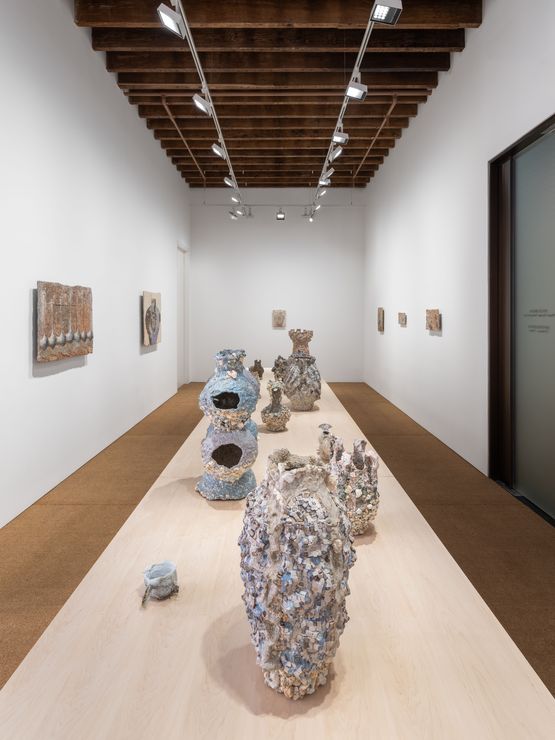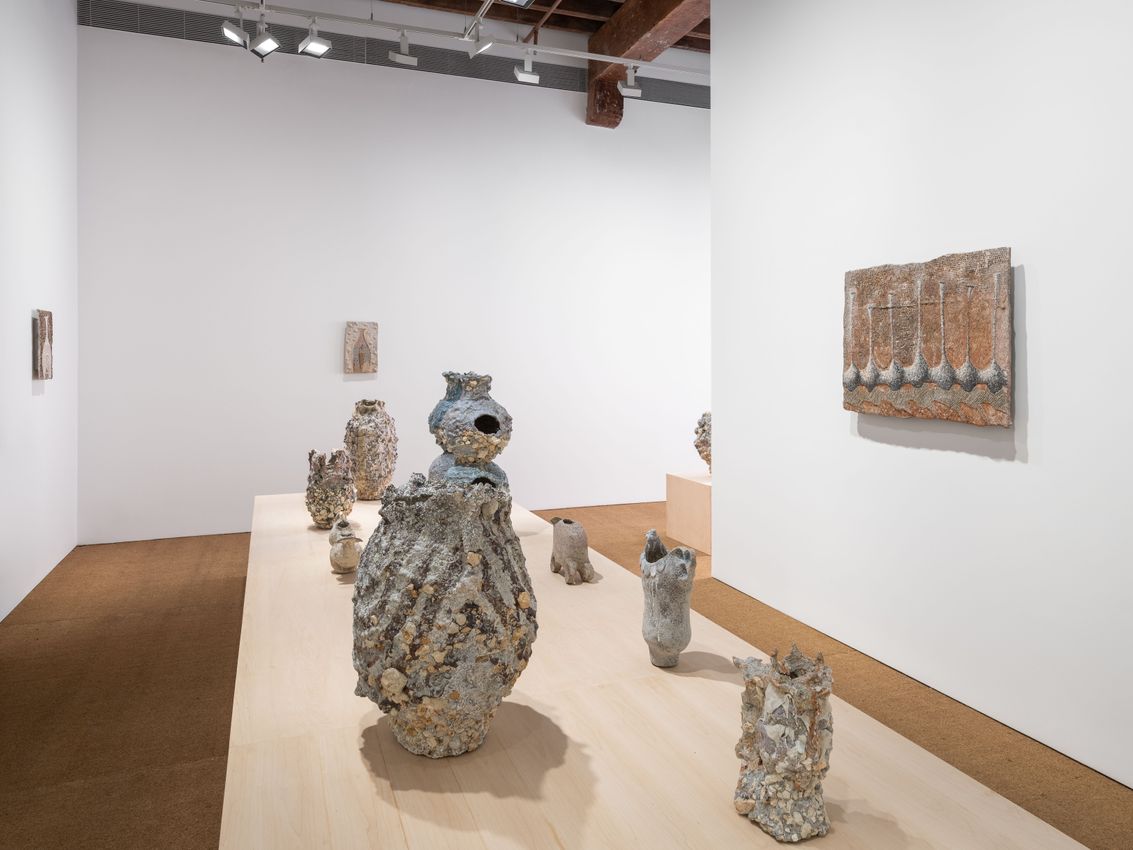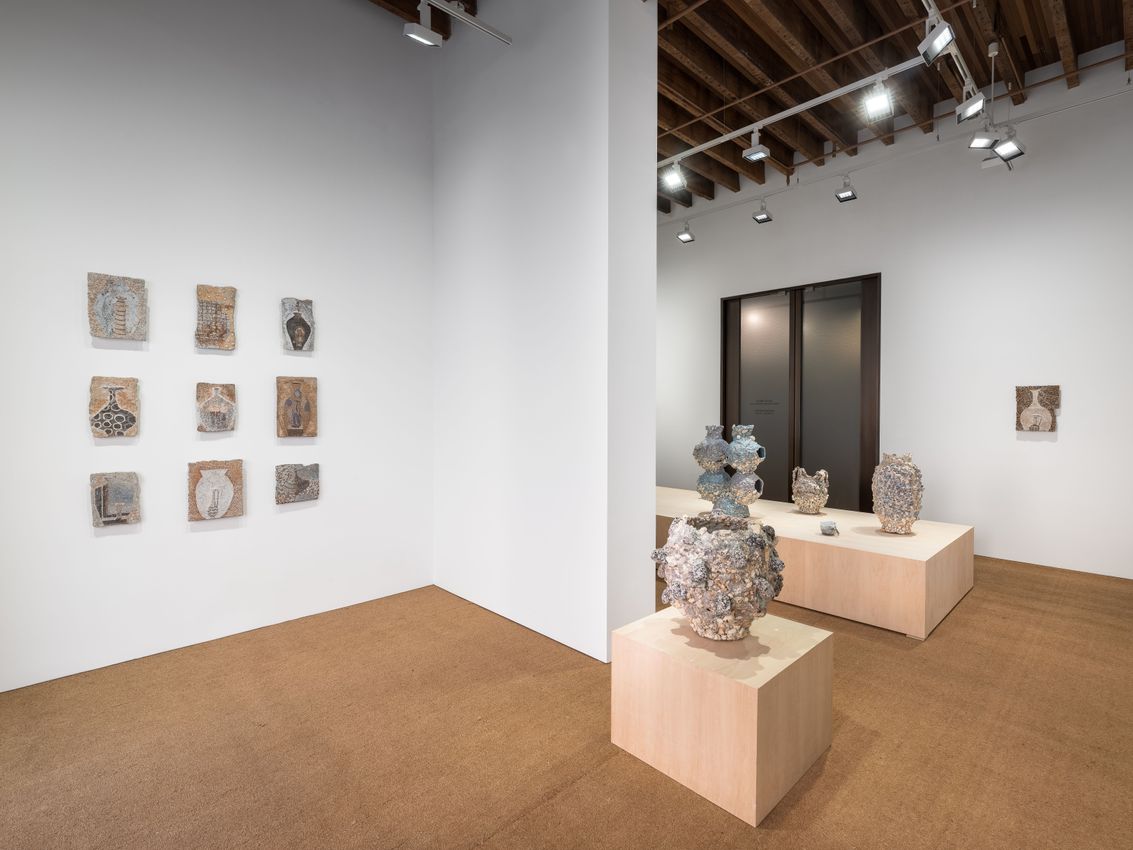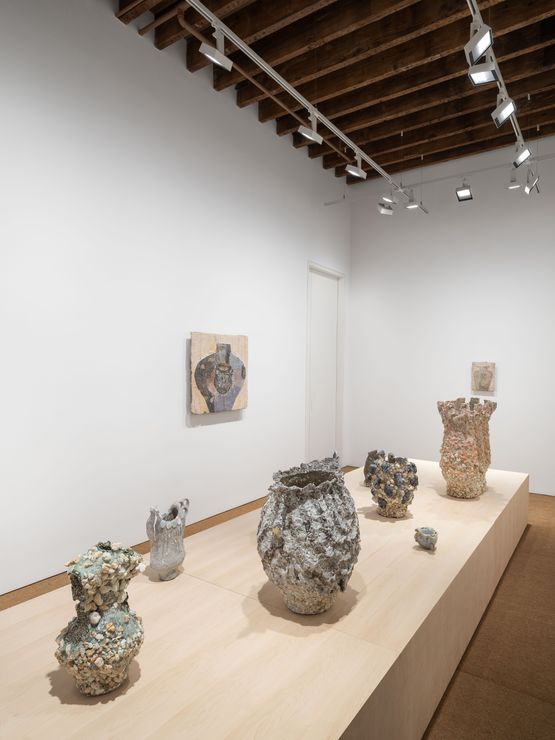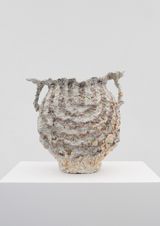
For his first solo exhibition with Lisson Gallery in China, the Japanese sculptor Masaomi Yasunaga presents a new body of experimental and expressive vessel sculptures along with recently developed tablet works comprised of hand-made mosaic tiles forming intricate images. Renowned for his unprecedented production methods, Yasunaga’s work offers a re-evaluation of ceramic’s technical traditions and the vessel’s role in cultures across millennia, positing new expressive potential.
Inspired by cobblestone streets — which are shaped over time by countless footsteps — the exhibition centres around the notion of ‘stepping on the earth,’ conjuring a meditation on how human interaction and movement leave lasting traces and memories. Inspired by his upbringing within Japan’s Catholic minority and ensuing appreciation for aesthetics of Western origin, Yasunaga honours a global range of vessel forms and ritual objects. With titles referencing physical states of being — empty, melting, fused, molted, shedding, skeleton, flesh and bone — the artist evokes nature’s physicality and spirituality’s ascension into earthenware, eliciting an emotional connection with the viewer.
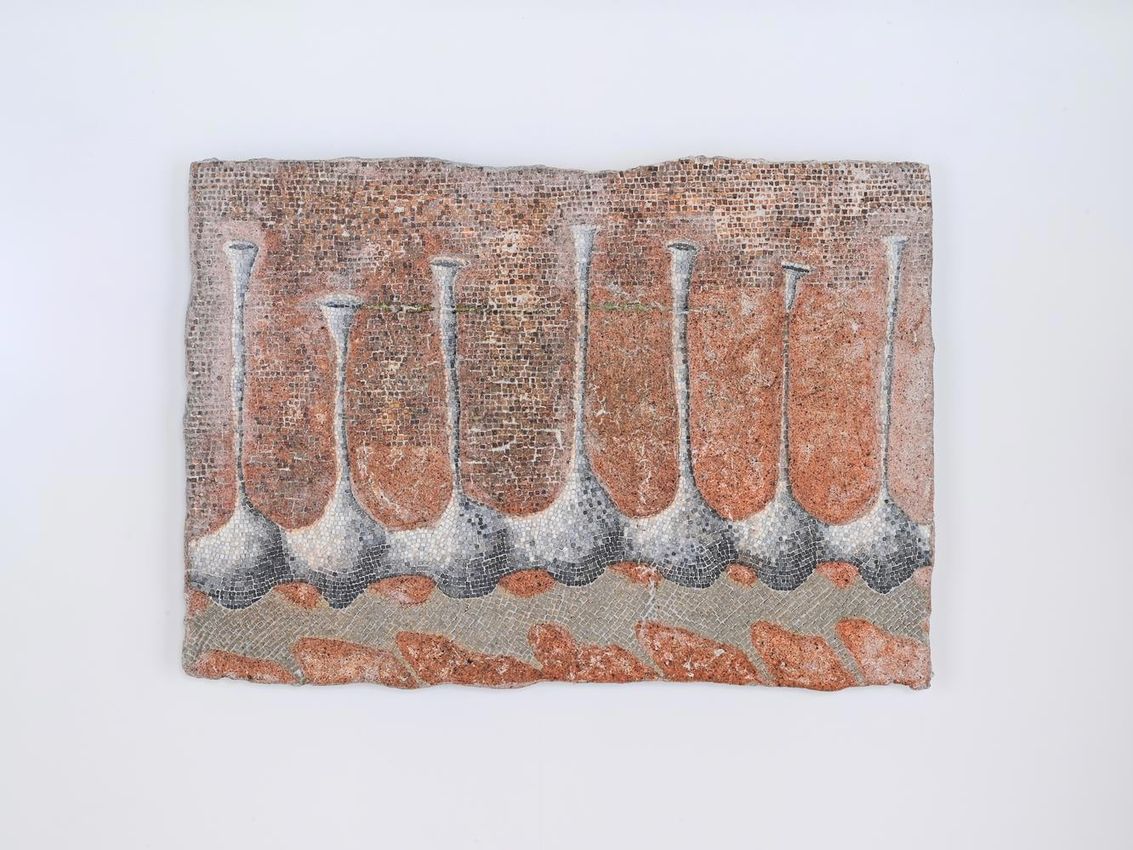
Yasunaga’s new Mosaic series is a nod to an artistic styles of far-away places and long-ago times. The works extend Yasunaga’s exploration of multiple techniques, both ancient and cutting edge. Yasunaga’s pixelated tablets, which depict compositions of vessel containers in various arrangements, extend the vessel metaphors achieved by the raw and rough texture of his three-dimensional works.
To enhance the more than thirty works displayed on walls and pedestals, the gallery floor is covered with an organic material that absorbs the footprints of visitors. As the audience moves through the space, the floor gradually accumulates footprints and marks, forming a shifting trail that alludes to the passage of time and to the impermanence of human presence. The presentation invites viewers to experience the depth of Yasunaga’s conceptual and material investigations and his unique approach to the intersection of time, body, and object.
Masaomi Yasunaga was a student of Satoru Hoshino, a protégé of the avant-garde ceramic group Sodeisha: a post-war (1940s – 1990s) movement that questioned the mandate of functionality within the ceramic medium and pioneered a new sculptural philosophy. The artists of Sodeisha, which translates as ‘crawling through the mud society’, rebelled against the prevalent ceramic traditions in Japan to create emotionally driven artworks. By focusing on the process of creation, centred around the sculptural form rather than the functional use of the object, Yasunaga extends the legacy of Sodeisha group’s experimental ethos and is faithful to the existential concerns of its founders.
A historic achievement of Masaomi Yasunaga’s practice is his unprecedented use of glaze, elevating ceramic’s surface treatment material to become his primary material. While pottery is typically formed from clay, fired in a kiln and sealed with a finishing coat of glaze, Yasunaga build his sculptural works with specially adapted glaze. Combined with unique raw materials such as feldspars, whole rocks, metal or glass powders, Yasunaga’s glaze forms are buried in various strata of sand or kaolin (unrefined porcelain clay) to preserve their structure in the firing stage. After cooling, Yasunaga’s sculptures are excavated from their beds in a studio process analogous to archaeological excavation and discovery. The yielded objects appear honed and shaped by earthly elements over centuries, some whole and others curiously fragmented. Aesthetically, these sculptures are simultaneously primitive and contemporary; objects of human culture which appear as if lost and found, seeming to confirm the supremacy of nature’s order over the world of mankind.
At the heart of Yasunaga’s practice is the elemental force of fire. In pursuit of ‘fundamental beauty’, the artist considers the flames as a filter and the kiln that controls the flame as a time machine. This represents Yasunaga’s intention to remove his will and ego, making room for a return to nature. Through meticulous manipulation of his singular glaze forms and firing techniques, Yasunaga transforms a decorative element into an expressive force that embodies both intention and unpredictability. The layered, organic surfaces of his works reflect the tension between control and chance, where the firing process reveals intricate textures and forms organically shaped by natural forces rather than artistic artifice. This distinctive approach to glaze sets Yasunaga apart from other ceramic artists, allowing for a nuanced exploration of materiality and temporality.


Masaomi Yasunaga was a student of Satoru Hoshino, a coterie of the avant-garde ceramic group Sodeisha: a post-war (1940s–1990s) movement that questioned the mandate of functionality within the ceramic medium and pioneered a new sculptural philosophy. Translated as ‘crawling through the mud society’, artists of Sodeisha rebelled against the prevalent ceramic traditions in Japan to create existentially and emotionally driven artworks. Yasunaga extends the legacy of Sodeisha group’s experimental ethos by focusing on the process of creation, centred around the sculptural form rather than the functional use of the object. Inspired by his upbringing within Japan’s Catholic minority and ensuing appreciation for aesthetics of Western origin, Yasunaga honours a global range of vessel forms and ritual objects. With titles referencing physical states of being—empty, melting, fused, moulted, shedding, skeleton, flesh and bone—the artist evokes nature’s physicality into earthenware, eliciting an emotional connection with the viewer.


Established in 1967 in London, Lisson Gallery is one of the most well-known galleries operating globally. Boasting an influential and continuing legacy, including playing a pivotal role in the careers of many pioneers of historically important art movements, the gallery works with some of the most significant contemporary artists today.

A respected voice in contemporary art discourse.
Focusing on ambitious storytelling and insightful art-world commentary. Ocula Magazine publishes in-depth interviews, critical essays and timely analysis on the artists, exhibitions and ideas driving the global art world.
Learn more about Ocula Magazine
Showcasing the best of the art world.
Ocula partners with galleries from around the world to highlight their artists, artworks and exhibitions. Gallery membership is by application and invitation, with each member vetted by an independent panel.
Learn more about Ocula Membership

Specialises in the sale of major artworks.
Led by a team with deep ties to the world’s leading auction houses, galleries and collectors. Ocula’s advisory team offers bespoke services to high-net-worth clients from around the world who are looking to acquire the best of contemporary and modern art.
Learn more about our team and services